
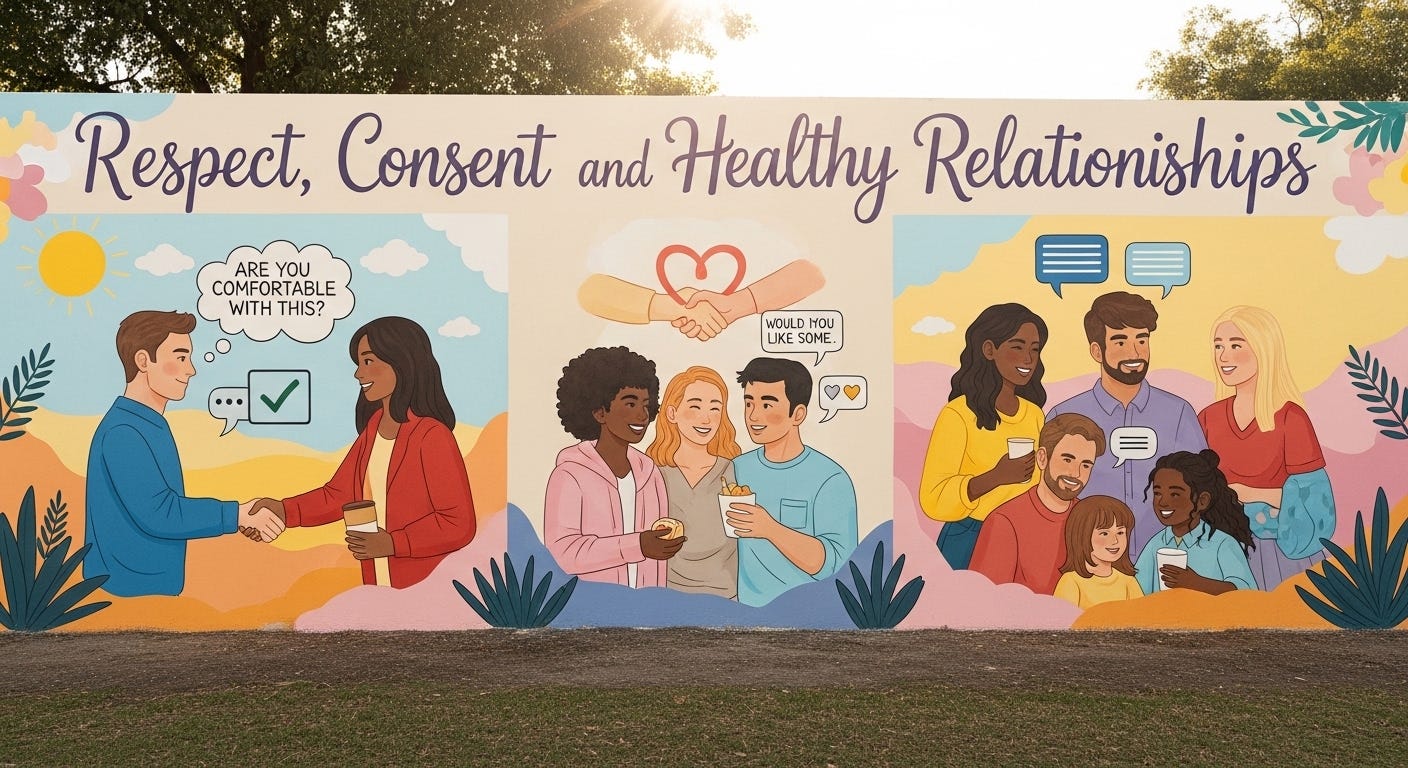
We tend to treat our most important connections like a series of checkpoints. We wait for a nod, a verbal yes, a signal that it is safe to move forward. And somewhere along the way, we turned “consent” into a one-time event: a verbal agreement that covers everything that follows.
But if you have ever sat across from someone and felt a sudden distance between you, even while they were smiling, you already know that human connection is never that simple.
The problem with how we talk about respect and consent isn’t that we talk about them too much. It’s that we talk about them as if they are administrative tasks, items to tick off before getting on with things. We’ve reduced “respect” to basic politeness and “consent” to getting permission.
In reality, these are the things that hold a relationship together. To build a connection that lasts, you have to look at the invisible structure of how you treat someone every day, built not from words alone, but from attention, safety, and the willingness to be honest.
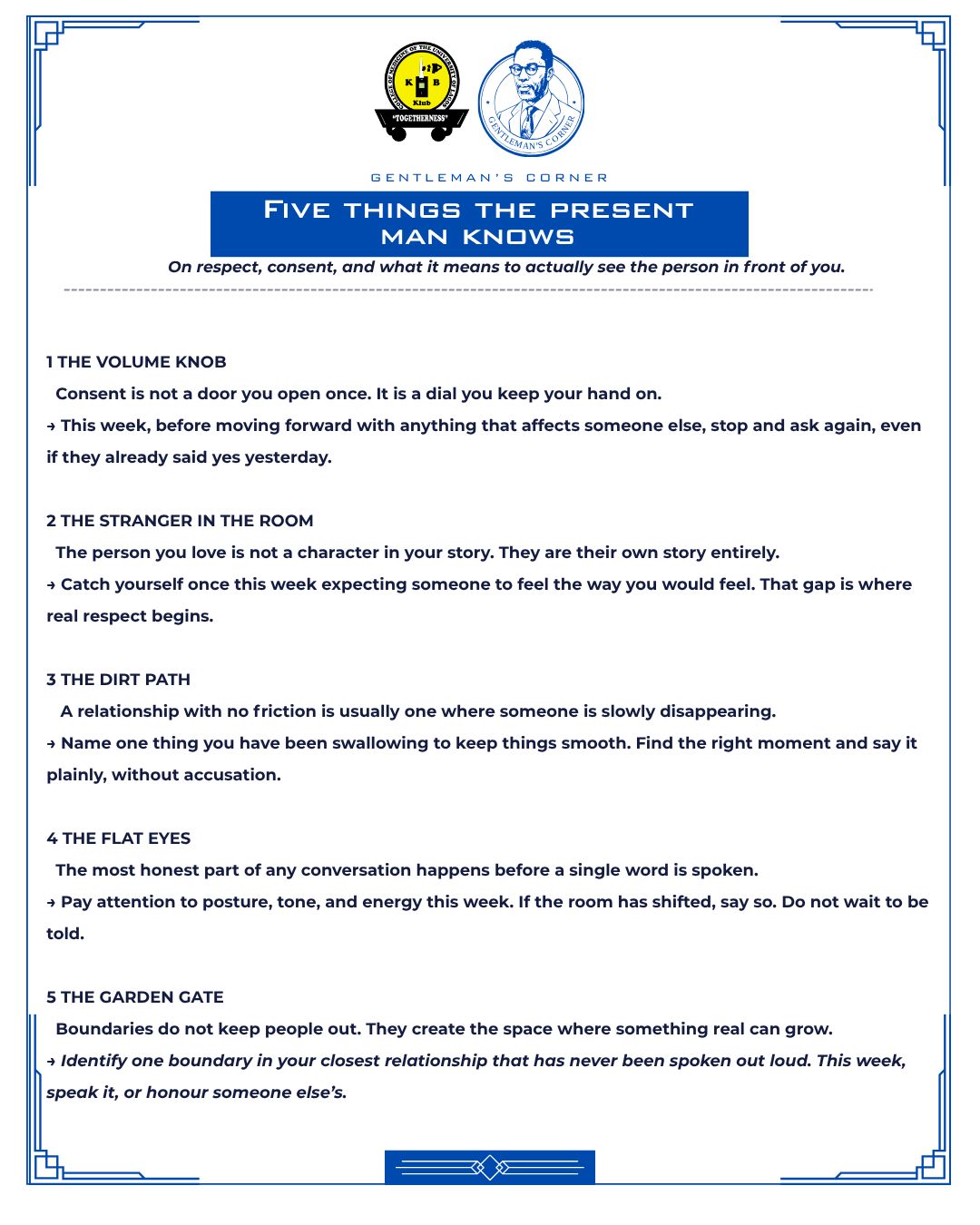
There is a dangerous idea that consent is a destination. You ask, the other person says yes, and the door stays open. But in a healthy relationship, consent is more like a volume knob than a light switch. It is a continuous process, and it shifts with the moment.
Think of two musicians playing together. You don’t agree to play the song and then stop listening. You are constantly reading your partner: their tempo, whether they grow quieter, whether they want to stop. You listen with your whole attention, not just your ears.
In a relationship, this means understanding that a yes at dinner is not a yes for the rest of the night. When we treat consent as a one-time deal, we stop seeing our partner. We start interacting with the permission we got an hour ago rather than the person in front of us now.
The most important truth about consent is this: it only counts if “no” is a real option. A relationship where no is easy to say is the only place where yes means anything. If you feel you cannot say no without causing a fight or being met with cold silence, then your yes isn’t a choice. It’s a way of keeping the peace. True health in a relationship means that both people can change their minds at any time, without cost.
We often think respect means being nice: holding the door, using kind words, not interrupting. That version of respect is decent, but it isn’t deep.
Real respect is closer to hospitality. When you invite someone into your home, you make space for them. You don’t force them into a chair that doesn’t fit or serve food they can’t eat. Respect in a relationship is making space for your partner’s otherness: the recognition that they are a completely separate person, with their own history, fears, and quirks that have nothing to do with you.
The greatest threat to respect is when we stop seeing our partner for who they are and start seeing them as who we want them to be. We respect the version of them that pleases us and grow frustrated with the version that doesn’t. We begin, quietly, to edit them.
“True respect is the ability to see a person as they are, to be aware of their unique individuality.” — Erich Fromm
If you find yourself thinking, “I don’t get why they’re upset; I wouldn’t be,” you are falling into this. Respect is not about agreeing with how your partner feels. It is about accepting that they do feel that way. It means letting them be their own person rather than a character in your story. When you truly respect someone, you stop trying to fix their feelings and start trying to understand them.
We want everything frictionless: fast internet, smooth deliveries, relationships that require no effort. We’ve been told that a healthy relationship is one without arguments, where everything flows easily.
But a relationship without any friction is usually one where someone is slowly disappearing.
Some friction is natural. Two different people, building one life, will have different goals, different habits, different needs for space. If there is never any tension, it usually means one person is swallowing their feelings to keep the surface smooth.
Think of the difference between a sheet of ice and a dirt path. The ice is perfectly smooth, but you can’t walk on it without falling. The dirt path is uneven, but it gives you the grip to move forward.
Respect and consent are how you handle that friction. They are not meant to make two people identical. They are meant to make it safe to be different. A healthy relationship isn’t one where you never bump into each other. It’s one where, when you do, you navigate the collision without causing harm.
We rely too much on words. We think that if we said the right thing, we did our part. But the most honest communication has always happened in the body, long before language gave us precise terms for what we felt.
The most important things in a relationship happen in the silences.
It is the way a partner’s shoulders tighten when a certain topic comes up. The way someone’s eyes go flat even as they say, “Sure, that’s fine.” If you pay attention only to the words, you are missing the most honest part of the conversation.
If you only wait for your partner to speak up, you are placing all the work on them. You are essentially saying: it is your job to tell me when I am hurting you. A respectful partner takes on half that work. They pay attention to the energy in the room.
Asking “Are you okay with this?” is a start. But noticing that they look uncertain and saying, “You seem unsure, let’s slow down,” is what makes a relationship genuinely healthy. It turns the rules of consent into a shared effort. It shows that you care more about the person than the yes you are hoping to get.
We often see boundaries and consent as fences: walls built to keep people out. And in a way, they are. But a fence doesn’t only keep people out. It defines the space where a garden can grow. Without it, the garden is just a patch of ground that anyone can walk through. Nothing takes root.
A healthy relationship is that garden. Respect is the soil: the deep foundation that makes growth possible. Consent is the gate: checked often, kept in good repair, never forced.
When we stop seeing these as rules to follow and start seeing them as the way intimacy is built, everything changes. We stop looking for permission and start looking for the person. We stop trying to be right and start trying to be connected.
So the next time you are with someone you care about, ask yourself a simple question: am I looking for permission to do what I want, or am I trying to understand the person in front of me? The answer is the difference between a checklist and a real relationship.
No posts
Comments
Nothing yet. Say the first thing.
Sign in to join the conversation.