
0:00
-28:19
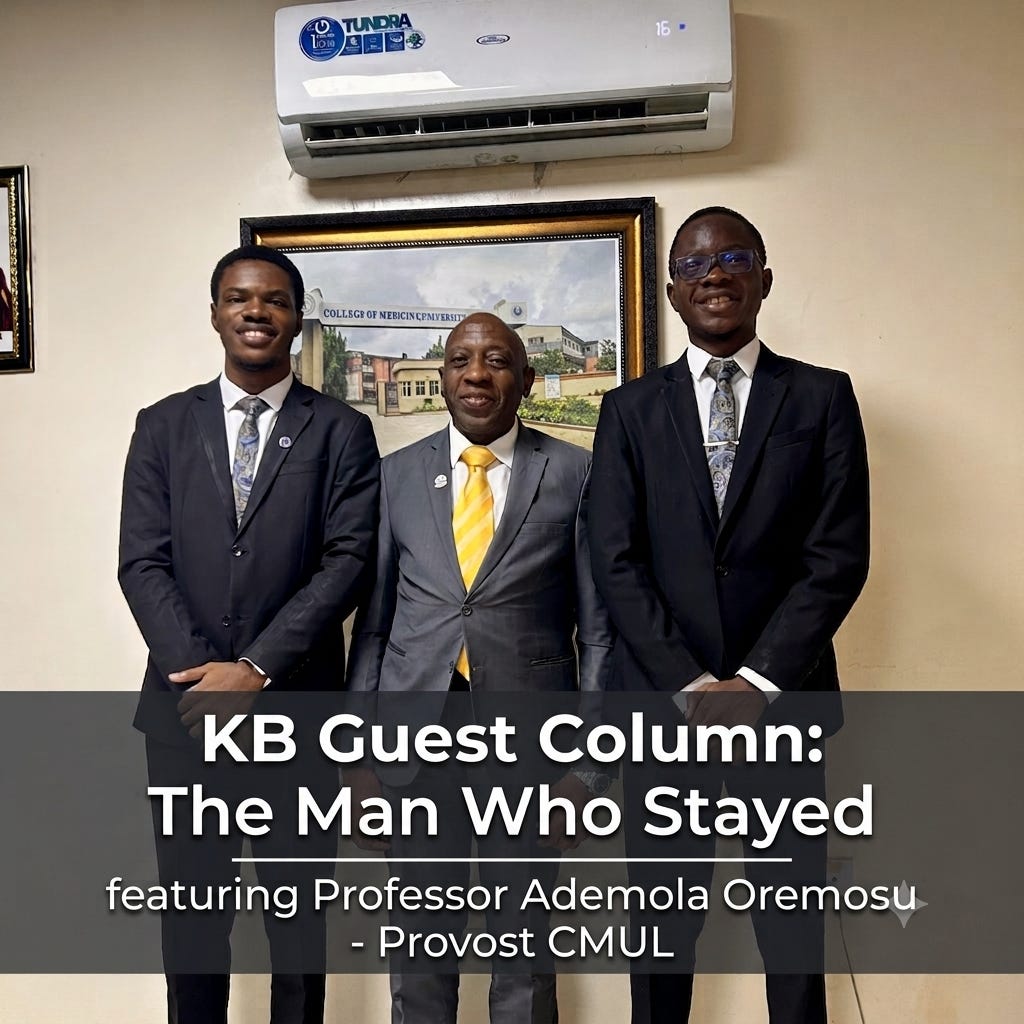
KB Editor: "Good day, everyone. My name is Nnodim Precious, and I am your host as well as the current KB editor of the KB Klub. Today, we are honored to welcome a distinguished guest: Professor Ademola Oremosu, who serves as the provost of the College of Medicine at the University of Lagos. In this edition of the KB Guest Column, we will engage in a conversation that explores his professional journey, leadership in medical education, and the enduring legacy he continues to build within the institution. I am pleased to facilitate this discussion, which promises to provide valuable insights for both students and faculty members. The theme for today's KB Guest Column is 'The Man Who Stayed.' In this interview, we will first examine Professor Oremosu's decision to remain at the institution that influenced his professional growth. We will then discuss his contributions to the College's enduring legacy and conclude by considering how his leadership has shaped and continues to guide the next generation of medical professionals. Through this structure, the interview aims to provide a comprehensive understanding of Professor Oremosu's ongoing impact within the University of Lagos."
KB Editor: "Good afternoon, sir."
Provost: "Good afternoon."
KB Editor: "It's a pleasure to have you here, sir."
Provost: "My pleasure too."
KB Editor: "Before we begin the main interview, could you please introduce yourself to the audience and briefly describe your role as provost, as well as share something about yourself that most people might not know?"
Provost: "Okay, I'm Professor Ademola Oremosu, Professor of Human Anatomy here at the College of Medicine, University of Lagos. And yes, I've been a professor for many years now, and I've also been teaching for 35 years. And I'm currently the provost of the College of Medicine, University of Lagos."
KB Editor: "Wonderful, wonderful. Okay, thank you so much, sir. Thank you for your brief introduction. Turning now to the main focus of our interview, your extensive career and background provide a valuable context for this discussion. We will be focusing on your role as the provost. Could you share what your initial expectations were when you assumed this position, and how your experiences in the role have shaped or altered your perspective?"
Provost: "Okay, so initially I said, yeah, I'm provost, but I also have degrees from this college: an MBBS degree, and then a master's and a PhD in human anatomy. Yes, as a provost, my experience has been good because I've had to manage so many things. I've had to manage a student population of about 6,000. I've had to manage a nonteaching staff population of about 1,600. I'm also involved in supporting the academic staff, which is about 400+. And this requires a lot of administrative acumen. And looking at that, I also have programs. With programs come the curriculum and accreditation. And so we have six professional programs under my watch. The MBBS program, the BDS program, medical lab science, radiography, physiotherapy, and nursing. And then we have three non-professional programs: pharmacology, physiology, and anatomy. So it's quite busy work as a provost, making sure that everything goes on well, the lectures go on well, the course contents are covered, and the curriculum is maintained. Now we are running the core curriculum, minimum academic standard, which we call the CCMAS."
KB Editor: "Okay, thank you so much for such a brilliant answer. So, we'll move on to the next question. And, you know, with us, we've done a lot of, you know, background checks on you. And your career is mostly spent as an educator, as a teacher. And what's fascinating is the fact that behind the provost is an educator, a teacher. So, can you share a specific example of how your instinct as a teacher influenced your work as provost, such as a decision you've made or how you approach difficult conversations with faculty or students?"
Provost: "So, as I mentioned, as a teacher, when you come into academia, you come in at the level of lecturer two with a PhD, and you rise through the ranks. So when you're at the lower level, your administrative commitment should be just about 20%, and academic commitment about 80%. But as you get to the professorial level, you're spending more 80% administration and 20% working. So, having gained 35 years of teaching experience and rising through the ranks, it has helped me to shape the vision I have for the medical school. Because you could compare what it was in the past with what it is now. Now, some things were much better in the past in terms of facilities, which we don't have now. But there are many more positives, in which case we have moved away from a teacher-centered curriculum to a learner-centered one. So a lot of what I do as provost is to make sure that the modalities of delivery follow global best practices. And so we're looking at case-based studies, problem-based studies, evaluation objectives, and objective structural clinical examinations. Such things, and then we look at small-group learning and focus-group discussion. So the idea of a student being the shining star, even though the system still accommodates it, but we're looking at people working as teams, teamwork. So a lot of the curriculum is now designed to ensure that, from an early start, everyone in training, whether as a doctor, physiotherapist, or nurse, sees themselves as part of a team. Because at the center of it all is the patient, and I tend to say to students now, and myself, my faculty, that you must let your students know that the patient is a client. So, even though some of them may be vulnerable, you must treat them as the center of what you're doing. Every other thing revolves around that. So those are some of the things, my vision in terms of bringing back that culture into medical education."
KB Editor: "Okay, that was very good. Thank you so much, sir. As a student myself, I believe I am also a beneficiary of these implementations; for instance, the shift toward a learner-centered curriculum has noticeably enhanced my engagement and critical thinking skills. Observing these changes in practice allows me to appreciate how such reforms not only improve the quality of education but also foster collaborative learning and adaptability among students.
So we'll move to the next question, which will focus on the theme: the man who stayed. In recent years, there has been a significant trend known as the 'japa syndrome,' where many medical graduates choose to leave Nigeria after completing their studies in search of better opportunities and living conditions abroad, particularly in the diaspora. Despite this widespread movement, often motivated by the pursuit of greener pastures, you decided to remain in your own country. So you chose to stay here and contribute to the health education in your own country, in Nigeria. I would like you to tell us what motivated that decision. What made you say that you will stay and improve health education in your own country?"
Provost: "Thank you for that question. The reality is that sometimes your profession finds you. You're not the one finding the profession. And before I studied medicine, I always knew I wanted to study medicine and surgery. But before I got admission into, you know, the University of Lagos, I also had the opportunity to be admitted to the University of Nottingham. We had gone there with my father, but he asked me, 'Make your choice,' and I said, 'I will stay in Lagos to study medicine.' So, by the time I finished, the japa syndrome was no longer new. We also wanted to travel abroad together. And two of my very close friends had made it to America, and they were like, you know, by next year, Georgia. But a few things also happened. Around 1990, I had finished my houseman-ship and youth service. And I had also gotten my papers to go via the Caribbean route. But my father then took ill. And I said to myself, as a first child, are you going to leave this man ill just because you want to pursue a japa agenda? And it was one of the things that made me decide, you know, to stay.
Secondly, because I was, would I say, a bit outstanding in the subject of anatomy, I was made a student demonstrator from my 300 level. So, I'll come back and teach the junior ones. So, by the time I graduated, the then head of department, Professor Nona, looked at me and said, 'You know, we will need you in the department.' And I said to her, my desire really is to be a surgeon. I wanted to do primaries to join Professor Atuebe, who came in as the 12th provost. Then I did primaries, and it wasn't quite successful. And then they said, come to anatomy, take a master's qualifying exam. And I did, and I passed. So, that was the beginning of the journey to anatomy. And of course, I had somebody I saw that looked exciting to follow, who is a Life Kbite, by the way. Professor Oladapo Ashiru. He was my teacher, 200 level. And the way I saw him with the American style and talking about Nebraska, so I thought, yeah, I could make a career path in this area. So, he was also one of the reasons, apart from Professor Nona , who asked me to come and helped me decide to make a career out of academics. I have no regrets. No regrets at all. Okay."
KB Editor: "Thank you very much, sir. Your response was highly comprehensive, providing significant context and depth as we reflect on the motivations and decisions that have shaped your career path. I can see that there was a mentor figure who, you know, also helped you pick your career path. So, moving to the next question: just placing yourself in that mentor role. What advice would you give to the student listening to this or reading this? What advice would you give to students who want to pursue academic medicine and research alongside clinical practice?"
Provost: "That is a very good question. I have a passion for students. And my joy and my sense of fulfillment come when I come across my students all over the place who have listened to me at some point and have been inspired to bring out their best potential. First of all, I believe that those who come to study any of the programs here must aspire to be the best of what they can. So, whether you're a physiotherapist, aspire to be the best, whether you're a nurse, and so on. Having said that, I believe there are two forms of mentoring: direct and indirect. Direct mentoring occurs when you have an established relationship with a mentor, typically knowing the person's name and perhaps sharing common interests or experiences. But indirectly, if you are there as a head of an institution and you are able to project to people that there is a future in medical practice, in whatever sphere, not everybody will be clinicians.
Some will want to be like me, where research is the focus. Now, in all, I still encourage people that even if you are not an academic person, you should still have a background in research because the world only evolves by interrogating things around us. You want to find out why this is happening and what interventions can be made. And I always give this analogy. If you look at a vehicle, it has a windshield. Now, you want to clean the windshield. Some initial people designed wipers that would come from below, and they move in sync. Somebody said, 'Why don't they come from above? And why don't they move towards each other?' And then somebody said, 'why can't it just be a single wiper?' Then it comes out. So, that is basically what research is all about. You interrogate, why should a door open and have a handle? And then someone will say, why should there even be a key at all? And today, you go to hotels, you don't even have keys. And someone says, 'Why do you even need to use a card? Why can't your face be recognized?' So, the world advances through research. And so, I want to encourage every medical student to develop a culture of interrogating things. Whether you are a clinician or even in clinical practice, a lot of diversification is being done now. People now specialize in the heart and the kidney together.
People now specialize in intervention practices, interventional radiology, and interventional surgery. So, AI is good. AI has come to stay. Many say, 'Well, AI will do the work of doctors.' True, some. But the medical field is still an area where people will find relevance and expression.
So, whether you are a nurse, physiotherapist, medical lab scientist, radiographer, or any of the others. Alright? You will still find expression. So, I want to say, focus on what you are doing.
Again, at times, you may be doing something that is not exactly what you wanted to do. There is nothing wrong with coming back. In fact, there is a former student for whom I will be the chair of her wedding this Saturday.
She initially came in to study physiology. I was her lecturer. She completed her youth service and returned to do MBBS. Medicine. And who knows what she will specialize in again?
So, the bottom line is, find expression. And, try to put out your name to be known by something. That will be my advice for any medical student today."
KB Editor: "Okay. Thank you so much for that wonderful advice. I believe that our readers or our listeners were inspired by that. And, they have kind of gotten some clarity with that. You mentioned research. That everybody should be involved in research.
And, I think that is something that is really important. By questioning things, we are able to evolve further. And, just to chip in here.
My friend, Michael, has also been involved in a lot of research. Very good. He is also teaching me how to get into these spaces. He is my very, very close friend. And, he has done a lot of research himself. He is really experienced in that aspect. And, he is one of those people who has motivated me to want to learn more about research. Shout out to everyone listening. They should conduct research, especially in the medical field. Hearing your emphasis on the value of research and inquiry has further inspired me to pursue research more seriously, as it clearly aligns with the broader theme of cultivating innovation and progress within medical education. This insight reinforces the idea that personal growth and meaningful contribution to the field are closely tied to a willingness to question and explore. Thank you so much for your advice.
So, moving on to the next question. Sir, you have been an educator. And, you are the current provost. So, you have been an educator and a leader. So, in all this, what has been the most rewarding moment of your career as both an educator and a leader?"
Provost: "Yeah. So, the aspect of the career that is very rewarding, as I said, is to see what impact you have made. And, impact is measured in various ways. There could be a formal quantitative impact analysis. And, there could be a qualitative impact. My late mother, before she died, sometimes went to some health institutions. And, they pick up her card. And, they say, Oremosu. And they ask, 'Are you the mother of Professor Oremosu?' And, she's proud to say, yes. And, she gets first-class treatment."
KB Editor: "Exactly."
Provost: "So, that has gladdened my heart a lot. That, you know, we have every lecturer in this institution puts a part into students. But, that people still remember. Because between 200 level and 600 is a long time. It's a very long time. But people still remember that, oh, this person impacted my life. That's number one in terms of the qualitative impact. In terms of the quantitative impact, I'm quite happy that today I've reached the height of what they call academic degrees. Usually, there's nothing higher than a PhD. Except you want to do some other things. Also, I've reached the height of my academic progression, which is being a professor. Any other thing, distinguished emeritus, are just appellations to add to the professor. And then, of course, in terms of administration within the college, I've also reached the height of the provost. Sometimes, some people tease me and say, 'You're a man of many Ps. Professor, provost.' But, you know, those are things that gladden my heart. And, the part of being provost is that I have an opportunity to make the change I've always desired. And I said to several students who have come to see me, 'I know the quality of the ambiance we experienced when we came here.'
Now, fast forward. A lot of such subsidies have been removed. Things are more expensive. The government is not funding us as before. But we must still be able to create a conducive environment where students have what we call a positive student experience. When we create a positive student experience, and they become successful in life, at whatever level, they have a sense of giving back. This institution made me. And so, ever so often, I come to the student hostel area to see the living conditions, to see how we can intervene. And so, we've done a lot of intervention in terms of creating an environment that people feel comfortable with. You know, there were a lot of shanties when I became provost. If you remember, for those who have been around for a while, the front of Aliakilu was covered with debris and looked very rough."
KB Editor: "Yeah, I remember what that place looked like."
Provost: "Exactly, we had to clear all that, make sure we plant flowers, and all that. Apart from that, I was told at the time, you know, there was not enough water. So, I had to get generators available when the public power supply is out. Now, we're working on solar systems for the hostel area. So that a person wakes up. And I keep saying this, that when we were in med school, all you needed to do was just wake up and go to class. There were maids who would come and make your bed. And then, the government would supply through them. They would put soap, tissue paper, and all that. They were supplied weekly. Alright? And eating, if you wanted to cook, it was your choice."
KB Editor: "Right."
Provost: "We had, you know, a good pottery, we called it that. So you'd go there, you'd take your 15, yeah, I think 15 kobo per meal ticket. And you get a decent meal. So, we may not be able to completely replicate that, but I want your kitchenettes to be decent. I want your bathrooms, I mean, we had hot and cold showers. So, for me, being provost, those are my ideas. Bring as many of those periods back into the living experiences of our students. So, yeah, those are some of the things I want to achieve before leaving office."
KB Editor: "Okay, thank you so much, sir. You know, from your answer, I can see that our seniors, our parents, really enjoyed it."
Provost: "Oh, yeah. They really enjoyed the national cake."
KB Editor: "It was just a dispensation."
Provost: "Dispensation, yeah, that was good."
KB Editor: "Okay, I know we promised we'd only ask you five questions, but I think I just want to add one more. I think this is just something to..."
Provost: "That's what they call a bonus."
KB Editor: "Bonus, exactly. Something to wrap everything up and bring it together.
For this final question, I would like to shift the focus to a more personal aspect of leadership. Leadership roles, such as that of the provost, can at times become overwhelming or isolating. In such moments, where do you typically seek support? Are there specific habits or routines that help you remain grounded and composed during challenging periods? We would appreciate hearing your perspective on how you navigate these personal and professional challenges."
Provost: "Okay, that's a very nice, interesting question. Well, again, the good thing about administration is that it has a structure. So, when challenges come up, you have to escalate, okay? And they come from all over. They come from the sister institution, from academic staff, from non-teaching staff, from students, from people who are stakeholders in the system. The alumni want things done, parents want things done, people are asking for all kinds of favors. So, yeah, you're right. It can be very busy sometimes.
Well, one of the things I've done is to ask those who have been before, how do you cope? And they've given me different strategies. Some I use them at some times, some I don't. Part of the strategies, one of them told me, he's a senior anatomy professor, he finished, he was at Ibadan, and he said, take a day a week where you just sequestrate yourself so that you can ventilate.
That really has not worked for me. But what I do is I have a very listening, understanding, and experienced vice-chancellor. So, many times when I don't know how to navigate something, I seek her care. Now, when you are in leadership, you must also be ready to take bashes. So, sometimes you go to the superior, and they say, 'on this matter, you messed up.' I say, okay, thank you.
But there are different coping mechanisms. One of the things I enjoy, even though I don't have the luxury of taking leave because of my administrative position, is that I'm able to leave Lagos once in a while. I just shut down, try to enjoy myself, go out with friends, just unwind. One thing you should also know as a leader is that you're not indispensable. So, I always carry the deputy provost of Lagos with me, and we work in synergy.
So, do I get angry? Yes, I do, but I keep it to myself. Because when you're managing a large organization, you have to have emotional intelligence. You have to read the people. When people say they are on strike, you don't foil it.
You find a way to talk to them and calm them down. Yes, we understand what's going on, but please don't lock the gates or don't lock the classrooms. Those kinds of things. You're engaged. So, but so far so good. It's been almost a year and a half now.
Usually, we have two years, and most times, if you're doing well, people will say do the second time. So, I'm hoping there'll still be time ahead, but it's up to the electorates to determine that."
KB Editor: "Okay, thank you so much for answering our questions. I sincerely hope you will consider serving a second term, as your continued leadership would undoubtedly sustain the positive changes you have initiated. Overall, this conversation has been highly enriching, offering significant insights into leadership, mentorship, and the role of commitment within academic medicine. Engaging with you today has underscored the importance of dedicated educators in shaping both institutional legacy and student experiences.
I want to thank you for having us. Thank you for having the KB Klub. And I think, from everything we've discussed so far, it just shows that the teacher is still there.
The teacher, the educator, is still in you, and you are using that to lead the next generation of medical practitioners. And that is a very beautiful thing and a wonderful thing to do. Your love for the student shows, the love for academics shows, and I think it's just up from here.
Thank you for that.
We've reached the end of the KB guest column, and I'll be signing out.
KB KB !
No posts
Comments
Nothing yet. Say the first thing.
Sign in to join the conversation.