
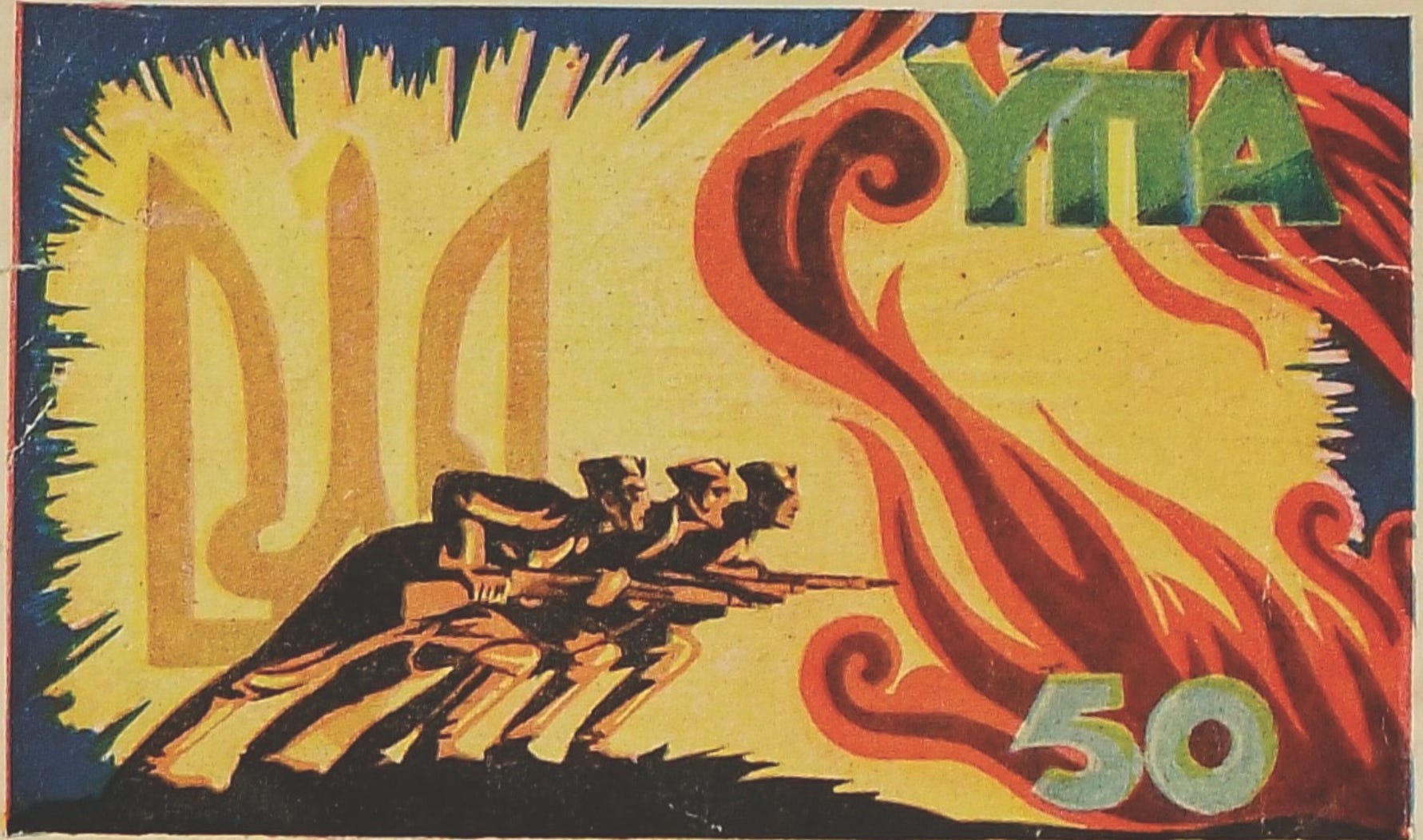
“In the immediate aftermath of World War II, upward of six million concentration camp survivors, prisoners of war, enslaved laborers, Nazi collaborators and political prisoners flocked to Germany. The Allies repatriated the majority of these individuals to their home countries (or helped them resettle elsewhere) within the next several months. But by late 1945, more than one million remained unable — or unwilling — to return home.”
— Claire Bugos, “The Little-Known Story of World War II’s ‘Last Million’ Displaced People”
The crimes that go unreported, unnoticed, undertaken in the dark crevices of night, are among the most awful of all. The chaos of the displaced persons (DP) camps after World War II was the backdrop for significant violence and state-sanctioned murder, as the politics that had driven the war did not end on VE Day.
Some of the worst atrocities happened in DP camps holding refugees from Ukraine, and in particular involved rival members of different factions of the Organization of Ukrainian Nationalists (OUN). The Ukrainian groups were known or suspected to be riddled with Soviet double agents, and paranoia about this was very strong.
Inside the camps, there was a secret war between the OUN members who followed Stepan Bandera and the Soviets; between different factions of the Ukrainian emigré community; and between corrupt members of these groups and non-political Ukrainian refugees caught up in the battle over repatriation of former Soviet citizens to the USSR. All of this was, apparently, overseen or monitored by U.S. intelligence agents.
It wasn’t until 1975 that the first major account of what happened in the Ukrainian DP camps surfaced in the U.S. press. Among the more shocking revelations was that Ukrainian refugees had been murdered and their bodies burned in bread ovens in at least one of the larger DP camps. The story was written by two radical authors and published in WIN Magazine, published in Rifton, New York.
“One of our informants who was a witness to these events,” the authors wrote, “insisted that American soldiers —probably intelligence officers under the cover of ordinary soldiers — held the keys to the Mittenwald bread/body ovens.” The killers were members of an ultranationalist wing of the OUN led by Stepan Bandera.1
The OUN snuff squad had to apply to the Americans each time it wanted to make use of the ovens….
The evidence of the OUN complicity in mass murder is extensive. No one investigating the period could be ignorant of it. Certainly the spooks of CIC [Counter-Intelligence Corps], Air Force Intelligence, Naval Intelligence and the CIA knew who they were getting involved with. [WIN Magazine, 1975, pg. 5, PDF pg. 3; and pg. 17, PDF pg. 9 — text in brackets is added]
No one disputes that over the last 80 years the United States government has strongly backed Ukrainian nationalists in their political battle with Russia, and before that, the Soviet Union. But what is less known is the origin of that alliance. The 1975 article cited above, by pacifist Maris Cakars and Barton Osborn, a former participant in the CIA’s Operation Phoenix program turned whistleblower, described how the Pentagon, the CIA, and the Bandera faction of the Organization of Ukrainian Nationalists (OUN-B) formed an alliance amid the chaotic turmoil of the displaced persons camps in postwar Germany.
The full title of the article, as published in the September 1975 issue of WIN Magazine (Vol. XI, No. 30) was, “Operation Ohio: A Special WIN Report Detailing American Sponsored Political Assassination and Torture in Post-War Germany, Demonstrating That the Phoenix Program Was Standard Operating Procedure.” WIN Magazine was a biweekly (and at times weekly) pacifist magazine published by the War Resisters League.2
According to Cakars and Osborn, the U.S./OUN-B alliance was sealed in blood, as U.S. intelligence “financed, supervised and tolerated the murders of numerous innocent men and women” who were perceived to be Soviet sympathizers or double agents. Certainly some of the victims were likely double agents, but an untold number were simply opponents of the Bandera faction of the OUN in the DP camps in Germany and Austria in the late 1940s and early 1950s (WIN Magazine, pg. 5, PDF pg. 3). In some cases, those targeted for elimination seem to have been people merely resisting OUN-B financial shakedowns, or were the unfortunate victims of personal grudges.
The main elements of this story are lurid, bizarre even. But they appear to be true, and a good deal of the text that follows is an attempt to corroborate the WIN authors’ charges of U.S. complicity in the OUN assassinations. Hence, this examination of Operation Ohio will look both at and beyond Cakars and Osborn’s version of the story.
One important thing that Cakars and Osborn’s article did was to establish the parameters for subsequent discussions of Operation Ohio’s history, particularly with its central emphasis on the role of the secretive U.S. Army Counter-Intelligence Corps (CIC).3
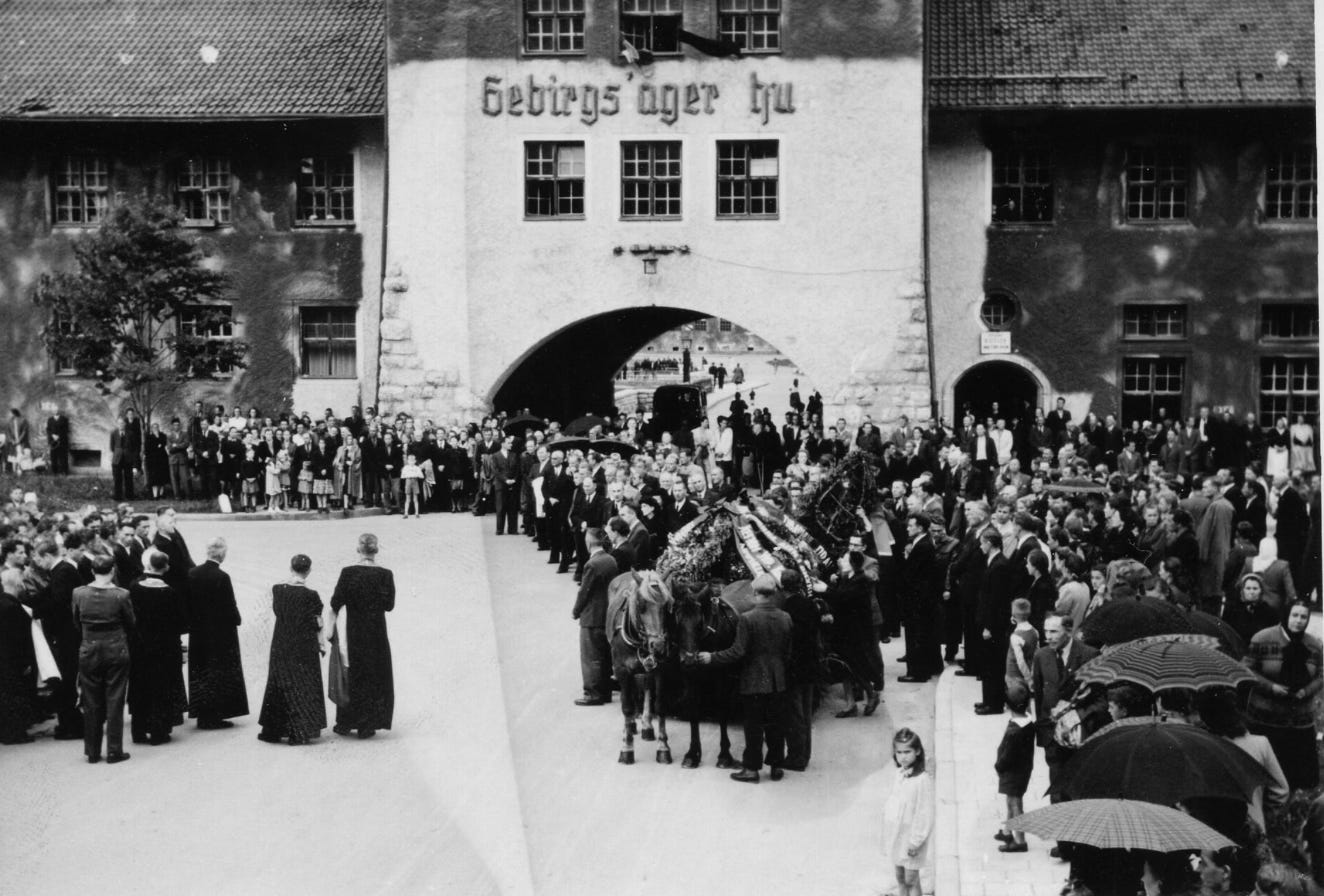
The CIC operation was codenamed “Ohio.” The WIN article goes into a fair amount of detail on Ohio operations at the “Mittenwald DP camp located in the Bavarian Alps and the scene of a number of the murders uncovered by the WIN investigation.” Cakars and Osborn believed “possibly over 100 men and women were killed” in the Ohio operation (WIN Magazine, pg. 5, PDF pg. 3).
According to the Internet Encyclopedia of Ukraine, Mittenwald is “a health and vacation resort center (2019 pop 7,327) in Germany on the Isar River near the Austrian border in Bavaria. After the Second World War many Ukrainian displaced persons were housed at two displaced persons camps in Mittenwald: 2,900 in Jäger-Kaserne (1946–51) and 1,200 in Pionier-Kaserne (1947–50).” The camp was in the American zone of occupation. For those unfamiliar with the post-WWII history of Germany, there were four German occupation zones after the war, administered separately by the Americans, the British, the French, and the Soviets. DP camps holding Ukrainians also existed in the British and French zones of occupation, as well as in Austria, which also had been divided into its own four occupation zones of the victorious powers.
Nearly all the evidence and testimony on Operation Ohio agrees that the killers of numerous DPs at Mittenwald and elsewhere were members of the Stepan Bandera faction of the Organization of Ukrainian Nationalists (OUN). As Cakars and Osborn explained, “Specifically it was the SB (Stuzhba Bezpeky), the secret political police of the OUN that carried out the killings. Patterned after the notorious Nazi SD (Sicherheitsdienst), our informant,4 referred to it as the OUN’s ‘combat organization’ and seemed pleased to report that, as far as he knew, it had been phased out after 1959 with the assassination of the OUN’s leader, Stepan Bandera.”
The SB was effectively the law enforcement in the approximately 80 [DP] camps where Ukrainians were the only, or the most numerous, national group. There was no check on its excesses other than by the OUN’s American sponsors. [WIN, pg. 9, PDF pg. 5]
Horrifically, with the alleged connivance of the CIC or other American intelligence agencies, the OUN killers, using “techniques borrowed from the Nazis,” burned the bodies of those they killed “in large bread baking ovens…. the very same ovens used to bake the bread for the hungry residents of the camp” (WIN, pg. 7, PDF pg. 4).
As already mentioned above, an eyewitness to the events at Mittenwald told Cakars and Osborn “that American soldiers — probably intelligence officers under the cover of ordinary soldiers — held the keys to the Mittenwald bread/body ovens (WIN, pg. 9, PDF pg. 5). The OUN-B killers had to coordinate somehow with U.S. intelligence in order to get rid of the bodies of their victims.
Accordingly, Cakars and Osborn felt “the responsibility for the assassinations must rest ultimately with American intelligence, first the Army Counter-Intelligence Corps, then Naval and Air Force Intelligence and finally, by 1954, the CIA” (Ibid.).
In their article, Cakars and Osborn described the OUN as having “a long history of committing murders, beginning with the German occupation of Ukrainia during World War II… when the OUN played a significant role in the extermination of Jews and other ‘undesirables.’ Its murderous role continued after the war under American sponsorship” (Ibid.).
One Cakars and Osborn informant, an ex-CIA agent, believed that the U.S. intelligence-OUN linkage continued to operate to “the present day,” i.e., to 1975, the year the WIN article was written. The “Operation Ohio” authors dedicated an entire section of their report, “The OUN’s War Record,” to documenting some of the OUN-B’s Nazi-linked atrocities, including the murder of two leaders of a rival OUN faction (see WIN, pgs. 15-17, PDF pgs. 8-9).5
According to Cakars and Osborn, under Operation Ohio, “The primary reason for the OUN murders was cold-bloodedly ideological,” targeting members of less militant nationalist factions of the OUN, as well as members of a rival group, the Ukrainian Supreme Liberation Council (ZP/UHVR), led by former Bandera allies who had turned against Bandera (WIN, pg. 7, PDF pg. 4).6
As part of their research, Cakars and Oborn had interviewed the then-foremost English-speaking authority on Ukrainian nationalist movements, the author of the 1955 book, Ukrainian Nationalism (Columbia University Press, updated and revised in 1963).
“l have no doubt that these people killed their rivals,” admitted John Armstrong, a political science professor at the University of Wisconsin who has done numerous classified studies of Soviet refugees for the Air Force. ln our interview with him, Professor Armstrong added that “the motivation was strictly to eliminate the political opposition.” [Ibid.]
The total number of those murdered in the displaced persons camps is not known. One informant told Cakars and Osborn, “Some undesirable Ukrainians received threatening letters with death sentences from the SB. Only a few of the liquidated Ukrainians were known. Many murders and liquidations remain in the dark” (WIN, pg. 9, PDF pg. 5).
The head of the SB at the time of Operation Ohio’s heyday in the late 1940s was Mykola Matwiyeko (aka Myron Matvieyko). According to an October 1948 top secret CIA report, the Agency saw Matvieyko as “an intellectually dishonest and incompetent person.”7 In 1951, he was sent on a secret mission to Ukraine by “one of the Allies’ intelligence services” and supposedly disappeared. Cakars and Osborn commented, “rumor has it that in fact the purpose of the mission was to get Matwiyeko out of the way because he knew too much” (WIN, PDF pg. 5).
But Matwiyeko/Matvieyko apparently did not disappear, according to a fascinating and informative blog posting by Moss Robeson at the Bandera Lobby Blog. Back in 1975, many documents from the postwar period had still not been declassified. Robeson has looked at the record on Matwiyeko as we now have it, and it appears the former head of the SB was a Soviet double agent. He did seem to disappear after his ill-fated parachute drop into western Ukraine, which was orchestrated by the British. But not too long later, he was operating as an OUN official inside Ukraine, supposedly connecting the OUN’s partisan war against the Soviets with the emigre OUN-B diaspora in Western Europe, including inside the DP camps.
According to Robeson, who relied on declassified documents, as well as Grzegorz Rossolinski-Liebe’s biography of Stepan Bandera, Life and Afterlife of a Ukrainian Nationalist, Matwiyeko/Matvieyko was captured and “turned” by the Russians, if in fact he hadn’t been recruited by the Soviets even earlier. In the early 1950s, he operated in Soviet Ukraine as a presumably Bandera-committed nationalist leader. But he was helping the Russians defeat the OUN-led insurgency in Ukraine after the war. In his article, Robeson also makes a case for Matwiyeko’s involvement in the assassination of Bandera in 1959.
According to a 1950 CIA document Robeson obtained, it was double agents like Matvieyko that made U.S. intelligence agencies leery of the Bandera wing of the OUN:
[Matvieyko] “masterminded” all courier missions mounted by the OUN/Bandera, all debriefings and liquidations of suspected Soviet agents, counterfeiting of documents, contacts by SB members with American intelligence agencies including CIC [Counter-Intelligence Corps], MIS [Military Intelligence Service], ODEUM [Gehlen Organization], G-2 EUCOM [U.S. European Command intelligence], ONI [Office of Naval Intelligence], and ourselves, and OUN/B attempts to penetrate other Ukrainian emigrant organizations. Along with Yaroslav STETZKO, subject [Matvieyko] exerted tremendous influence on the policy and thinking of Stefan BANDERA. . . . Every courier he managed from 1946 on misfired: either the couriers never arrived in the Ukraine, or in the case of Yaroslav MOROZ (SLAVKO) . . . the courier ran right into the hands of the RIS [Russian Intelligence Service] and was sent back doubled to Germany. {Text in brackets above is asd in the original Robeson article.]
Robeson has done tremendous work over the years in documenting the activities, both historical and contemporary, of the followers of Stepan Bandera, and interested readers should study his blog essays.
There is no doubt that considerations over the degree to which the OUN had been penetrated by Soviet intelligence played a role in the interactions of U.S. intelligence with OUN members in the displaced persons camps. But whatever the problems of utilizing the OUN were, U.S. intelligence was reluctant to break all ties, as the value of the Banderites was precisely their potential use for what was then an expected war between the U.S. and the USSR.
An example of the CIA’s thinking on this is quoted by Robeson: “An assistant director of the CIA wrote to the commissioner of the Immigration and Naturalization Service in 1951, and acknowledged the existence of ‘the Liquidation Squad of the SB of OUN/Bandera’”:
Since the SB kept elaborate files and conducted investigations on Ukrainians and suspected Soviet agents of other nationalities, no serious attempt has been made by American officials in Germany to disband the SB…. Operating independently, the SB has upon occasion been more of a headache to American intelligence than a boon. Nevertheless in war-time a highly nationalistic Ukrainian political group with its own security service could conceivably be a great asset to the United States.
Cakars and Osborn’s article provides the names of a number of Ukrainian OUN members involved in the Operation Ohio assassinations. There are too many names to list here, but one of them was a former OUN leader from their partisan days in the latter years of World War II, when the Bandera faction fought Red Army troops entering eastern Ukraine in the weeks and months after the German defeat at Stalingrad. The former OUN partisan was Roman Petrenko (not to be confused with any modern day individuals with the same name), who later ended up settling in Buffalo, New York.
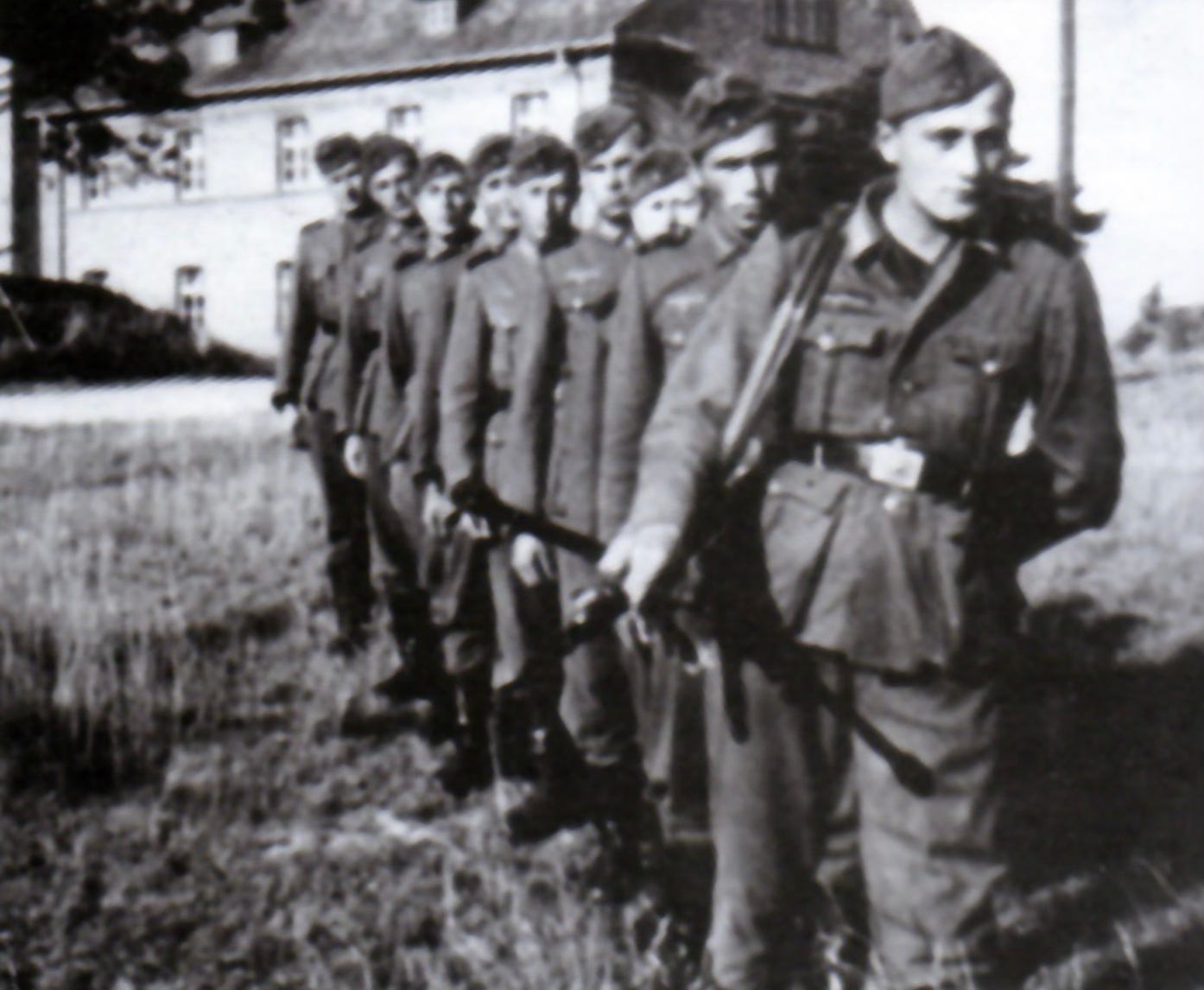
It was Petrenko who, directed by the leadership of the OUN, first established contact with the Army Counter-intelligence Corps (CIC) in 1946. Instrumental in the contact was also Rev. Ivan Grinyokh who had served as the chaplain of the Nazi-OUN “Nachtigalle” battalion during World War ll, and had been awarded the German Iron Cross. Grinyokh also had worked for the Gestapo and had used the names Orlov and Herasimowskyj. Earlier he had been an advisor to Nicholas [aka Mykola] Lebed, the first chief of the SB. [WIN, pg. 9, PDF pg. 5.]
According to Cakars and Osborn, “a key element” of OUNs “arrangement with the CIC” was that “it offered to eliminate Communist agents in the West.” Unfortunately for the CIC, OUN seemed less interested in this than in identifying political opponents and others who had crossed the OUN in various ways, either by “failure to pay ‘protection’ money or. . . the result of personal squabbles” (Ibid.) (Some have seen the OUN actions in the camps differently, and disagree with Cakars and Osborn in terms of who the primary victims of Operation Ohio were, as will be discussed further below.)
When CIC investigated the lists of “Soviet agents” that OUN provided them, very few of the cases “turned out to warrant further investigation” (1 percent in one example Cakars and Osborn mention) (WIN, pg. 10, PDF pg. 6).
According to the 1989 book, America’s Secret Army: The Untold Story of the Counter Intelligence Corps, by Ian Sayer and Douglas Botting (Fontana Paperbacks, London), after the end of World War II “the OUN stressed the inevitability of war between the Western powers and the USSR and saw this as the perfect opportunity to continue the fight for the liberation of their Ukrainian homeland.”
Sayer and Botting, who seem to have had extraordinary access to CIC records, claimed that a CIC report from Berlin in the summer of 1946 stated “that the OUN was using funds allegedly collected from Ukrainian DPs for the purchase of weapons, ammunition and other items necessary to equip and maintain an army” (pg. 349).
The funds “collected” were often coercively obtained. A 2020 article by Jan-Hinnerk Antons in Harvard Ukrainian Studies described the situation:
Due to the concentration of intellectuals in the U.S. zone, the OUN-B, with its working class and peasant followers, was especially strong in the British zone of occupation. Besides holding official positions, they ruled the community by their established strategies of clandestine intimidation and violence. Donation requests in support of the Ukrainian Insurgent Army (UPA) serve as a good example. The UNRRA [United Nations Relief and Rehabilitation Administration] director of the Lysenko camp in Hannover described the proceedings: “Persons, names of whom we do not know, who are supposed to belong to an underground Ukrainian Movement called the ‘Bandura Army’ [sic], are from time to time circulating the a/n camp [Lysenko],8 soliciting for money among the camp population. This happened four times in the last eighteen months, last time a few weeks ago. When people are contributing money, they are issued with obligations or bonds….Of those who refuse to pay, names are taken by collectors. Through such action the people are scared and in our opinion this illegal action should be stopped at once. [Bracketed material on UNRRA is added — JK]
Sayer and Botting’s narration of the Ohio episode at Mittenwald is similar to that of Cakars and Osborn, and even draws on some of their research. Nevertheless, they are of the opinion that CIC was not involved in Operation Ohio. They believe that the assassinations were coordinated with Americans from the Office of Policy Coordination (OPC), a covert action arm of the U.S. government set up after World War II and, though associated with the CIA organizationally, was led by Frank Wisner and nominally under the jurisdiction of the Department of State and the Department of Defense.
Sayer and Botting cite CIC’s hostility to the OUN. They note that “CIC official records contain no reference to Operation Ohio or the horrors of Mittenwald — possibly because sensitive records of activities subsequently taken over by the CIA have usually ended up in the closed archives of the CIA itself. Nor have any former CIC agents spoken up about CIC participation in this black episode” (pg. 352).
As an example of CIC’s disillusionment with the OUN, the authors of America’s Secret Army described how the CIC obtained “eleven volumes of the secret internal files of the OUN, which clearly showed that its members had made a significant contribution to the Nazi war effort by working as policemen, executioners, partisan hunters and officials for the Gestapo and SS and raising several divisions of Ukrainian volunteers for the Waffen-SS” (Ibid.).
While Sayer and Botting present an intriguing hypothesis, Cakars and Osborn’s “Operation Ohio” article provides ample evidence regarding CIC’s role, evidence Sayer and Botting failed to mention in their version of events. The WIN authors dedicated an entire section of their article to “the context” surrounding Ohio.
As Cakars and Osborn explained it, after World War II CIC’s “job was to establish absolute authority for security in occupied Europe.” CIC’s first actions were to form “informant nets within the German and Austrian civilian community and the labyrinth of displaced person camps in order to finger those opposed to American policy, while at the same time conducting a campaign to enforce authority over the German and Austrian population. At first the CIC’s target was deNazification, but almost immediately the emphasis switched to the battle against Communism” (WIN, pg. 13, PDF pg. 7).
Even a cursory look at the documentary record shows that after the war the U.S. and allies saw Nazi influence in the DP camps as a special problem. The issue surfaced in various newspaper reports, such as the Associated Press article, dated January 1, 1946, “Many Pro-Nazis Discovered Among Baltic Nationals Who Pose as Displaced Persons”:
The American G-2 [intelligence] investigation pointed the finger of suspicion, too, at Nazi elements who enjoy an Allied haven by day but engage in depredations at night and who are responsible for the main source of disorder and crime in Germany....
The report on the two camps said:
“In two camps containing Baltic nationals at Mainfranken a majority of those investigated were found to consist of voluntary pro-Nazi exiles.” [Material in brackets is added]
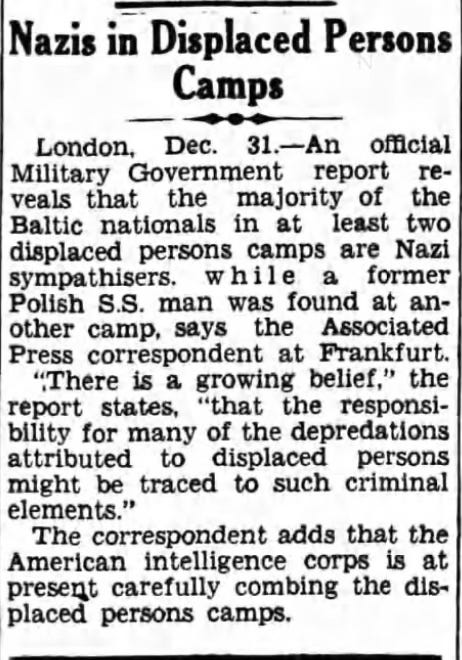
The presence of fascists in the Ukrainian DP camps was a central topic during the January 1946 convention of the left-wing Ukrainian Canadian Association. (The group changed its name to the Association of United Ukrainian Canadians [AUUC] at this same convention.)
According to a January 16, 1946 article in The Brantford Expositor in Ontario, the convention formally requested that the Canadian government explain “why Dr. W. [Wasyl] Kushnir, Chairman of the Ukrainian Canadian Committee, ‘was permitted to go to Europe when his purpose was to establish connection with the Ukrainian Fascist element known as the Ukrainian displaced persons in the British and American occupation….’” (The Ukrainian Canadian Committee [UCC] was a right-wing, conservative rival Canadian Ukrainian group which had been formed with the assistance of the Canadian Federal Government in 1940.)
The Ukrainian Canadian Association/AUUC was not mistaken about Kushnir, who was also a notorious antisemite.9 A 2016 article by Richard Sanders in Press for Conversion told how Kuhnir visited “interned Galician SS veterans in Europe,” part of a UCC campaign to “bring these veterans to Canada.”
The main point here is that the identification of fascistic elements among the DP population of Ukrainian, Baltic and other refugees was clearly seen as a problem by a number of state and other actors in the year following the end of the war in Europe. The CIC was integral in tracking them down.
As a consequence, CIC operations in Germany and Austria were huge. There were at least 18 CIC detachments in the U.S. occupation zone. The largest was “the 970th CIC Detachment, headquartered at first at Wiesbaden, Germany, and later in the immense I.G. Farben Building in Frankfurt-am-Main.” These detachments were further divided into teams that “roamed in a designated area and established informant nets in the population, especially the DP camps, which were sometimes located in former Nazi concentration camps” (WIN Magzazine, pg. 14, PDF pg. 8).
The 430th CIC Detachment in Salzburg had a “special section known as the Displaced Persons Screening Project or DP-48....” Its facilities included “Accomodations for the secret solitary confinement of up to 100 arrestees at one time... Ten cells equipped for secret monitoring and recording of conversations” and “Ten private, soundproof interrogation rooms” (Ibid.).
Like the later historians of CIC’s role, Sayers and Botting, Cakars and Osborn also had some access to former CIC eyewitness personnel.
Once the CIC gained control in these areas, it was easy for its operations to get out of hand. In the words of a retired Colonel who had been with the 430th CIC and who later went on to play a key role in the Vietnam Phoenix Program, “ln those early days we had some wild ass times in Europe. Now-and-again a suspected Communist agent would get killed. Things were so tense in those days that it didn’t take much, you know.” [WIN, PDF pg. 8]
By June 1954, the responsibility for interrogations was shifted from CIC to the CIA. It is around this time that CIA also took over responsibility for the Ohio program in the Ukrainian DP camps.
Operation Ohio was not the only violent covert program run by U.S. intelligence forces in Europe at the time. The late 1940s and early 1950s was the period of the little known Operation Rollback, run by OPC, the primary U.S. covert action arm at the time. Rollback was modeled after partisan operations in WWII behind fascist lines, organized and run by the U.S. Office of Strategic Services (OSS) and British Special Operations Executive (SOE). Unlike the WWII OSS and SOE partisan war, things did not go so well for the Western-backed agents sent behind the “Iron Curtain.”
As author Peter Grose wrote in 2000:
When the Americans, sometimes alone, sometimes with the British, began trying to insert small teams of agents into Yugoslavia, Albania, Ukraine, Soviet Moldavia, or other places to foment resistance and ultimately rebellion, the results were almost uniformly disastrous. Agents offloaded on the Albanian coast were quickly confronted by guards, who killed or arrested most of them.
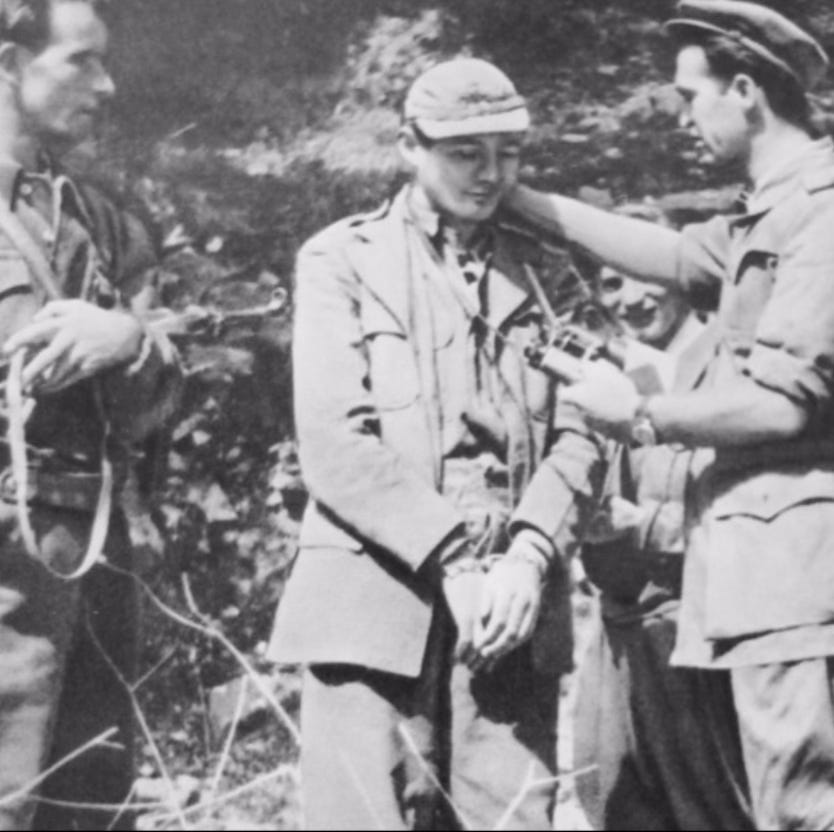
In another example of Cold War brazenness, the U.S. also ran a kidnapping program known as Snatch/Counter-snatch. Cakars and Osborn referenced it in their WIN article:
An example of an operation that crossed the line into illegality was one named “Snatch/Counter-Snatch” that ran for a number of years in the late 1940's and early 1950's. This official, if ludicrous, codename referred to a series of American and Soviet kidnappings. The official CIC history concentrates on Soviet kidnappings as they were thwarted by one of the “most extensive investigations ever conducted by the 430th CIC Detachment.” Nevertheless a participant in the operation has revealed to us that kidnappings were carried out by Americans as well. [Win Magazine, pg. 15, PDF pg. 8]
Snatch/Counter-Snatch does seem almost too bizarre to be true. Would the U.S. intelligence services really run an operation with such a crazy, yet obvious codename? Turns out, yes, they would, and the files for this program — four volumes of them — are listed in the U.S. National Archives catalog. (Unfortunately, these files are not currently online, and I bet they never will be!)
One of the CIA’s kidnappings concerned the case of Peter Moroz, an employee at the CIA's Institute for the Study of the USSR, who "was seized by CIA operatives posing as German police," and taken to a "safe house" near Munich. Moroz was held in isolation without charges for three months and subjected to sensory overload. He was “forced to sleep in a basement room without furniture while bright lights were left turned on. He was fed highly salted food. Constantly Indonesian music was piped in over loudspeakers. The CIA’s objective was to make Moroz denounce his son, thereby blunting the propaganda effect of his [son’s supposed] defection” (Ibid. — text in brackets added).
According to Cakars and Osborn, Moroz’s kidnap team was led by “a man named Muller, a CIA agent posing as the Legal Counsel of the American Committee for Liberation from Bolshevism” (Ibid.). Ultimately Moroz was released, but his attempts to have his abduction investigated went nowhere, demonstrating the impunity by which these U.S. covert programs were conducted.
Whatever the culpability of CIC in the Ohio assassinations (and I tend to believe much of Cakars and Osborn’s reporting) both Sayer and Botting and Cakars and Osborn agree that the CIC (or OPC) intelligence agents supervising the OUN murderers in the DP camps later turned sour on the OUN-B, and supervision of the Ohio assassinations fell to Navy and Air Force intelligence units, and later to the CIA.
The WIN article has little to say about what happened after CIC (or OPC) exited, except that the assassinations continued. These Navy and Air Force intelligence units certainly were involved in the Cold War anti-Soviet paranoia that was gripping the U.S. political establishment. Like the CIC and the CIA, they likely found Bandera’s OUN, like its political opponents in the ZPUHVR, useful for anti-Soviet purposes.
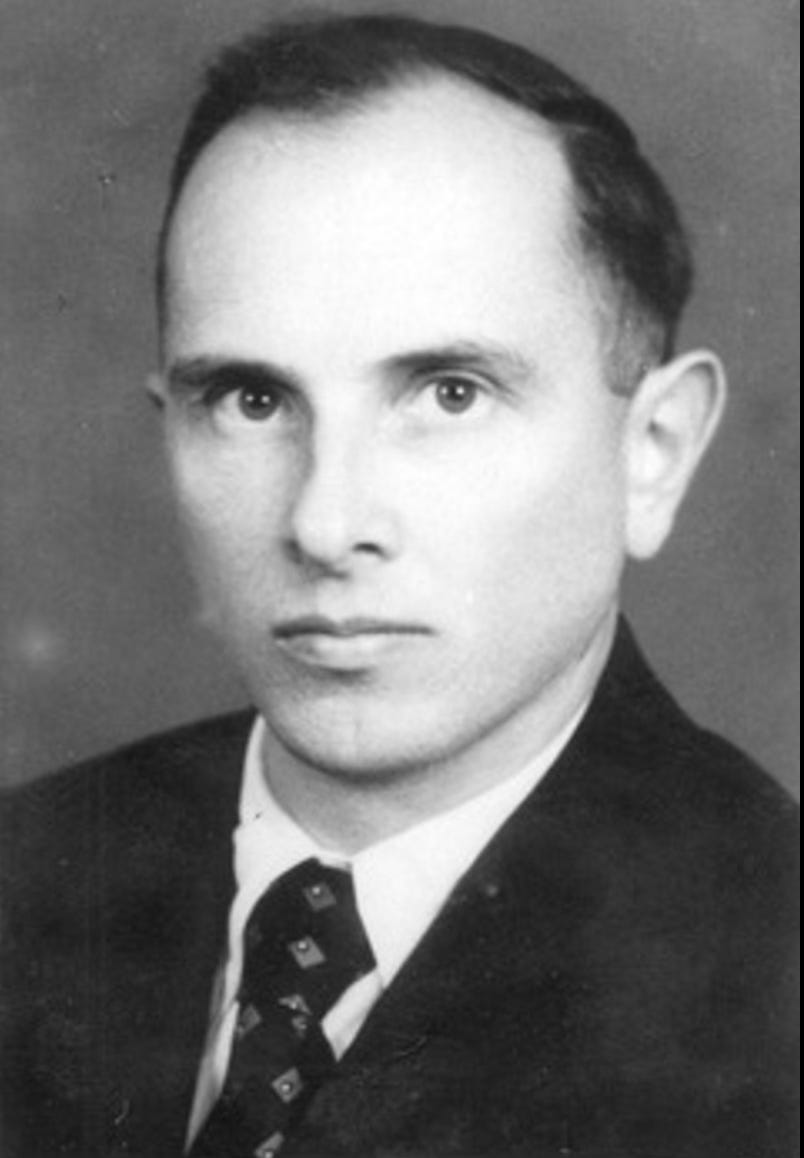
Both the Sayer/Bottling and Cakars/Osborn narratives on Ohio agree that the OUN-B “reign of terror” in the DP camps came to an end, or was at least seriously ameliorated, by “early 1952” when “an OUN member unsuccessfully attempted to assassinate General Diomid Gulai, the head of the Ukrainian Liberation Movement.10 This was too much. The CIA tightened control and OUN assassinations were on their way out although support of the OUN was to continue” (WIN, pg. 13, PDF pg. 7).
Cakers and Osborn’s timeline here is a bit wobbly, at least as regards when the CIA really assumed control. In their discussion of the Gulai episode, they appear to say that the CIA was tightening control over OUN in 1952, while elsewhere they describe CIA coming into control of Ohio later, in 1954. While this could be narrative sloppiness, I think the uncertain timeline regarding what U.S. sponsors were in charge when is most likely due to the secret and classified nature of the program and its operations, as well as the vagaries of relying on oral testimonies vs. documentary evidence. It is important to remember that we are only peeking through a tiny opaque window into a vast world of top secret operations and covert wars.
One example of the confusions introduced into the history of this period is that fact that, unbeknownst to the OUN-B leaders at the time, the CIA was backing multiple sides in the world of Ukrainian nationalism, always hedging their bets, and maneuvering and manipulating its assets for its own benefit. The Ukrainian Liberation Movement, to which General Gulai belonged, and another Ukrainian outfit, the Union of Ukrainian Federalist Democrats, were two other CIA-sponsored organizations in the DP camps. One has the impression that the situation in the DP camps, if not the entire nationalist milieu, was one of intense turmoil, intrigue, backstabbing, and complex, interlocking hatreds.
Given the incendiary nature of many of the charges made by the WIN article, it’s worth examining the credentials of its authors, and the credibility of their charges. The record shows that both Cakars and Osborn were taken very seriously by the political establishment of their day. A 2006 article in Yale University’s “News” described Cakars as “a renowned anti-war activist and pacifist who was editor of Win magazine.”
By the mid-1970s, Cakars was a well-known pacifist and, according to a March 1992 obituary in The New York Times, also “a leader in the movement against the Vietnam War.” He was born in Riga, Latvia in 1942. Towards the end of World War II his apparently anti-communist family fled Lativa and Maris spent a few years living with them in a displaced persons camp. He was 49 years old when he died in Brooklyn, New York of “internal hemorrhaging.” The circumstances surrounding his early death are otherwise unknown.
The New York Times obituary described Cakars’ career. “For 12 years he worked for Win, a small but influential magazine that opposed the Vietnam War and expanded to other social issues. It encouraged radical change but nonviolent tactics. He was the editor for about six years. Among those associated with Win were Abbie Hoffman, A.J. Muste and Hendrik Hertzberg,” the Times wrote.

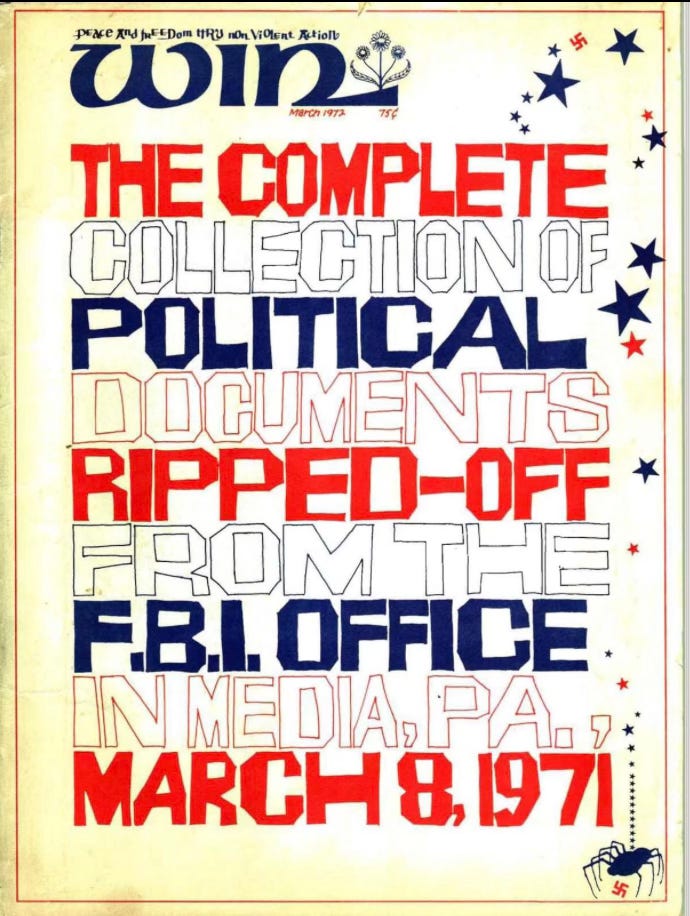
Cakars and WIN were also well-known for exposing government crimes. In 1972, WIN Magazine gained attention for posting the first complete collection of the FBI COINTELPRO documents, which were stolen from an FBI bureau office in Media, Pennsylvania in 1971. The burglary of the FBI offices, and the incredible discovery of documentary evidence of the FBI’s “secret counterintelligence program” and covert black operations was the subject of Betty Medsger’s 2014 book, The Burglary: The Discovery of J. Edgar Hoover’s Secret FBI.
Maris was a pacifist, a tax dissident, and someone who wasn’t afraid to put himself on the line. As early as 1965 he was arrested for blocking the entrance to an Army induction center. He also, according to his obituary in the Kingston Daily Freeman, “was arrested by the KGB for passing out anti-war leaflets in Moscow.” (I tried but could not find more information on the Moscow arrest.)
Kenneth Barton Osborn was by 1975 also well-known, respected by many, though vilified by supporters of the Vietnam War. From 1967 to 1968, at age 23, he had been an “agent for the U.S. Army Intelligence and Security in Vietnam.” He had also been assigned to the Phoenix Program, and outraged by what he saw, had turned whistleblower. His whistleblowing concerned not just CIA-supervised torture and assassinations, but similar, even more brutal torture and murder by U.S. Marine Corps interrogators.11
After his testimony helped blow open the CIA Phoenix scandal, Osborn became a “co-founder of the Fifth Estate, Inc. … an independent publically-supported research group on the government intelligence community” (WIN, pg. 5, PDF pg. 3).
In his later years, Osborn apparently lived in some obscurity. He died in September 2007, age 62. There were no obituaries I could find to mark his passing.
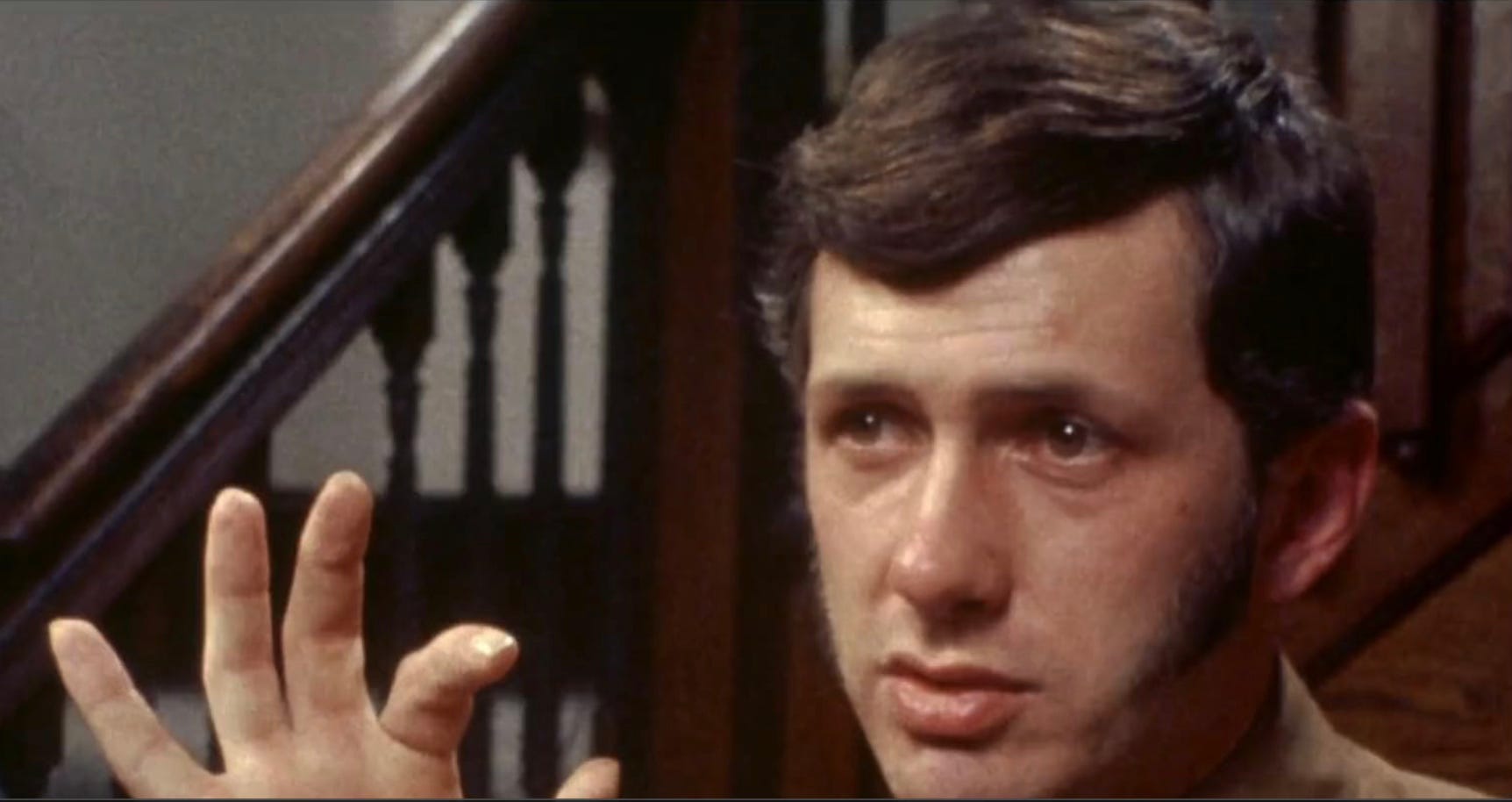
Osborn was an eyewitness to the CIA’s Phoenix Program and his assertions about the similarities and personnel links between Operation Ohio and the Phoenix project some twenty years later carry much weight. Cakars and Osborn made the linkage between the two programs explicit in their article.
According to the most important book documenting Phoenix, Douglas Valentine’s The Phoenix Program: America’s Use of Terror in Vietnam (Open Road Media, originally published by William Morrow and Co. in 1990), “Developed in 1967 by the Central Intelligence Agency (CIA), Phoenix combined existing counterinsurgency programs in a concerted effort to ‘neutralize’ the Vietcong infrastructure (VCI). The euphemism ‘neutralize’ means to kill, capture, or make to defect…. Central to Phoenix is the fact that it targeted civilians, not soldiers’ (Valentine, pg. 25, Kindle edition).
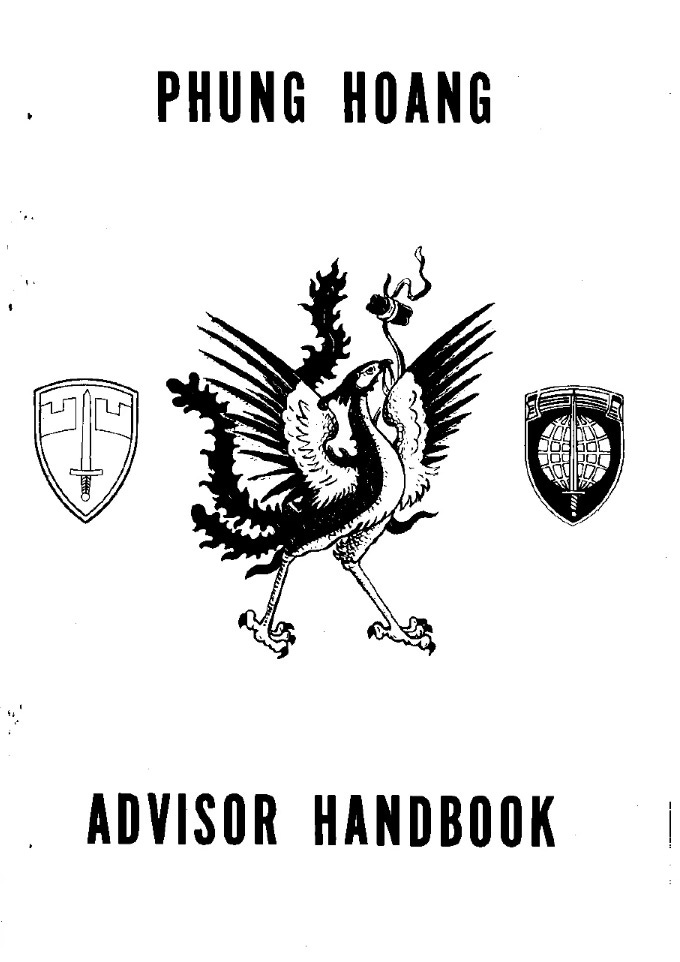
Under Phoenix, or Phung Hoang, as it was called by the Vietnamese, due process was totally nonexistent. South Vietnamese civilians whose names appeared on blacklists could be kidnapped, tortured, detained for two years without trial, or even murdered, simply on the word of an anonymous informer. At its height Phoenix managers imposed quotas of eighteen hundred neutralizations per month on the people running the program in the field, opening up the program to abuses by corrupt security officers, policemen, politicians, and racketeers, all of whom extorted innocent civilians as well as VCI. [Valentine, pg. 26, Kindle edition]
The world first heard about Phoenix in February 1970 at hearings before the U.S. Senate’s Foreign Relations Committee, which revealed details on the CIA’s Vietnam counter-terror capture, torture and assassination program. The Phoenix program evolved from earlier CIA “Counter Terror” and pacification programs in the mid-1960s.
But the Senate hearings, despite some revelations, were largely a “limited hangout.” A February 18, 1970 article in The New York Times provided the typical liberal gloss:“Designed by the United States Central Intelligence Agency to weed out an estimated 75,000 Vietcong political leaders and agents from the civilian population, the program is not the sinister, cloak‐and‐dagger, terror operation that some critics, including the Vietcong, have portrayed it to be, [U.S.] officials insist” (text in brackets is added).
Osborn’s own whistleblowing testimony helped sink that fairy tale. In December 1970, Osborn testified before the National Veterans Inquiry on U.S. War Crimes in Vietnam, held in Washington, D.C. Osborn’s testimony at the event was entered into the March 1, 1971 Congressional Record by Representative Ron Dellums, who that same day was introducing “a joint resolution proposing a full-scale congressional inquiry of American war crimes and war crime responsibility” in Vietnam. Osborn’s testimony (see pages 4241-4245), and that of other vets, were meant to bolster the case for the vote on the congressional war crimes investigation.
Osborn told the National Veterans Inquiry that when he arrived in Vietnam, after intelligence training at Fort Holabird, his job entailed “spotting, analyzing, recruiting, training and running and terminating agents.” He stated that his agent nets did covert work that was “denied by our government.” They were involved in “the overt, active, aggressive collection of intelligence.” The government’s frank approach to breaching the laws of war was the beginning of Osborn’s education.
As Osborn remembered it:
Of course, the starting point with the orientation at [the U.S. Army Intelligence School at Fort] Holabird was that, all this that we were going to be trained to do was against the Geneva Accords, and if we had moral compunctions about it, we could opt out of the program if we wanted to. If we had none, you just go ahead and play along with the program — be trained this way, and then they would return to us as a result the privilege of autonomy from the military…. In other words, we would be more or less free agents. [pgs. 4241-4242, text in brackets added]
Some months later, in August 1971, Osborn testified before the House of Representatives Foreign Operations and Government Information subcommittee about Phoenix’s atrocities. Osborn explained that he had been assigned to the Phoenix Program, and outraged by what he saw, had turned against the program.
The House subcommittee hearings were where the CIA’s William Colby (who later went on to head the CIA) claimed that the Phoenix Program had killed “20,587 members of the ‘Vietcong infrastructure’… from 1968 through May 1971.” Colby had claimed the U.S. role had been “primarily an ‘advisory’ one,” according to reporting at the time by the National Guardian.
But the House report which followed the hearings (a report that was leaked and not formally released) belied that story. According to the National Guardian’s reporting, “many of the so-called ‘Vietcong’ killed under the Phoenix ‘pacification’ program were innocent civilians.... [the program] allegedly included torture, murder and inhumane treatment of Vietnamese civilians…. The program had access to secret CIA funds.... Assassination teams of mercenaries and U.S. agents who compiled lists of persons to be assassinated were secretly funded.”
Osborn, who had “supervised agent networks for 15 months beginning in 1967.” played a central role in the House revelations. His testimony refuted Colby’s “limited hangout.”12
From the National Guardian article:
Osborn contradicted Colby’s disclaimers of direct U.S. responsiblity for the Phoenix program and made it clear that U.S. personnel particpated in murders and tortures. He said U.S. ‘advisors’ were really directing the program.
Osborn also described atrocities he witnessed, including seeing Vietnamese pushed from helicopters, a practice known as ‘airborne interrogations.”13
The Phoenix link was crucial to the relevance of the Operation Ohio story when it came out. As Cakars and Osborn noted, “At least three of the American intelligence agents who ‘graduated’ from this [Ohio] program went on to work with the notorious ‘Phoenix’ program in which over 40,000 Vietnamese lost their lives. Among these Americans was Richard Helms, later Director of the CIA and now [1975] ambassador to Iran” (WIN, PDF pg. 5, PDF pg. 3, text in brackets added).
In a 2001 monograph, The Early Cold War in Soviet West Ukraine, 1944–1948, historian Jeffrey Burds described his attempt to corroborate Cakars and Osborn’s “highly controversial article” on Operation Ohio. In a footnote pertaining to Mykola Lebed (called “Nicholas Lebed” in the WIN article), the SB’s first intelligence chief and himself at one point later targeted for assassination by the Bandera OUN faction, Burds wrote:
Though I have been able to verify from CIC documents that there was an Operation Ohio where suspected Soviet moles were investigated, I have not succeeded in gaining release of specific documents to substantiate directly any other aspect of the Win article. It is significant, however, that one of Lebed’s first joint operations with the CIC following his formal recruitment in 1947 was Operation Bingo, the American government’s use of Ukrainian nationalist agents in the refugee camps to find and liquidate suspected Soviet moles, 1949–1950. [Page 58].14
I was interested in the seeming similarities between Operations Bingo and Ohio. But there was extremely little on Operation Bingo that I have been able to find. However, there was one relevant US Army Intelligence and Security Command/Central Security Facility (INSCOM/CSF) document, dated February 21, 1950, released as part of the JFK Assassinations records review.
The INSCOM/CSF document referenced “Bingo” files, and how a “Bingo swooping operation” captured one Soviet agent, Ilya Jakushow, who was subsequently imprisoned for interrogation (see report pgs 1-2, PDF pgs. 2-3). The Americans’ plan for this individual was to either convict him for espionage, or get him expelled from Germany. There was no discussion of assassination in this document, although I suspect such plans are not typically written down. I don’t know the ultimate fate of this individual, though there is a 1962 CIA document that references Jakushow and some of his associates, citing the earlier February 1950 INSCOM/CSF report.
In 2001, Fourth Estate/HarperCollins published British academic Stephen Dorril’s book, MI6: Fifty Years of Special Operations. Dorrill corroborated much of Cakars and Osborn’s reporting. In a footnote, he related how “Maris Cakars personally informed [British socialist] Peter E. Newell (letter, 6.9.88) that, following the WIN report, he received documentation from the Soviets much in line with his own findings” (pg. 825, bracketed material added, but parentheses were in the original).
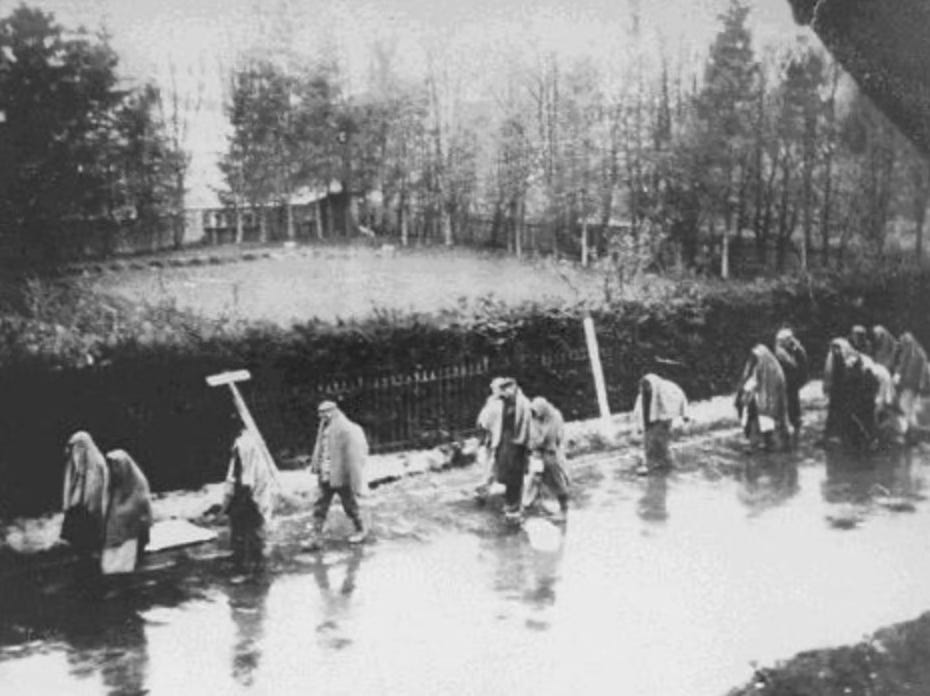
Dorril’s book is also interesting for the intricate description of internal OUN politics in the post-World War II period. The British author explained how the American CIC, in an operation code-named ANYFACE, had protected Bandera from Soviet capture and/or assassination. Even so, it was Britain’s MI6 that initially supported Bandera, while U.S. intelligence and OUN-B eyed each other with suspicion.
U.S. reluctance to embrace the Bandera wing of Ukrainian nationalists had only increased, Dorril wrote, when “a CIC agent… managed to photograph ‘eleven volumes of their secret internal files’ which contained proof that the majority of its members ‘had worked for the Gestapo and the SS as policemen, executioners, partisan hunters and municipal officials’” (Dorril, pg. 234).
In March 1946, a OUN “unity” conference declared that the organization would condemn “all ‘totalitarian mono-party’ trends and [condemn] all acts of terrorism” (Dorril, pg. 233). This was seen as a political feint against Bandera. Accordingly, Bandera and his followers split from the OUN and “created an overarching organisation for all the former pro-fascist nationalist exile movements, reconstituting the Nazi-sponsored 1943 Anti-Bolshevist Front, as the Anti-Bolshevik Bloc of Nations (ABN)” (Ibid.).
Dorrill described OUN-B’s violent power grab among the Ukrainian exiles. “The OUN-B gained dominance over its rivals by control of the DP camps in Germany, Austria and Italy,” Dorril wrote (pg. 234), where some quarter million Ukrainian refugees then lived.15 As described later in this article, refugees from eastern Ukraine held a precarious position inside the camp. These refugees lived, as Dorill put it, “in fear of being repatriated to the Soviet Union, and the prospect of internment in a labour camp, or death.” The situation meant that eastern Ukrainians in the DP camps were open to blackmail, and could “only be ‘helped to escape the repatriation if they would accept the Bandera-Stetsko leadership’” (Ibid.)
(For a more detailed discussion of the conflicts that divided East and West Ukrainian refugees, see the appendix “In the DP Camps” at the end of this article.)
With OUN-B now acting on its own as an anti-communist organization in the DP camps, they reached out to the Americans, who despite their initial cavils, decided to help out the Banderists, at least for awhile. Dorril had this to say on the Ohio episode:
During the summer of 1946, following the establishment of liaison with the US CIC by Roman Petrenko — a senior member of OUN-B’s secret police, the Sluzhba Bezpeky (SB) — the OUN-B embarked on a reign of terror in the camps. Father Hrynioch had acted as the go-between when the CIC office in Rome made an approach to [Mykola] Lebed, after which Petrenko offered the SB’s services in eliminating communist agents. On 22 July, the SB handed the CIC a list of alleged communist refugees, mostly, but not exclusively, in the Frankfurt am Main area. In response, the Americans arrested several hundred people who were questioned and in many instances tortured by OUN-B members dressed in US military uniforms. The torturers included Lebed. Yet out of all those arrested, only 1 per cent of the cases turned out to warrant further investigation; all were set free within a few months ‘for lack of evidence’. This made the Americans more cautious and, as time went by, the OUN-B’s secret police largely took over what was known as Operation OHIO. [Page 234]]
The victims of the OUN-B’s U.S.-assisted assassination campaign weren’t only alleged Communist double agents or sympathizers. There were also a number of murders of OUN-B’s political opponents from other OUN factions. For instance, the Banderites accused Andriy Melnyk’s faction of the OUN (OUN-M) of including “both Gestapo and NKVD collaborators” (Ibid.). As Dorril explained it, OUN-B launched “a killing spree” against OUN-M members in the DP camps “in which more than one hundred Ukrainians were murdered” (pg. 234).
A few were undoubtedly Soviet agents but most appear to have been DPs who, for various reasons, opposed the OUN-B, objected to black market activities, or were members of more moderate, but still anticommunist, Ukrainian groups. Another reason why some were eliminated was that they knew too much about the Ukrainians’ pro-Nazi past and participation by OUN supporters in the mass murder of Jews, Poles and ‘Red’ Russians. Personally directing Ohio were Lebed, Stetsko, Stefan Lenkovsky, Father Hrynioch and Stefan Bandera. In Kornberg, Mittenwald, Munich and other camps in Germany and Austria, many DPs were questioned, tortured and killed. Mittenwald had an underground torture chamber which was used by the SB until the summer of 1948. A private flat in a camp near Kornberg served for interrogations during 1946 and 1947, while, in 1949, another interrogation chamber was set up at Regensberg. In the two years to 1951, a bunker in the basement of the DPs’ hostel at Furnchstafe, in Munich, was the scene of SB torture. [Dorril, age 234-35]
One other important piece of evidence concerning Operation Ohio comes from Miles Copeland Jr.’s 1974 book, Without Cloak or Dagger (New York: Simon & Schuster, pg. 241). I found the reference to Copeland in Christopher Simpson’s extraordinary 1988 book, Blowback: America’s Recruitment of Nazis and Its Destructive Impact on Our Domestic and Foreign Policy.16
An August 1974 review of Copeland’s book in The New York Times Book Review described Copeland as a “senior CIA officer” and a member of “‘the old boy net’… in good standing” at the time Without Cloak or Dagger was published. Simpson doesn’t mention it, but other sources state that prior to his CIA career, Copeland worked for CIC prior to his transfer to CIA’s WWII predecessor, the Office of Strategic Services.
In his book, Copeland detailed the advantages of using organized groups of refugees over individual recruits. One example he provided of such a refugee group was the “Nightingale” organization, “a near-fanatical secret organization” formed of “aging emigrés from Czarist Russia, joined by a smaller number of disillusioned Soviet Communists” (p. 239).
Copeland elaborated:
For all its headaches, the “Nightingale” program became a model for the management of fanatical emigré groups — an especially apt model for the OPC, the CIA’s clandestine-activities branch, in the days before the PPPM [CIA’s Psychological Political and Para-military Division] was taken over by the SPD [CIA’s Special Projects Division]. The OPC saw there were obvious advantages — in morale, security, and general motivation — in allowing the emigrés to work as groups rather than individuals. For one thing, their disciplines and no-nonsense handling of the occasional traitors who turned up in their midst could not have been allowed in the OPC itself. (pg. 241, material in brackets added)
Simpson felt that Copeland was, among other things, referring to the OUN and the assassinations conducted as part of Operation Ohio. Simpson’s discussion of Ohio takes place in the context of an examination of the use of assassinations more generally during the early Cold War period. The confrontation between the Soviets, fresh from a powerfully successful but still devastating conflict with the Nazis, and the U.S. and its allies, in the first five to ten years after World War II was intense and the battleground involved nearly every East and Central European country, as well as France and Italy.
Simpson described the role of the CIA in the various rebellions against Soviet rule in East Europe.
The rebellions against Soviet rule were not initiated by the agency; they exploded inside the country out of discontents that were bound to give rise to violent resistance. Still, it is clear that CIA aid sustained such rebellions longer and made them more deadly to all concerned than they might otherwise have been. Moreover, these widespread shotgun-style slayings served as cover for a smaller number of specific individual assassinations that appear to have been directly ordered by U.S. intelligence officers. [Simpson, Blowback, pg. 223, Kindle Edition]
Simpson added, “Former Nazi collaborators made excellent executioners in such instances, because of both their wartime training and the fact that the U.S. government could plausibly deny any knowledge of their activities” (Ibid.)
The killings did not begin or end with the Ohio operation. Simpson explained:
“Several such killings did take place during the late 1940s under Operations Hagberry and Lithia, both of which were approved at senior levels of the Pentagon. These two instances, furthermore, must be considered only the documented examples of a more widespread practice” (Simpson, Blowback, pg. 224, Kindle Edition).
Simpson appears to have felt most of those killed in Operation Ohio were double agents. He doesn’t mention Cakars and Osborn’s discussion about how political assassinations of suspected agents became a cover for the liquidation of political rivals, or of otherwise innocent DPs caught up in the illegal shakedowns or grudges so common at the DP camps.
Simpson wrote:
Ohio employed a squad of Ukrainian ex-Nazis to carry out at least twenty murders in a displaced persons camp at Mittenwald, south of Munich. The Army CIC and later the CIA are reported to have financed this squad for strong-arm work against double agents, Soviet spies, and similar undesirables. The fragmentary evidence still available suggests that most of the squad’s victims were double agents whose deaths—when they became public at all—were attributed to factional violence among rival right-wing Ukrainian émigré groups. [Simpson, Blowback, pg. 225, Kindle Edition]
One of the most amazing, and least discussed, episodes in U.S. history concerns how U.S. intelligence agencies worked with fascists after World War II as part of an alliance forged to destroy the Soviet Union. This program, known as Operation Bloodstone, was something much bigger than the otherwise well-known Operation Paperclip, which recruited Nazi scientists to work in the United States.
Bloodstone was an early Cold War, State Department and National Security Council covert program that utilized the CIA-linked Office of Policy Coordination in an operation to recruit Soviet emigrés, who could be used as spies or penetration agents against the Soviet Union. Its activities included “recruiting defectors, smuggling refugees out from behind the Iron Curtain, and assassinations.”
Bloodstone and other similar operations were summarized in a book review by Earlean M. McCarrick of Christopher Simpson’s book Blowback:
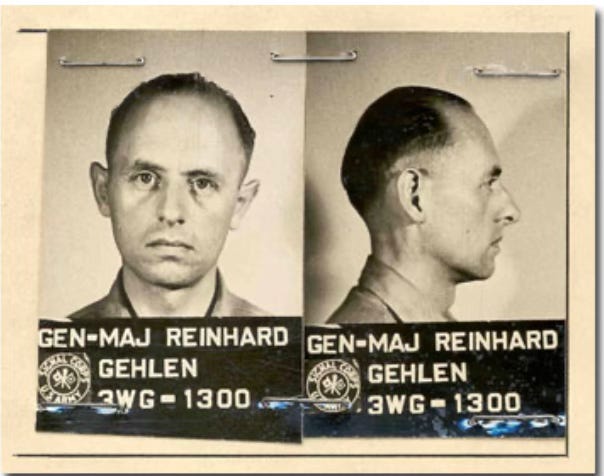
[Simpson] explores in depth the conversion of the CIC’s role from investigating Nazis to combating communism and using Nazis to do so; the CIA’s use of Nazis in its attempted coup d’etat in Romania in 1947 and in its interventions in the 1947 Greek and 1948 Italian elections; the Operation Bloodstone recruitment of Soviet emigrés from 1948 to 1950, including Nazi collaborators, for ‘political warfare’ in Eastern Europe, the Ukraine, and the Baltic states, which eventually led to sabotage and assassination operations abroad and the entrance of the CIA into [U.S.] domestic politics in the 1950s through support of ‘liberation’ groups; and the recruitment and role of [former German Army “intelligence chief for the Eastern Front during World War II,” General] Reinhard Gehlen, whose ‘organization ... left the most substantial imprint on the United States’ because its analysis of the USSR ‘became widely accepted in U.S. intelligence circles and remains so to this day’ (McCarrick, p. 52 — bracketed material and link added].
In the months and years after World War II, U.S. and UK recruitment of right-wing Ukrainian assets — themselves frustrated by the failure to construct a fascist, capitalist Ukrainian state in alliance with Nazi Germany — was the origin of an alliance that many decades later would culminate in a U.S. organized coup in 2014 in Ukraine and ultimately the current Ukraine war with the Russians.
That current Russia-Ukraine war carries the seeds of a Europe-wide war, if not a nuclear world war threatening the very existence of humanity! This is admitted even by President Donald Trump, who publicly chided Ukrainian leader Volodymyr Zelensky, “You're gambling with the lives of millions of people. You're gambling with World War Three. You're gambling with World War Three….”
There is a more distal, though crucial, reason for today’s U.S.-Russia proxy war in Ukraine, which goes back decades. I am speaking here of the fact that any total overhaul of U.S. policy in Ukraine would mean the abandonment of a policy of supporting fascist and other right-wing elements within Ukrainian nationalism for the past 80 years!
Very few people, even among those who back Russia, know that an alliance between the U.S. and elements of the OUN, specifically (and temporarily) the grouping around Stepan Bandera, was forged in the chaotic aftermath of World War II in Europe.
As journalist Kit Klarenberg reminds us in an extraordinary exposé on the links between Bandera and British intelligence, “As the mainstream media has acknowledged, Bandera’s legacy endures in modern Ukraine, in the form of Neo-Nazi military units such as Azov Regiment. He also remains a venerated figure in certain quarters of the country, much to the chagrin of Kiev’s Eastern European neighbours” (bold emphasis in original).
It’s time that the full history of the ties between the U.S. and Ukrainian nationalists becomes widely known, and even more, discussed. The fate of our species may depend on obscure murders conducted by Ukrainian exiles in the displaced persons camps of World War II, murders and assassinations undertaken with the foreknowledge, and apparently the cooperation or assistance of U.S. intelligence agents lurking in the shadows, a story that has been mostly, but not entirely, suppressed in the intervening decades.
A revealing 2020 article by Jan-Hinnerk Antons in Harvard Ukrainian Studies, the journal of the Ukrainian Research Institute at Harvard University, states there were “more than one hundred Ukrainian Displaced Persons camps in the western zones of occupied Germany.”
Antons describes the chaotic postwar situation. Ukrainians who had collaborated with the Nazis, including members of the Organization of Ukrainian Nationalists (OUN), as well as other criminal Holocaust perpetrators, tried to escape the Allied policy of “forced repatriation” of nationalities at the end of the war. In fact, the vast majority of Ukrainians returned to the Soviet Union by choice after the war, many of them having been slave laborers for the German Reich, or prisoners of war. But not all wished to return.
According to Antons:
When the tide of war finally turned against Germany, many Ukrainian military men, administrative officials, and other collaborators fled with the retreating Wehrmacht, together with nationalist activists, some clergymen, and others who feared Soviet reprisals.[8]
After the liberation of Germany, these refugees found themselves among two million Ukrainians in the western zones of occupation. About 90 percent of them went back to their homeland, many voluntarily and often for the simple reason of homesickness and in order to reunite with their families, while others were forced to do so by the Western powers following the Yalta Agreement.[9] Of the 200,000 Ukrainian DPs who remained in the western zones of Germany beyond 1945, 30 to 40 percent were refugees who had actively left their homeland in fear of Soviet rule; and the remainder were former slave laborers who had been imported by the Germans. [Footnotes are in original article]
The displaced Ukrainians did not consist only of fascist collaborators. By far the largest amount had been either prisoners of war or slave laborers sent into Germany. Wsevolod W. Isajiw and Michael Palij described the situation in “Refugees and the DP Problem in Postwar Europe,” part of a larger volume, The Refugee Experience: Ukrainian Displaced Persons after World War II (Canadian Institute of Ukrainian Studies Press, 1992).
Ukrainians were not the only people who fled the Red Army to the West, although, as in the case of Ukraine, the majority of refugees from other East European countries and Russia did return to their home socialist republics in the Soviet Union. Isajiw and Palin described those who refused to return:
In Western Europe (including Germany, Austria, France, Switzerland, Italy, and northern European countries), there were roughly 58,700 Estonians, 153,300 Latvians, 78,800 Lithuanians, 250,000 Ukrainians, 200,000 Poles, and 125,000 Yugoslavs (mainly Serbs and Croats). (pg. xvi)
The majority of the Ukrainian DPs were not that political. They were mostly interested in survival. Inside the camps themselves, there was a jockeying for influence and power among those who were political, and the most influential and gangster-like clique was the Bandera faction of the OUN (OUN-B).
This finding isn’t just my opinion, or taken from one source, but a robust finding across multiple researchers, as referenced throughout this essay. It’s worth documenting, as it is a history that is otherwise little mentioned today.
In the second edition (1963) of his oft-quoted book, Ukrainian Nationalism (Columbia University Press), historian John A. Armstrong briefly discussed the role of OUN-B in the DP camps. He concentrated on the split between East and West Ukrainians in the post-WWII refugee diaspora.
West Ukrainians were “the numerically dominant element” in the camps. Many East Ukrainians, that is, those remaining in the West who hadn’t joined the vast majority of Ukrainians who returned to the Ukraine Soviet Socialist Republic, had, according to Armstrong, lied and told occupation authorities they were from West Ukraine. This was because a number of East Ukrainians wished to avoid the forced repatriation policy agreed upon among the Allies.
According to the agreed Allied policy of forced repatriation, there was a “loophole” for West Ukrainians: “persons who had been resident in the areas annexed by the Soviet Union in 1939 or later were allowed to remain in Western zones.” This put “West Ukrainians (or those who could pass themselves off as such)… beyond Soviet power” (Armstrong, pp. 311-312, parentheses in original).
This is relevant because East Ukrainian fugitives in the displaced person camps, who passed as being from West Ukraine, were vulnerable to blackmail or extortion by certain politically ruthless West Ukrainians. The latter used their eastern compatriots’ vulnerability to “compel East Ukrainians to adhere to the nationalist cause. In some cases, it is said,” Armstrong wrote, “nationalists also resorted to violence to control the camp administrations and maintain a monopoly of propaganda” (pg. 312).
And which nationalists were involved in the resort to violence? Armstrong wrote, “Much the most active nationalist group in this regard, according to many reports, was the OUN-B….” (pg. 312, italics added for emphasis).
In the aftermath of the disaster that was World War II, tens of millions of refugees crisscrossed borders to find safety and in some cases reclaim their homes. Many of these wartime displaced persons (DP) had been forcibly moved from their lands; many had been forced into slave labor in Nazi Germany. Others had been liberated from concentration camps. Some were war criminals trying to escape justice, or the vengeance of their victims.
In countries that had been occupied by the Germans, or that had been ruled by Nazi puppet regimes, many military officers, soldiers, camp guards, police, and Einsatzgruppen killers fled West to escape the wrath of the Red Army and Soviet war crimes prosecutions.
As Antons’ article at Harvard Ukrainian Studies described it:
When the tide of war finally turned against Germany, many Ukrainian military men, administrative officials, and other collaborators fled with the retreating Wehrmacht, together with nationalist activists, some clergymen, and others who feared Soviet reprisals.
After the liberation of Germany, these refugees found themselves among two million Ukrainians in the western zones of occupation.
Ultimately, according to this article, some ninety percent of the Ukrainian refugees returned to Soviet Ukraine. But approximately 200,000 remained in Germany, and they were gathered, like other ethnic or national refugees, into the majority of displaced persons camps, which dotted the German landscape across all the different zones of occupation (U.S., British, French, and Soviet), as well as a smaller number of such camps in Austria and Italy.
Antons’ estimated that 30 to 40 percent of the Ukrainian refugees that did not repatriate “had actively left their homeland in fear of Soviet rule; and the remainder were former slave laborers who had been imported by the Germans.”
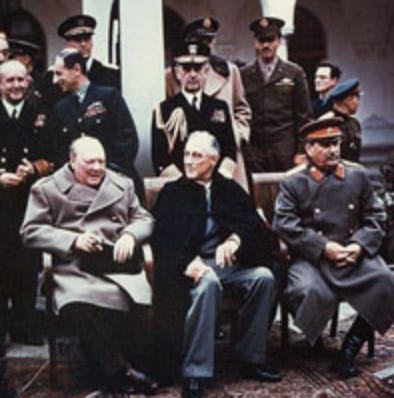
In the February 1945 Yalta Agreement between the victorious great powers, it was agreed that “All Soviet citizens liberated by the forces operating under United States command and all United States citizens liberated by the forces operating under Soviet command will, without delay after their liberation, be separated from enemy prisoners of war and will be maintained separately from them in camps or points of concentration until they have been handed over to the Soviet or United States authorities, as the case may be, at places agreed upon between those authorities.”
This forcible repatriation of both U.S. and Soviet citizens — “forcible” because the policy was enforced by force if necessary by the military police of the occupying powers — became a sore point at the very beginning of the Cold War. While the repatriation of captured U.S. personnel was non-controversial, there were anti-communists among those who had been imprisoned by the fascists, or had resided in lands occupied by the fascists. Not least among these were the Ukrainian, Polish, Baltic, or members of other nationalities that had sided with the Nazis or their puppet governments.
The Yalta Agreement had also provided that military authorities from both the U.S. and the Soviet Union would “without delay inform the competent authorities of the other party regarding citizens of the other contracting party found by them.” Both sides were to take all “necessary steps to implement” the agreement on repatriation of citizens. Moreover, each side was to allow the other’s representatives “the right of immediate access into the camps and points of concentration where their citizens are located” in order to facilitate their repatriation.
To summarize, while they were a minority of all displaced persons after the war, there were former citizens of the Soviet Union who did not want to be sent back home. This included those who had fought with the Nazis in their armies, and hard-core anti-communists, and members of political parties that opposed Soviet rule.
Americans know very little about the titanic struggles and upheavals that engulfed Europe, especially Russia, the Caucasus and Eastern Europe, after the Russian Revolution. The Second World War, and its aftermath both continued and accelerated these battles. Events in that part of the world, including in Russia and Ukraine, still echo the conflicts of that time.
Some sources use the spelling “Stefan,” but except where I have quoted certain authors in this article, I have kept to the most generally accepted English transliteration of Bandera’s first name.
The version of “WIN Magazine” in this article should not be confused with a different publication of the same name. In the latter case, that magazine’s use of “WIN” stands for “Wrestling Insider Newsmagazine.”
The website for the War Resister’s League has a page dedicated its WIN Magazine, which was discontinued in Spring 2015. The WRL site states:
WIN magazine, formerly the Nonviolent Activist, was the quarterly magazine of the War Resisters League. Through articles, interviews, and reviews, WIN covered resistance to war abroad as well as resistance to violence and militarism within the United States. WIN nurtured its readers as activists, equipping them with relevant and accessible information to support their organizing work. WIN worked to build bridges between various struggles against violence and for justice, to support the growth of a broad-based, nonviolent, anti-racist, and revolutionary movement to end all war and oppression.
I originally obtained a copy of WIN Magazine with the Cakars and Osborn article discussed in this current essay from the San Francisco Public Library. I subsequently found that Swarthmore College had a copy of the article, which was in Volume 11, number 30 of WIN. Only when writing this article did I discover that Swarthmore had digitized the article and made it available online.
Because links tend to disappear on the Internet, it’s important to have alternate sites to access important documents. Two other links to access the WIN article on Operation Ohio are at ciatruth.wordpress.com and Internet Archive.
According to a brief history of the CIC at the website of the National Counter Intelligence Corps Association, “ The mission of the CIC was the detection, neutralization and/or destruction of espionage, sedition, sabotage and subversive activity against the US Army. High standards were set for individuals selected for CIC service….. To accomplish their CIC missions [CIC Special Agents] often operated in civilian clothes rather than military uniforms and had false undercover identification and concealed weapons when necessary…. CIC was heavily involved in the security of the Atomic Bomb development and the Normandy Invasion among others. At the end of World War II, CIC personnel were successful in an operation called ‘Paper Clip’ that obtained German Rocket Scientists for America before the Soviets took them.”
According to the WIN article, the informant was a “Russian-born anti-Communist” who left the Soviet Union sometime in the 1920s. By the time Cakars and Osborn met him, he was “a former CIA employee who lived at the Mittenwald ‘displaced persons’ camp at which a number of the murders occurred” (PDF pages 3-4).
Other informants utilized by Cakers and Osborn included a former member of the Nazi-created Vlasov Army, who had been both a “soldier of fortune” for the French and Spanish foreign legions, and later “served as a guard in the Schleisheim camp for displaced persons”; a female secretary at the Mittenwald DP camp; and a number of both European and American anonymous sources who “had direct experience with the long arm of the ClA” (PDF pg. 3).
Cakers and Osborn also cited the assistance of others in the research and other, perhaps financial, assistance in the publication of the article, including the “Committee for a Fifth Estate, the Center for National Security Studies, [poet and member of the rock band, The Fugs] Ed Sanders, [former special assistant to the Deputy Director of the CIA] Victor Marchetti, [Counter-Spy editor] Tim Butz, [former U.S. Army Intelligence Agent] Gary Thomas and many others” (Ibid., bracketed material added).
As an example of the kinds of material Cakars and Osborn used, they quoted the Nuremberg Trial testimony of German Lieutenant Erwin Bingel, who testified that “Ukrainian militiamen (OUN members) participated in an action at the Vinnitsia airport in the Western part of Ukrainia.”
The Jews of Vinnitsia had been assembled at the airport and then:
“One row of Jews was ordered to move forward and was then allocated to the different tables where they had to undress completely and hand over everything that they wore and carried. . . Then, having taken off all their clothes, they were made to stand in line in front of the ditches, irrespective of their sex. The commandos then marched in behind the line and began to perform the inhuman acts. . . With automatic pistols and 0.8 pistols these men mowed down the line. . . Even women carrying children a fortnight to three weeks old, sucking at their breasts, were not spared this horrible ordeal. Nor were mothers spared the terrible sight of their children being gripped by their little legs and put to death with one stroke of the pistol-butt or club thereafter to be thrown on the heap of human bodies in the ditch, some of which were not quite dead.” [WIN, pg. 17, PDF pg. 9]
NOTE: the “0.8” pistol mentioned was likely the Pistole 08 (or P.08) Luger pistol, which the German Army used extensively in WWI. By 1938, the Army had switched to using the Walther P38.
According to an October 1948 CIA report, “Project Icon: Postwar Ukrainian Exile Organizations in Western Europe,” the seven most prominent Ukrainian groups the U.S. was dealing with at that time were 1) the Organization of Ukrainian Nationalists (OUN), which at that point existed only in its original form inside Ukraine as partisan groups; 2) the “right-wing ultranationalist” OUN/Bandera (OUN-B), an emigrant nationalist group of some 5,000, led by Stepan Bandera; 3) OUN/Melnyk (OUN-M), an emigrant nationalist group of some 2,000 members, known, as was OUN-B, to have collaborated with the Nazis; 4) the Ukrainian Revolutionary Army (UPA), which ran a partisan resistance inside Soviet Ukraine; 5) the Ukrainian Supreme Council of Liberation (UHVR), “founded in 1944 in west Ukraine… the government set up by the military and political forces of the Ukrainian resistance movement as its highest organ”; 6) the Foreign Representation of the Ukrainian Supreme Council of Liberation (ZPUHVR), which was a section of the UHVR ordered to emigrate to support from abroad the work of the UHVR; and 7) the Ukrainian National Republic (UNR), which consisted of older Ukrainian politicians who went into exile after the Bolsheviks consolidated power in Ukraine during the Russian Civil War. See pgs. 3-4 of “Project Icon”, though the entire report is a commentary on these groups, their leading members, their rivalries, etc.
The author of the Project Icon report was highly critical of utilizing either OUN-B or OUN-M in intelligence work. He or she also ruled out alliances with the UNR. The report goes on to discuss the kinds of work that could be done with the ZPUHVR.
It is helpful to remember that the membership of these organizations were somewhat fluid, that the nationalist movement was subject to repeated splits and rivalries that were in some cases ideological, in some case personal, and often were both. By the late 1940s and early 1950s, the movement was heavily manipulated by the British and American intelligence agencies. It was also heavily infiltrated by agents of the Soviet Union.
On OUN-B and British intelligence, see Kit Klarenberg’s March 2025 article, “Stepan Bandera’s Sinister MI6 Alliance Exposed.”
According to ChatGPT, “A/N (Assembly and Normalization) camps were UNRRA processing centers where displaced persons were assembled, registered, medically examined, screened, and documented prior to transfer to regular displaced persons camps or repatriation.” Link to ChatGPT’s discussion.
“‘Let our culture be national rather than serve the international Jew,’ preached Father Kushnir at the First Ukrainian Catholic Workers’ Congress in 1937.” (See 2016 article, “Left-Right Camps: A Century of Ukrainian Canadian Internment,” by Richard Sanders, pg. 43, PDF pg. 4.)
According to John Armstrong’s book, Ukrainian Nationalism (2nd ed., 1963, Columbia University Press) Chapter 13, “After the War,” the Ukrainian Liberation Movement (ULM) was formed in 1951 and considered itself, though thoroughly anticommunist, less hostile to Russia than the Bandera wing of the OUN, and opposed “extreme Ukrainian nationalism” (pg. 318).
The ULM had allied itself with the American Committee for the Liberation of the Peoples of Russia, a CIC/OPC creation, though the OUN was presumably not privy to that link. The Bandera group was suspicious of a pro-Russian presence in the committee, even after the committee changed its name to the American Committee for Liberation from Bolshevism. It is likely that the CIA did not take kindly to the Banderites extending their assassination activities to other CIA proxies.
An example from Osborn’s testimony, as reproduced in the March 1, 1972 Congressional Record:
At another point, I had identified one of the members of the village committees for VC logistical supply, as I remember. In any case, he was picked up and brought in as what was described earlier as a detainee, not a POW, but a detainee. The fellow was put in the same hootch with the four cages, in another cage, and he was forced to lay on the floor with his hands tied behind his back and they would insert a bamboo peg — a wooden peg, I’m not sure if it was bamboo — a wooden peg, a dowel with a sharpened end, into the semicircular canal of of the ear, which would be forced into the head little by little as he was interrogated. And eventually, did enter the brain and killed the subject, the detainee. They never got any viable information out o! him — they called that a loss but in any case that was one thing that was a standard operating procedure. And I asked the lieutenant, I said, how often do you do this kind of thing? He said, Whenever we can’t get information by easier methods. [page 4242]
Another whistleblower, Francis Reitemeyer, described his experience with the Phoenix Program in a filing with a U.S. District Court in February 1969. Reitemeyer, “a Seton Hall Divinity School dropout who was drafted and later testified before the Senate Foreign Relations Committee” about the crimes of the Phoenix Program.
In his essential 1990 book, The Phoenix Program: America’s Use of Terror in Vietnam, author Douglas Valentine described what Reitemeyer told the federal court about his responsibilities under Phoenix:
… that he would supervise and fund eighteen mercenaries “who would be explicitly directed by him” to “find, capture and/or kill” as many VCI [Viet Cong infrastructure personnel] as possible within a given area. The VCI were defined as “any male or female of any age in a position of authority or influence in the village who were politically loyal or simply in agreement with the VC or their objectives.” Reitemeyer was told that he would be required to maintain a “kill quota” of fifty bodies per month and that for him to locate VCI, “resort to the most extreme forms of torture was necessary.” (Valentine, pg. 433; material in brackets added)
Valentine has also made available the many audio tapes he made of interviews with Phoenix personnel. His interviews with Colby can be accessed at cryptome.org. Click here to download the National Security Archive Index to the Valentine Vietnam Collection. Doug’s personal website is an amazing resource in itself.
Of interest to readers is Osborn’s July 20, 1973 statement to the Senate’s Armed Services Committee, some of which is still classified. The statement can be read at the CIA’s FOIA Reading Room.
More could be said about Lebed, who went on to run the CIA’s Prolog propaganda program, which came under a CIA covert operation known as AERODYNAMIC (aka CARTEL, ANDROGEN, AECARTHAGE). This program provided CIA financial support for the Ukrainian Supreme Liberation Council (ZP/UHVR), which began in 1949 and lasted until at least 1970. Lebed had his own codename, AECASSOWARY-2.
According to Ian Sayer and Douglas Botting, the authors of America’s Secret Army: The Untold Story of the Counter Intelligence Corps, one of the few books ever written on the CIC, Lebed was “a convicted murderer and graduate of the Gestapo training school in Krakow,” as well as the “Home Secretary and Police Minister to the Nazi puppet administration in Lvov.” He “specialized in the killings and torturing of Jews, Poles, Communist partisan leaders and rival right-wing Ukrainian nationalists. CIC reports in 1945 and 1946 described Lebed as ‘a well known sadist and collaborator of the Germans’” (Sayer and Botting, pg. 351). Nevertheless, when Lebed approached CIC in Rome after the war, a Captain Hale in the CIC recommended him, and the organization helped clandestinely move him to Munich, where CIC’s Region IV “was already running Klaus Barbie and Emil Augsburg’s network of SS men” (Ibid.).
An amazing mainstream article on Lebed and the OUN in its post-Ohio years was Joe Conason’s February 1986 article in the Village Voice, “To Catch a Nazi.” On the U.S. program that brought Lebed to the United States, Conason wrote:
Eli Rosenbaum, a former OSI [Office of Special Investigations, part of the US Dept. of Justice] prosecutor and now general counsel to the World Jewish Congress, recently examined the declassified CIC files and other documents on Mykola Lebed. “I’m particularly dismayed,” he said, “by the absence of even the slightest indication that any of the government agencies cared to ascertain the truth of the damning and very specific charges against Lebed contained in these files. It’s as though they assumed the charges to be true, and proceeded to bring him here anyway.” [Text in brackets added for context]
On the number of Ukrainian refugees, see Richard Breitman and Norman J.W. Goda, Hitler’s Shadow: Nazi War Criminals, U.S. Intelligence, and the Cold War (U.S. National Archives, 2011), pg. 76. Of special interest is the book’s Chapter Five, “Collaborators: Allied Intelligence and the Organization of Ukrainian Nationalists.” Breitman and Goda state in their notes, “On cleavages in the Ukrainian emigration see Lubomyr Luciuk, Searching for Place: Ukrainian Displaced Persons, Canada, and the Migration of Memory (Toronto: University of Toronto Press, 2000); Vic Satzewich, The Ukrainian Diaspora (London: Routledge, 2002)” (pg. 91).
Full citation: Simpson, Christopher Blowback: America’s Recruitment of Nazis and Its Destructive Impact on Our Domestic and Foreign Policy (Forbidden Bookshelf Book 4) (p. 478). (Function). Kindle Edition.
Comments
Nothing yet. Say the first thing.
Sign in to join the conversation.