
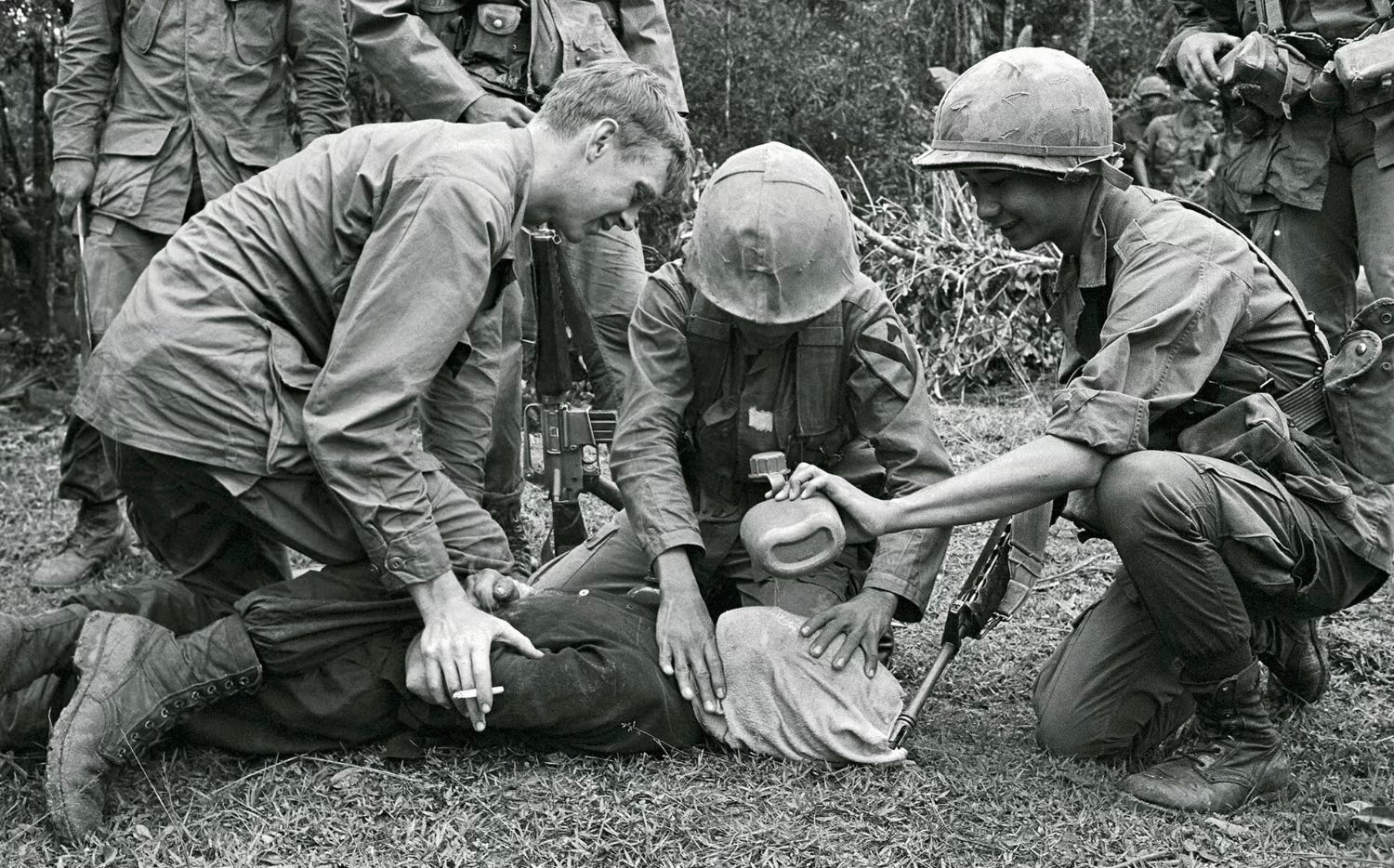
“They are going to find out the truth anyhow…. Go ahead and tell the truth, gentlemen. It can’t hurt us. You don’t know anything.”
— Marine Corps Major Walter R. Harris, Feb. 24, 1954, on instructions he received during the Korean War on how to respond to enemy interrogation
At the height of the scandal over American use of torture at both U.S. military and CIA sites holding prisoners from the Afghanistan and Iraq wars (both of which the U.S. started), it was revealed that a little known military program, SERE, was involved in the construction of the U.S. torture program. SERE stands for Survival, Evasion, Resistance, Escape.1 Ostensibly, SERE was meant to train U.S government personnel how to handle incarceration and interrogation or torture when held by captors who do not follow Geneva Convention rules for treatment of prisoners.
In July 2008, reporter Scott Shane at The New York Times wrote an article, China Inspired Interrogations at Guantánamo,” which helped spin the torture scandal in such a way that anger at the use of torture was misdirected from the actual torturers at CIA and the Department of Defense to “Chinese communists.” Shane cited “a 1957 Air Force study of Chinese Communist techniques used during the Korean War to obtain confessions, many of them false, from American prisoners.”
The only putative false confessions that ever made the news out of the Korean War were the written statements (accompanied sometimes by verbal broadcasts) from two dozen captured U.S. Air Force and Marine Corps officers that the U.S. had conducted biological warfare against both China and the Democratic People’s Republic of Korea (DPRK). I have researched those particular charges for a number of years now. In 2008 I wrote a refutation of Shane’s article,2 and some years later, after further research, I was able to present overwhelming evidence of the lie about tortured false confessions in the Korean War.
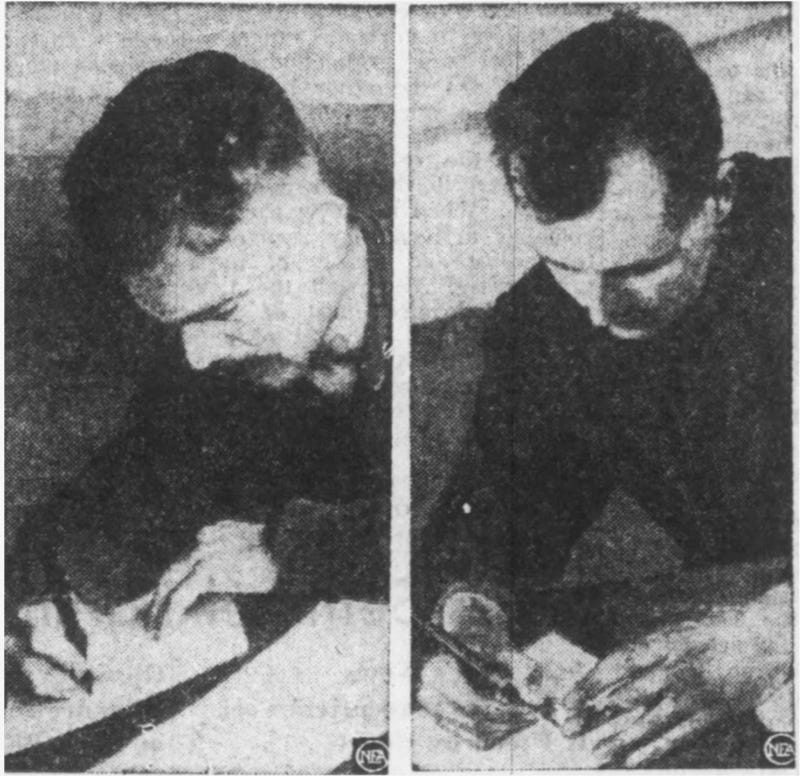
Sad to say, this evidence has been overwhelmingly ignored by U.S. journalists and historians. That’s because the old propaganda lie was and still is useful for the U.S. government, which relies upon a compliant academia and politically captured press to spread the false accusations about Chinese torture.
A campaign against exposing the truth of the U.S. use of biological weapons in the Korean War — a massive war crime by any standard — began almost as soon as the news about it was broadcast from both China and the DPRK in early 1952. There were denunciations by U.S. military leaders and politicians. There were incredulous op-eds from U.S. opinion makers about the Commies’ “same old malarky.”
But U.S. policy makers were frustrated. In the aftermath of ongoing revelations, especially the September 1952 report of an “International Scientific Committee” headed by famed British scientist Joseph Needham, U.S. efforts to counter the charges it used germ warfare were ineffective outside the United States itself. Therefore, after the Korean War armistice in July 1953, President Dwight Eisenhower’s high-level psychological warfare Operations Coordinating Board (OCB) implemented a secret, “specific program of U.S. action to destroy and counter-exploit the Soviet bacteriological warfare myth” about U.S. use of bacteria and viruses as a weapon.
The OCB, which had been formed in September 1953, consisted of the top number two men at both the State Department and the Department of Defense; the Director of the CIA, Allen Dulles; and the President's Special Assistant for Psychological Warfare, who as the time was Life Magazine publisher C.D. Jackson. (Years later, Jackson would broker the deal for Life to buy the famous Zapruder film of the JFK assassination, and then proceed to keep the film out of public circulation for years.) Under Secretary of State, Walter Bedell Smith, was the OCB’s first chairman. The CIA had tremendous influence on the OCB. Smith had only recently stepped down as CIA director himself. The group’s secret plan to address the biological warfare claims by the Communists was one of its first efforts.
Readers will notice in the screenshot of the document below, which outlined the OCB “basic plan” to counter the “myth” of U.S. bacteriological warfare, that the administration was already propagandizing its own government bureaucracy by declaring that the confessions of such use by U.S. prisoners of war were extracted “by physical and mental torture.” By the end of this article, I will demonstrate that this assertion was a total lie.
The aim of the program was “to discredit Soviet propaganda and undo and reverse any belief” in the biological warfare allegations — even though in the eighteen months prior to the issuance of this “basic plan,” Armed Forces cryptanalysts secretly had been listening in real time, and passing to the CIA, North Korean and Chinese military units’ communications about the extent of and necessary response to multiple biological weapons attacks by U.S. planes.
The OCB judged that to achieve the aims of the U.S. government both overt and covert actions were needed. The covert programs were placed under the control of the CIA. Operational plans were proposed to use “counter-propaganda and personalized seduction and coercion” to be “initiated as a matter of urgency against persons and groups where the Soviet [BW] campaign has been especially effective” (italics added for emphasis).
Since I have written on these subjects before, why bring up these matters again, as important or interesting as they may be? The reason is that there is another aspect to this story that has been ignored for decades. This part of the story links to the once secret alliance between U.S. biological warfare researchers and that section of Japan’s World War II military that itself conducted major germ warfare research and operations.
Later on in this article, I will reproduce an unjustly ignored Japanese document that describes how to conduct torture. It is taken from a 76-year-old book published in the early days of the Cold War. Titled Materials on the Trial of Former Servicemen of the Japanese Army Charged with Manufacturing and Employing Bacteriological Weapons (Foreign Languages Publishing House, Moscow, 1950), the book contains trial summaries and testimony, and related evidence, from the Soviet Union’s Khabarovsk war crimes trial in December 1949.
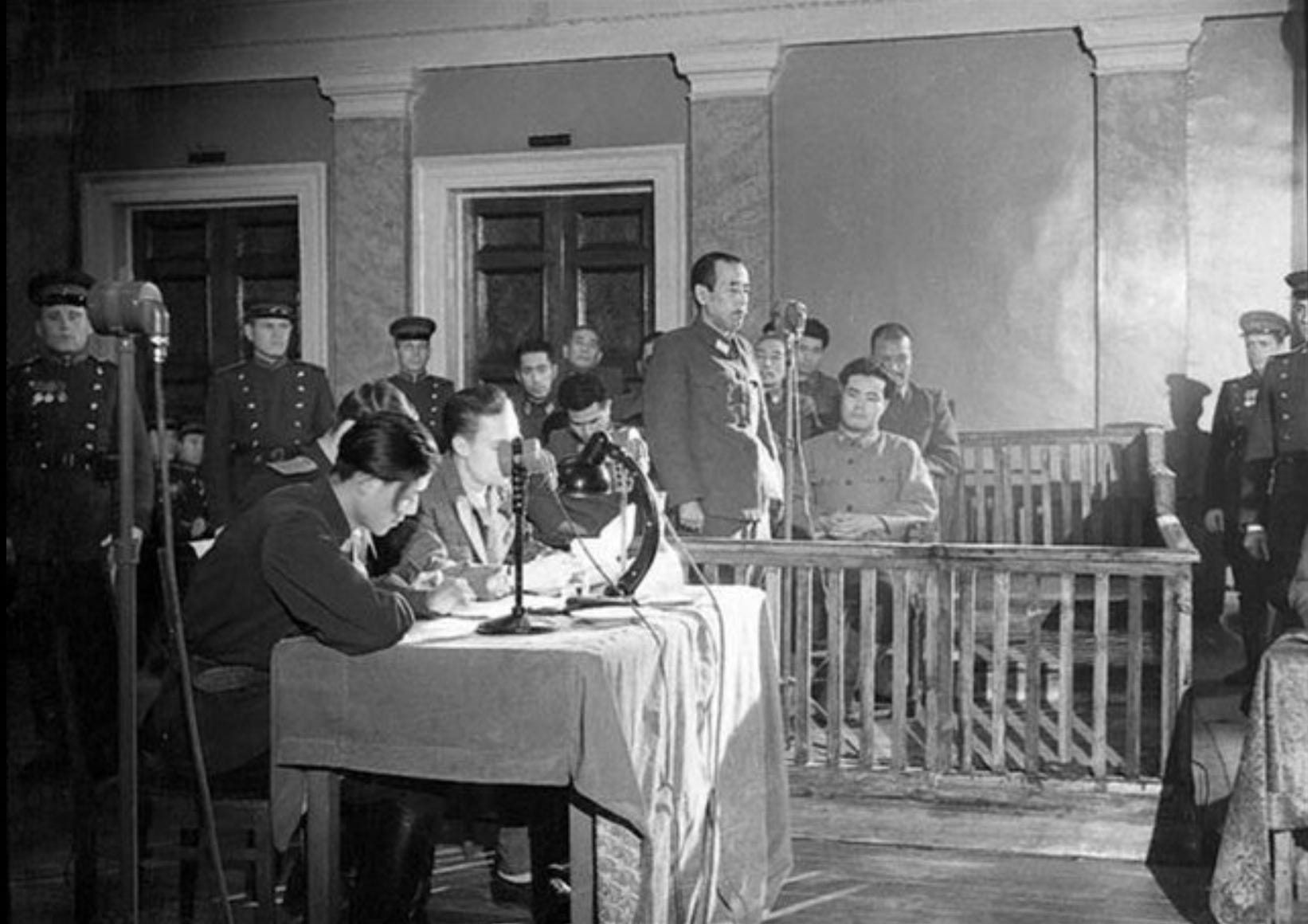
Derided as just another Stalinist show trial at the time, historians have since confirmed the evidence regarding the crimes prosecuted, including deadly biological experiments on prisoners by special units of the Japanese Imperial Army, the most famous of which was Shiro Ishii’s Unit 731.
According to Jenny Chan, Director at Pacific Atrocities Education:
The West often dismissed the Khabarovsk War Crimes Trial as “Communist Propaganda.”3 However, it was the first time scientists from the “Epidemic Prevention and Water Purification Department” of the Imperial Japanese Army (IJA) came forward with the crimes they committed during World War II. [Chan, Jenny. The Khabarovsk War Crimes Trial: Unearthing Biological Warfare in WWII (p. 23). (Function). Kindle Edition.]
Most of the personnel in Unit 731 and similar units serving in China and elsewhere escaped back to Japan at the end of the war, where, like anti-Soviet Nazi war criminals in Europe, many were hidden and protected by the U.S. Army Counter-Intelligence Corps, and later the CIA. But the Soviet advance into Manchuria in early August 1945 was so swift, some Japanese biological warfare officials, as well as officers of the Kwangtung Army to which they belonged, were captured before they could flee. After it became clear that the American-controlled Tokyo war crimes trial would not include the crime of waging biological warfare, the Soviets decided in 1949 to hold their own war crimes trial of certain officers of Unit 731, Unit 100, and the Kwangtung Army, whom they had captured.
In 1950, the Soviet Union published the transcripts, attorneys’ statements, and various documents from the trial in book format in a number of languages. The Materials book was out of print in English for decades, except via some few libraries and antiquarian bookstores. (I found my own copy on the Internet at AbeBooks.) But in recent years Google Books has made it available online free of charge.
In order to provide an idea of what the Khabarovsk trial was like, an example from the trial testimonies follows. The defendant answering questions in the selection below was Major General Kiyoshi Kawashima, the 56-year-old former chief of Unit 731’s production division, which assembled the various agents used for germ warfare. Kawashima detailed the production of plague-inoculated fleas (fed on the blood of plague-infected rats) and experiments on prisoners. (While these experiments themselves can be considered a form of torture, the torture document I will detail further on is directly linked to interrogations, not biological experiments.)
Question: ... with its available equipment, the [731] detachment could produce 45 kilograms of fleas in one production cycle?
Answer: Yes, that’s true.
Question: What was intended to be done with these fleas in the event of bacteriological warfare?
Answer: They were to be infected with plague.
Question: And employed as a bacteriological weapon?
Answer: Yes, that is so.
Question: In what manner were the plague fleas to be used as a bacteriological weapon?
Answer: In my time, it was considered that the most effective method was to drop the fleas from aeroplanes.
Question: Were fleas dropped from aeroplanes by the [Japanese] expedition to China?
Answer: They were.
Question: Fleas infected with plague?
Answer: Yes. The bacteriological attack in China with the help of plague fleas was to cause a plague epidemic....
Question: Will you tell us what you know about the experiments performed by the 1st Division on living people?
Answer: The prisoners kept in Detachment 731’s inner prison were used for various researches in preparation for bacteriological warfare. The object of the researches was: to increase the toxic effect of the lethal germs of various infectious diseases, and to study methods of employing these germs on human beings.,..
Question: After a person had been infected with a particular germ, was he given medical treatment in the detachment’s prison, or not?
Answer: He was.
Question: And after he recovered, what happened to him?
Answer: As a rule, after he was cured he was used for other experiments.
Question: And this went on until the person died?
Answer: Yes.
Question: And every person who got into Detachment 731’s prison was bound to die?
Answer: Yes. I know that in all the period the prison existed, not a single prisoner emerged from it alive. [pgs. 256-257, material in brackets added]
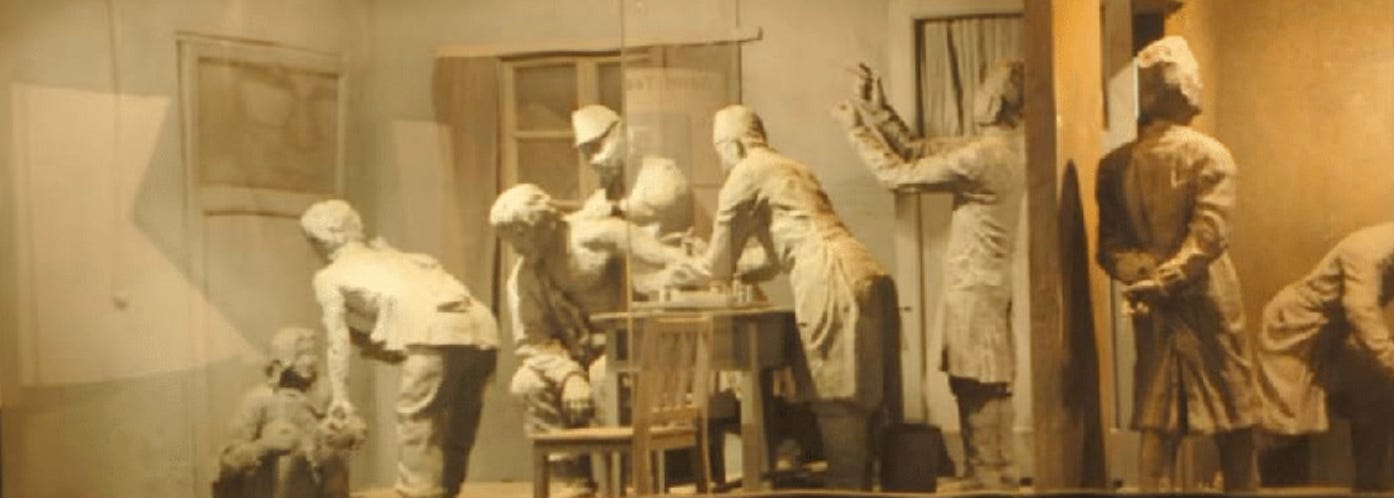
Today, we know that thousands of prisoners sent to Unit 731 had been subjected to biological experiments, and then murdered and disposed of in crematoria. The results of the experiments were operationalized in biological warfare campaigns by the Japanese in China which killed, recent estimates claim, approximately half a million people.
Why, one may ask, hasn’t this material been reported more widely? Why do most history books either ignore it, or only barely mention it? The reasons for such a lack of historical writing is not lack of interest, but because after the war what materials the Japanese did not destroy were kept classified by the Americans for decades as part of an amnesty deal made with the leaders of the Japanese biological warfare program. The deal included a transfer of data on the fatal human experiments to the U.S. Army and intelligence services. Both the Department of Defense and the State Department, and likely (by 1947) the CIA, were involved in the decision to give amnesty to the Unit 731 criminals.
For more information on the deal made between the U.S. and the Japanese as described here see John W. Powell, “Japan's germ warfare: The U.S. cover-up of a war crime,” Bulletin of Concerned Asian Scholars, Volume 12 (4), 1980; Peter Williams and David Wallace, Unit 731: The Japanese Army Secret of Secrets, 1989, Hodder and Stoughton, London; Sheldon H. Harris, Factories of Death: Japanese Biological Warfare, 1932-1945, and the American Cover-up, rev. ed. 2002, Routledge, New York; Daniel Barenblatt, A Plague Upon Humanity: the Secret Genocide of Axis Japan’s Germ Warfare, 2004, Harper, New York; and Derek Pua, Danielle Dybbro, and Alistair Rogers, Unit 731: The Forgotten Asian Auschwitz, 2nd Ed., 2019, Pacific Atrocities Education.
While the testimony on biological warfare was the primary purpose of both the Khabarovsk trial and the publication of its transcripts and evidence, there were other crimes covered by the Soviet prosecutors. The section on Japan’s use of torture, reproduced below, appeared in a section of the Materials book labeled “Documentary Evidence.”
The reader will notice in the section from the “documentary evidence” quoted below that the Japanese Army demonstrated many of the same techniques and concerns the U.S. showed when it was implementing its own torture program under the CIA and the Department of Defense in the early 2000s.
The Japanese torture program included, as described in Materials, use of stress positions, physical attacks, confinement in squeezed quarters, and a form of waterboarding. The interrogators were instructed to be aware of possible false information provided by prisoners in order to get “relief from suffering.” While Japan’s military was concerned about the truthfulness of information obtained from torture, and the possibility of deception by prisoners, even so, it considered torture an essential part of its interrogation regimen.
The Japanese military was also worried about others discovering their use of torture. Japan’s use of torture had already been publicized in the West. Japanese military authorities warned “measures must be taken” so that prisoners did not talk about the torture “afterwards.” Given that at the end of World War II, Japan’s military division in charge of biological warfare, Unit 731, murdered the prisoners they held as experimental “maruta,”4 it is not outrageous to think that tortured prisoners were often murdered to render them permanently silent as witnesses of Japan’s use of torture.
The material on torture from the Khabarovsk trial materials is consistent with that published in a report by the Supreme Commander of Allied Powers (SCAP) on “Japanese Methods of Prisoner of War Interrogation” (June 1, 1946). Techniques described there included: beatings of various sorts (derided, though, as “the most clumsy method”); threats of “murder, torture, starving, deprivation of sleep, solitary confinement, etc.” (pg. 3); psychological threats; water torture, which sometimes resulted in fatalities; attaching a prisoner’s thumbs to a “motor car which proceeds to pull him around in a circle until he falls exhausted” (pg. 4) and other forms of torture. After the war, some Japanese soldiers and officers were prosecuted for war crimes for such inhumane and criminal conduct.
The Khabarovsk document reprinted below, an “Operation Officer’s Guide,” appears on pages 235-237 of Materials. The Soviet trial materials did not include the entire torture guide, but what they did include is damning enough. I have tried my best to reproduce the text as it is in the book. What is italic or bold here is italic or bold in the book. Extra spacing between letters resembles that in the printed material. Case has been preserved. Paragraph breaks are by extra lines, while in the book they are by indent.
File No. 48. Pages 90, 112, 113, 124, 125, 126. “Operation Officer’s Guide (Part I).” From the files of the Mutankiang J.M.M.
Translated from the Japanese
S t r i c t l y C o n f i d e n t i a l
Seal: “MUTANKIANG J. M. M.
Received June 14, 1945
Inc. No. 9”Page 90
MILITARY INVESTIGATION DIVISION
OF GENERAL HEADQUARTERSCopied by Unit
No. 471-MANSHUSECRET WAR SERVICE GUIDE
Page 112
I n c l o s u re
Fundamental Rules for Interrogating War Prisoners
Page 113
G e n e r a l R u l e s
1. The present rules relate to cases of interrogation with the view to obtaining information, but do not relate to the interrogation of criminals.
2. Persons who have surrendered, deserters, captured enemy spies, those who illegally cross the frontier, crews of aircraft compelled to make a forced landing or of vessels compelled to come to our shores, escaped war prisoners who had formerly served in our army, the inhabitants of districts we have newly occupied, and also civilian refugees from the sphere of enemy influence, except on special matters, are interrogated in conformity with the methods of investigating and interrogating war prisoners.
Page 124
62. Sometimes, depending on circumstances, it is advantageous to resort to torture, but often this may lead to harmful consequences, and therefore, before resorting to it, it is necessary to carefully consider whether this should be done or not. Furthermore, torture must be applied in such a way as not to lead to bad consequences for us.
Page 125
63. Torture, the infliction of physical suffering, must be sustained and continued in such a way that there shall be no other way of relief from suffering except by giving truthful information.
Torture is advantageous because of the speed with which it is possible with relative ease to compel persons of weak will to give truthful testimony, but there is the danger that, in order to relieve himself from suffering, or in order to please the interrogator, the person interrogated will, on the contrary, distort the truth.
In the case of persons of strong will, torture may strengthen their will to resist and leave ill-feeling against the empire after the interrogation.
64. In relation to persons of weak will, torture is usually applied in those cases when the person interrogated does not speak the truth in the face of evidence, but there is full reason to suppose that this person will speak frankly if torture is applied.
65. It is necessary to bear in mind that the methods of torture must be such as can be easily applied, as will sustain suffering without rousing feelings of pity, and as will not leave either wounds or scars. However, in those cases when it is necessary to create apprehension of death, the harm caused the person interrogated can be ignored, but this must be done in such a way as not to make it impossible to continue the interrogation.
The following examples of torture may be given:
1. Compelling the person to sit up straight and motionless.
2. Putting pencils between the fingers not far from their bases and tying the tops of the fingers with string and moving them.
3. Putting the person interrogated on his back (it is advisable to raise the feet a little) and dripping water into the nose and mouth simultaneously.
4. Putting the interrogated person on his side and stamping on his ankle.
5. Compelling the interrogated person to stand under a shelf that is too low to enable him to stand straight.
66. In a case when a wound is accidentally inflicted on the person interrogated, it is necessary, taking into account the general situation and the interests of our country, to take resolute measures, taking full responsibility for same.
67. On receiving testimony as a result of applying torture, it must be ascertained whether this testimony is the result of a desire to avoid further suffering and to please the interrogator; in such cases, some corroboration of the truth of the testimony is necessary.
Page 126
68. After the application of torture, it is necessary to convince the person who had undergone torture that the torture applied to him was quite a natural measure, or to take such measures as will induce him out of a sense of pride, sense of honor, etc, not to speak of it afterwards. In the case of persons from whom this cannot be expected, measures must be taken as in the case of those upon whom accidental wounds have been inflicted.
69. Nobody must know about the application of torture except the persons concerned with this. Under no circumstances must other prisoners know about it. It is very important to take measures to prevent shrieks from being heard.*5
Translated by Senior Interpreter, Master of Historical Sciences
Signed: (PODPALOVA)*The rest is omitted. – Trans.
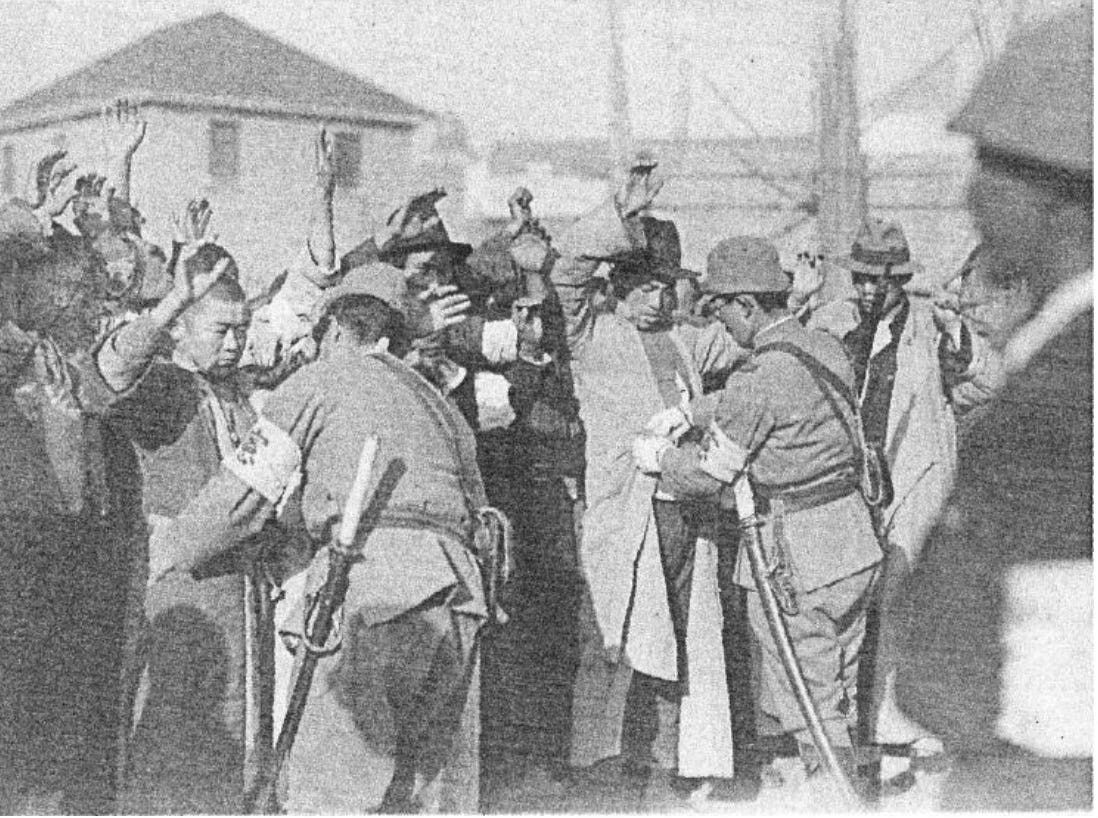
Despite a number of government investigations, we really don't know the entire story behind the U.S. use of torture after 9/11. We know that both the CIA and the Department of Defense decided to use various previously proscribed interrogation methods which came to be euphemistically called “enhanced interrogation techniques.” They were described in a series of Office of Legal Counsel and Department of Defense (DoD) memoranda, and in certain declassified CIA documents.
One of the DoD documents from Guantanamo is reproduced in part below:
The December 10, 2002 “‘SERE’ INTERROGATION STANDARD OPERATING PROCEDURE” guidelines for use on detainees describes the kinds of toture techniques used at the U.S. illegal torture prison at Guantanamo. The techniques enumerated in that document have similarities to Imperial Japan’s methods, which the 1946 MacArthur SCAP document shows were examined by U.S. forces after the war.
The SERE Interrogation SOP included calculated physical abuse — so-called “Degradation Tactics,” such as the “Shoulder Slap” and “Stomach Slap,” and “insult slaps” meant “to shock and intimidate the detainee” (pg. 4). Other techniques included forcefully stripping the detainee; use of stress positions; hooding; and manhandling of the prisoners.6
The Japanese technique of “Compelling [an] interrogated person to stand under a shelf that is too low to enable him to stand straight,” also seems similar to the CIA’s own version of imprisoning a detainee in “cramped confinement” (see reproduction on CIA “enhanced interrogation techniques” below). Similarly, the CIA’s use of the waterboard technique is very similar to that described in the Japanese manual.7
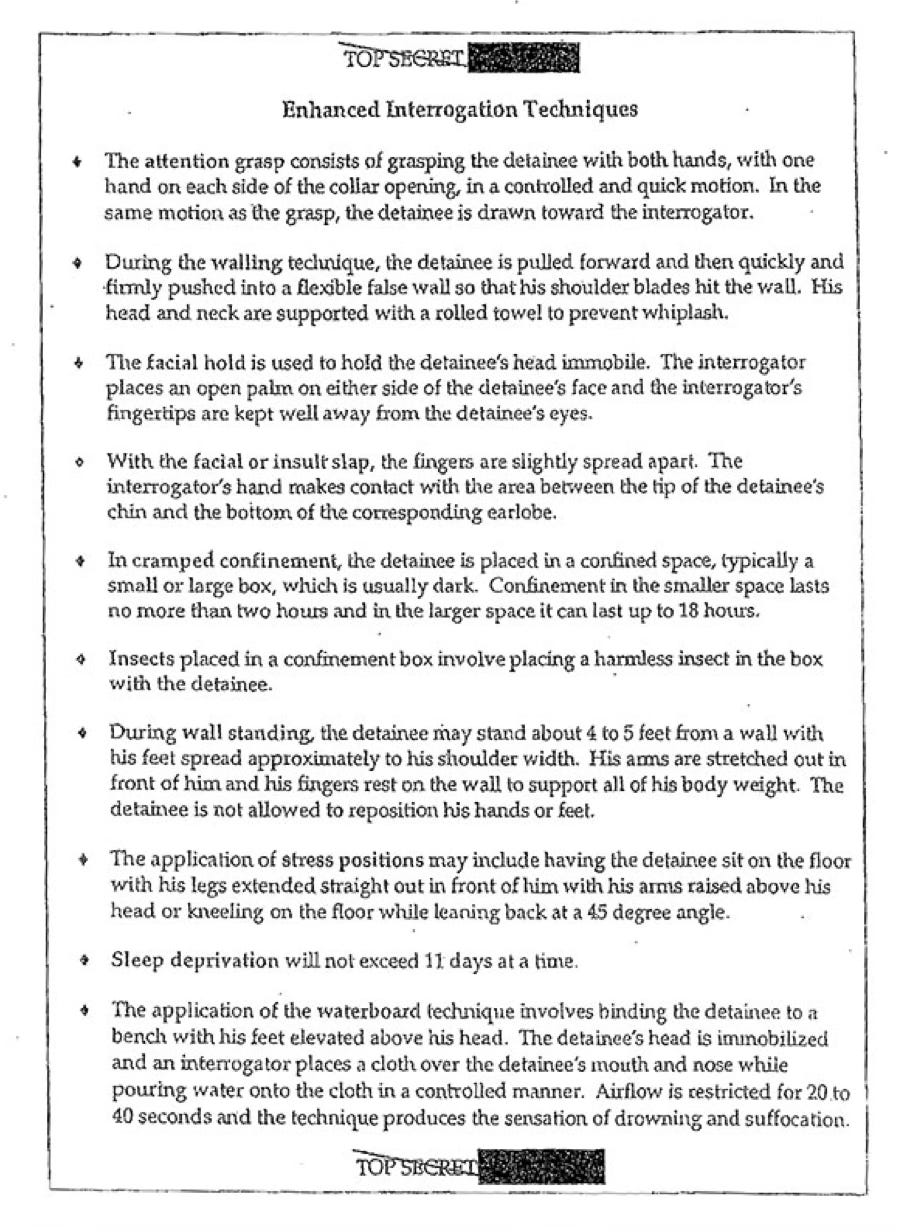
Readers may notice that waterboarding or water torture was missing, however, in the list of techniques in the Department of Defense/SERE version of the torture techniques. But this exception was only conditional, at least initially.8 Waterboarding had been discontinued at the Army and Air Force SERE schools, as well as at survival school trainings run by the Pentagon’s Joint Personnel Recovery Agency (JPRA) before September 2001. Only the Navy SERE school continued its use. This led to a good deal of internal DoD controversy after the U.S. torture scandal exploded because of the Abu Ghraib scandal. As I discussed in a March 2010 article at Truthout:
… there was fierce criticism within the DoD of the Navy SERE school in North Island, San Diego, for being the only SERE facility to still use waterboarding in its training program.
[A] memo, obtained by Truthout, stated that the use of waterboarding left students “psychologically defeated” and impaired in the ability to develop “psychological hardiness.”
Such impairment resulting from waterboarding was really a form of post-traumatic stress disorder, or, “learned helplessness.” Yet waterboarding, the instructions for which were meticulously laid out by the CIA in internal documents, was not the only form of water torture used by the U.S. government. In a two-part series of articles I wrote for Truthout in August 2011, I documented how the U.S. military used a variety of techniques based on forcing water into the nose and mouth, as the Japanese had directed.
One example here will suffice to display the full barbarity of the U.S. torture program. Readers can decide for themselves how much the water torture described below may have been based on the Japanese model. As for “Communist” countries, I have yet to see any description of water torture or waterboarding used by any “Communist” country.
The testimony below comes from a 2008 legal filing by the Center for Constitutional Rights in the case of Djamel Ameziane, an Algerian Berber who was held at Guantanamo for over eight years, despite the fact he never received military or terrorist training, nor even fought against the U.S.:
In another violent incident, guards entered his cell and forced him to the floor, kneeing him in the back and ribs and slamming his head against the floor, turning it left and right. The bashing dislocated Mr. Ameziane’s jaw, from which he still suffers. In the same episode, guards sprayed cayenne pepper all over his body and then hosed him down with water to accentuate the effect of the pepper spray and make his skin burn. They then held his head back and placed a water hose between his nose and mouth, running it for several minutes over his face and suffocating him, an operation they repeated several times. Mr. Ameziane writes, “I had the impression that my head was sinking in water. I still have psychological injuries, up to this day. Simply thinking of it gives me the chills.” [Emphasis added.]
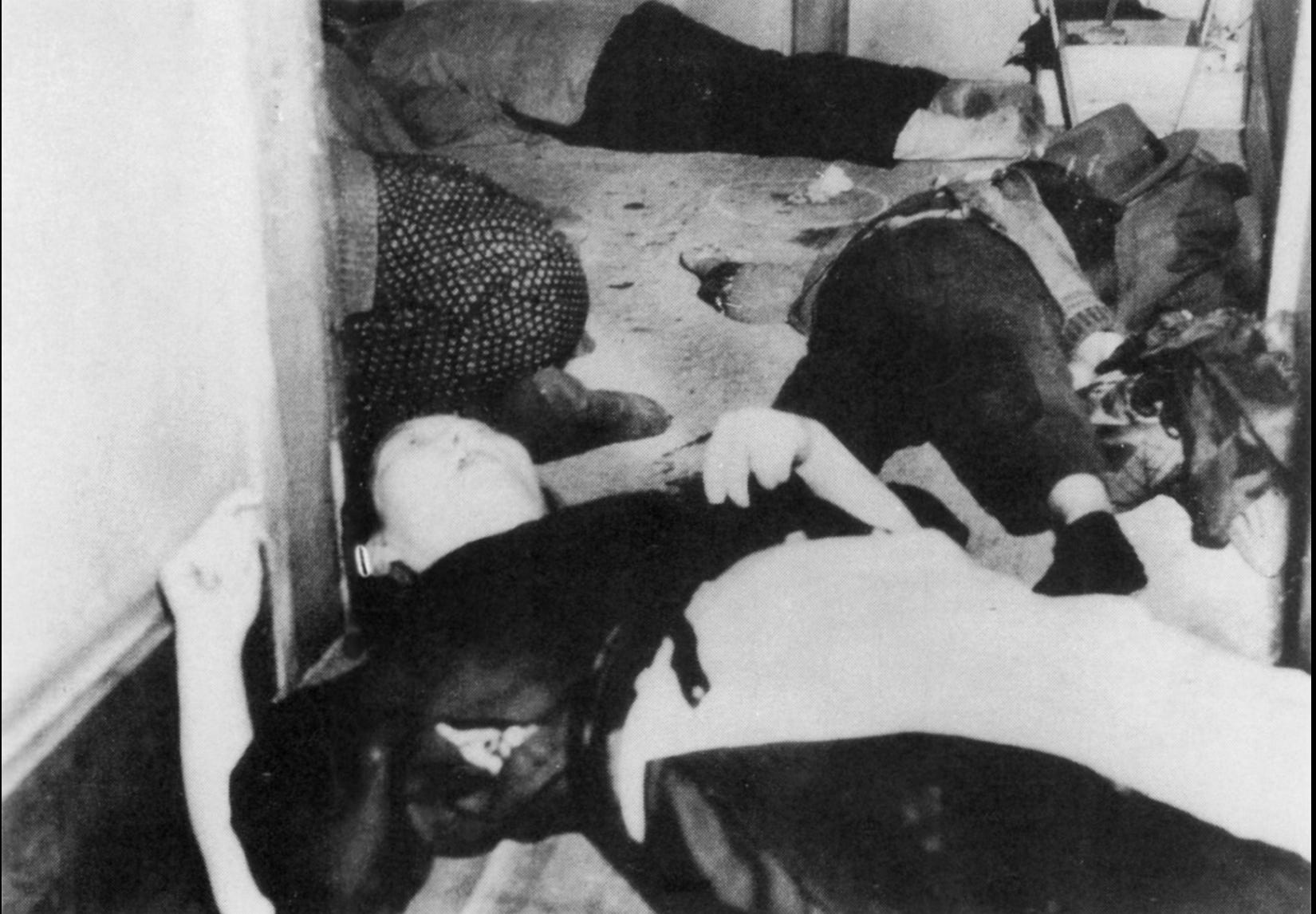
The Khabarovsk trial material included information about crimes that were not related to experiments on or use of biological weapons by Units 731 and affiliated biowarfare units. The Soviet prosecutors also brought up experiments done on freezing, blood transfusions, etc., that were the equivalent of any monstrous form of experiment conducted by the Nazis.
One particular experiment seemed particularly egregious, until you realize that it was probably meant to both examine the use of particular poisonous agents, as well as forms of psychological manipulation that could be utilized to trick people into killing themselves. The entire episode related below brings up visions of Jonestown, as well as a crime well-known in Japan, the January 1948 Teigin Incident.
The Teigin Incident was a bizarre bank robbery that occurred in the early years of the U.S. occupation of Japan after the end of World War II. The scene of the crime was a Tokyo suburb still reeling from the effects of intense U.S. firebombing. A Japanese man entered the Imperial Bank (Teikoku Ginko) at closing time disguised as a health official working with the Americans. He claimed that he had information that the bank’s employees had been exposed to dysentery bacteria. He also explained they did not need to worry. He had brought an antidote for the employees to drink under his strict instructions. The employees lined up to get the cure, only to soon discover to their horror they had been poisoned. Twelve of the bank’s workers died in the ensuing minutes. Four workers survived.
The man who administered the poison, and stole money afterwards from the bank, was never found. It was assumed by Tokyo police at the time that he was affiliated with Shiro Ishii’s Unit 731. It is said that U.S. occupation officials kept Japanese police from investigating further. Instead, an innocent Japanese artist, Sadamichi Hirasawa was tortured into confessing the crime. Despite his recantation, he was convicted. He spent decades on death row, where he died in 1987. The Japanese government never could bring itself to execute him.
As you read the selection below, taken from the Khabarovsk testimony of Kasuo Mitomo, consider how similar it seems to the scenario that unfolded one winter’s day in an unsuspecting Japanese bank. The Teigin Bank crime is considered unsolved. Perhaps following up Mitomo’s testimony years later can help solve it.
The man murdered with potassium cyanide was a Russian prisoner who, Mitomo testified (pg. 21), had been experimented upon for two weeks in August 1944. “His constitution having broken down,” a decision was made to kill him with a cyanide injection. He was not the only prisoner killed because his experimental use had expired. Mitomo mentioned two other Russian officers he witnessed shot “because no more experiments could be performed on them in view of their exhausted state and unsuitability for further experimentation.”
Like the prisoner injected with cyanide, their bodies were unceremoniously dumped into a pit for dead cows.
One unexpected finding as I reviewed the relevant documents for this article was the U.S. assessment that the Japanese Army’s torture was more often used on captured airmen than on ordinary soldiers. The reasons for this are not too difficult to understand, as Japan was subjected to some of the most brutal and murderous air bombing campaigns ever undertaken.
From the report on Japanese Interrogation methods put out by the Allied Translator and Interpreter Section of the Supreme Commander for the Allied Powers:
Interrogation techniques proceeded from the gentle to the cruel, with the distinct condonment of torture and with a tendency towards greater harshness in treatment of airmen….
Cruel treatment of PsW [prisoners of war] of all branches of our service has been thoroughly proven in our War Criminal Trials. However, there is some indication that harsh and brutal treatment during interrogation, often ending with decapitation, was applied more to air than to ground troops. Our air forces initially turned the tide and assisted all of our operations by gaining air superiority and contributed greatly toward obtaining Naval superiority; both of which were so essential to the success of our amphibious operations. Perhaps the brutal treatment of captured air men is at least partially explained by Japanese realization of this and a desperate desire to obtain all possible information with which to combat it: Evidence indicates that such treatment commenced in the early Southwest Pacific Campaigns— [pg. 10, material in brackets added]
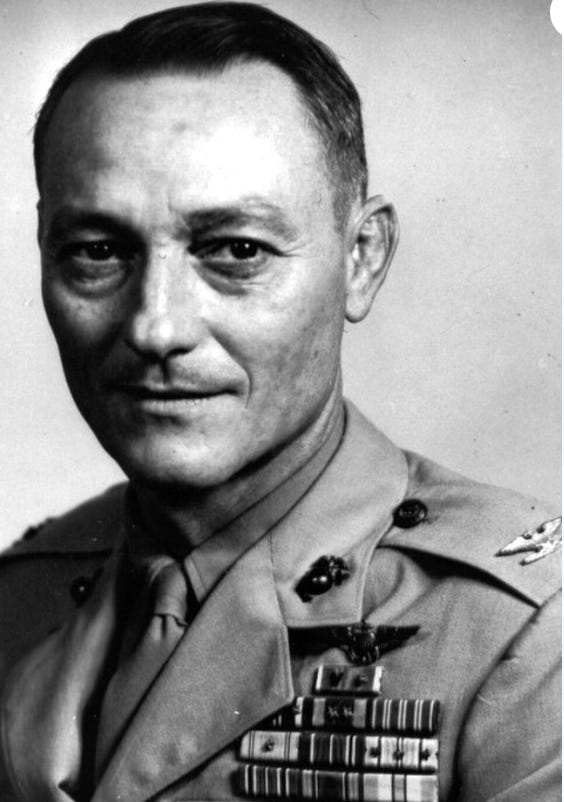
The military’s experience with Japanese torture of U.S. airmen may have led to the Pentagon’s decision to instruct U.S. airmen involved in the biological weapons attacks on North Korea and China during to the Korean War to tell their captors whatever they wished to know. The apparent aim of this instruction was to spare captured airmen from feared torture by their Communist captors.
This startling instruction, which was openly discussed by the press during the 1954 Court of Inquiry for Marine Corps Colonel Frank Schwable, was subsequently suppressed in all accounts of the war that followed. I don’t believe any other author writing after the mid-1950s has ever mentioned this fact. I rediscovered this controversial instruction in the course of researching the true circumstances surrounding U.S. use of biological weapons during the Korean War.
The record shows that U.S. prisoners confessed to germ warfare without the use of torture, “brainwashing,” or any special interrogation techniques by their Chinese or North Korean captors. This fact alone disproves the assertions that these confessions were coerced, and that SERE training — and U.S. “enhanced interrogation” torture — was subsequently based on Chinese Communist torture methods.
Some of this article is based on a work I published in August 2013, when I wrote under the pseudonym “Valtin.”. I have updated that text (including fixing broken links), and greatly expanded it for Substack.
The main hearings on this were by the Senate Armed Services Committee, which wrote in the executive summary of its 2008 report: “In December 2001, more than a month before the President signed his memorandum, the Department of Defense (DoD) General Counsel’s Office had already solicited information on detainee ‘exploitation’ from the Joint Personnel Recovery Agency (JPRA), an agency whose expertise was in training American personnel to withstand interrogation techniques considered illegal under the Geneva Conventions. JPRA is the DoD agency that oversees military Survival Evasion Resistance and Escape (SERE) training.” (pg. xiii).
The committee, headed by Democratic Senator Carl Levin, continued the long-time U.S. propaganda slander about Chinese torture supposedly used to force false confessions: “The techniques used in SERE school, based, in part, on Chinese Communist techniques used during the Korean war to elicit false confessions, include stripping students of their clothing, placing them in stress positions, putting hoods over their heads, disrupting their sleep, treating them like animals, subjecting them to loud music and flashing lights, and exposing them to extreme temperatures. It can also include face and body slaps and until recently, for some who attended the Navy’s SERE school, it included waterboarding” (Ibid.).
When I wrote my article debunking The NYT piece back in 2008, there was still much I had to learn about the U.S. war in Korea, and the powerful propaganda the U.S. used for decades to hide its crimes. My 2008 article, for instance, still presumes that some portion of what Scott Shane and the U.S. government maintained about Chinese use of coercive interrogation was true. Today, I know better, but I ask that the reader here go through the entire article you are reading right now to understand how my position regarding this issue changed over the years.
For those curious to see the 1957 Air Force study to which Shane referred, here’s a link to it. In addition, for those wanting more definitive information about how the U.S. POW germ war confessions can be corroborated from existing U.S. documents, see my April 9, 2021 article at Counterpunch, New Revelations on Germ Warfare: It’s Time for a Reckoning with Our History from the Korean War.”
J.B. Nie, J. Bioethical Inquiry (2004) 1: 32. https://doi.org/10.1007/BF02448905 [Footnote copied from original text. Chan, Jenny. The Khabarovsk War Crimes Trial: Unearthing Biological Warfare in WWII (p. 28). (Function). Kindle Edition.
In his essay, “The West’s Dismissal of the Khabarovsk Trial as ‘Communist Propaganda,” Nie wrote (pgs. 38, 39):
On both sides of the Atlantic, the message emanating from diplomatic circles was straightforward: ‘The whole Khabarovsk trial should be seen as a confidence trick’.(1 : 228) In the UK, a ‘tiny paragraph’ appeared in a couple of national newspapers, in addition to three columns in the Communist Daily Worker which charged the US with ‘jumping to the defence of the 12 high Japanese officers who had admitted the most atrocious war crimes ... including tying victims to iron posts ... while bombs containing disease gems were exploded near them’.(1 : 228) Not only was there even less media coverage in the United States, but US government official Joseph Keenan, the chief prosecutor at the Tokyo trial, was repeatedly cited in Japanese newspapers as stating that ‘the Japanese had not planned to use bacteriological warfare in the last war’.(1: 227) And a MacArthur spokesman declared that while Japan had conducted research with animals, ‘there was no evidence they ever had used human beings’.(2: 228)….
In fact, the evidence suggests that few people in the West, including journalists and professional historians, paid any serious attention to the trial and its published proceedings until the 1980s.
Reference 1 in the quote above, with citations of page numbers, is to Williams and Wallace, Unit 731: The Japanese Army’s Secret of Secrets. London: Hodder & Stoughton, 1989. Reference 2 is to Sheldon Harris, Factories of Death: Japanese Biological Warfare, 1932-1945 and the American Cover-up. 2nd ed. New York: Routledge, 2002 (1994). Hence “(1: 228)” is a reference to Williams and Wallace’s book, Unit 732, page 228.
In an example of both dehumanization of the enemy, as well as a practical application of security measures, prisoners of Unit 731 were referred to as “maruta,” or “wooden logs.”
Why did the Japanese torture manual say it was “ very important to take measures to prevent shrieks from being heard”? This was likely a response to the propaganda bonanza that followed from the January 1944 revelations from testimony by then-recently released prisoner John B. Powell. Powell has been the editor of the English-language paper, China Weekly Review, when he was captured and tortured by the Japanese.
Powell’s story was written up by his assistant, Frances Long, who also had been imprisoned and released by the Japanese. In the nationally syndicated article, Long described how Powell heard the terrible torture of six U.S. flyers held in an adjacent cell. These were six “aviators captured after the Doolittle raid.” Powell said, ‘They were tortured unmercifully.’”
I believe Japan’s prestige was hurt by the torture revelations, and they sought afterwards in their torture instructions given in June 1945, as reproduced above, to keep their torture sessions as secretive as possible in an effort to prevent unnecessary press exposure. There is textual evidence for this concern, as the “Guide” notes, “torture must be applied in such a way as not to lead to bad consequences for us.”
Powell’s son, John W. Powell, was able to extract some revenge upon his father’s torturers when in 1980 he exposed to an English-speaking audience both Japan’s secret use of biological weapons, and its equally secret pact with the U.S. to turn over the substance of its expertise to Army germ warfare specialists at Fort Detrick after the war.
My thanks to Jenny Chan at Pacific Atrocities Education for bringing the Frances Long article to my attention.
To provide a flavor of the SERE interrogation SOP, one of the stress position techniques was labelled “Worship-the-Gods”: “The detainee is placed on knees with head and torso arched back, with arms either folded across the chest or extended to the side or front.” As a matter of minimal humanity, the Department of Defense cautioned, “The detainee will not be placed in a position facing the sun or floodlights.”
Some astute readers might object that the U.S. used waterboarding, aka “the water cure,” during its vicious colonial war in the Philippines (1899-1902), and that U.S. use of the same after 9/11, and earlier during the Vietnam War, traces back to the Philippines experience. It’s a reasonable objection. But I would argue that the use of the waterboard was condemned even back then, and its use did not reenter the culture of the U.S. military until its wars in Southeast Asia in the 1960s-1970s. Not only did the U.S. document Japanese use of water torture during World War II, as I note in this article, they also prosecuted some Japanese Imperial Army officers for doing so. The main U.S. experience with waterboarding after its war against the Philippines was when the torturers became the torture victims during World War II. In my opinion, the institutional memory of waterboarding, which was transferred to the military survival schools in the 1950s, and later to SERE, came from the World War II experience with Japan’s torture regime.
… waterboarding was one of a number of “counter-resistance techniques” requested for use at Guantanamo by Maj. Gen. Mike Dunleavy, commander of Task Force 170. In an October 2002 memo from Dunleavy’s intelligence chief requesting use of a number of techniques, including sensory deprivation, isolation, stress positions, forced nudity and death threats, there was also a proposal for “Use of a wet towel and dripping water to induce the misperception of suffocation.”
In a follow-up memo approving most, but not all of the requested techniques, Department of Defense (DoD) general counsel William J. Haynes II said of the “wet towel” and other so-called “aggressive” “Category III” techniques, “While all Category III techniques may be legally available, we believe that, as a matter of policy, a blanket approval of Category III techniques is not warranted at this time.” (Emphasis added.)
Jeff Kaye, “Despite New Denials by Rumsfeld, Evidence Shows US Military Used Waterboarding-Style Torture,” Truthout, August 2, 2011.
Comments
Nothing yet. Say the first thing.
Sign in to join the conversation.