
I've just wrapped up a semester of teaching Wharton MBAs about decision making, and every year in my final lecture, I spend a little time on the science of happiness. Because really, what's the point of making good decisions if not to produce happiness? I suspect you might appreciate a few science-based tips on this topic, too, so I dug back into the Choiceology archive to pull a conversation with UCLA Professor Cassie Holmes, whose research shows that focusing more on time and less on money is a surprisingly powerful path to a happier life. I hope you'll enjoy it!
The Importance of Ignoring Sunk Costs: A new episode of Choiceology featuring economics Nobel Laureate Richard Thaler on the sunk cost fallacy, or our tendency to let irrecoverable costs drive decisions instead of focusing on what lies ahead, and how to avoid it.
7 Secrets to Maximize Your Wealth: This article from Kiplinger’s offers advice on how to avoid biases that put your financial wellbeing at risk, featuring a tip from me.
Wait…Where Did My Retirement Money Go?: I joined This Is Uncomfortable from Marketplace to talk about why we find it so hard to motivate ourselves to do financial “chores” like tracking down retirement accounts from old jobs.
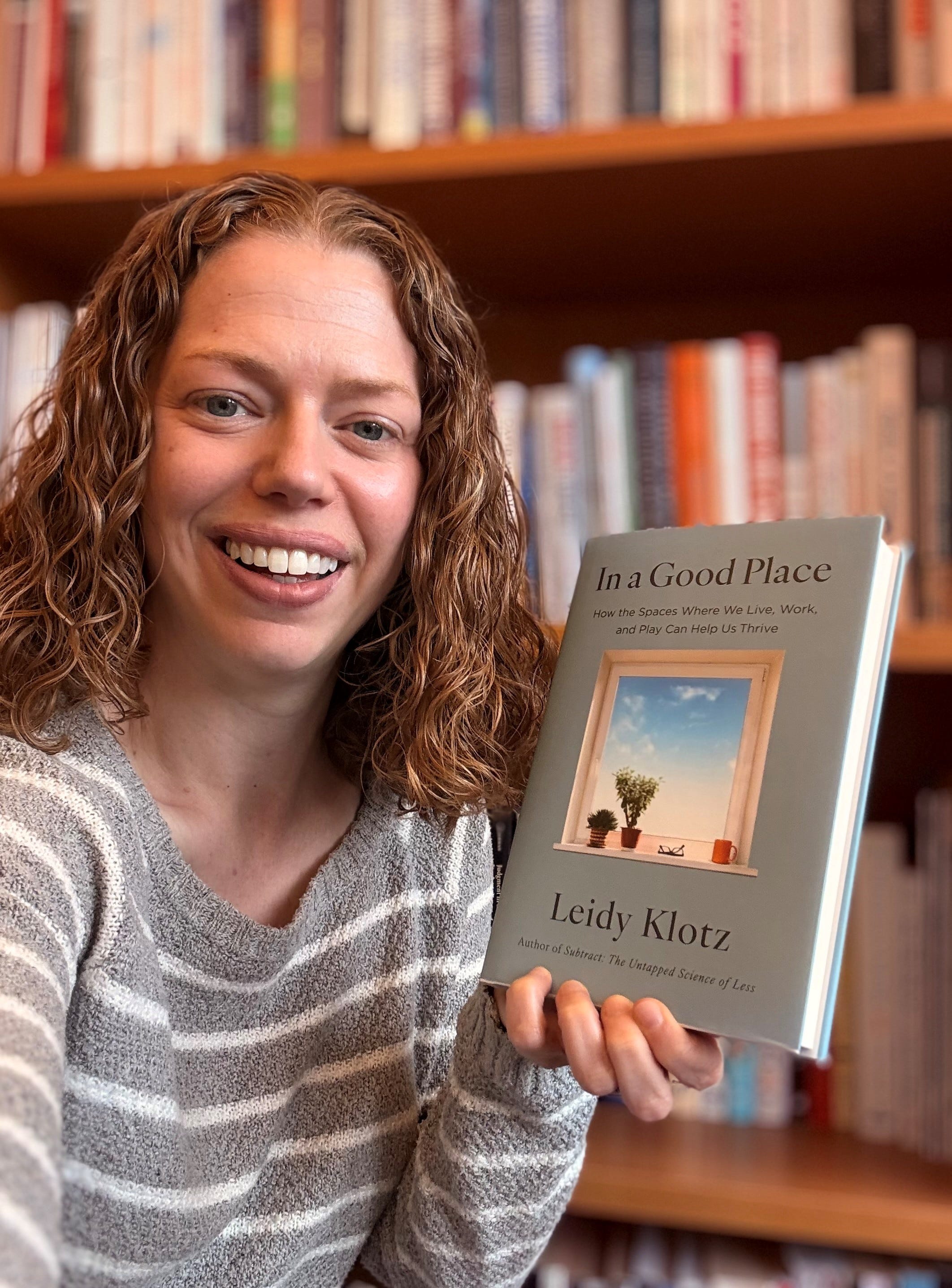
In A Good Place: How the Spaces Where We Live, Work, and Play Can Help Us Thrive is just out from UVA Design Professor Leidy Klotz (bestselling author of Subtract) and I can’t wait to read it!
This month’s Q&A from Choiceology is with UCLA Marketing Professor and bestselling author Cassie Holmes, who shares insights from her research on happiness and how to live a more fulfilling life.
Me: Could you describe your favorite empirical study that compares people’s happiness levels when they focus on time versus money?
Cassie: There are actually two studies that I love to show this point, and when you put them together, they make the point really well. When we ask people: Which do you want more of – more time or more money? – and we measure their happiness and satisfaction in life, you see a correlation between preferring time over money and happiness, controlling for demographic factors.
Me: So, the more I care about time, the more I am a happy person, even when you take everything else about me out of the equation basically.
Cassie: Yeah, but the question is what’s the effect there? Is it that happier people that want more time, or is it that drawing people’s attention to time versus money could also influence people’s happiness? And to look at that, we went to an environment where people both socially connect as well as spend time working: at a cafe. And what we did was as people were entering the cafe, we presented them with a survey, and asked them if they wouldn’t mind filling it out.
Me: I love this study. Am I remembering correctly that you randomly assigned some people to see a survey that drew their attention to money, some to see a survey that drew their attention to time, and others to see a survey that didn’t draw their attention to either time or money? Is that right?
Cassie: Yes. And I had a research assistant observing how people spent their time at the cafe – to what extent did they spend their time chatting with others or socially connecting, whether in line with the barista or with friends? And how much of their time at the cafe did they spend doing work on their laptop?
And what we found was that those led to think about time spent a greater proportion of their time at the cafe socially connecting than those who were led to think about money and those in the control condition. Then when they were leaving, we asked them to fill out another survey to tell us how happy they were feeling, how satisfied they felt with their experience at the cafe that day. Those who were led to think about time going in left happier because of that social connection.
Me: Those studies are so interesting, Cassie. I’m wondering if you could explain why you find these patterns of behavior?
Cassie: Well, it’s actually when people think about time, they become more deliberate with how they spend it – spending in ways that are more fulfilling, more in line with their values. And the reason is because they become more self-reflective. So how we spend our time is a direct reflection of who we are. How we spend our hours sum up to our days, our years, and ultimately our life. Social connection is an activity that contributes to happiness in the moment, as well as a greater sense of meaning. So it’s about being deliberate and thoughtful with this resource that makes people happier.
Me: So Cassie, you’ve just talked a bunch about the benefits of focusing on time. But are there any downsides?
Cassie: For a lot of us when we think about hours, we start freaking out because we’re like, “Oh my gosh, I don’t have enough hours in my day.” And this experience of time poverty is not positive at all. It’s actually quite negative. And we’ve been exploring the prevalence of time poverty. And so time poverty is this feeling of having too much to do and not enough time to do it. And we find that in a nationally representative sample of Americans, almost half feel that they never have enough time to do everything they want to do.
And the effects of that are actually quite negative. When we feel time-poor, we are less happy or are less healthy. You also see that people are less kind when they feel time-poor. They’re less likely to slow down and spend time to help others. So between being less healthy, less nice, and less happy, those are really negative effects of time poverty. And that stress from thinking and being so absorbed with how few hours you have in the day.
The positive effects of time come from realizing that those hours are sort of pieces of your life overall. And when you think about your time in life, that’s where you get these wonderful effects where people become more deliberate and focused on meaning.
Me: Are there downsides to focusing on money, or is that just the equivalent to having no focus on time?
Cassie: My focus in my research has been the relative attention devoted to time versus money. There is other work that finds that being focused on money does have negative effects. There’s work that looks at the downside of materialism, where a feature of materialism is that their values are tightly tied to how much money they have, how many things they have. And research has showed that materialistic people are less happy.
Me: What does your research suggest people should do or think about differently in their lives to be happier?
Cassie: People should be more focused on time as the critical resource for their satisfaction in life, their happiness in the day-to-day than the typical attention towards money. And also, they should take away that, unlike money, where more is better, for time it’s not necessarily that more is better. It’s really how you spend the time that you have, both the activities that you spend it on, as well as your engagement and mindset when you’re spending that time.
Me: Cassie, are there better and worse ways to spend our money when we’re thinking about the importance of time and using it wisely?
Cassie: That’s a great question. There are ways of spending money that are associated with greater happiness. There’s a body of research that shows that investing money in experiences over material goods is associated with greater happiness and greater lasting happiness. And one of the reasons, actually, for that is social connection that is associated with greater happiness. Another way of spending money that is associated with greater happiness is actually spending on others. So, more charitable giving, which again – there’s a social value to that.
Me: When you reflect on all the research that’s been done on happiness over the years, research by yourself, research by others, do you have a few favorite science-based tips for how people can spend their time that would lead to greater happiness? And that might not already be completely intuitive to people?
Cassie: Count the times of something you love doing that you have to do it left. We found that when people recognize their time is limited, whether as they’re aging or they’re reminded, based off of situations in their environment or they continue to remind themself the reality that our time is in fact limited in life, people savor their simple moments, their day-to-day moments, more.
And I think it’s really powerful because there’s so much happiness available to us already in our lives if we just pay attention, and that we are not distracted during them, whether it’s distracted with our phones or even distracted in our minds, because we’re cycling through all the things we have to do. When we recognize that the time that we have in our life is limited, we pay attention to those moments that are so precious.
And so, if you sort of reflect back on your week, what are the ways of spending time that were most satisfying, most fulfilling, most joyful, I suspect that they required very little money, if any at all. But they do require attention, and they also don’t require a whole bunch of time. It’s not that you have to quit and spend hours upon hours on those activities. It’s just that when you do spend them, you’re fully engaged and you can anticipate them while you’re doing it, you can savor them, and then afterwards continue to reflect on them and feel grateful for them. Just those moments can have a profound influence on how much satisfaction we feel in our life.
Me: I love that takeaway. Thank you so much, Cassie.
This interview has been edited for clarity and length.
To learn more about Cassie’s work, listen to the episode of Choiceology where we dig into her research on the happiness, or order a copy of her terrific book HAPPIER HOUR.
Wishing you a happy end of April. See you in May!
Katy Milkman, PhD
Professor at Wharton, Host of Choiceology, an original podcast from Charles Schwab, and International Bestselling Author of How to Change
P.S. Join my community of over 100,000 followers on social media, where I share ideas, research, and more: LinkedIn / X / Instagram / BlueSky / Threads
No posts
Comments
Nothing yet. Say the first thing.
Sign in to join the conversation.