
This piece is a slightly expanded version of an essay from Movement Matters.
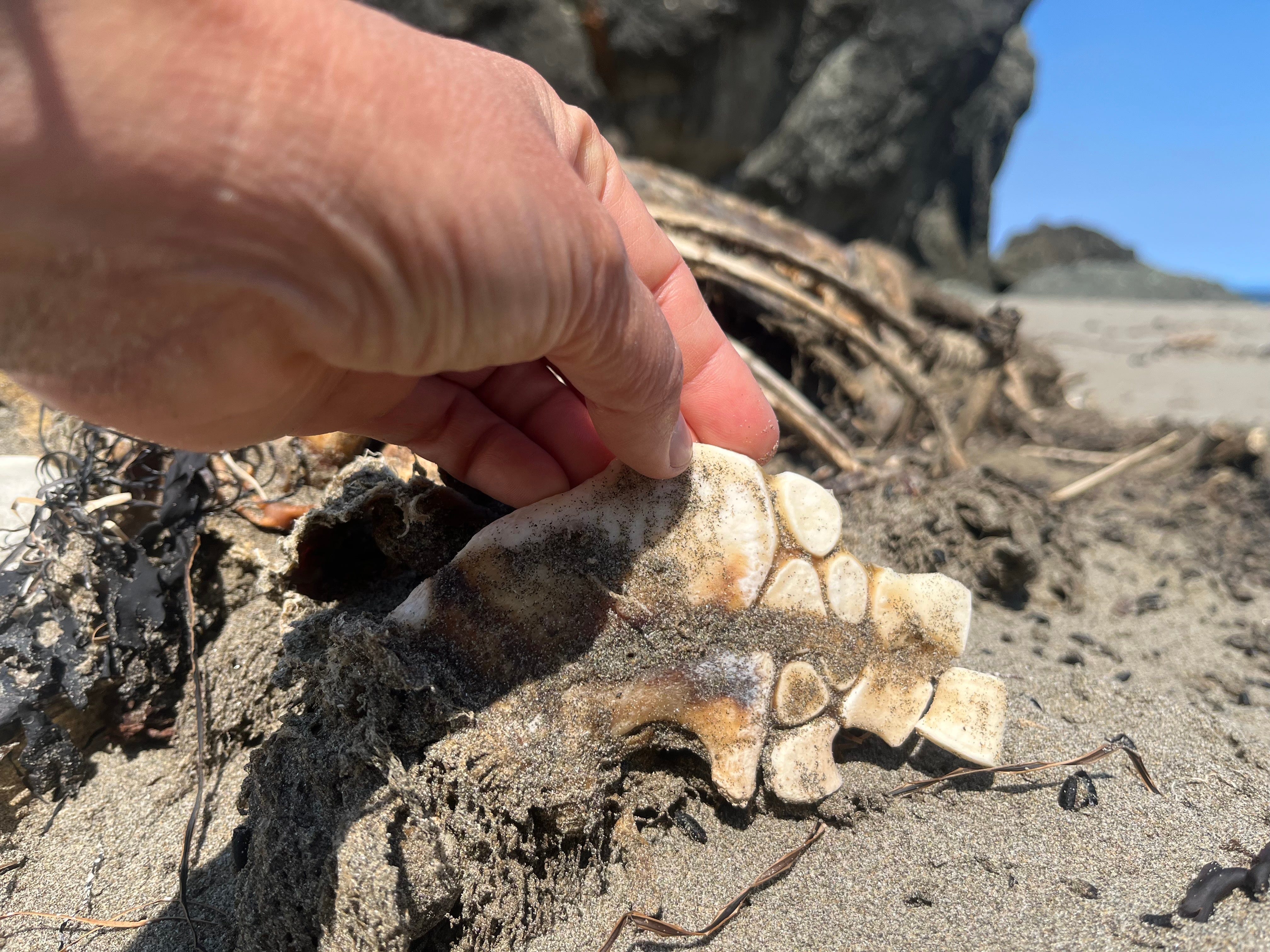
I encountered a seal (sea lion?) carcass on a backpacking trip this weekend and wanted to share a photo of the wrist bones of its front flipper. (Zoom in to see the ligaments between each bone before they dry up and out!)
If your hand has ever been crushed by someone’s firm handshake, your phalanges and these carpal bones are what’s being squished. P.S. We have matching chiclet-shaped bones in our feet (the tarsals) also tightly bound with tiny ligaments between each bone. When you have a hard time taking your bare feet over a rocky path, it’s often stiff tarsal joints keeping your feet from relaxing over what’s underfoot. When you roll your feet out on a ball or roller, you’re giving these parts a dose of “vitamin texture.”
One of the coolest things about skeletal anatomy is that once you know which shape each bone is, you can apply the knowledge to most of the vertebrates in the animal kingdom. Horse, whale, bird, dinosaur, human—a pelvis is pelvis-shaped, ribs are easily identified, and yep, that’s a femur. Knowledge of the skeleton is easily transferred from animal to animal, which saves time when it comes to figuring things out about each individual animal. The lung-location isn’t such a mystery. “Where does the baby come out?” doesn’t need to be deduced every time.
Though not as tangible as the hardened minerals that comprise skeletal bone, there is a framework of nutrients or nutrient-esque essentials (all of the inputs that support us physically) that could be generalized as necessary to a wide variety of animals. Not that all animals require identical inputs (nor skeletons, for that matter). Bats have different dietary needs from whales, and some animals live in groups while others spend their adult lives in isolation. Still, the shape of a general nutrient framework—the well-researched facts demonstrating that there are essential habitats, diets, and social structures necessary to each animal—is sufficient to save us time when it comes to figuring out all that human animals require.
Nutrients are something our bodies need that our bodies either cannot manufacture at all or cannot manufacture in sufficient quantities. They cause our physiology to be altered when they are introduced to our bodies. When nutrients are missing or insufficient in a human body, the result is a disease or malfunction; thus, nutrients can only be identified once we understand that the symptoms we are have is coming from a missing input. This is a super-important point (Is it weird to write “super-important” in your own article? Probably, but I really want you to get what I’m saying.): Nutrients are identified through hindsight, and this means we must pay close attention and document changes in groups of humans living in particular ways.
So, we have a current list of human nutrient needs. On the most general level, we say that humans need food and water and shelter, but this is overly simplified. We don’t need just food but nutrient-dense food. Our need for shelter is really how we meet our needs for warmth (or a stable temperature) and protection, and thus adequate rest. We also need to move (and to be moved), and what about sleep? Humans need gravity (our space studies show), and a flourishing microbiome, and natural light. And if we use our framework of animal needs and our understanding of how humans have succeeded historically, we find that humans need close contact with other humans.
Until very recently, the social structure of human animals has been organized by the same efficiency principles that organize everything in nature. We lived in small groups (and perhaps groups within groups), where necessary work was shared, in a way very different to how work is shared in society today. Unlike the honeybees, in mainstream Western culture individuals struggle daily to execute all tasks necessary for a collective to survive. Each person is responsible for getting their own groceries, making their own meals, cleaning their own house, minding their own kids. We have one person we expect to handle all our daily debriefings (and also to help us through every crisis, know what we want for our birthday, motivate us to change, find us mysterious and interesting, while loving us for who we are). On the contrary, our natural social structure used to be—and still is, in a few very discrete places—more like that of the trees. In nature the structure of society is stacked so that individuals work together, in a cooperative fashion, to regularly use their personal strengths to provide something to the group as they are also provided for.
Our traditional use of community is hypothesized to be all about food and kids. Human animals have a long juvenile period. It takes a long time to learn how to eat from the wild. The adult humans in modern-day hunter-gatherer communities we can research aren’t ever providing just childcare; children are always—even in their play— being exposed to skills that will parlay into food acquisition. Moving with adults who are gathering and processing food is also education for children on gathering and processing food, and it’s healthcare for all. But it isn’t only parents providing education and healthcare to their children. In a tribe, juvenile care (and thus education, movement, and touch) is provided by parents and also alloparents—grandparents, childless peers, other children. This arrangement is efficient in that it increases the child’s chance for survival; gives purpose and contribution to elder tribal members and allows essential information to pass between generations; provides not-yet-parents the opportunity to be with children; and saves the primary parent from burnout. The parents of young children in a tribe, despite their status, are still required to go out and work for their food, much like we all have to in non-tribal societies. And did I mention the movement? At the heart of everything a tribe offers, is a day rich in movement for everyone.
A tribe is efficiently organized in that it utilizes local resources of people to directly meet the needs of all members of the group. A tribe is a stacked community. For most of us today, our relationship with “others” is sort of like all of our relationships with all other things from the natural world—we’ve separated it into parts. Isolated and found at separate locations are many of the elements a community offers: food, childcare, education, spiritual guidance, art, music, medicine, touch therapy, eldercare, exercise. We’ve kept all these things because they are necessary elements of human society, but they are unstacked from the way human groups initially organized. I propose that the inefficiency of modern societies might be hindering our ability to be fully nourished, either because of TIME (i.e., there’s no possible way to get everything we need when it’s all separated), or because there’s something more to the “whole” of an intact community, greater than the sum of its parts, that we don’t yet understand.
When we outsourced our physical movement to machines, robots, and people outside our local community, we decreased the role for immediate community. And as we stopped moving on behalf of ourselves and community, our sheer ability to move decreased, as did what we could physically contribute to a community. So now we’re at the place where it’s necessary for a sedentary society to get all the essential elements of community in separate parts. To continue to operate our current society this way is to perpetuate a society that requires we stay sedentary.
In addition to feeling under-moved, there are other feelings so many of us can relate to right now: feeling too busy, feeling too tired, feeling stretched in too many directions. Feeling as though there’s something missing from our lives; spending money on things we don’t need to try to fill the space left by the something that’s missing. We’re a large group of people all experiencing these troubling feelings. Depression, addiction, anxiety, loneliness, pain, and chronic illness are common in our culture, which is why I’m going to repeat my super-duper important point: Nutrients are identified through hindsight, and this means we must pay close attention and document changes in groups of humans living in particular ways.
The discovery of vitamin C was made possible by those who figured out that citrus fruits worked for treating scurvy symptoms before they knew why:
The pioneering controlled clinical trial of the various therapies recommended for the disease of scurvy… was carried out in 1746 by James Lind on sailors at sea…. He took 12 sailors, all with a similar severity of the disease, divided them into pairs and, for 2 [weeks], gave each pair one of the many treatments that had been recommended for the condition.… The pair receiving lemons and oranges were almost recovered after only 6 d[ays], whereas those receiving either dilute sulfuric acid or vinegar had shown no improvement after 2 [weeks]. The importance of Lind’s trial has often been described as showing that citrus fruit was a cure, or preventive, for scurvy. This had, in fact, been known already for some 200 y[ears] but could not always be made use of.
To recognize deeper human-to-human interaction as a nutrient, we must be able to identify the symptoms of a lack of it. Doesn’t the list of troubling feelings above read like a list of symptoms? The next step in discovering a nutrient is to see if community, or elements found in a community, has proven to be successful as a therapy.
Elements of community—belonging to something and to have something to contribute to; our need for touch, communication, support—are successful in treatments of addiction and depression, and as we find touch therapy and movement to be effective in reducing the symptoms of chronic pain and other ailments. We must then ask ourselves: Do we frame community as medicine or community as a nutrient? Which makes it easier to get your needs met?
At first, we might need a therapeutic approach. If you have no “others,” you can schedule in the elements of community, like using protein powder or vitamin and mineral supplements when a food diet falls short. Eventually though, it’s possible to restructure areas our lives (in the same way we learn to eat in a more nutritious way) where community is built into our daily fabric—so that the symptoms of “low community” stop manifesting in the first place. Maybe before you find your others, you have to get with yourself first. I can hear some of you saying “Katy, I’d really love a dose of community but I just can’t, with people.” For that, I’ll point you to Dan Harris’ recent article with tips from Nedra Glover Tewwab: “For When Other People are Being a Pain in the Ass.”
Many have learned the value of and skill set to eating a nutritious diet, and likewise, it’s possible transition to make new choices, and organizing our time and community members in a way that nourishes everyone more fully.
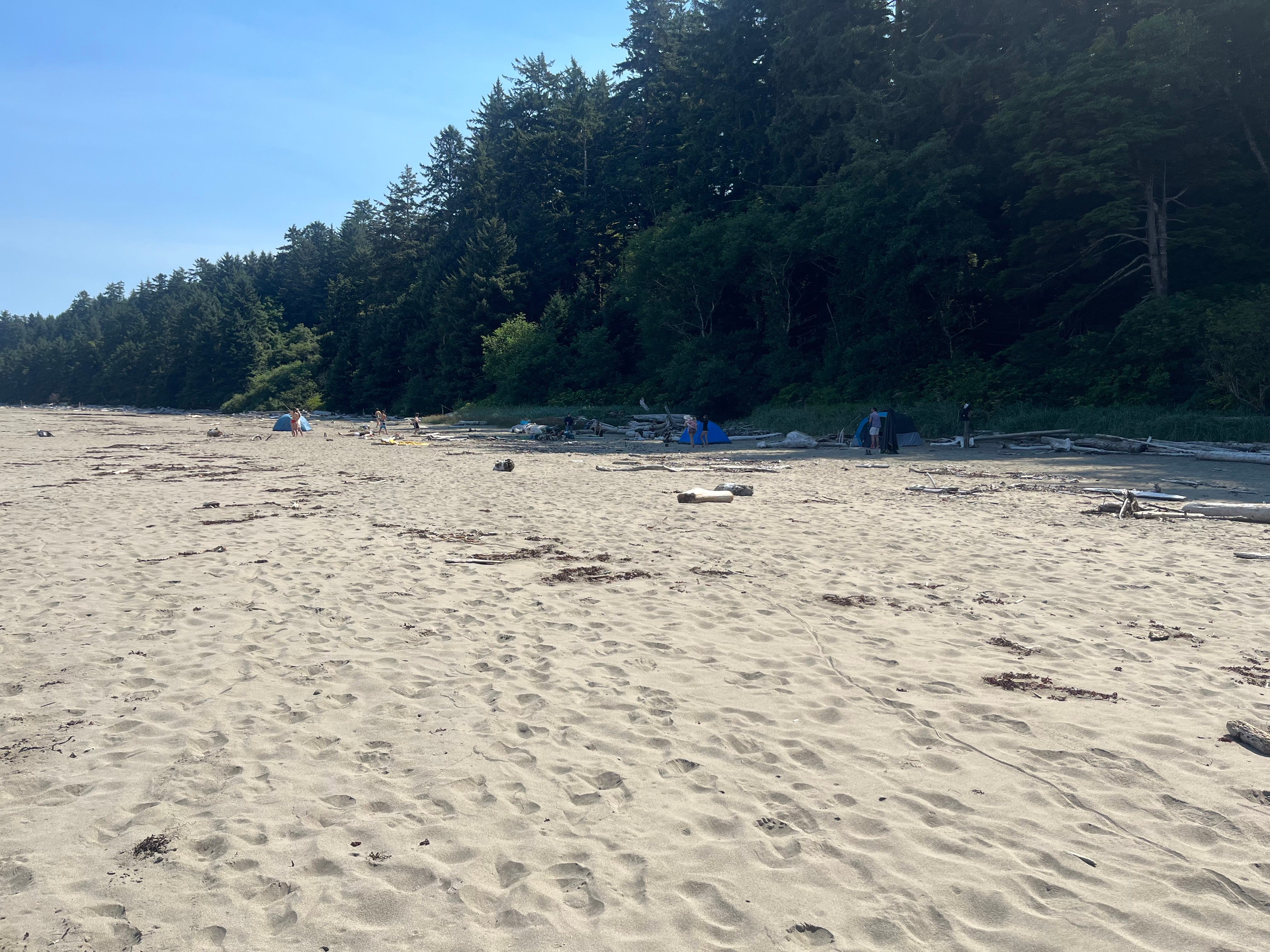
Seventeen of us, including two toddlers, did an overnight backpacking trip this weekend. Group camping is a simple way to create a low-key village experience: shared work of setting up camp, making meals, caring for kids, and making space for play. The hike in was 4.5 miles, which sounded short until we added 20–35 pound packs and crossed a couple of miles of sand. The round trip was closer to eight hours of strength work. I’ve trained with a weighted vest and done plenty of rucking. But getting the “whole-food” version of exercise—where the movement isn’t separated from all the other parts of living—is what nourishes my soul most.
Read more essays in Movement Matters: Essays on Movement Science, Movement Ecology, and the Nature of Movement
No posts
Comments
Nothing yet. Say the first thing.
Sign in to join the conversation.