
This monthly missive is a way for me to make connections with people interested in art and creativity in order to inspire a more satisfying and thoughtful daily life. I’m an author and editor, always on the lookout for inspiration.
We spend our whole lives processing memories of what happened to us as children. Perhaps that’s what makes us human: that we’re constantly striving to understand the forces that shaped us.
We’re trying to figure out who we are, really, and who we’re meant to be.
I’ve often wondered how this revisiting of the past might be different for people who live their entire lives in one place. If you never leave “home,” do you still experience the kind of nostalgia that ends up defining you?
When I was eleven, my family moved from Brooklyn Heights to central London. I was leaving behind subways and disco music, brownstone buildings and boys. In fifth grade, I had a crush on a cute kid from my class with a big afro (it was the Black Power era in New York) who wore tight polyester shirts and played hopscotch with me in the concrete school yard near the Brooklyn Bridge. I entered a new world: mohair sweaters and fishnet tights, girls-only schools and red double decker buses.
All in all I spent 14 years in London. Almost every year since then I’ve returned at least once, sometimes as often as two or three times. It helped that I moved to Boston and my parents own a flat in my old neighborhood, so going back and forth has always been pretty easy.
I’ve just been back for a week to celebrate an old friend’s big birthday, and I did what I always do: I revisited the same old series of memories.
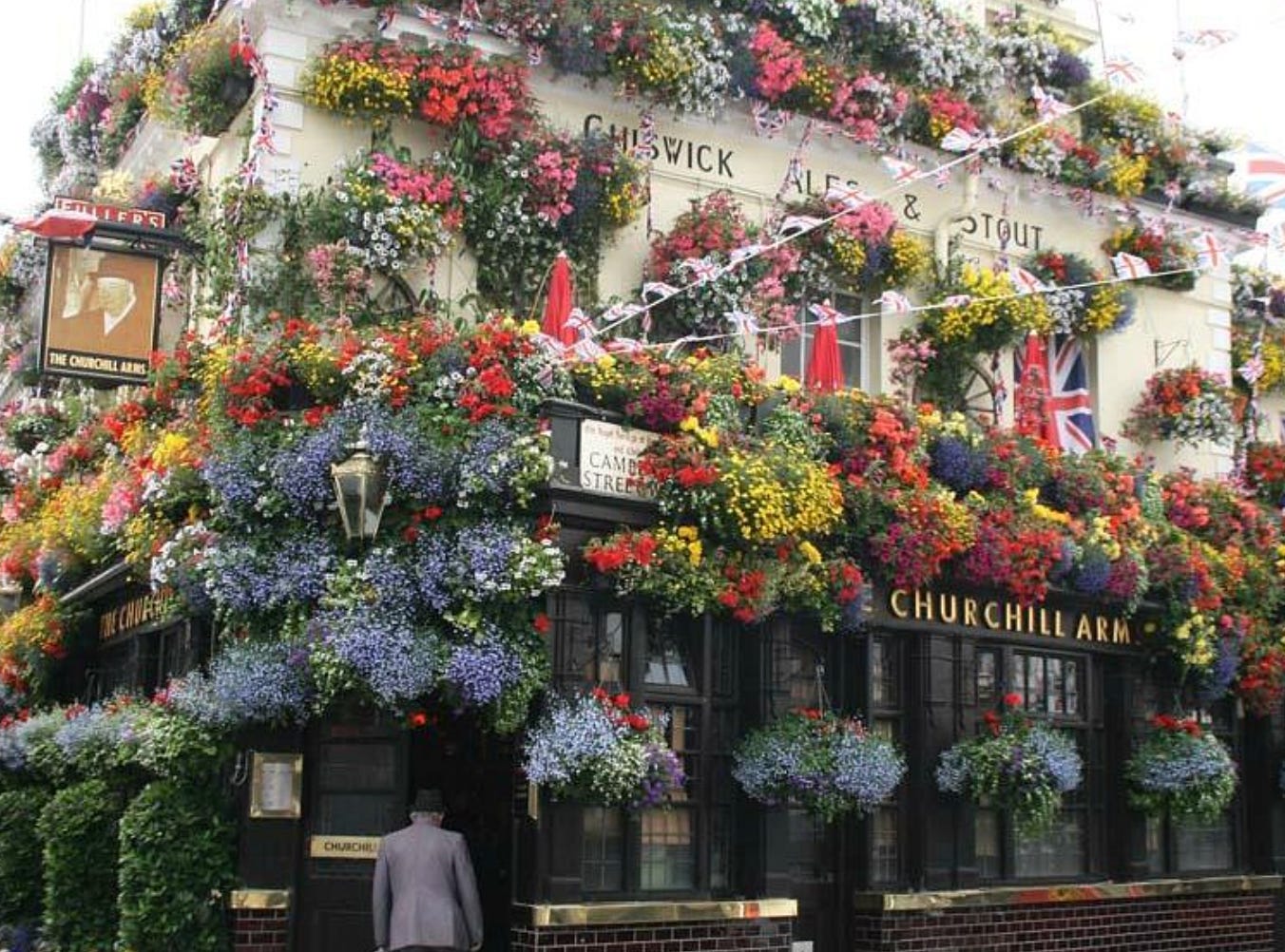
The Churchill Arms is a famous pub on Kensington Church Street, adorned with cascading flowers in the early spring. Every time I walk past it I remember one particular night I went there as a teenager with my best friend, her boyfriend and his gang of friends.
All I wanted back then was to find a boy who loved John Donne’s poetry as I did, and, preferably, looked like James Dean.
My memory is this: sitting in a corner (literally) while everyone played darts and ignored me. It’s possible I didn’t have a single conversation that night. But that image of me silently sipping a big yellow beer is one I’ve revisited countless times.
Some months later I met my James Dean look-alike. He not only loved poetry but wrote it, too. Oh boy, was I primed for heartache. We spent two months hiding from his girlfriend, and lying to everyone.
He was hands down the worst “boyfriend” I ever had, and I think of him every time I’m in London. He ended up bald, living in LA producing movies based on video games. So much for John Donne, eh?
I spent countless weekends in Dorset with my best friend’s family. Her father was a tyrant, slick and nasty, and her mother made the most delicious toast. We took long wet walks through meadows and pressed our thumbs into the corks of cheap Yugoslavian wine so we could guzzle a bottle before attending lame church dances.
But during the daytime those old churches had great rummage sales where we bought old fur jackets and men’s lace up shoes. I got a 1950’s turquoise silk dress that shone purple in certain lights; I’d never fit into it anymore but I badly regret giving it away when I moved to the US years later.
To this day I still hit the charity shops in my old neighborhood (like Salvation Army but with great vintage clothing) and every time I do I remember those Dorset churches, and my best friend with whom I had a painful falling out. I invariably come away with a £5 cashmere sweater, an A-line suede skirt or a lamé maxi dress that I might wear once or twice, or never.
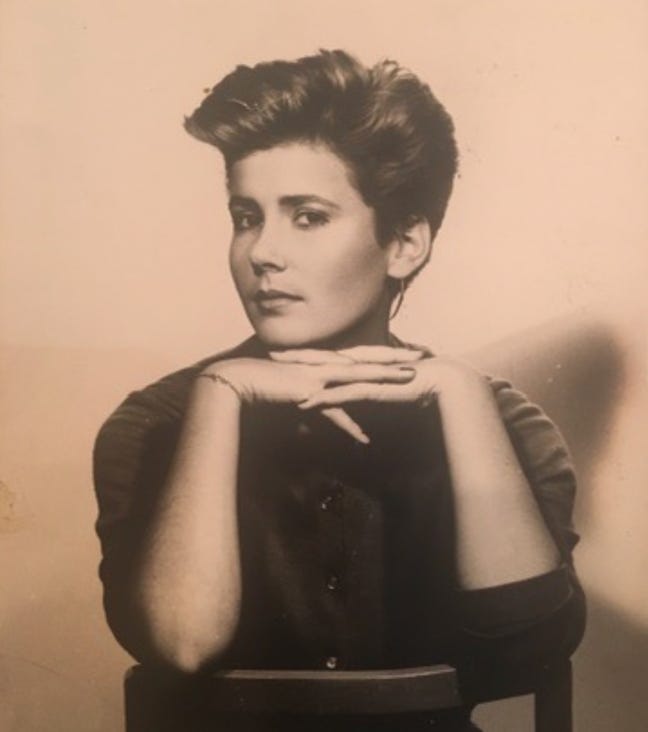
This ritual reminds me of the days when wearing fishnet tights and stilettos, tartan miniskirts and beaten up leather jackets marked me as a rebel. I guess I still want to think of myself as a bit of a rebel.
Shopping for vintage clothing also always makes me think back to one specific outing during my last year of school, when I was allowed to leave campus between classes to sit in cafés chain smoking and drinking milky earl grey.
My new boyfriend took me out for lunch and I wore blue stilettos that were one size too large. They rubbed my heel so badly I limped there and back (not quite the impression I was trying to make). What I remember best, though, is scanning the menu to find the cheapest item—he told me I could order whatever I wanted, but what I wanted was to not be a burden.
While he didn’t love John Donne, he was a nice guy. He died a few years ago.
It’s hardly surprising, I know, but I was a big reader. How I adored Lawrence’s Lady Chatterley’s Lover and Flaubert; it was a kind of ecstasy to let the language transport me away from my schoolgirl realities. Now whenever I go back, I linger in Waterstone’s bookstore on Ken High Street, looking for fiction published in England. I’m always hoping to find something I haven’t yet heard of.
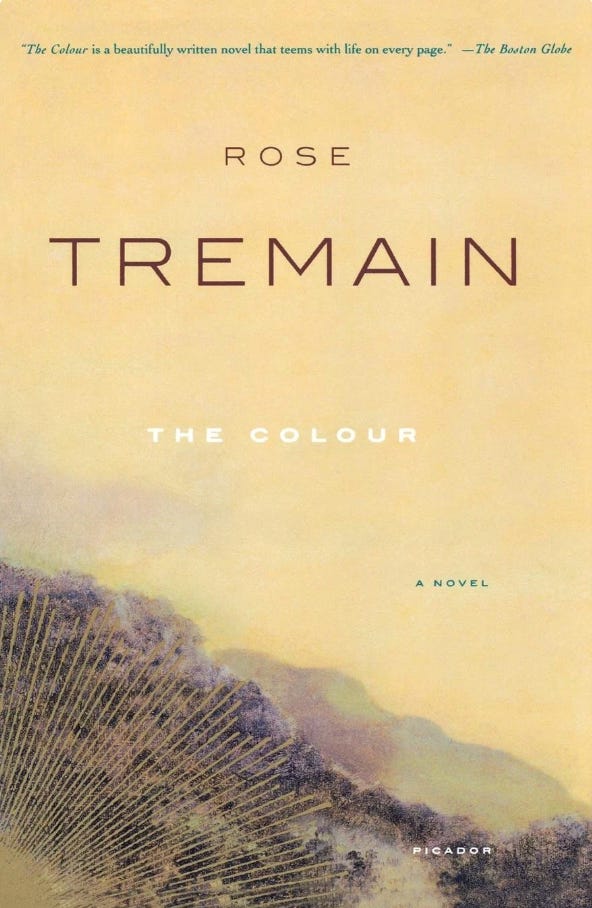
That’s how I stumbled on my favorite book of all, The Colour by Rose Tremain. Read it, you will not be sorry!
The Waterstone’s is near where W.H. Smith’s used to be. That’s where I went, age twelve, to buy the single God Saves the Queen by the Sex Pistols. They didn’t stock it; too controversial.
Three days ago I scanned my father’s bookshelf and found my original copy of Lady Chatterley’s Lover and re-read it. I’ll be writing about that at greater length soon. It was a powerful experience.
I remember going to the midnight showing of The Harder They Come, starring Jimmy Cliff, and being caught lying about staying overnight at my friend’s house. I was always being caught in a lie.
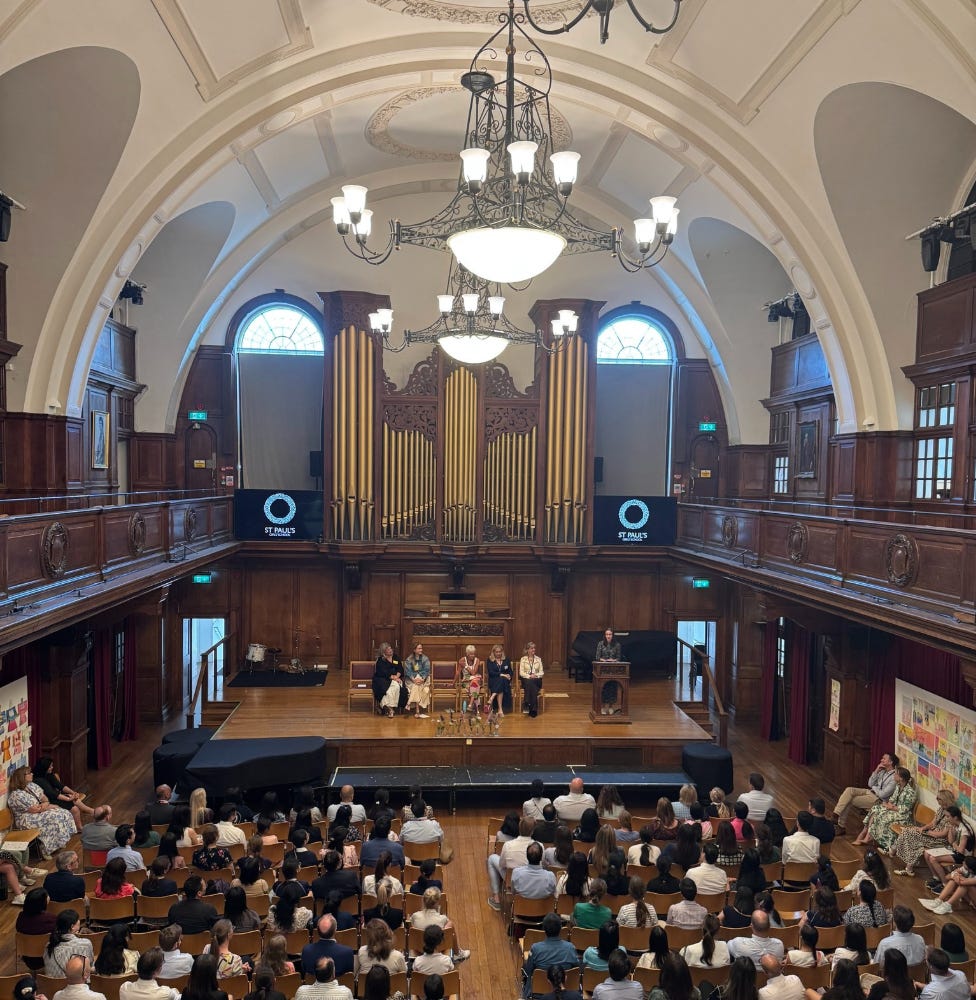
I remember riding my bike down Ken High Street, no helmet and barely awake, to go to my all girls school at 7:45 am. I was always late. Each morning 100s of girls gathered in the Great Hall to sing hymns accompanied by an organ.
My old street, Holland Street, is full of memories. The time I was eleven and a blonde-haired man flashed his penis at me. Later I struggled to describe his belt buckle to the policewoman (I was definitely not thinking about his belt buckle).
The time I was seventeen and took myself to the family planning clinic to get my first birth control (a free clinic built inside a row house that’s now a private home again, worth many millions of pounds).
The time I leaned out of my window on the fourth floor of our tall, narrow townhouse to sneak a cigarette (and was caught).
None of these memories represent big turning points in my life. They’re just ordinary everyday events that return to me, again and again and again, year after year.
Why don’t I remember other moments—far more important ones—as vividly? Each street, house, shop, bus stop contains a particular memory I’ve now recalled so many times they’ve accumulated and calcified, and taken on an oversized importance.
I love going back. There’s no rewriting history, just reliving it.
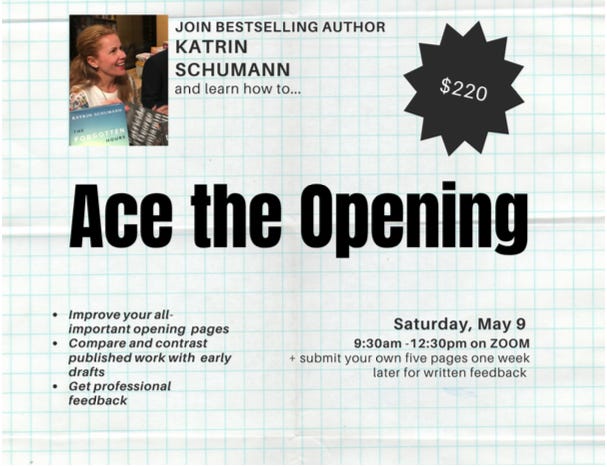
$220 payable upfront by Venmo
In addition to our workshop, you will receive a written assessment of your first five pages, which you can submit to me up to a week after class (May 16).
email me to sign up
The opening of your book is make or break: agents and editors often stop reading after just a single page. You must bring your audience into the unique world of your story with confidence and creativity—but when you’re so close to the material, it’s often hard to know if you’ve pulled that off.
Using real-life examples, we will contrast discarded openings with their final published versions, examining the behind-the-scenes editing process and highlighting the choices the writer made in order to both ground the narrative and propel it forward.
Through in-depth analysis, we’ll look closely at the critical elements of the first sentence, paragraph, and page. How do writers introduce theme, character, setting and plot without an information dump? What works and what doesn’t? By discussing the differences in the texts, you will learn what you wish to highlight in your own opening pages, and whether or not you’re achieving your goals.
Comments
Nothing yet. Say the first thing.
Sign in to join the conversation.