
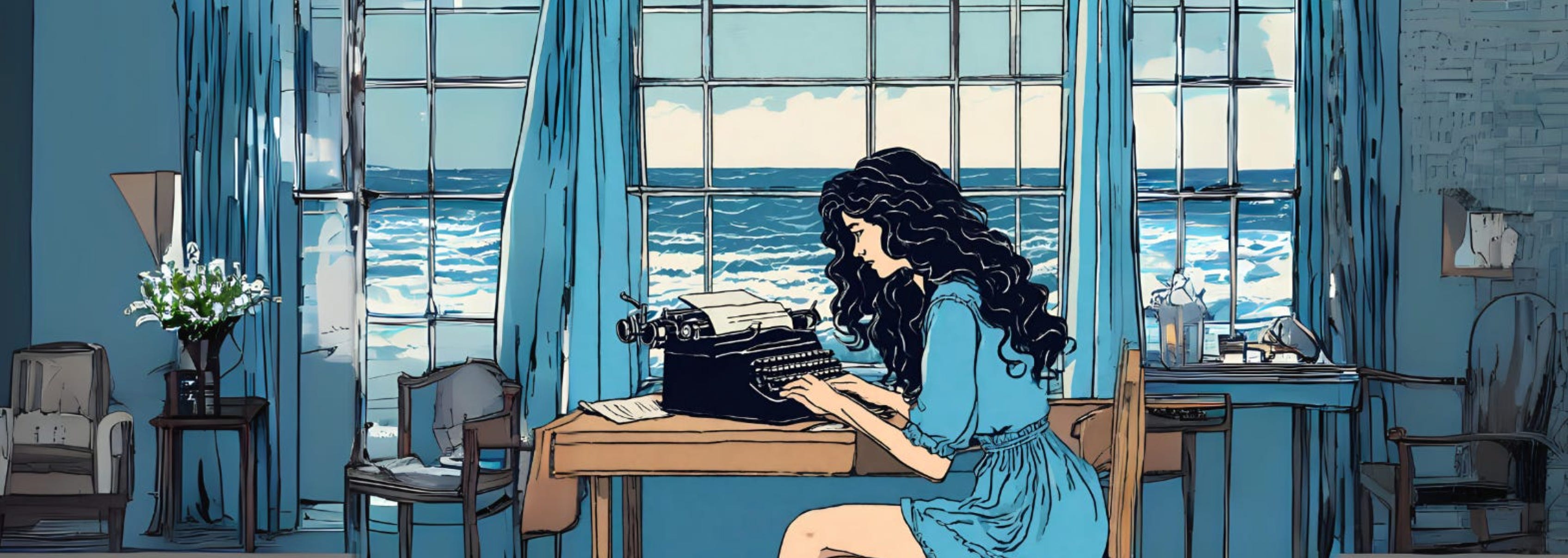
Welcome to Palimpsest: A Novel. This is a subsection of my personal newsletter, Metanoia Road. Every Thursday, I’ll be sharing a chapter from my novel Palimpsest, published in Australia in 2010. If you’d prefer not to receive these letters, follow the instructions here to unsubscribe from this section. If you’re staying - thank you - let’s go revisit who I was and what I needed to write in this novel, sixteen years ago. 💙

Dear You —
Welcome back to Palimpsest: A Novel. Here is Chapter 2.
0:00
-8:25
Akindynos’s five sisters watched over his body until my mother and I arrived from Coober Pedy, Australia, fifty-two hours later. Thomas was at Perasma’s tiny airport to escort us to the hospital where the sisters were waiting.
It wasn’t just the black they wore, it was the languid way they sat on the red benches in the hospital corridor that signalled to us that Akindynos’s story had ended. They didn’t have that nervous tension, the quick movement, the strained necks and shoulders, the intense look of women in anticipation of news, good or bad it didn’t matter. No. These lackadaisical figures yielded the terrible reality without having to say a thing.
Thomas walked quickly ahead of us. My mother Anastasia was a step behind him and I was a step or two behind her. Then I heard her cry, Andra mou! A guttural a- and that final shrill -ou, the primitive transcriptions of the age-old language of emotion. For a brief moment it was all that could be heard. It made me stop my trance-like procession along that long creamy-yellow corridor with the mosaic floor. The sisters finally moved towards us and enclosed us in a harmony of voices, the howling allegro and deadening adagio of commiseration.
Anastasia never wanted to see Zelopolis again. She would never have set foot in the village had Akindynos not returned to it, and died in it. And I would never have followed her, had I not become — after Thalia — so derelict. More than that. I’d never have become curious about Akindynos’s decade of life here had I not faced his eschatological silence in one of the hospital’s basement rooms.
While Anastasia maniacally addressed doctors, relatives and acquaintances extracting any facts that could fill in the decade-long gap in her husband’s history and account for his inexplicable end, I imagined that the questions gaggling in my head would never be answered because my father’s stiff mouth would never utter another phrase. I stood there in that off-white room with its pungent smell of unwellness and just looked at my father.
Akindynos was completely familiar — the round head, the fierce eyebrows, the Socratic forehead — and yet, without the animation of life, like nothing I remembered. Over the past ten years I’d often called up his likeness in a photo that he’d sent not long after he left Coober Pedy for Zelopolis. The framed portrait of Akindynos wrapped up in a blue toga had been taken, he explained in an accompanying note, on the inaugural gathering of the Zelopolis Academy of Hellenic Philosophies, where ‘an afternoon of conversation could educate any man, woman or child.’ The photograph was published in the local papers and gained him the title of Village Philosopher. On the bottom of the photograph, Akindynos had, in his awkward hand, written:
To My Kallisto,
Don’t believe Socrates when he says he knows nothing.
He only wants to manipulate you.
Learn things in your own way.
Love,
Akindynos the Philosopher
I’d hung the framed Akindynos on the back of bedroom, kitchen and bathroom doors before packing him into a box for the move back home to Coober Pedy, and forgetting him there.
Now, I looked at Akindynos and addressed him silently in my head: You are right here, and yet you are gone. My father was so silent on the hospital bed, and it was so loud in the room. Anastasia, the sisters, and my grandmother Kallisto had gathered around him, their medley of ululations filling the room. The details of my father’s death — whether it was orchestrated or won by default, whether it was his heart that failed him or his mind, or whether some other agent had done God’s work — were yet to be determined, and Anastasia and the sisters scuffled about the room accosting what remained of Akindynos, who could not answer them, and the doctor, who did not yet know.
There was something strange here. That’s what I thought. It wasn’t the, as yet, untold story of my father’s demise that was strange, and it wasn’t the misfortune of losing him (if death is a misfortune at all). The strangeness was in the confrontation of death itself. The first time I felt the strangeness was with Thalia. That was when I came to know how this startling absence, confronted in death, sets off one of two responses in those who witness it. It either cauterises the living, as it had with me so that I just stood there by my father’s side, inert, careful not to wake him. Or, it throws a person into a paroxysm of inquiry as it had Anastasia who fell onto Akindynos, when the thick, bleached hospital sheet was pulled back off his head, searching for her lost husband, kissing his hands, patting his forehead, calling out to him as if, if not he, then someone, somewhere would offer her a response, some sort of answer. This encounter of the living with the dead revealed the ultimate dichotomy of presence and absence. Anastasia cried out in the tones of her ancestors, ‘Where are you, Aki mou, where are you?’ But Akindynos was lost. He was gone.
His body, however, still persisted. My father’s once thick fuzz of golden blonde hair, hair that I’d inherited, hair that had maintained its colour well into his old age (thereby adding to the family lore that Akindynos was a God’s offspring) had finally receded to the middle of his skull, and the colour had been sucked right out of it. I imagined the acrid taste of the metallic strands. Then I walked out of the room.
I brought up my father’s likeness in the photograph once more. I imagined him alive, the sky-blue fabric of his toga flapping behind him, and catching between his legs, as he walked about Zelopolis doing philosophy for the locals.
Thanks for reading! See you next Thursday for Chapter 3.
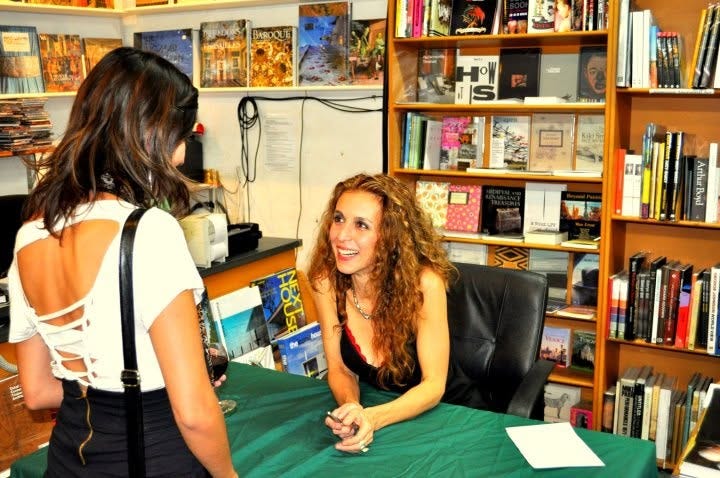
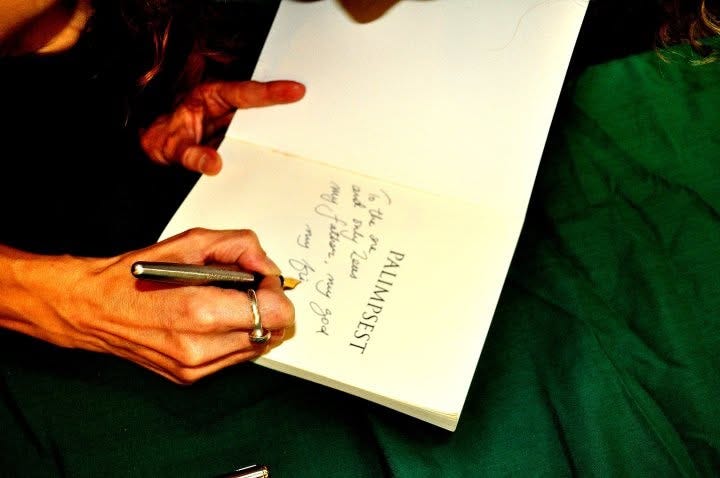
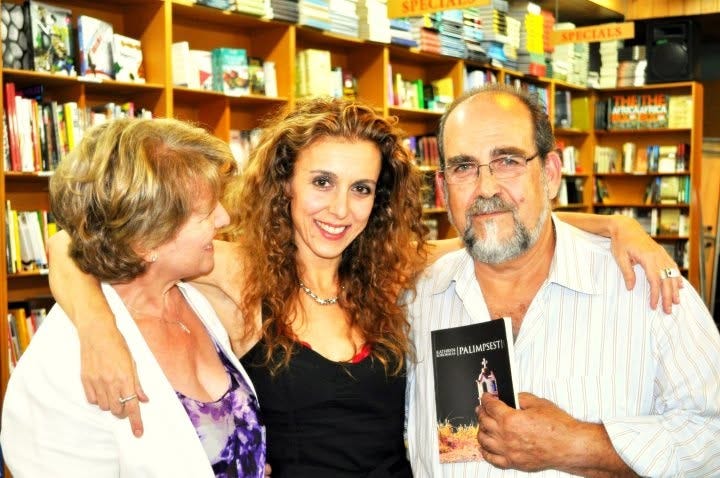
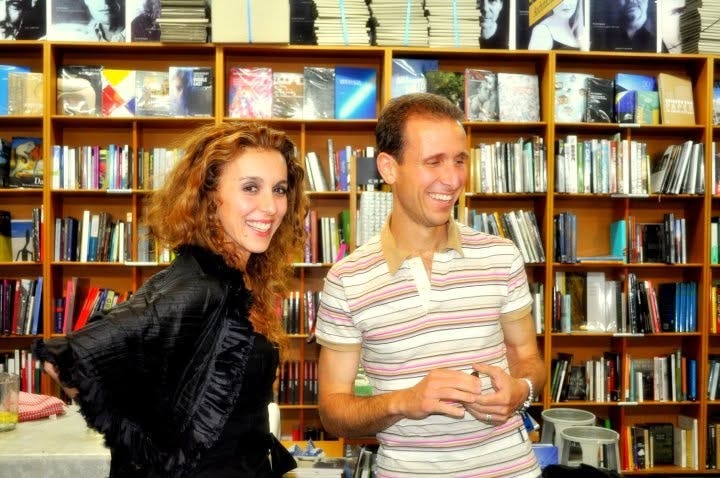
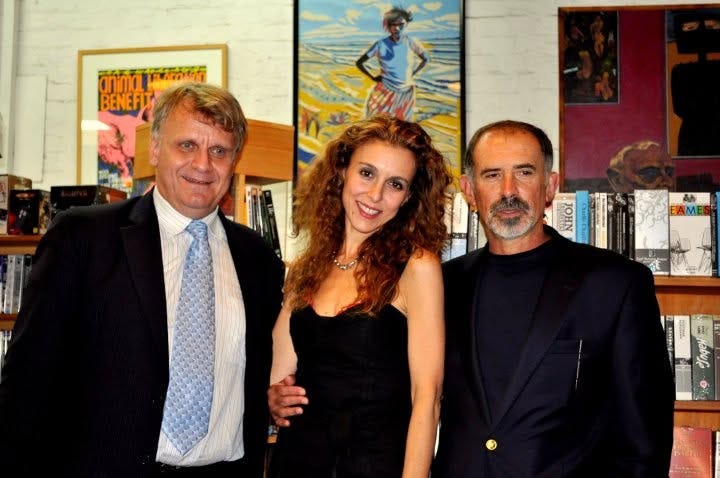
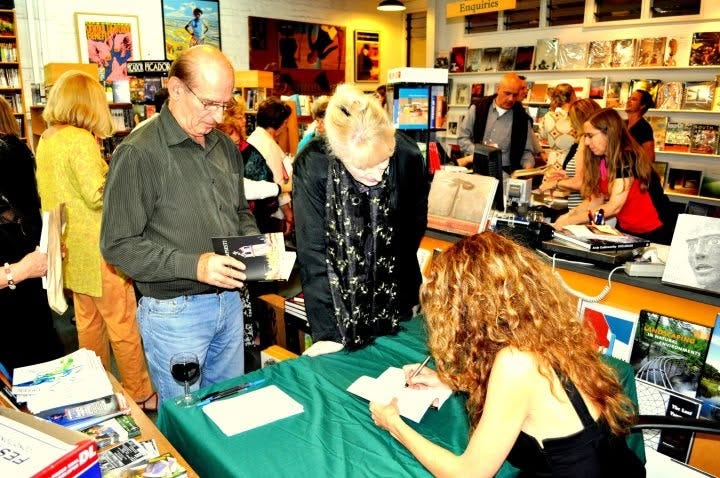
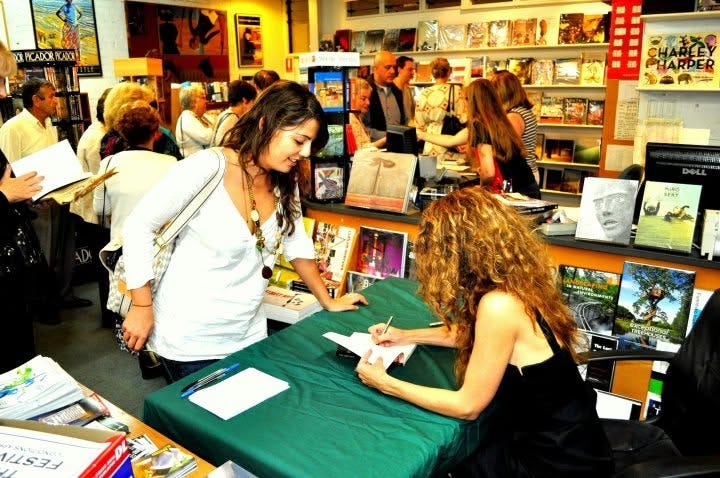
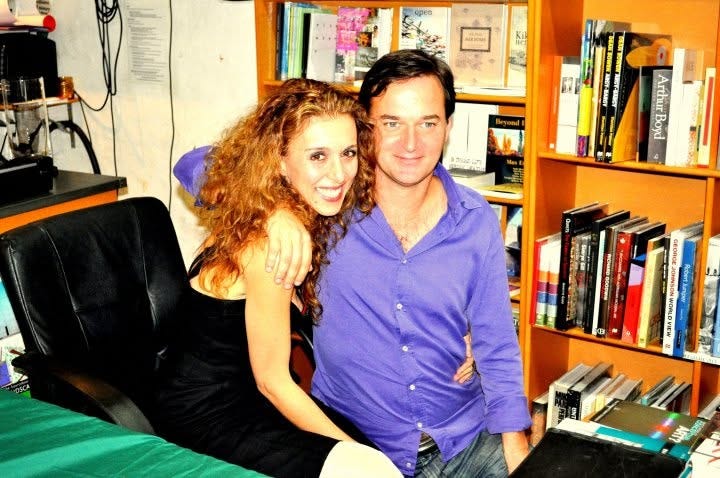
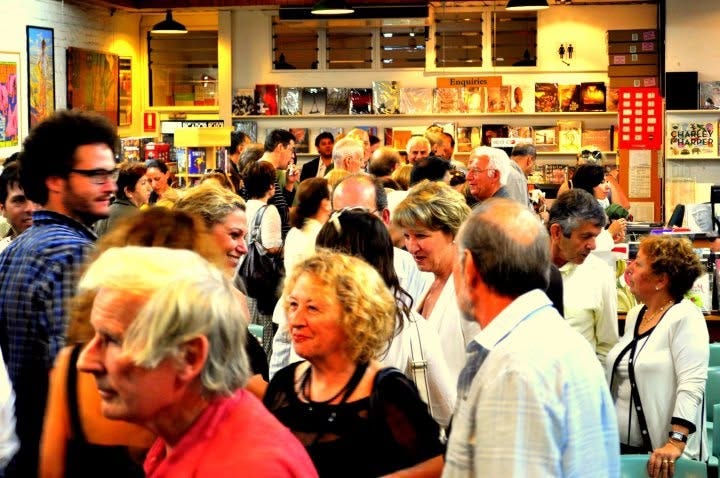
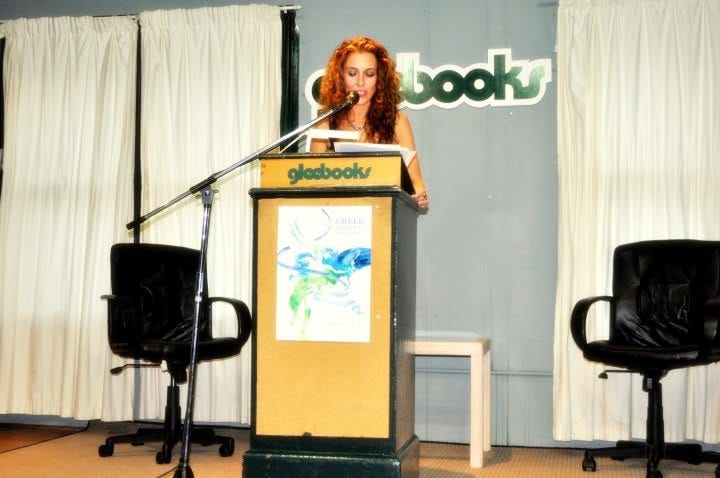
Meanwhile, here are some scenes from the novel’s book launch in April, 2010. Gleebooks, Sydney.

Hey, thanks for reading. Over the course of this serialisation, I’d love to hear your thoughts on the story, the writing, the themes, as well as your own obsessions and explorations into forms and genres that can hold your stories.
Comments
Nothing yet. Say the first thing.
Sign in to join the conversation.