
Welcome to Palimpsest: A Novel. This is a subsection of my personal newsletter, Metanoia Road. Every Thursday, I’ll be sharing a chapter from my novel Palimpsest, published in Australia in 2010. If you’d prefer not to receive these letters, follow the instructions here to unsubscribe from this section. If you’re staying - thank you - let’s go revisit who I was and what I needed to write in this novel, sixteen years ago. 💙

Dear You —
Here we are! Let’s begin. I’ve recorded this first chapter for you. 💙
0:00
-13:18
If just one man amongst all these men
Died of disgust—
Quietly, sadly, modestly,
We could, at least, revel in his funeral.
— Kostas Karyotakis, ‘Preveza’
MY FATHER WAS BORN and baptised in a depressed little village called Zelopolis in 1928 and found dead on Zelopolis beach seventy-seven years later. It was a local shepherd who found him early on that Wednesday morning. The tide had eased and my father’s wrecked body lay perpendicular to the pull of the Ionian, his toes still playing at the edge of the water. I learned later that my father had taken to wearing a chiton — the ancient dress — and that’s what he had worn that day. When Thomas Paleologos found him, my father’s chiton had been torn at the shoulder, so it looked more like a kilt than a robe, and his brown leather sandals were lost to the sea.
Thomas, who became my sometime guide, told me that he had always looked to the beach for signs of death on that day – June 11 was the anniversary of the poet’s death and the copycat suicides – but he hadn’t seen a body in years. That morning the shepherd had been lying flat under the shade of a pine tree, his dull thoughts lulling him into the sleep he’d been deprived of due to his morning duties. His flock grazed behind him on the hillside that ran up off the beach and undulated for a few hundred metres before it plateaued out into Zelopolis village proper. When the hot eye of the sun peeked through a gap in the tree’s canopy and woke him, Thomas sat up, alert, as though he’d not just been asleep, and lit a cigarette. He knew what he would see, and he looked to the beach to see it.
There was my father. Akindynos Palamas. Quite clearly visible – the distance to Thomas was less than a hundred metres. Distinct in his sky-blue toga, his body was inanimate. Not in the way a sleeping body might be, unmoving and yet, comfortably, naturally – one could say – sprawled. But in that eerie twisted way that one, if one has had the opportunity, confronts only in death.
Thomas whistled to his flock of thirty-three. The animals, nervous by nature, understood the urgency in their shepherd’s call. They moved quickly down the hill and across the road to where Thomas instructed them, in the sheepman’s language of whistle and whoop, and there they remained occupied with the foliage that sustained life there. Thomas then made his way down to the pebbled beach and headed to the static form that once belonged to his friend, my father. When he finally stood over the body, he frowned. ‘Christe mou,’ he said, and nudged Akindynos’s hip with his boot. ‘You, too?’
Thomas bowed his head and executed the sign that every simple man makes when confronted with matters beyond his understanding: he brought his thumb, fore and middle fingers together then gently flicked his wrist so that the triad of fingertips drew the shape of a cross in mid-air, there just in front of his chest. He then unclipped his mobile phone from his shirt pocket to make two phone calls. The first was to Babis at the police station. The second was to Stamatia – the eldest of Akindynos’s five sisters – who then called my mother. It was six in the evening in Coober Pedy when the call came through. I simply let the phone ring, with the dull ringtone that Anastasia had chosen so as not to startle me when I was supposed to be working, just as I always did. The world, brought home through the telephone and other connective devices, was out of bounds for me. In any case, Anastasia had just returned from the mine so she answered it.
‘Come quickly!’ Stamatia had said. She told Anastasia that Akindynos was quite ill when, in fact, he was already quite dead. Stamatia had said that my father was in intensive care, that they didn’t know exactly what was wrong with him, that it wasn’t a stroke and it wasn’t the evil sickness, but whatever it was it was very serious and that we should hurry. Stamatia believed it best to avoid talk of the true state of affairs, at least until Anastasia and I had arrived when there would be no choice but to face death head on. The prospect of more life, even if sickly, proved to be more of a comfort to us than the vacuous invitation of death. And so, Anastasia made the urgent plans for travel with the expectation that we could once again see Akindynos.
When Babis and two other uniformed men joined Thomas and the dead Akindynos down on the beach, Thomas rattled on about his morning’s find. ‘Summertime, I graze the sheep there,’ Thomas said, pointing back to the green strip of land from which he’d first seen Akindynos. ‘And there,’ he said, pointing to the modest white house inserted into the slope, ‘is Akindynos’s home.’ Thomas’s commentary was more rhetoric than revelation since Babis, the police chief, knew both shepherd and corpse. ‘See,’ Thomas said, ‘how his head twists back to look at his house for one last time. Look, even aged bodies can demonstrate agility in extraordinary circumstances.’
Thomas, Babis, and the other men from the Perasma City Police Station pronounced that Akindynos was the very last person in all of Epirus they imagined they’d find dead on this or any other day. In fact, ever since Akindynos had arrived in Zelopolis and started doing philosophy for the villagers, the policemen no longer expected the early morning alarm on June 11, the signal that the day of the suicides had come, once again. They’d come to understand that Akindynos’s philosophy could cure a man’s disgust, the source of all human crime. But now, the appearance of the drowned philosopher only a few feet from where the poet had been found, (alive — for he was a good swimmer — only to shoot himself later that day, seventy-seven years ago) threw every simple theory of human nature into perplexity. Babis simply shook his head and said, ‘This. I did not expect this.’ Thomas said they should use the logical devices of their ancestors to determine a possible cause of death. It was what Akindynos the philosopher would have wanted. It was all he had crusaded for over the last decade. But Babis had long rejected Akindynos’s teachings because he knew that out in the country it was instinct that prevailed over intellect. Babis had come to the renegade conclusion that it was always instinct that insinuated the truth long before reasoned deduction ever acknowledged it.
The ambulance crew packed Akindynos up, switched on the revolving red light, and silently escorted him along the National Road, then through the flat geometric sprawl of modern Zelopolis, and out through the restored fortification walls of ancient Zelopolis, then down past the bus depot and the fancy city cemetery with its large marble crosses, busts, and angel-winged sculptures, past the stark rectangle of the army barracks, past the commemorative plaque built on the spot where the poet’s body was finally found (dead, under the shade of a poplar, with his head propped up on his straw hat) and, then, along the lower part of the port, past the fishermen with their blue boats and portable radios, the one-eyed cats and gammy-legged dogs, until finally, the vehicle rolled onto the grounds of the Perasma Municipal Hospital. As Thomas walked through the glass doors of the newish town hospital he knew that something else, something quite new, had begun. He then turned toward the kiosk and ordered a shot of sweet Greek coffee in a short plastic cup.
A siren penetrated the early morning hush announcing Akindynos’s unanticipated finale. Church bells would echo the announcement more exuberantly later that day.
Thanks for reading! See you next Thursday for Chapter 2.
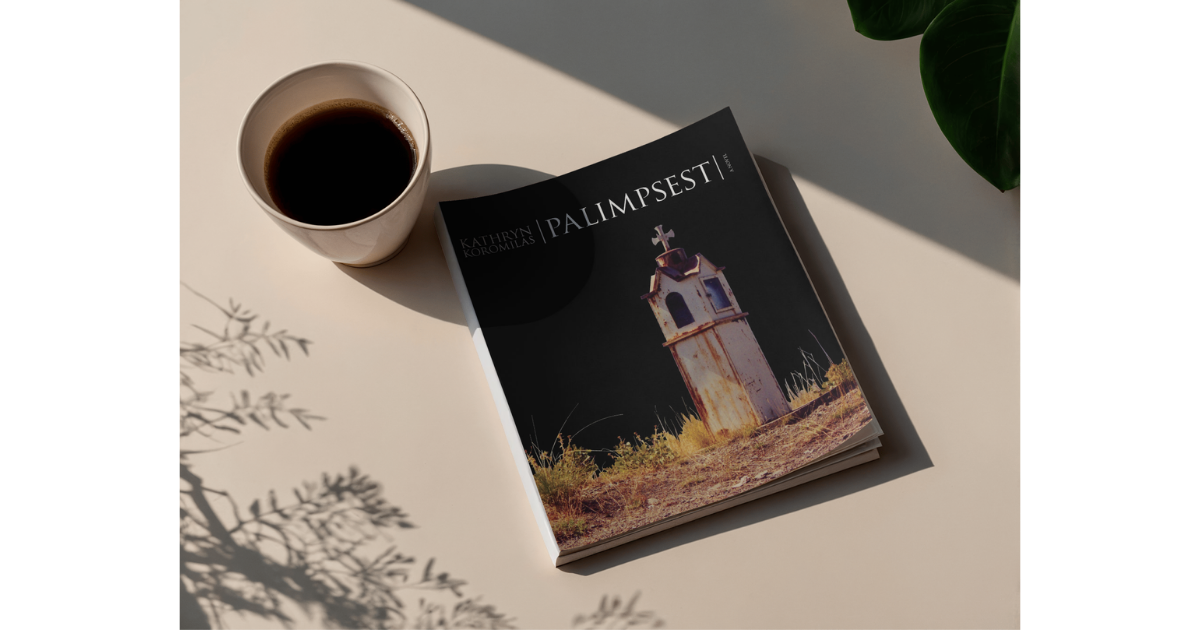

Hey, thanks for reading. Over the course of this serialisation, I’d love to hear your thoughts on the story, the writing, the themes, as well as your own obsessions and explorations into forms and genres that can hold your stories.
Comments
Nothing yet. Say the first thing.
Sign in to join the conversation.