
Hi there. It’s hard to believe it is July.
This month, we are focusing on threads of gratitude in the reading life. Coming your way are posts about…
Acknowledgements in books
Gratitude for the library
A deep appreciation of audiobooks
So let’s get this gratitude-fest started.
I do.
I especially enjoy the ones with inside jokes, anecdotes about how a loved one played a role in the writing process, or nicknames that I will never really know the truth behind. These little treats are like the special wink, nod, or clandestine phrase during an Oscars’ acceptance speech. In a book’s last pages, you step out of the story and into a room with the author and all the people, present and past, who in some way contributed to this momentous occasion. Because it is a momentous occasion, a book was written! Let’s be grateful for books being written and never forget that it is a very good thing. And look, this author has people! People who helped, inspired, supported, or at the very least brought sustaining snacks to this writer so that we can read their words.
Gratitude is the real juice of the acknowledgement section. It’s a literary example of the thank-you notes that your mom forced you to write in childhood. Or maybe it’s a little deeper because hopefully it’s not the shortest note you could get away with, so you could go watch TV. It’s also not dissimilar to a popular practice where a letter is written expressing gratitude to someone, past or present. Writing a gratitude letter is sometimes part of a psychology class, therapy, or a prompt from the internet to “increase well-being.” But there is something to it; it helps the brain turn towards gratitude. These letters may or may not be given to the letter’s subject, depending on the circumstances. But for those who write a book and thoughtfully approach their acknowledgements, it gets printed hundreds of times for an audience of strangers to either skip over or partake along their side. There are certainly the somewhat formal acknowledgements that feel more like a corporate memo. I won’t jump to the conclusion that these authors are less grateful. Perhaps they keep their gratitude private and personal. That’s my hope at least.
And then there was the one day I found my own name unexpectedly in an acknowledgement section. At the end of Hello, Cruel World! Science-Based Strategies for Raising Terrific Kids in Terrifying Times*, author Melinda Wenner Moyer, graciously names writers and creators who work in the parenting space. A space I contribute to. And there was my name. I did contemplate that perhaps I was having some kind of delusion of grandeur and imagining it, but no, it was there.
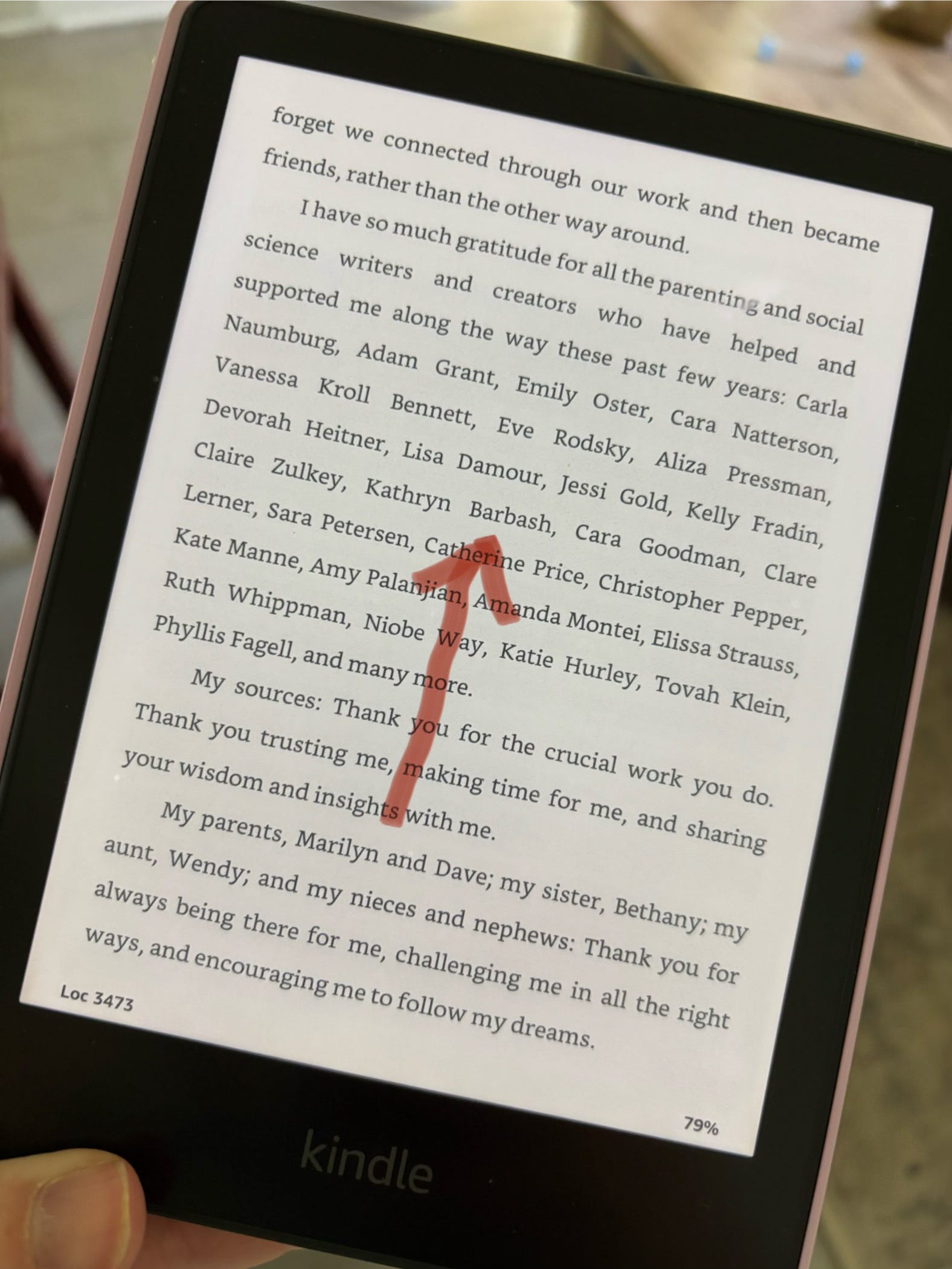
So you should always check because you just never know. Although I am not sure that is a helpful takeaway. As a recipient of this form of public gratitude, I was surprised and delighted. In a time when we are so often thanking others publicly in such temporary forms, like a social media post or a tag that quickly dissolves into the darkness of an algorithm. It feels a little like an illusion in a desert, at a time when we all feel a little disconnected. It goes away so fast. Was it even really there? But to see gratitude in print, that feels like something for authors, recipients, and readers to hold onto.
Send out some gratitude for your reading life and those who contribute to it:
Send a thank you to the friend who recommended a book you loved
Write a letter or email to an author whose book you enjoyed (I’ve done this, AND some wrote back!)
Make a big showy thank you song and dance to your kids when you were able to read for a period of time, and no one died
Send a book as a thank you to a friend or family member in appreciation of something they have done
Oh, and read some acknowledgements; you never know what you might find
Combine print and audio.
This can work in different ways depending on your needs. You can read the print book while listening to the audio to help stay focused. You can also go between print and audio to continue your reading experience at different times. I’ve done this with non-fiction or very lengthy fiction. I often purchase the book, new or used (I purchase a lot of books used; highly recommend), and then borrow the audio through the library or vice versa, so it doesn’t become unwieldy as far as expense goes.
Pump up the AC, rest your body, and get into the comment section.
Do you read the acknowledgements?
Who would you acknowledge if you wrote a book?
Keep your summer reading recs coming…we are all thankful for it.
Comments
Nothing yet. Say the first thing.
Sign in to join the conversation.