
I recently came across a post1 where a young man argued that a key factor in the current mental health struggles is the loss of a “third place” - a space outside of work and home where people gather, build community, and find a sense of belonging. For those of us who work from home, this absence is even more pronounced, as our work and personal lives blur within the same walls.
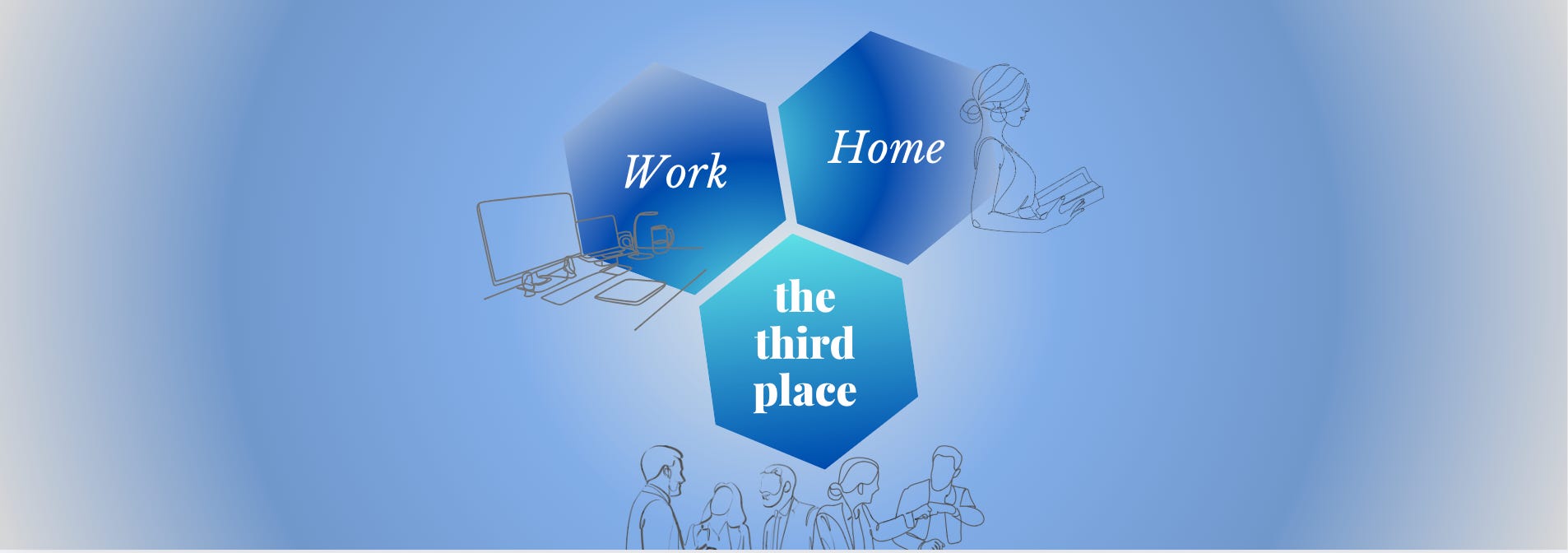
Reflecting on this idea through the lens of my own experience, I can see how our third places have diminished over time, leaving many of us feeling disconnected. Much like a tapestry frays when its threads loosen, the unraveling of these communal spaces has left gaps in the fabric of our lives. But can we mend what’s been lost? Can we weave new connections to restore a sense of belonging? What happens when they disappear, and what does it take to rebuild them in a changing world?
If we want strong, meaningful communities, we must be intentional. We must plan ways to reconnect, cultivate spaces where people can gather, and create opportunities for belonging. Third places don’t happen by accident—they are the result of deliberate effort.
I can remember a time when I had access to plentiful and vibrant third places, many built by an immigrant community striving to create a sense of belonging in a new land. Over time, as people moved away and children integrated more fully into the dominant culture, the once-thriving social circles shrank and community events took a backseat to school and work. Without a deliberate effort to sustain the connection to the clubs, to attend the gatherings, and to participate in shared traditions, access to the third space gradually faded, growing more distant with each passing generation.
In my early 20s, I was involved in school clubs, a writing group, a dance troupe, and was closely affiliated with my family’s church- attending and participating in services and related events, ethnic community celebrations, and gatherings with friends on a weekly if not daily basis. In my late 20s, as work and family took on a larger portion of time, attendance at those events dwindled and, at least for me, was replaced by online communities where I found others from around the world who were interested in the unique constellation of interests that were gaining popularity - journaling, creative planning, and art-filled letter-writing and penpaling.
When the pandemic hit, online communities became a lifeline for many of us. But as screen fatigue set in and the stress of survival took precedence, I suspect that many of us withdrew (whether intentionally or not) from the digital spaces we had once relied on. This left a gap in my social tapestry that remained vacant for a long time. Why was it now so difficult to find and to re-integrate into community life? Many of the organizations and clubs still existed, but no longer held the same attraction they did in my youth. And who was responsible for creating them in the first place? Experiencing this social void made me realize just how essential third places are, and how much we rely on the people who create and sustain them.
Looking back, I now see how vital these spaces were - not just for socialization, but for fostering a sense of purpose and belonging. Whether formal or informal, all third places share one essential element: they are intentionally created and sustained by individuals or groups who curate the experience. Given the nature of my work (more on that in a future post), I have come to deeply appreciate the role of community organizers. These are the people who bring educational, cultural, social, religious, sporting, and other niche events to life. They are the backbone of third places and, in keeping with my initial metaphor, the weavers of community. As relationships deepen and shared experiences accumulate, the tapestry takes shape, the weave tightens and strengthens, ultimately growing more intricate in pattern and more resilient as a whole.
Even when a particular third place fades from our daily lives, its influence lingers, reminding us that we were once part of something larger than ourselves, and that we can be again. And this is where I find myself: ready to begin again. I feel nostalgia for the social fabric of my youth and, as many have lamented before, for the effortless friendships that once formed through proximity and group affiliations curated by the caring adults in our lives.
I have come to accept that we move through life in cycles, each stage bringing shifts in how and where we find connection. (A realization I credit, in part, to my wonderful astrology mentor Bronwyn Simons Astrology.) In adulthood, we become the pattern-makers of our social tapestry, and often, we must also serve as the loom upon which new connections take shape.
So, with an open and welcoming heart, I set out to find (or perhaps create) the third place I need at this stage of life. It will take intention, and willingness to mend what has frayed or, most likely, a determination to weave something entirely new. But if we truly want to reclaim a sense of belonging, we must be willing to plan, cultivate, and create it.
Won’t you join me?
Curious about the original article? Want to learn more about the origin of the term “third place”?
https://www.newsweek.com/gen-z-man-theory-generation-depressed-goes-viral-2030436
From the article:
“The concept of the "third place" was coined by urban sociologist Ray Oldenburg, in his book _The Great Good Place_ (1991). Oldenburg emphasized the importance of informal public spaces—such as cafes, pubs, and community centers—in fostering relationships and well-being. "Life without community has produced, for many, a lifestyle consisting mainly of a home-to-work-and-back-again shuttle," he wrote. "Social well-being and psychological health depend upon community."
No posts
Comments
Nothing yet. Say the first thing.
Sign in to join the conversation.