
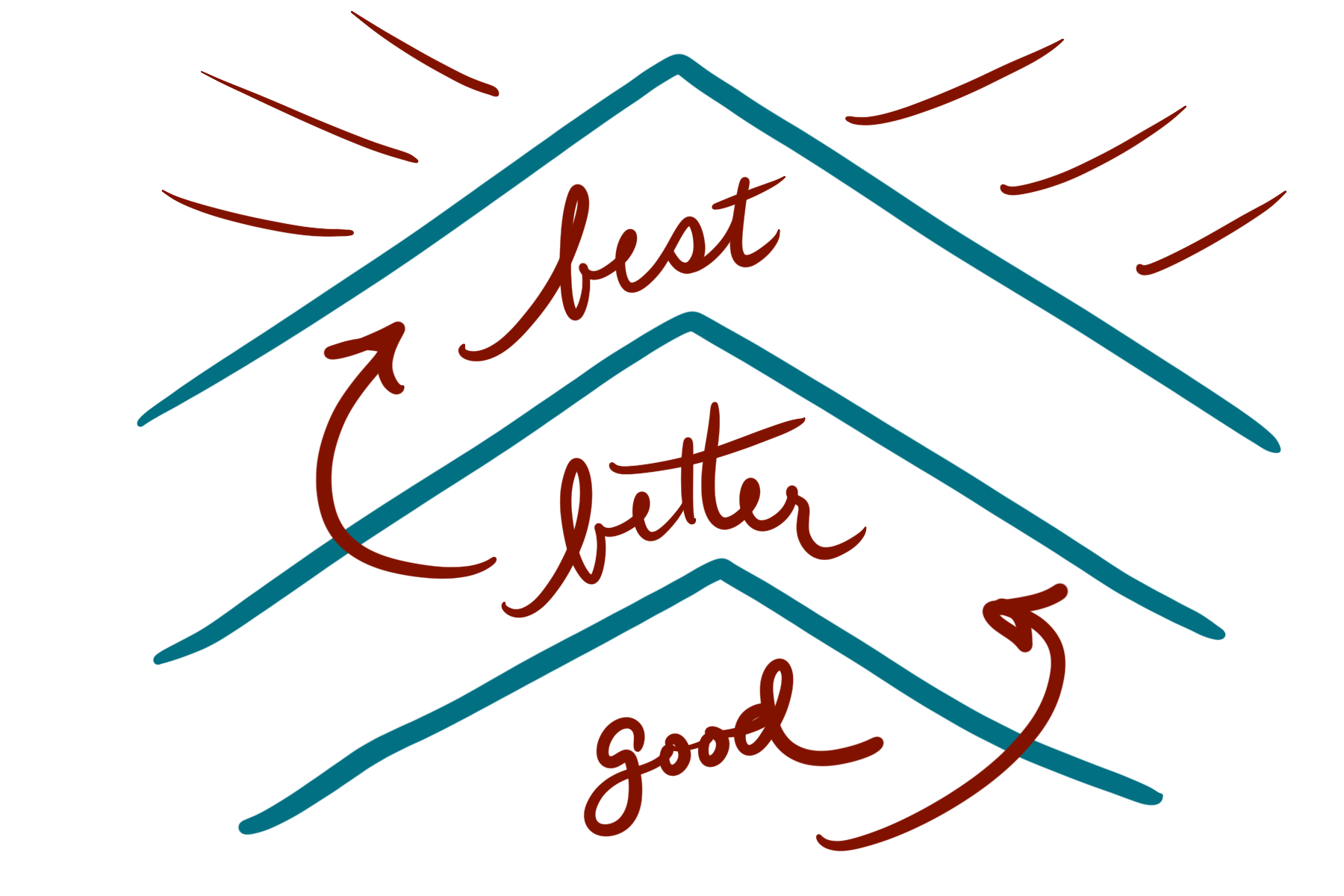
Have you ever heard of the framing, “Good - Better - Best”?
I learned about it from a colleague several years ago, and every so often I take it off the shelf in my mind labeled “Mental Models and Frameworks,” dust it off, and examine an idea through its lens.
This morning I was reading “Connected by Nature” the impact report from the Canadian Wildlife Federation. One of the calls to action was, “If everybody takes just one action, each week, all year, that’s 52 actions. Multiply that by the population of Canada and we have a movement.” 1
It made me think of how positive environmental habits can be nurtured in daily life starting at a young age. Since I work in education, naturally my mind went to how schools can integrate more of these actions as part of a holistic education. I came up with a few ideas, and used “Good - Better - Best” to frame them.
Some schools have “house systems” similar to those in Harry Potter. What if environmental education was added (good), infused (better) and embedded (best) into that system? Playing around with this idea, I came up with the following:
Good - Students receive house points for any and every positive environmental act.
Better - House groups plan and execute extracurricular activities and projects promoting one environmental cause (their house name can even reflect that cause), along with receiving points for every environmental gesture.
Best - Houses are environment-focused and points are accumulated for every environmental action, every fundraiser, every volunteer activity, every project. Outdoor education and outdoor classrooms are the norm. Environmental-based experiential activities are embedded in the curriculum, and students take part in Place-Based Learning projects (also known as Community Service Learning or Authentic Learning Activities) with a focus on bettering their local environment.
There are myriads of ways environmental education can benefit from small and large gestures, and the Good-Better-Best framework can meet you where you are, and get you thinking about the next 3 steps. I encourage you to try it out for yourself, and share it with others in your community. And if you work in education in Canada, there is some exciting news in the report: The Canadian Wildlife Federation has launched the “Canadian Centre for Nature-based Education” - I am excited to learn more about it!
Wishing you a day of Good, Better and Best case scenarios,
Katherine
P.S. Does this need to be said? Just in case… I am in no way sponsored by or affiliated with the Canadian Wildlife Federation. I received the report because I donate to the cause and read it this morning over coffee and got inspired. Voilà.
P.P.S. Post web-search note: Just found out a sports team made the GBB framing famous in 2025? Who knew! Speaks to its versatility as a framework, so give it a try!
Source: “Connected by Nature” Winter/Spring 2026 Impact report by the Canadian Wildlife Federation
No posts
Comments
Nothing yet. Say the first thing.
Sign in to join the conversation.