
Most people have never heard of the Malthus versus Godwin debate. But they are living inside it, and this summer a 136-page report dragged the whole argument back into daylight.
In June 2026, the World Inequality Lab launched its Global Justice Project. Thomas Piketty, Lucas Chancel and a team of researchers spent two years building a model of the global economy out to 2100. The question they asked was the one Malthus and Godwin fought over two centuries ago, only sharper. Can a finite planet deliver a good life for everyone? Their answer was yes. Their condition was a hard turn toward sufficiency. Shorter working hours. A different basket of consumption. More health and education, less stuff. A drastic cut in inequality of income, wealth and power.
It is a serious piece of work. The ecological economist Timothée Parrique called it a possible Meadows moment, the kind of research that can crack open a collective imagination that has been stuck for decades. He also wrote a long, generous critique of it. That critique is where the argument gets interesting, because it shows that the report may be more radical than its own authors are willing to say out loud.
A word that keeps getting smuggled
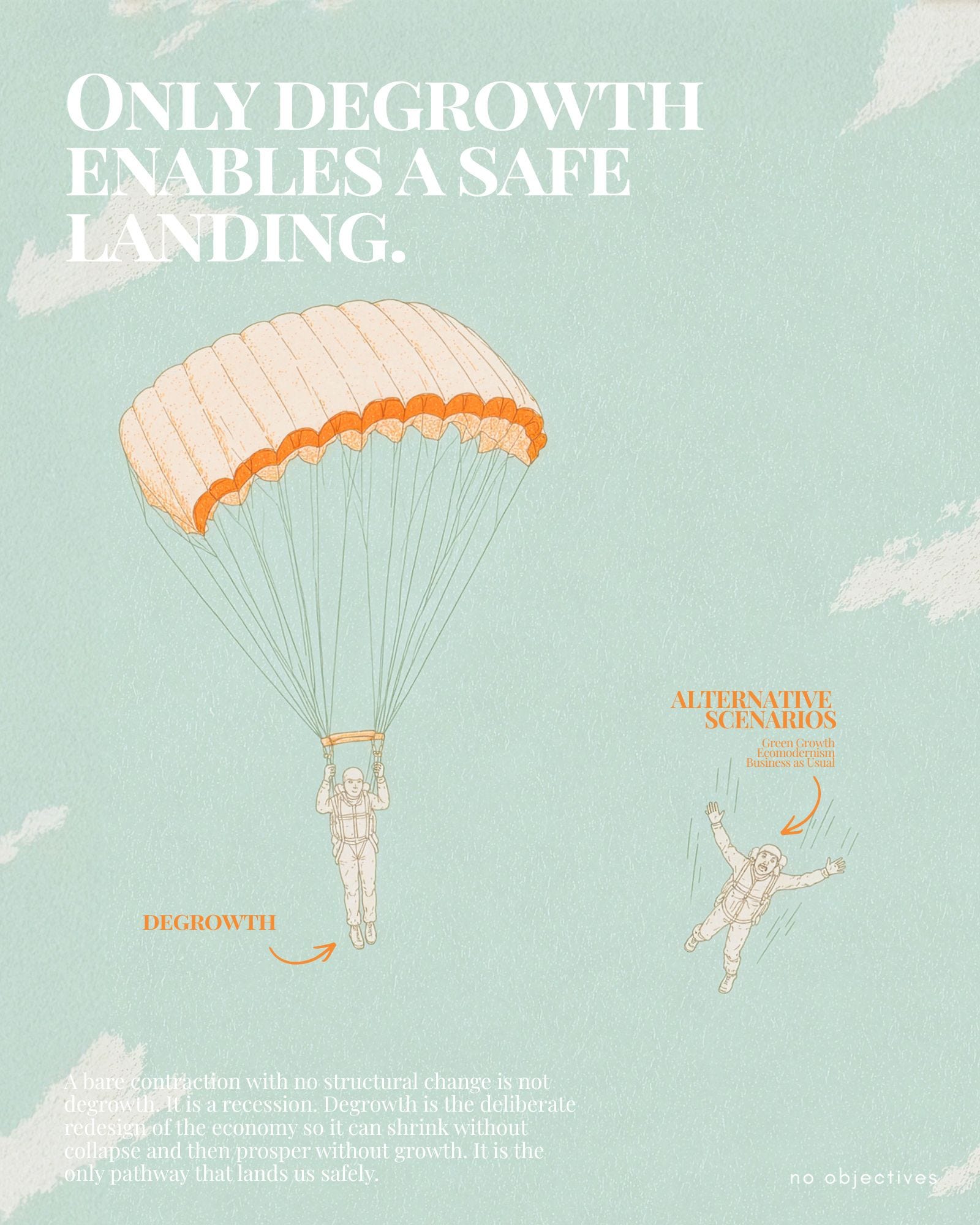
Start with vocabulary, because the whole debate turns on it. The report tests a set of scenarios. One of them caps world GDP per head at a low level and lets the economy contract. The authors call this “uniform degrowth” or “aggregate degrowth,” and they report a headline finding: targeted sufficiency can beat it. The implication readers take away is simple. Degrowth loses. Sufficiency wins. Parrique’s first move is to point out that this is not what degrowth means. Degrowth, in the actual literature, is never a blind shrinking of GDP. It is the planned, equitable downscaling of production and consumption, bundled together with structural change and designed to protect wellbeing while it happens. A bare contraction with no structural change is not degrowth. It has a much older name. It is a recession. So the honest version of the finding is not “sufficiency beats degrowth.” It is “sufficiency beats a recession.” Of course it does. Everyone already knew that. Tim Jackson’s old line, by way of Peter Victor, captures the difference perfectly. There is degrowth by design and
there is recession by disaster, and the entire point of the degrowth literature is to build the first so you never get the second. A recession is a growth-dependent economy seizing up against its will. Degrowth is the deliberate redesign of that economy so it can shrink without collapse and then prosper without growth. Label the recession “degrowth” and you hand every critic a strawman. You invite people to confuse a concept with its exact opposite.
The finding the report buried
Here is the part that should change the conversation. Once you fix the vocabulary, the report’s own numbers point the other way. Parrique reads the same model and finds that every degrowth scenario that includes structural change outperforms the favoured sufficiency pathway on emissions. And one scenario stands alone. The most ambitious degrowth pathway, the low-GDP one combined with structural change, is the only scenario in the entire report that actually holds warming to 1.5 degrees. Everything else overshoots.
Sit with that. The team built a vast model to show that you can reconcile a habitable planet with a good life. Their preferred answer, the Sustainable Convergence scenario, lands at 1.8 degrees. Close, but past the line drawn in Paris and past the safe boundary for climate. The only pathway in their own work that reaches 1.5 is the one they chose not to put on the poster. There is nothing wrong with picking a softer, more sellable scenario. Politics is real. But you should not let the softer choice hide the fact that, of everything on the table, the degrowth shaped strategies decarbonise the rich world fastest. The most sustainable resource is the one you manage never to use. If a country already has more than enough, producing and consuming less is not a sacrifice to be minimised. It is the most powerful lever in the room.
Even on wellbeing, degrowth holds up
The report has a clever rebuttal to all this. Raw GDP undersells the sufficiency path, so the authors build a richer measure they call augmented GDP. They add the value of all the freed-up leisure time. They add the value of avoided warming. Counted this way, their preferred scenario looks twice as desirable as the high-growth alternatives. The opposite of what plain GDP suggested. It is a strong move. The trouble is that it does not stop where the authors stop it. Parrique applies the same accounting to the radical degrowth scenario. That pathway frees up even more time, because it needs even less work. It avoids even more warming, because
it actually hits 1.5 degrees. Run the numbers consistently and the degrowth scenario does not merely keep pace. It comes out ahead. On the framework’s own terms, with the authors’ own valuations, the deeper cut delivers more welfare, not less. And that is before you make the obvious adjustment of valuing an hour of free life slightly more than an hour of paid labour, which would tilt the scale further still. The case for going further is sitting inside the report. It just was not totalled up.
Where the optimism gets shaky
None of this means the comfortable middle path is safe. Parrique’s third set of doubts is about whether the headline scenario is even biophysically real. The model runs on a single environmental constraint. Carbon. That is one face of the Rubik’s cube. There are eight other planetary boundaries, from biodiversity to freshwater to land, and a plan that decarbonises while quadrupling the size of the world economy may simply shove the pressure from one boundary onto another that the model never tracks. Run your data centres on clean electricity and they look fine through a carbon lens. Look at the materials, the land, the water, the wrecked ecosystems around them, and the picture changes.
Then there is the dematerialisation assumption, the quiet hope that rich economies can keep shifting from material sectors to services and shed their footprint as they go. The historical record does not cooperate. Across the world, the share of material sectors in consumption did not fall over the last half century. It rose slightly, from forty to forty-two percent. New consumption gets added on top of the old, it does not replace it. The environmental historian Jean-Baptiste Fressoz calls this the story of more and more and more. Nordic countries are the showcase for the service economy, and even they kept piling on material use in absolute terms. Norway’s footprint climbed faster than its GDP.
The reason is not mysterious. Service economies look weightless because they import their weight. Someone, somewhere, still mines the metal, pours the concrete, ships the goods and builds the server farms. A massage needs a heated room. Software needs hardware. In a world where every country tries to dematerialise at the same time, it gets very hard to say who is left holding the shovel.
And the engine of the whole model assumes labour productivity keeps rising more or less on its own, even as working hours fall. But historically that productivity was bought with energy and materials, with each worker handed more powerful tools fed by more throughput. Shrink the biophysical scale of the economy and it is not obvious the productivity gains keep coming. The model may be quietly importing, through its assumptions, the very throughput it claims to be retiring. Finally, the friendly 1.8 degrees is conditional. It assumes a best-case energy transition. Slow the decarbonisation to match what governments have actually pledged and warming jumps to 2.7. Slow it to what they have actually implemented and you reach 3.3, a Mad Max number. The optimism rests on a hypothetical, and hypotheticals are a thin thing to bet a planet on.
The Danish mirror
For anyone sitting in Copenhagen, there is an uncomfortable detail in the footnotes. The fair-share logic of climate justice cuts hardest at the countries that emitted first and emitted most. Tilsted and Bjørn examined Denmark’s flagship target, a seventy percent cut by 2030, and judged it drastically insufficient once you account for historical responsibility. Weigh the cumulative emissions properly and the remaining Danish carbon budget does not just shrink. It goes negative. The fair contribution stops being “emit less” and becomes “pull carbon back out.” Denmark sits just above the report’s 5000 euro income benchmark a month, one of only two countries in the model already past it. The green frontrunner, looked at honestly, is closer to an indebted culprit. That is not a comfortable sentence. It is an accurate one.
What Parrique actually proved
Strip away the modelling and the choice is the same one Malthus and Godwin left us. Malthus saw that nature has limits. Godwin saw that society can be transformed. The degrowth argument takes both seriously at once. It says the limit never went away during the long fossil-fuelled boom. It changed form, into climate breakdown, biodiversity collapse, soil and water stress, and rising instability. And it says the limit can still be met through justice rather than catastrophe, but only if rich societies stop defining progress as endless expansion.
What Parrique did was settle the argument on the report’s own ground. He did not bring outside numbers. He did not wave a manifesto. He took Piketty’s model, the most ambitious global transition model ever built, and he read it honestly. And read honestly, it says one thing without flinching. Of every pathway tested, only the deep degrowth scenario with structural change holds warming to 1.5 degrees. Every other route, including the comfortable sufficiency path the authors put on the cover, overshoots the line that climate science draws.
That is the verdict. Not a preference. Not an ideology. A result. The single pathway that obeys the science is the one that asks rich economies to produce and consume less, by design, with the gains shared. And when Parrique applies the report’s own wellbeing accounting, valuing freed time and avoided warming, that same degrowth pathway comes
out ahead on welfare too. It is the most effective on emissions and the most desirable on human flourishing. Both at once. So the case is no longer open. A liveable future for all is possible. The report proves it can be done. Parrique proves that degrowth is the only way it gets done in time. Everything softer leaves us above the line, betting the planet on a best-case energy transition that current policy is nowhere near delivering. The real question was never whether limits exist. It is whether we meet them by design or by disaster. The science has now picked the only door marked design. Our job is to walk through it before the other one opens on its own.
Source:
Primary sources
Lucas Chancel, Cornelia Mohren, Rowaida Moshrif, Moritz Odersky, Thomas Piketty and Anmol Somanchi (2026). The Global Justice Report: A Plan for Equality and Prosperity Within Planetary Boundaries. World Inequality Lab, Paris School of Economics. The 136-page report launched at the World Inequality Conference on 4 June 2026. https://inequalitylab.world/en/global-justice-project/ The underlying modelling paper is Chancel, Mohren, Odersky, Piketty and Somanchi, “Prosperity Within Limits? Planetary Habitability, Global Convergence and Structural Transformation, 2026 to 2100,” WIL Working Paper 2026/03 (February 2026).
Timothée Parrique (2026). “A response to the World Inequality Lab: Degrowth for global justice?” This is the long critique the essay turns on, including the “possible Meadows moment” framing, the reading that every structural-change degrowth scenario beats the favoured sufficiency pathway on emissions, and the point that only the deep degrowth scenario holds warming to 1.5 degrees. https://timotheeparrique.com/a-response-to-the-world-inequality-lab-degrowth-for-global-justice/
Joachim Peter Tilsted and Anders Bjørn (2023). “Green frontrunner or indebted culprit? Assessing Denmark’s climate targets in light of fair contributions under the Paris Agreement.” Climatic Change, vol. 176, art. 8. The source for the Danish 70 percent target being “drastically insufficient” once historical responsibility is weighed. https://doi.org/10.1007/s10584-023-03583-4
Joachim Peter Tilsted, Anders Bjørn, Guillaume Majeau-Bettez and Jens Friis Lund (2021). “Accounting matters: Revisiting claims of decoupling and genuine green growth in Nordic countries.” Ecological Economics, vol. 187. Underpins the Nordic and Norwegian material-footprint point.
Jean-Baptiste Fressoz (2024). More and More and More: An All-Consuming History of Energy. Allen Lane / Penguin. The source for the additive “more and more and more” account of energy and the claim that new use is piled on top of old rather than replacing it.
No posts
Comments
Nothing yet. Say the first thing.
Sign in to join the conversation.