
There is a belief circulating through progressive spaces right now that feels like wisdom and works like a sedative. It goes like this. We are stuck because we measure the wrong things. Fix the metric and the world will follow. Replace GDP with a wellbeing index, get profit to account for nature, build a greener set of national accounts, and behaviour reorganises around the new numbers. It is the most reasonable-sounding idea in the room. It is also quietly draining the energy from the people who could actually change something.
Start with the evidence. We have never measured the planet or society better than we do today. Satellite data, Scope 1, 2 and 3, national carbon inventories, atmospheric readings taken in real time, poverty rates, inequality indexes, health data, education levels, housing statistics, wellbeing surveys. The information is extraordinary. And emissions keep climbing. Social foundations are cracking. Inequality deepens. Health, housing, education, and care systems are under strain. We can see the wall coming in perfect resolution, and we drive at it anyway. So measurement is not the lever. If better information changed behaviour, the climate crisis would already be behind us. We have never been better informed, and we have never been further off track.
Sit with that, because it breaks the whole theory. The story says people act once they can see the truth. But we can see it. The truth has been measured, modelled, graphed and published for forty years. Seeing was never the thing standing in the way. Why does the measurement story keep winning anyway? Because it offers something comfortable. It lets you feel like you are moving while you stand still. Every new index arrives with a launch, a pilot city, a working group and a wave of optimism. It looks exactly like progress. It asks nothing of power. That is the quiet function of the narrative. A measurement is safe. It names no enemy and asks no one to give anything up. It promises that the road to a different world runs through better information, which means the work becomes research instead of confrontation. The pressure that might have gone somewhere dangerous gets poured into a spreadsheet instead. It is also the perfect product for an institution. Fundable, publishable, and guaranteed to offend no one who matters. You can build a career on a better metric. You cannot build one on telling powerful people the cost should fall on them.
Here is the part the scoreboard story cannot absorb. GDP did not win because it was measured more precisely than the alternatives. It won because it served capital and it served states. It still does. It turned messy human activity into a single number a government could grow and a market could chase. Useful to power is the only test a metric has ever really had to pass. A better number does not threaten that arrangement. It just sits beside it on a slide. You do not get a new value system by inventing a better metric. You get it by shifting who holds power. And power does not move when you show it a nicer dashboard. It moves when the cost of saying no climbs higher than the cost of saying yes.
History is blunt about this. Civil rights were not won by designing better choices for politicians. Nobody framed women into the vote. The eight-hour day arrived because workers made the alternative more expensive than the concession, not because employers were nudged into kindness. Pressure from below is the whole mechanism. You cannot nudge power. You confront it. This is what radical flank theory described. Herbert Haines showed it in 1984. Moderate reformers gain their leverage not from proximity to power but from the radicals standing behind them, raising the stakes. The moderate ask only sounds reasonable because something less comfortable is standing right behind it. Take the threat away and the reform comes with an expiration date. The conflict inside a movement is not a flaw to be smoothed away. It is the immune system.
The network science points the same way. Damon Centola’s work shows that norms do not flip because elites adopt them first. Elites are late. The people at the centre of a network are usually the last to move, not the first, because they have the most to lose from moving. Change runs through committed minorities who reinforce each other until they hit critical mass and the norm tips. Below that threshold the minority fails. Above it, the whole thing moves fast. Nobody measured their way there. They organised their way there.
With the Reduction Roadmap, a mobilization campaign, the Danish building industry was shown what it would actually take to stay within planetary boundaries. But it was not left as another report. The evidence was turned into a campaign. Companies were mobilized, power was confronted, and an entire industry moved from barely knowing what planetary boundaries were to seriously debating binding limits on how we build. Hundreds of companies signed on (The majority of all Danish workplaces in the building industry), from small craftsmen to some of the largest developers in the Nordics, and together we did something that had never happened before in Danish history. We mobilized not to fight regulation, but to demand it. We asked to be regulated. They demanded the limit instead of lobbying against it. This all happened, not because we handed the sector a better KPI, but because a committed group made the old way indefensible and the new demand impossible to ignore. We did not win everything. Powerful actors lobbied the policy down with deliberate misinformation, which is itself the proof. You only bother attacking a frame that threatens you. The ones adopted without a fight tend to be the ones that change nothing.
The campaign proved something bigger than a policy win. When you confront power, you do not just hope for better legislation. You start to move the culture itself. Three years on, the conversation in Denmark has shifted. It used to be about how to build greener. Now it is about whether we should build at all. Sufficiency became a serious word in an industry built on more. The next generation of architects is asking a different question. Not how do we keep expanding with a smaller footprint. But how do we use less, share the square metres we already have, renovate what is already standing, and stop mistaking growth for progress.
A Danish newspaper called recently to ask how it happened. They had been interviewing other architects working on the transition, and they had just visited the architecture school. They came back stunned. They could not find a single student who wanted to work on speculative new build. Not one. That is what a culture moving fast actually looks like. This is why action matters. This is why confronting power matters. It does not just win you a rule. It shows people there was another way all along.
This is why the most dangerous thing in this whole conversation is not denial. Denial is at least honest about being the enemy. You can argue with a denier. You know where they stand. The real danger is the well-meaning version that normalises insufficiency. The one that quietly moves the measuring stick from planetary limits to whatever feels achievable this quarter, and calls that realism. It is harder to fight, because it speaks your language and shares your values and still ends in the same place. It disarms the people who would otherwise push, and it does it with a smile and a better chart. It takes the anger that might have moved something and files it into a working group. None of this means measurement is worthless. We need the data. We need to know how bad it is and whether anything we do is working. The danger is not the measuring. The danger is the story we wrap around it, the one that says the measuring is the change. It is not. It is what you reach for when you want the feeling of progress without the cost of it.
So be careful with the seduction of the scoreboard. It feels like progress, because you built a new index. A fight becomes a research project. A movement that needs more nerve is told to go and gather more evidence. The better dashboard ends up holding the energy that should have gone into confrontation. Imagination gives us the destination. Measurement can describe it in fine detail. Neither one builds the road.
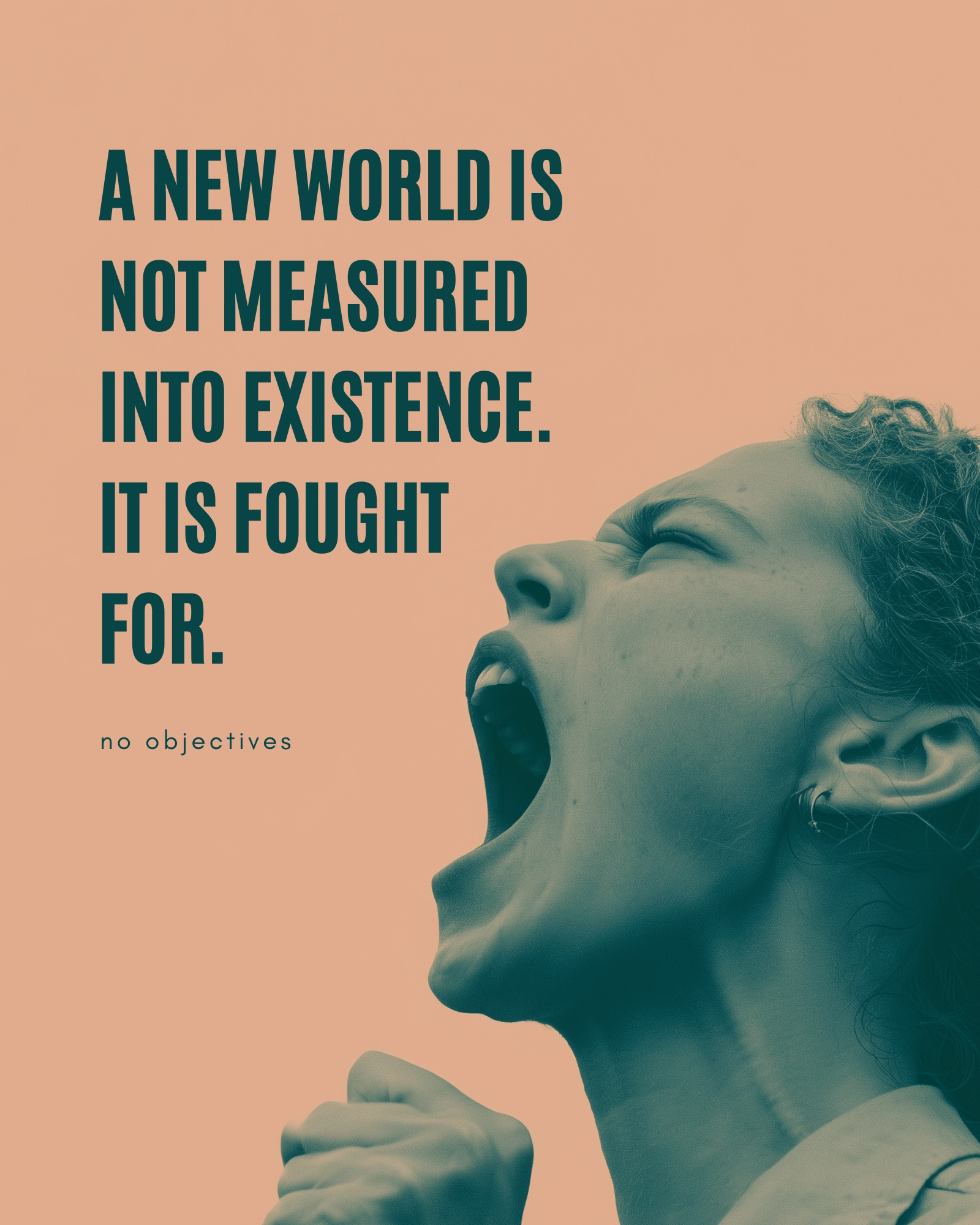
A new world is not measured into existence. It is fought for.
No posts
Comments
Nothing yet. Say the first thing.
Sign in to join the conversation.