
One of the occupational hazards of writing historical fiction is falling in love with details your readers will never believe.
History does not care about plausibility. It simply happened. And some of what happened is so strange, so perfectly suited to fiction, that putting it in a novel feels like cheating.
Here are five details I encountered in my research that I could not have invented—and that have influenced, or directly appeared in my work.
1. Courtrooms Were Held in Saloons—and Worse
In many frontier towns, there were not enough proper buildings for civic functions. Trials were conducted in the same rooms where men drank whiskey the night before. Justice on the frontier was improvised.
In Shoot Like a Girl, the prequel novella to the Annie Oakley Mystery series, Annie must testify in a jailhouse setting. No marble halls. No elevated bench. Just a woman standing her ground in a space that was never designed to take her seriously. The indignity of the setting becomes inseparable from the stakes of the scene—because where justice is administered says everything about who it was built to serve.
2. Annie Oakley Could Split a Playing Card Edge-On and Riddle It Before It Hit the Ground
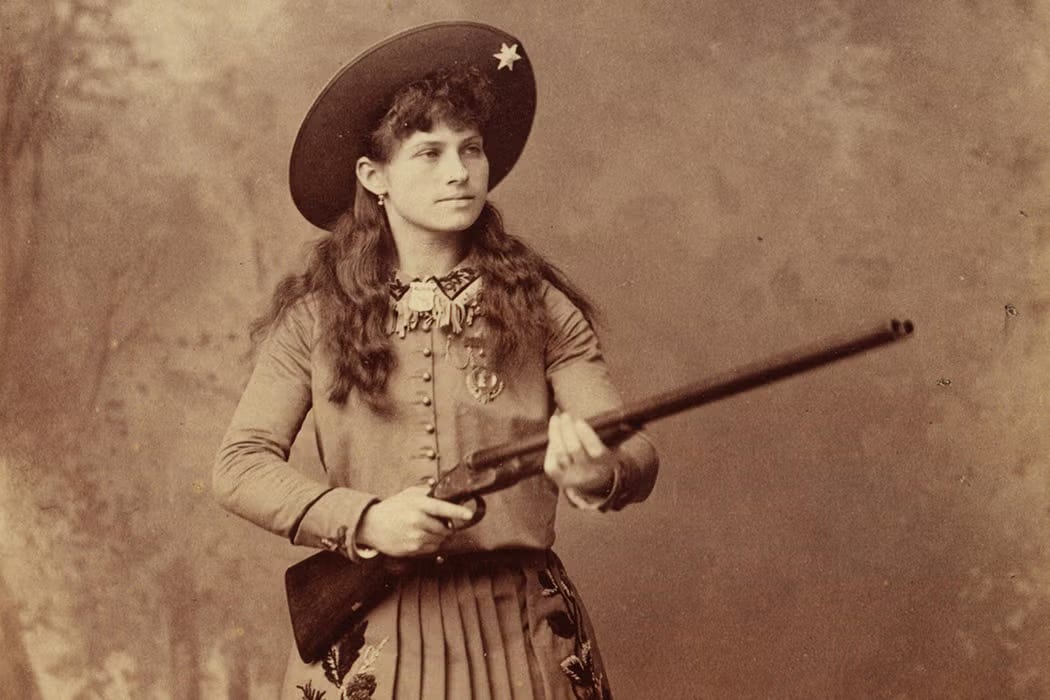
This is not legend. It is documented. At ninety feet, using a .22 caliber rifle, Annie could split a playing card held on its thin edge—and then put five or six more holes through it before it touched the ground. She shot dimes tossed into the air. She snuffed lit candles with a single bullet and uncorked bottles without breaking the glass. In Berlin, the Crown Prince of Germany insisted she shoot a cigarette from his mouth; she made him hold it in his hand instead. At sixty-two, she hit a hundred clay targets in a row from sixteen yards. When she died in 1926, her husband Frank Butler stopped eating. He followed her eighteen days later.
When I write Annie Oakley as a character, I never need to exaggerate. The real woman was already more extraordinary than most fictional heroes. The challenge is not making her impressive. It is making her just an ordinary woman with extraordinary talents.
3. Mourning Jewelry Was Woven from Human Hair
In the nineteenth century, it was common—and considered beautiful—to weave the hair of the dead into intricate brooches, rings, and watch chains. These were not macabre curiosities. They were acts of love, a way of keeping the departed physically close. But for a mystery writer, an object that is simultaneously sentimental and unsettling is difficult to resist. A mourning brooch can mean devotion. It can also mean obsession. And in the right hands, it can mean evidence.
4. Letters Were Written Twice on the Same Page
To save paper and postage, nineteenth-century letter writers often wrote horizontally across a page, then rotated it ninety degrees and wrote vertically over the same words. Reading one of these cross-written letters is an act of decryption—you must train your eye to follow one layer of text while ignoring the other. For a mystery writer, it is also an irresistible metaphor: the truth is there, layered beneath the surface, if you know how to look at it from the right angle.
5. A Book About Poisonous Wallpaper Was Itself Poisonous
In 1874, a Michigan physician named Dr. Robert Clark Kedzie was so alarmed by the deaths caused by arsenical wallpaper that he compiled a book of samples to warn the public. He called it Shadows from the Walls of Death. It contained eighty-six swatches of wallpaper collected from stores in Lansing, Detroit, and Jackson—every one of them laced with arsenic. He sent copies to libraries across the state. The book could, quite literally, kill the person reading it. Today, the surviving copies are stored in vaults, sealed in protective coverings. A book written to expose poison became a poisonous object itself—a detail so perfectly suited to mystery fiction that I still cannot believe it is real.
I weave details like these into my novels because they do double duty. They make the world feel real. And they give me the raw material for mystery — the blind spots, the assumptions, the things hiding in plain sight that only someone paying close attention would notice.
No posts
Comments
Nothing yet. Say the first thing.
Sign in to join the conversation.