
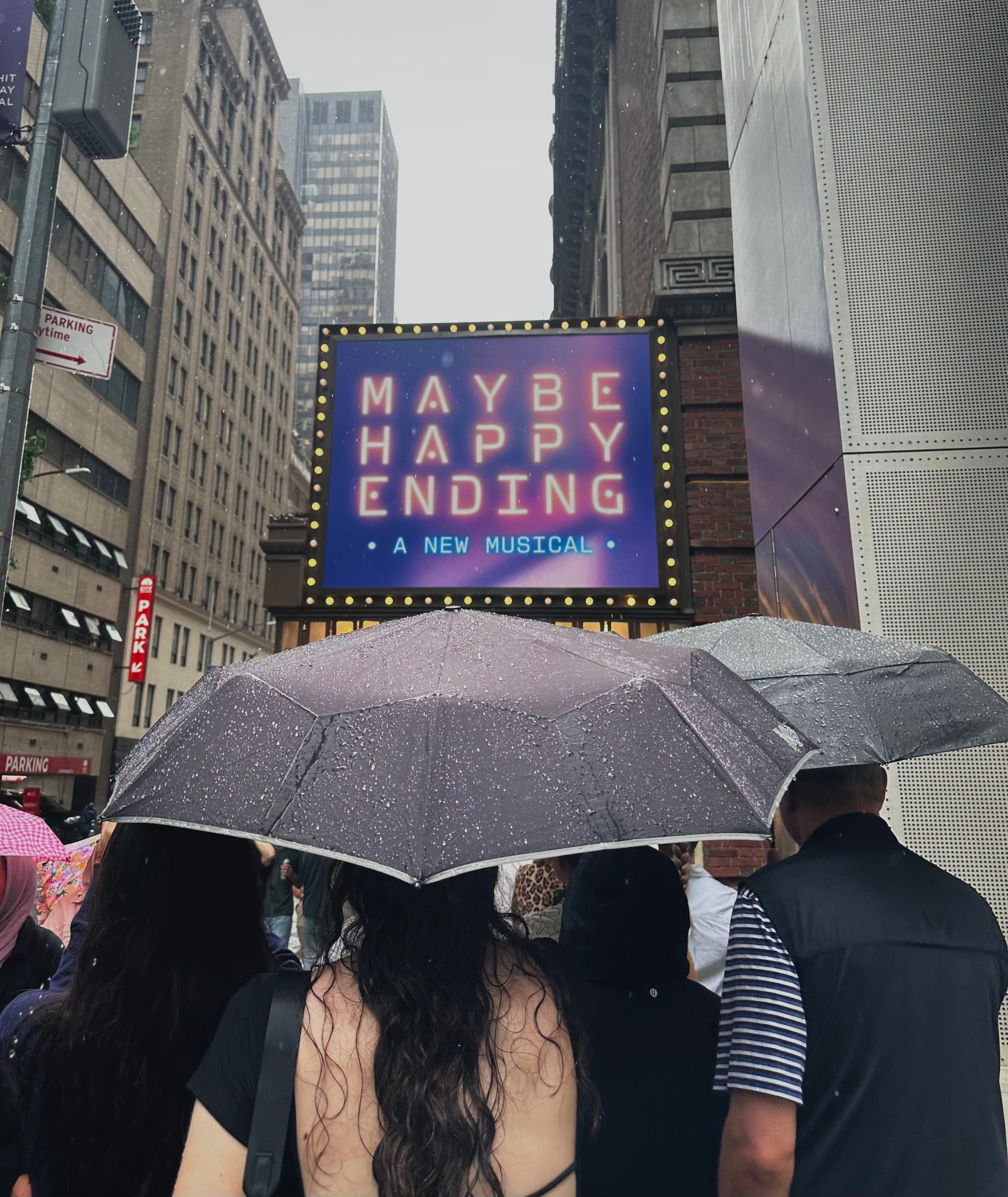
Outside the door of a performance hall, the line to get inside can feel competitive, even a little hostile, especially in the rain, as runoff from strangers’ umbrellas trickles down your neck.
But Saturday night on 44th Street, the mood was brighter than the day. Standing in the drizzle outside the Belasco Theater, everyone was smiling.
This is not my usual crowd. I am used to classical concerts where prim white-haired season ticket holders flash dagger eyes at any hoyden who claps between the movements. They will stab you with a hat pin if you walk faster than them towards the ladies’ room at intermission.
I’m not a big fan of musicals. I don’t hate them; they’re just not my first choice. The acting is broad, and the songs are often unremarkable. And then there’s my problem with suspension of disbelief. (Why is everyone suddenly singing?) But, growing up, my kids inexplicably loved musical theater (even worse, opera.) They could not get enough. They performed in them, sometimes on stage and sometimes in the living room, and watched the videos, and I took them to live performances. For years, we had season opera tickets for three and rotated through the children. Imagine a six-year-old attending a four-hour Mozart opera and staying awake nearly to the end. You have not lived if you have never witnessed a heroically confident eleven-year-old belting the Old Lady’s Tango from Candide.)
Now the Old Lady is grown and has a side gig subbing on violin and sometimes viola for this big play’s tiny orchestra. She has been in New York for eleven years, but this was her first time on Broadway, which is a distinct freelancing ecosystem with a completely different roster of players from the classical music world. For months, she’s been telling me the play is charming; everybody who sees it loved it, and we should try to come up. For part of the show, she appears onstage in the string quartet as part of a scene. She instructed me not to read up on the show in advance because she wanted my unbiased opinion.
Ticket prices are astronomical—here’s another reason we don’t go to shows. Good lord. Say what you will about chamber music, but you can get great seats for less than a hundred bucks, often a lot less. By the time I got around to buying our tickets, the hall was nearly sold out except for a few balcony seats with a safety rail across the sightline and some seats behind a pillar.
Once we got inside and out of the rain, we found our four-hundred-dollar seats in the first row of the Mezzanine on the aisle. The woman beside me said hello and warned me her service dog was beneath her seat—she hoped it was okay. I hadn’t noticed, but somehow, her large yellow lab was nestled down there, eye shut, completely still. She told me some people don’t like to sit beside a dog. She and her dog had been together for nine years, she said. He would soon retire. I told her I once had a black lab who lived to be fifteen. She said, even so, New York guide dogs retire young because here in the city the job is stressful.
“What happens to the dogs after?”
“If the owner can’t keep it, and a family member can’t take it, the school will adopt it out.”
She told me that because of her situation, living in Manhattan, she would be on a high-priority list for a new dog when the time came. “Last time, the wait was only a few months.” In the meantime, she would need to get around town using her white cane.
She had an assisted listening device (ADL) from the theater that she could pair with her AirPods. On the other end, a live person backstage would stream a simultaneous description of everything going on.
There would be a lot going on. The staging for Maybe Happy Ending is a complex set of sliding panels, rotating platforms, video projections, holograms, and innovative lighting tricks. So much dialogue, music, choreography, and gesture. During the show, she and I laughed side by side at the jokes, including the visual gags. In the mornings, Oliver, the lead character, a robot, brushes his teeth and then his open eyeballs. I marveled at her ability to take all of this in aurally, never missing a beat, and at the skill of her invisible-to-us helper, who was sitting somewhere backstage eyes on a monitor, translating into words every nuance of the stage in front of us.
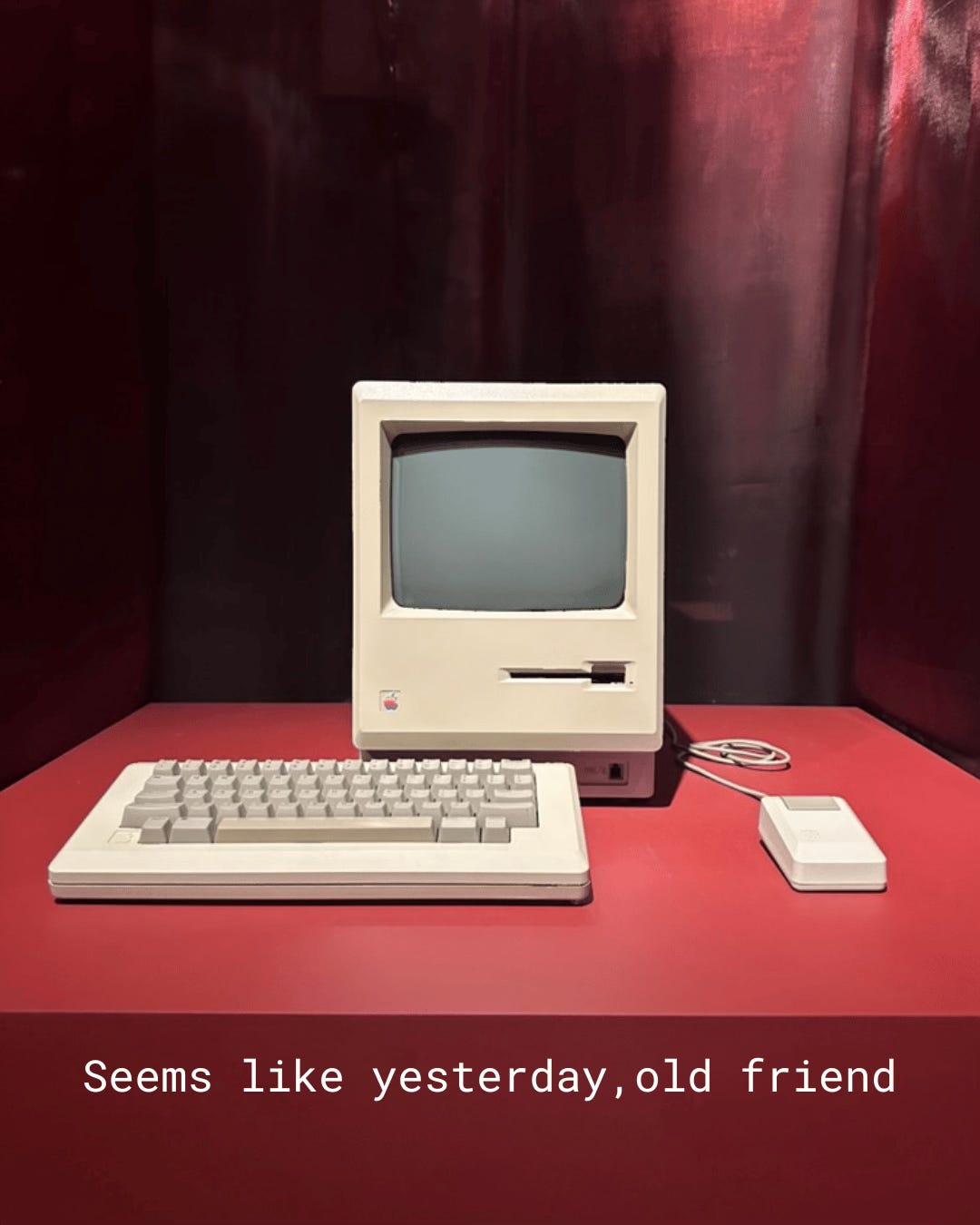
If you were not on an information embargo as I was, I might not need to tell you that the musical Maybe Happy Ending is a rom-com about robots in love. Last night it won “Best Musical” and five other awards at the Tonys. The year is 2064; the place is Seoul. Oliver and Claire are life-size humanoid personal assistants whose owners have parked them at a robot retirement home. They are obsolete. There will be no more updates. Imagine the laptop you depended on so much twelve years ago and how difficult it would be to use it today. That is Oliver and Claire.
Maybe Happy Ending is new to Broadway this season but was developed nine years ago simultaneously in English and Korean. Interesting to think about how our relationship with virtual assistants has morphed over those nine years. The two versions of the play are similar with a few key differences I won’t mention as not to spoil the plot.
Both Oliver and Claire are inexorably breaking down, as old electronics do. As we humans and our guide dogs do. You can get yourself a new knee or a titanium hip, but at some point, as you know, replacement parts will no longer be available.
In both versions, the still-sentient Helperbots face an existential struggle. Oliver, a primitive V3 (think: iPhone 3), has a longer battery life than Claire (V5), but unlike Claire, his processor is crude, and he cannot comprehend his own loss of purpose. He spends his time listening to the collection of jazz albums his beloved former owner, James Choi bequeathed him, waiting for Choi to return. Claire (V5) has a shorter battery life, glitchier hardware, and a savvier understanding of their situation. She knows why she was abandoned (it’s not why you think) and that James is never coming back. Both Oliver and Claire are inexorably breaking down, as old electronics do. As we humans and our guide dogs do. You can get yourself a new knee or a titanium hip, but at some point, as you know, replacement parts will no longer be available.
Until they meet, Oliver and Claire have experienced no primary relationship beyond the owners they assisted long ago. In rom-com tradition, they meet cute as adversaries and spar their way through accidental dependency towards love; that the musical pulls this off grandly without seeming formulaic or trite is a testament to the wit of the writers, designers, and cast.
Every love story ends in sorrow if you follow along past the happily ever after. Every story is a tragedy. Yours is, too, but you already know that. Yet, knowing this, we still choose love. We are built for it. Tennyson’s verse from In Memoriam A.H.H. is one of the most famous lines of English poetry, even for folks who’ve never heard of Tennyson:
'Tis better to have loved and lost
Than never to have loved at all.
Maybe Happy Ending displays, in its technical brilliance, the unanswerable question we face every day: What is the price of memory? We may writhe at the idea of lost love, lost agency, lost self, but our terror of forgetting what was dear to us is stronger than our desire to ease the pain. We have a universal horror of forgetting. No one says, “I look forward to dementia so I can forget my pain.”
In the final scene, with its echoes of Romeo and Juliet, Claire and Oliver have an impossible choice. Watching from my balcony, I felt the clutch inside my chest right on time, just as I was meant to. Brava, bravo to the artmakers. What happens next remains satisfyingly ambiguous in the English version of the musical. In the Korean version, the actor decides while on stage, sometimes switching her choice from performance to performance. I find that idea tantalizing: the destabilizing release the audience experiences, knowing the answer is never final.
We go through life sometimes as helper and sometimes as helped. Mother to child; guide to the guided. In these unequal relationships, there is the sorrow of detachment. And yet we choose to attach again; it must be.
My daughter tells me the actors aren’t divas, as you might expect. They are friendly to the musicians in the show. The kindness and funlovingness of this backstage world is a respite from the button-down and sometimes coldly competitive classical-centered life. Why do classical musicians not do more Broadway? Some have a horror of repetition: eight shows a week, same music, same show, day in and out. Some are snobs and want to play Schoenberg. But the truth is, it’s hard to break in. Broadway players have chops: they are classically trained but made a genre turn at some point early in their careers. On Broadway, they call classical players “legit”—a bit of a dig—meaning that despite their technical proficiency, classical players may not have the ease of spirit and facility to switch styles.
After the performance, our daughter walked us from the stage door to our parking garage, curious to know what I thought. I told her about the guide dog and how I was grateful for that encounter with my seatmate just before the curtains lifted. We go through life sometimes as helper and sometimes as helped. Mother to child; guide to the guided. My seatmate has lived with other dogs before this one, and there will be more to come. In these unequal relationships, there is the sorrow of detachment. And yet we choose to attach again; it must be.
Comments
Nothing yet. Say the first thing.
Sign in to join the conversation.