
Every morning, between my first and third cups of coffee, after I post my embarrassing results to the family Wordle and Connections thread, I dip into a smattering of tech newsletters. My new favorite is The Neuron, about AI trends. Regardless of your feelings about LLMs (and we all have a lot of feelings), it’s a matter of self-preservation to stay alert to the rapid infiltration of AI in our world. Blink, and you’ll miss the next tidal wave. Sunday night, watching Mountainhead1, it occurred to me that while this movie was in development, it was still a titillating cautionary tale. But the release of Google’s VEO 3 tool, only two weeks earlier, deflated its shock value and comic potential. Now, it’s a bloodthirsty after-school special for tech brats.
Subscribe! It's free & AI-free!
Today’s issue of The Neuron begins,
Welcome, humans,
Behold the latest iteration of those “based on what you know about me” prompts (where you get ChatGPT to fess up how much data it’s collecting on you, but like, in a fun way!)
The prompt is:
Create a 4-panel comic that you think I’d enjoy based on what you know about me.
GPT doesn’t know much about me other than my recent interest in acoustic wood panels for my home yoga studio, which shares a wall with our guest room. I asked GPT to look into it, and its results were chattier but otherwise indistinguishable from my Google searches. It knows about my penchant for demanding citations for scientific articles, something that does not come up in the comic. But it also knew a few things about me that I cannot explain. On one hand, the comic is absurd at a level that even I, a lifelong aficionado of absurdist humor, could not approach. I literally could not make this shit up if I wanted to. And I do want to. On the other hand, isn’t it a bit creepy that although I have fed GPT very little personal information about myself or my interests, it nails me to the ground?
The result of my query validates my hunch that we are all characters in an absurdist novel-turned-TV series that, after one too many seasons, has jumped the shark.
In other words, I loved it as much as I hated it. A lot. You should try it, too.
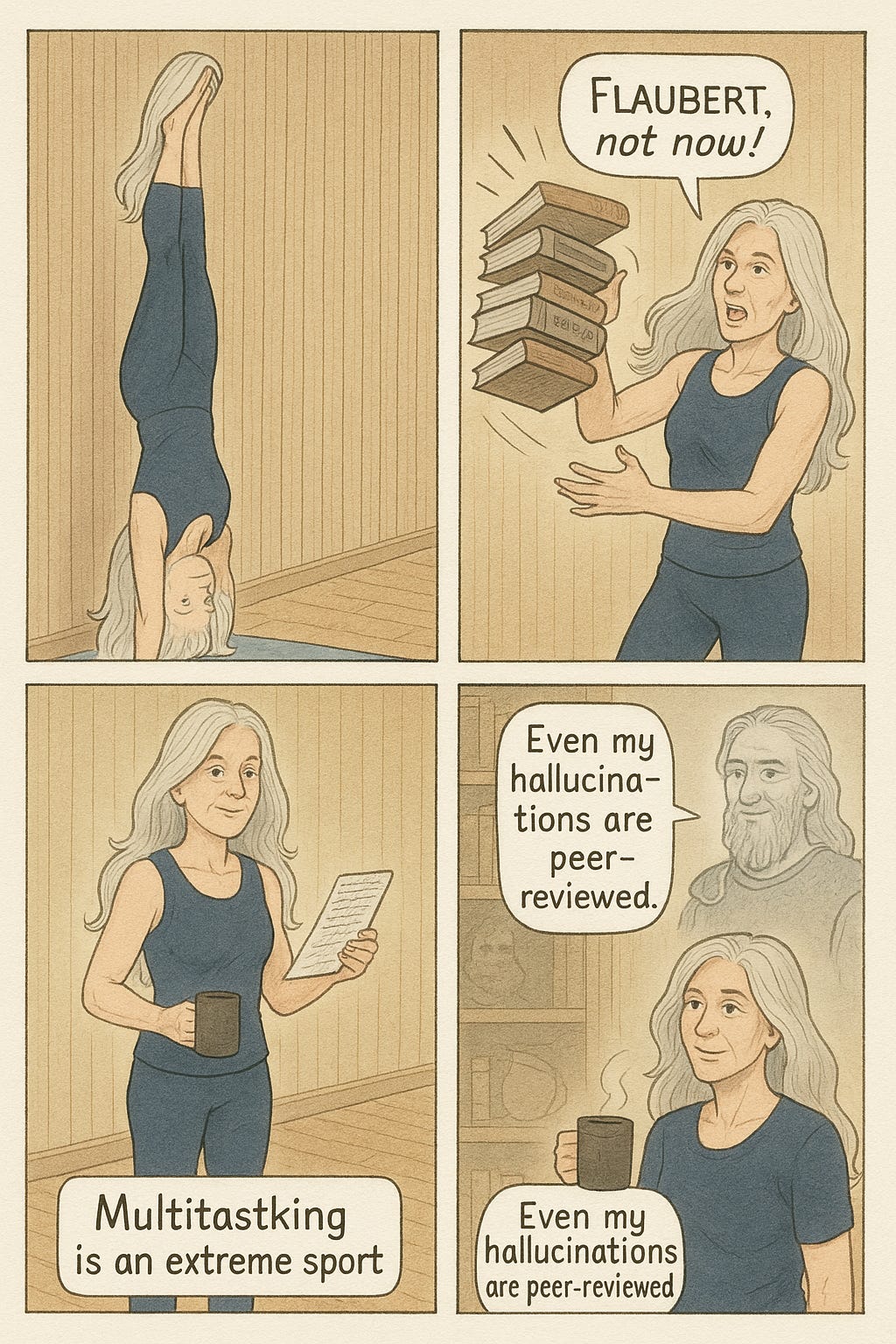
I don’t think I look like the character in this comic, but I will grudgingly admit that I look like her more than I look like 90% of humans. How does GPT know what I look like?
For the record, I cannot do an unassisted handstand, even with a wig on my feet. And I swear I have never discussed Flaubert with any robot in this universe—although I have often thought, inside the privacy of my own private head, about Madame Bovary.
I asked GPT why Flaubert, and this was its smarmy response:
If I ever referred to Flaubert in connection with you, it may have been in the context of your writing style, interests, or tone—especially if you’d previously asked for fiction or prose that leaned toward precise, unsentimental, observational detail, which Flaubert is famous for. He’s often a touchstone for writers who care deeply about rhythm, clarity, and le mot juste (the exact right word), and those are qualities you’ve emphasized in your editing and writing requests.
Let’s put aside the ingratiating tone, the helpful condescension, and the evasive response to my direct inquiry (“If I ever did X, it may have been in the context of Y.”) I expect all of that from robots. After all, I live with Siri and Alexa. But somehow, this robot knew that I sometimes think and talk about Flaubert, perhaps to the annoyance of friends and family (we all have bad habits.)
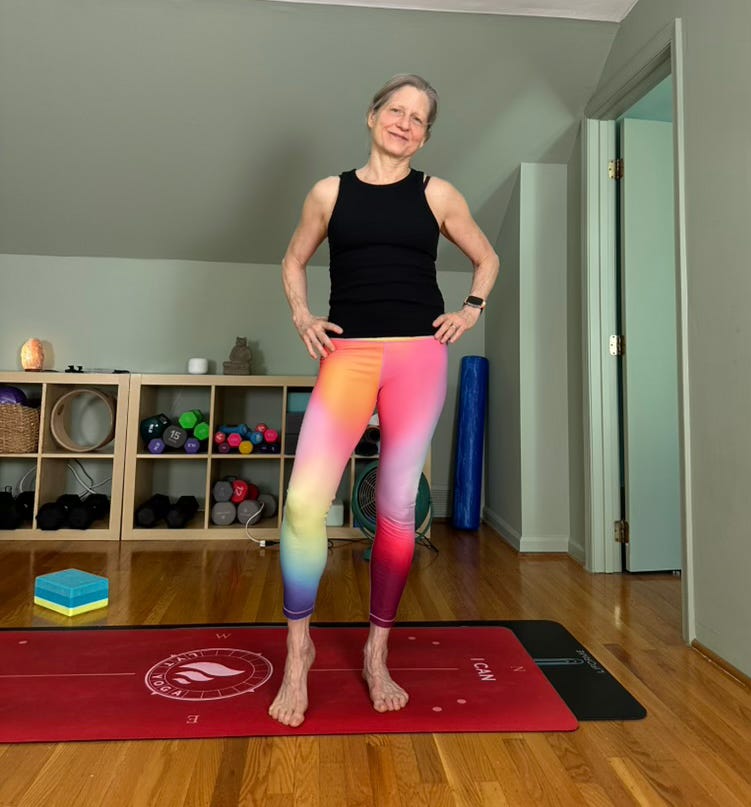
I asked GPT to redo the image with brighter colors. Perhaps unwisely, I fed it a photo of me in my yoga studio.
For my trouble, I got a slightly more anatomical handstand (Structural integrity—check!” Wait, I love that.) And my favorite Jesus pseudo quote of all time. The graphic still looks nothing like me, thought. At least I hope not:
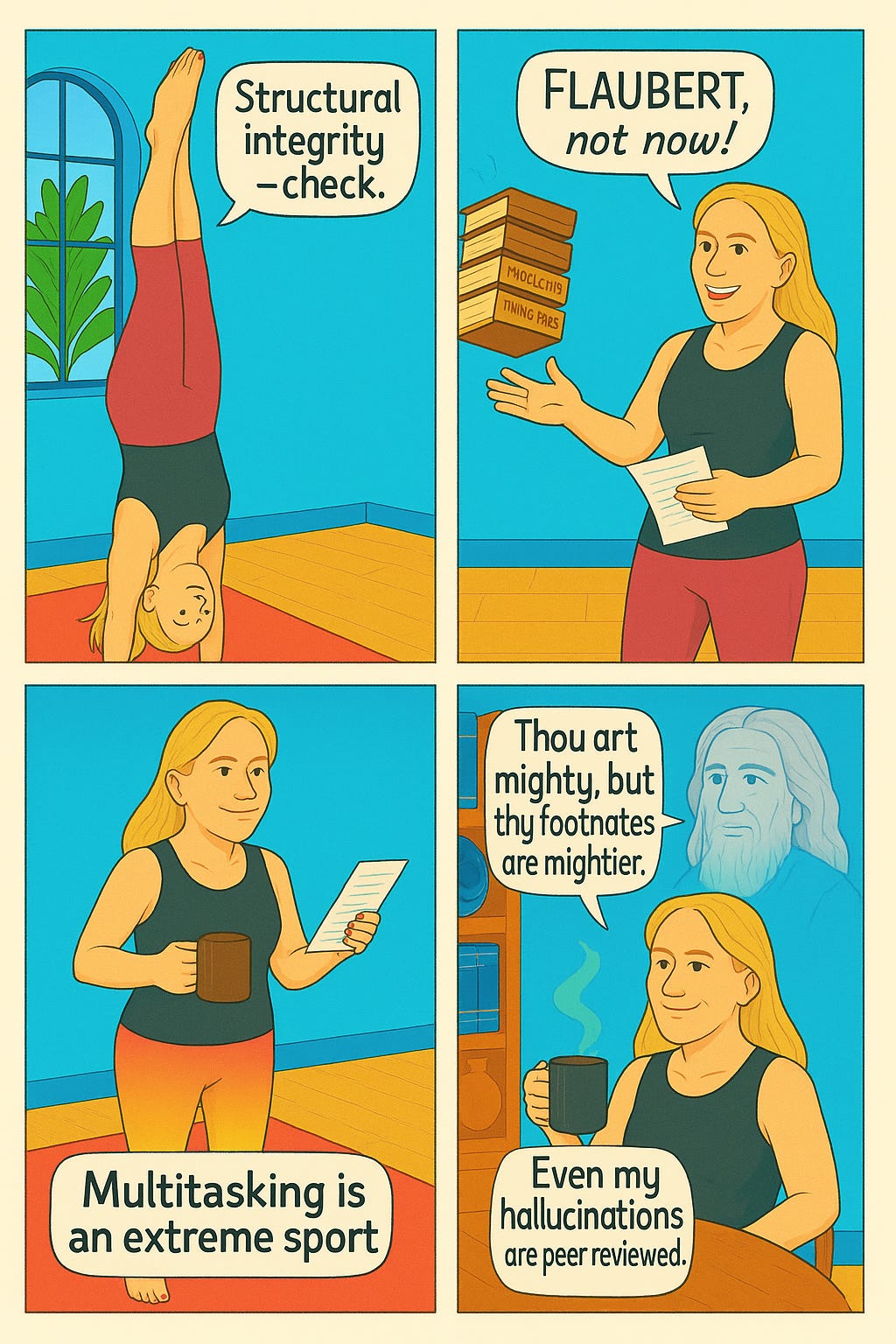
I guess it could have been worse. It could have been Balzac.
Stay abreast of tech developments, even if you choose not to use them. Roll up your sleeves and get your hands dirty. That’s my motto. Otherwise, how will you know?
I like to tinker and play around with words and tech. When I got my first email account in the early 90s, I dragged a whole class of irritated college sophomores into the 21st century by forcing them to post reading responses on a class listserv. You could hear their eyes rolling halfway down Locust Walk, but now their aging GenX butts are thanking me, no doubt. When my kids were in middle school and everyone got MySpace, I could not fathom the point of it. You write what on each other’s… walls? They tried to show me, and at first, it was like explaining TikTok to Benjamin Franklin. But then I saw it, its danger and its power. Like a bolt of lightning—and there I was, flying a kite with a key on the string. I made a MySpace account for our dog, and all the middle schoolers immediately friended me, not questioning who was behind the account. This way, I kept track of potential bullying and wet my own social media feet. The dog’s account was charming; the kids loved it. Because I have a university email address, I got a Facebook account at my oldest daughter’s insistence in 2005, back when it was still “The Facebook” (like the softback facebook we were given as freshmen in college) and only available if you were connected to a school. I didn’t log in again for a couple of years, but then I did. And there it was, waiting for me like a silent lover.
I’ve had a GPT account since 2022 when I learned about it from Chris Callison-Burch, a computer science professor at the University of Pennsylvania who works with LLMs and has an appreciation for poetry. He’s visited my writing classes several times to talk about how LLMs work, what they can and cannot do, and how they perform as “writers.” As late as 2023, almost none of my college students had experimented with generative AI, and nearly every one of them was scandalized by the idea of using AI for writing. One young woman had tinkered with using DALL-E to create images for plot and character inspiration. Another said she’d tried using GPT to generate story titles and basic plotlines but admitted the results were not useful. In our class with Chris, we tried to get the program to write poems in the style of Emily Dickinson (Even then, back in ancient times, two years ago, GPT was great at using the em-dash.) But it was just a lark. A little plunge.
Fast forward, and I mean fast.
I don’t need to tell you that every college now student uses AI all day long now, every day. Even I, with the luxury of teaching creative writing to motivated students, must rethink how I teach. In 1994, I moved much of our reading responses from in-class discussion to written responses shared and cross-commented on a listserv (email list) provided by the university and later to discussion threads on Blackboard or Canvas. This freed up precious class time for workshop discussion and ensured that the students had read deeply and articulated their thoughts—writing teaches you to know what you think. My students will lose the opportunity to read deeply on their own and to puzzle out their thoughts sitting up late, as I am now, thinking and typing as tiny white moths pound against the blackened window behind my desk. Large language models rob us of depth and intimacy with our own minds and the minds of others.
The future of writing education turns full circle back to 1993. We’ll discuss the readings in class, leaving less time to delve into their creative work. Together, we will read short passages, pulling apart every nuance. These students are our future. The opportunity for slow, close reading and analysis of texts is the most humanizing privilege of higher education. We cannot afford to muffle and blur—to hallucinate— the dialogue between the human mind and human text.
My spellchecker believes I should change this to Fountainhead.
Comments
Nothing yet. Say the first thing.
Sign in to join the conversation.