
I am no expert on artificial intelligence, and three weeks of reading has not made me one — but the question that has held my attention since the start of August turned out not to be a technology question at all.
The question is whether the debt now financing the buildout can survive contact with the physics of grid access, and the answer runs through one instrument almost nobody prices: the interconnection queue.
The queue is an options book, not an order book — 438 gigawatts of requests filed against a Texas grid whose all-time peak is 85.5, positions taken because they were nearly free, then cited as evidence of the demand they were supposed to be waiting for.
Four institutions published into that loop this summer — the IEA modelling demand to 945 terawatt-hours by 2030, McKinsey pricing the facility, Goldman Sachs dating the cycle against shale, Morgan Stanley walking the queue itself — and read together they describe a single mechanism: belief filed as load, load priced as proof, proof now margin-called by a governor’s letter.
What survives to Base Load classification will be the first honest print of the cycle. The dispute I try to settle here is whether that print confirms the demand or breaks it; the instruments that will tell are ERCOT’s 2027 forwards against the ninety-five-dollar threshold, and a credit default swap curve that already prices one member of the complex at two hundred basis points.
On the 3rd of August, a Monday, the Electric Reliability Council of Texas posted market notice M-A080326-01 — a document of a few paragraphs which said, in the flat register these things are written in, that ERCOT would not be telling anyone what their place in the line was worth.
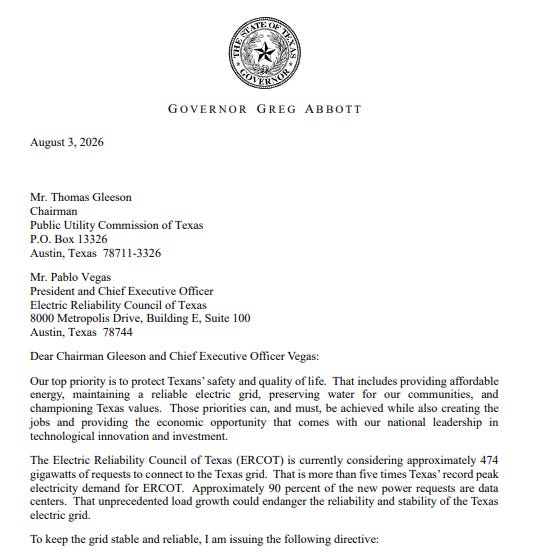
That morning a letter had arrived from Governor Abbott directing the grid operator and the Public Utility Commission to audit every data centre advancing through the interconnection process — its water draw, its onsite generation, its public subsidies, its ownership, its neighbours — before any of them moved another step.
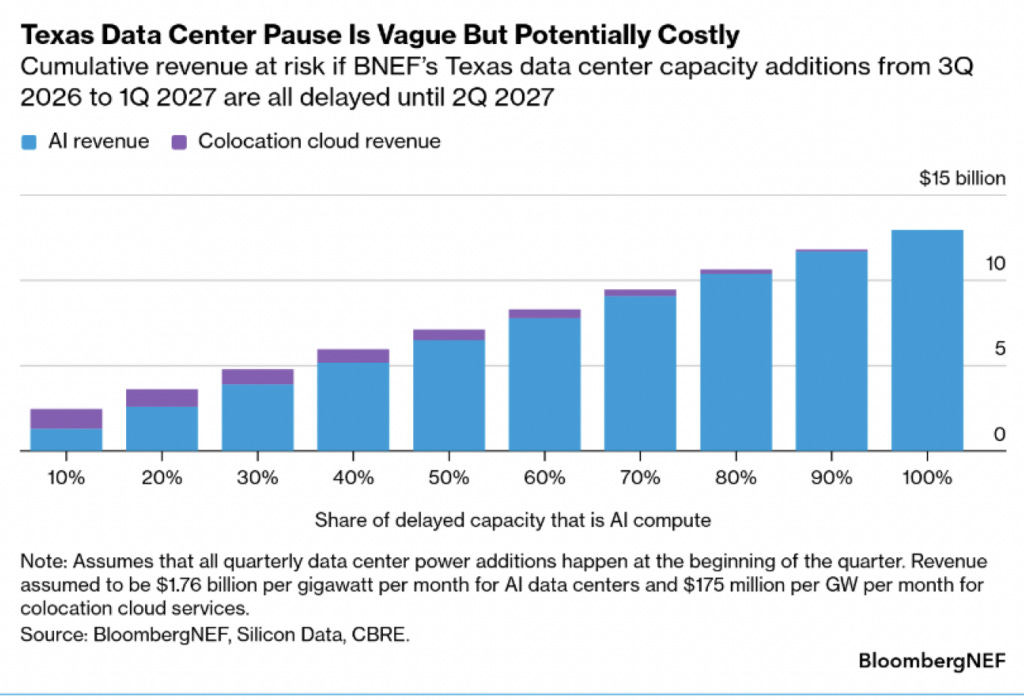
The notifications due on the 7th of August, the ones that would have sorted the largest interconnection queue any grid has ever carried into projects with a green light and projects consigned to study, did not go out.
The line, which had been growing for three years on the assumption that joining it was free, stopped — not because the power ran out, but because somebody finally asked who was actually in it.
I have spent the last three weeks trying to understand what that pause means for a set of instruments that sit, on the face of it, a very long way from a Texas substation: the credit default swaps on the companies building the machine.
The reading list assembled itself — the IEA’s Energy and AI, the most complete demand model in the public domain; the McKinsey Global Institute’s June work on colocation economics; Goldman Sachs’s GS SUSTAIN note of the 6th of August, which dates the AI cycle against shale; Morgan Stanley’s expert-call debrief of the 17th, which walks the Texas queue metre by metre; and the IFC’s July survey of where the buildout goes when the rich world’s grids say no.
None of these documents cites the others.
All of them, read in sequence, describe the same object from a different side — and the object is the queue.
The demand case deserves to be stated at full strength, because everything else in this piece leans against it and the lean only matters if the thing is load-bearing.
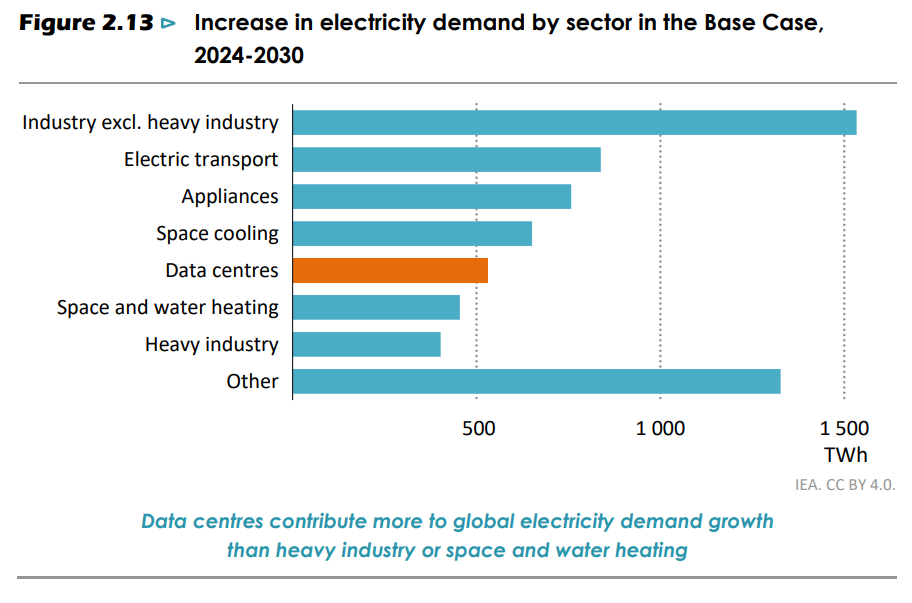
By the end of the decade the United States is set to use more electricity for data centres than for aluminium, steel, cement, chemicals and every other energy-intensive good combined — a sentence I have read a dozen times now without it becoming any less remarkable — with data centres taking nearly half of all US demand growth between now and 2030.
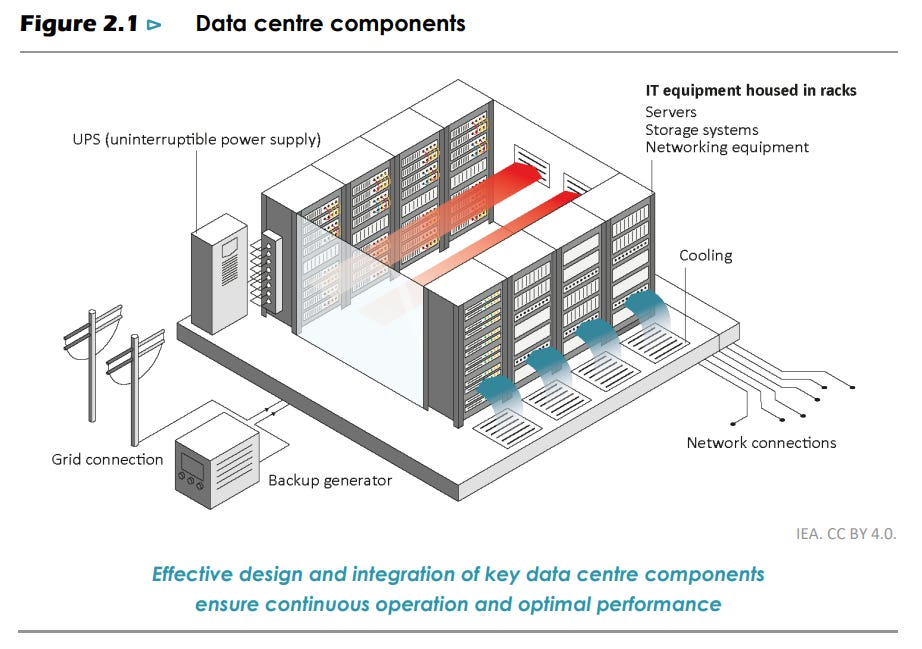
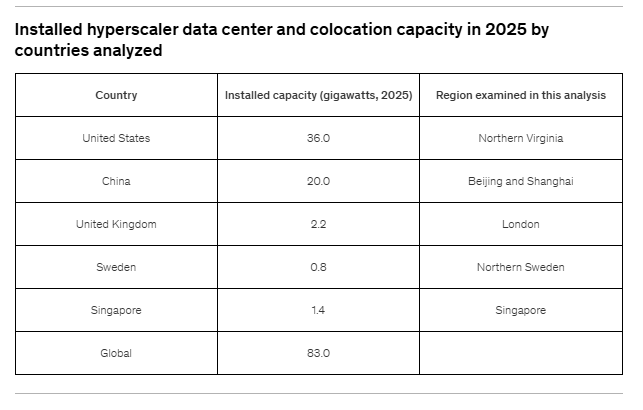
The capacity arithmetic runs the same direction.
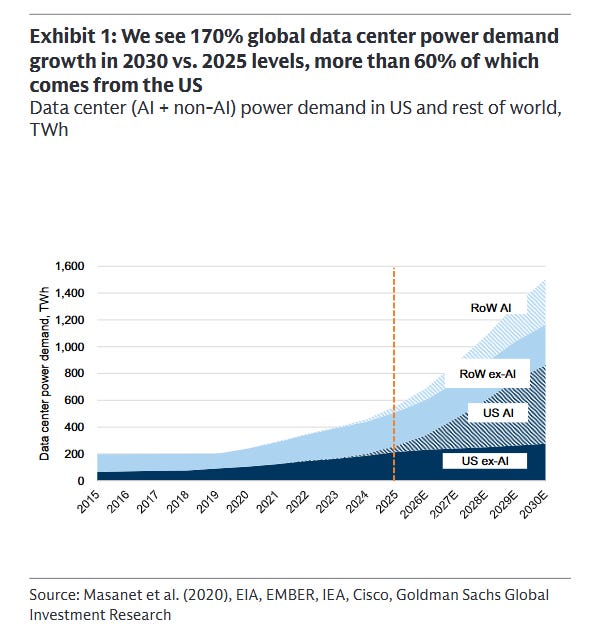
Goldman Sachs, revising upward again, now assumes global data centre power demand grows 170 per cent between 2025 and 2030 — the previous assumption was 117 — with the cumulative growth over 2023 exceeding the entire 2023 electricity consumption of Japan, the fifth-largest power consumer on earth.
Half a trillion dollars of investment went into data centres in 2024 alone, on the IEA’s count, double the 2022 figure.
Every one of those numbers is a forecast, and forecasts are the currency this sector trades in. What interests me is the moment a forecast stops being an estimate of the future and becomes a position in a line — because a position in a line is a different instrument entirely, with a different owner, a different cost of carry, and a very different relationship to the truth.
Here is the mechanism the whole piece turns on.
To build a data centre you need land, chips, capital and a grid connection, and of the four only the last is allocated by neither price nor market — it is allocated by a queue, administered by a grid operator, historically free or nearly free to join, and processed in the order and manner the operator’s rules prescribe.
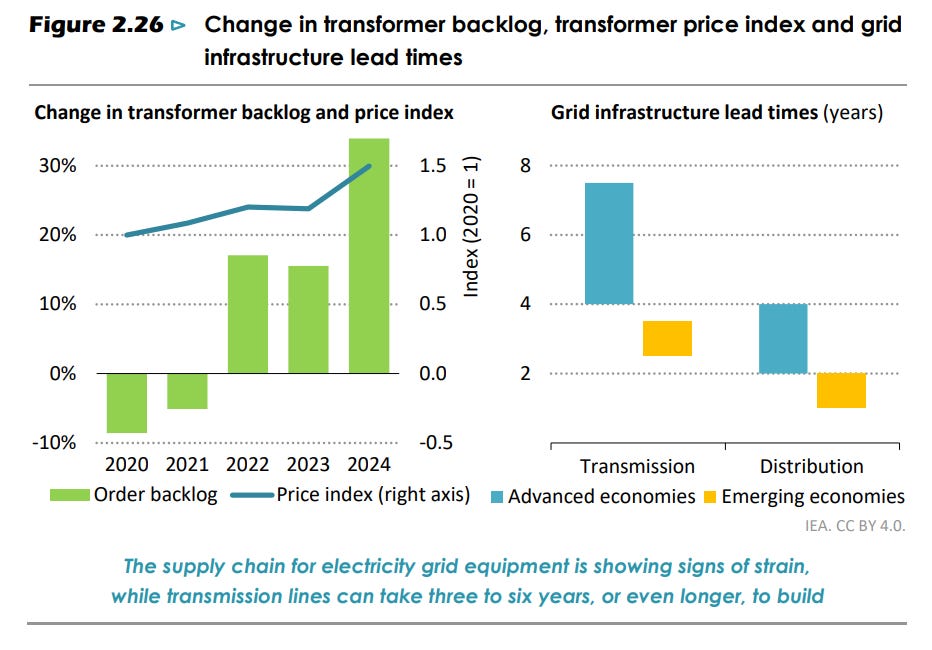
When the thing being queued for becomes scarce and valuable — and McKinsey has average grid-connection waits above four years, running to a decade in some markets, while the IEA has transmission builds taking four to eight years in advanced economies and transformer and cable lead times doubling in three — the rational developer does not file one careful request.
They file several speculative ones, in several jurisdictions, for more capacity than they will ever build, because each filing is a cheap call option on the scarcest input in the industrial world, and nobody exercises discipline about options that cost nothing.
That is how a grid whose all-time peak demand is 85,508 megawatts came to carry an interconnection queue of roughly 438,000 — ERCOT’s own tracking figure, with the Governor’s letter citing more than 474 gigawatts of pending requests and both numbers agreeing on the important part, which is that nearly ninety per cent of it is data centres.
The queue is five times the largest load Texas has ever served at a single moment.
Nobody — not ERCOT, not the developers, not the hyperscalers whose tenancy the developers are courting — believes anything like that capacity will be built.
The queue is not a forecast of demand. It is an inventory of options written by the grid to anyone who asked, and the defining feature of an options book, as against an order book, is that its notional tells you about the writing, not the wanting.
The trouble — and this is where the mechanism becomes reflexive — is that the market has been reading the notional as the wanting.
Utility capital plans are sized off the queue: American Electric Power has 45 gigawatts of large-load projects submitted into the Texas process, Sempra’s Oncor territory carries 44, CenterPoint 17, and each of those pipelines is presented to equity investors as capex upside.
Power forwards price off the queue.
The valuations of the powered-shell providers — the former Bitcoin miners whose grid positions are their principal asset — price off the queue.
And the equity story that licenses $250 billion of hyperscaler bond issuance this year rests, several links up the chain, on the same congested line being evidence that the demand is real.
A queue that costs nothing to join has become the collateral for a capital structure that costs a great deal to service, and the gap between those two facts is the trade.
The first thing the Texas process did — before the audit, before the politics — was attach a price to standing in line, and the effect was immediate and clarifying.
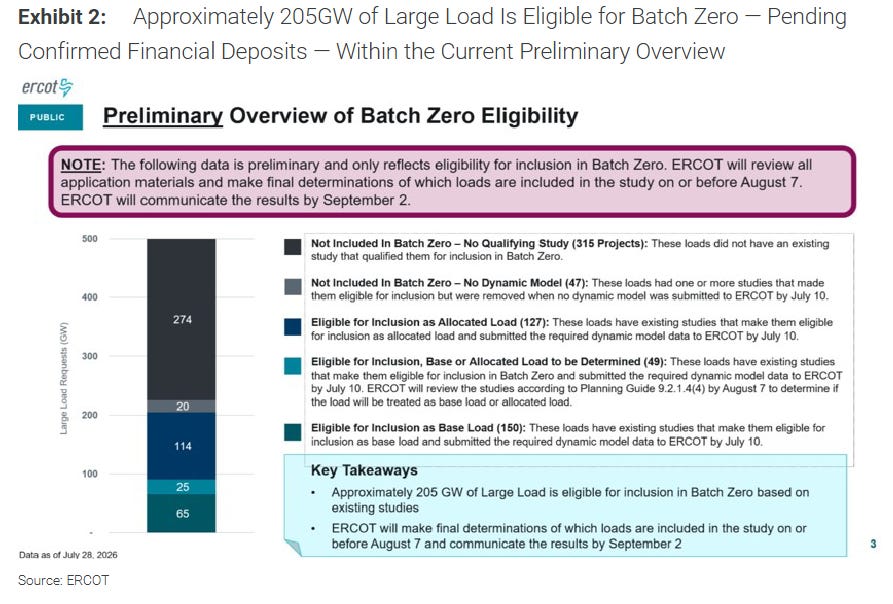
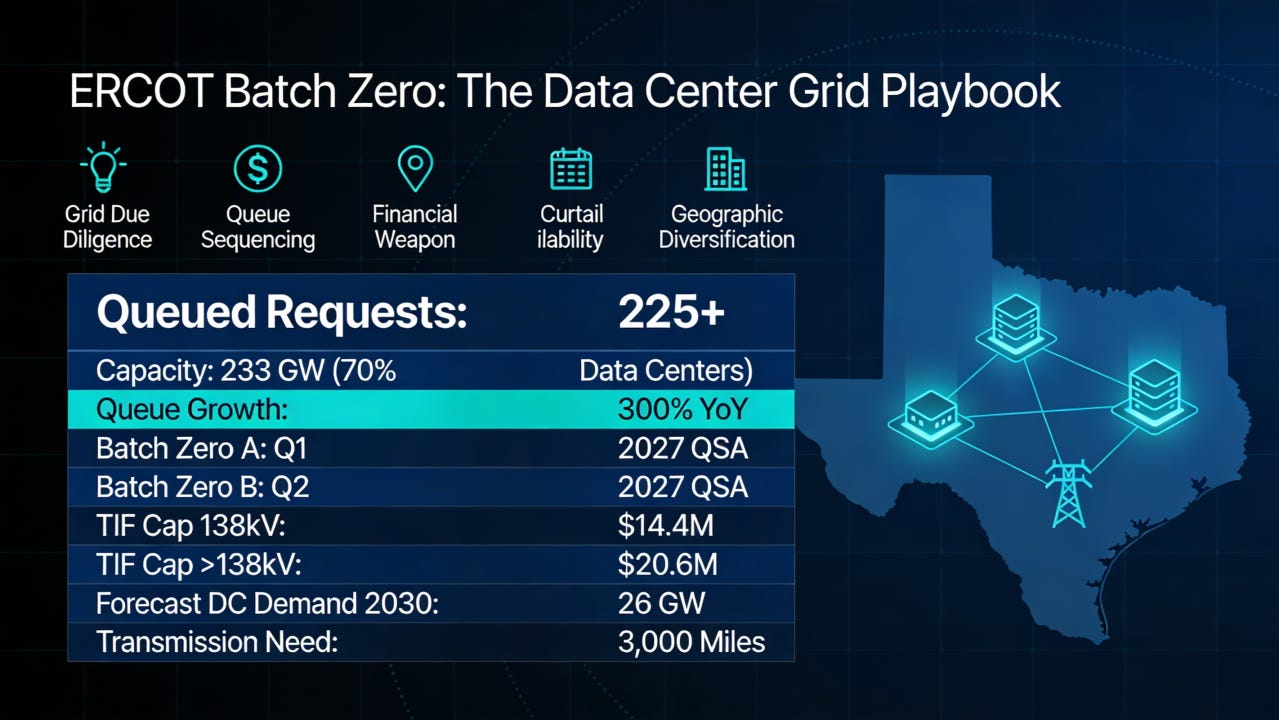
To qualify for Batch Zero, ERCOT’s one-time system-wide study of the backlog, a project had to show land, contracts, completed studies and posted financial security by hard July deadlines.
Of the 438 gigawatts of tracked requests, about 205 gigawatts across 326 projects survived to eligibility — more than twice what ERCOT staff had projected, and simultaneously less than half of what the raw queue claimed.
The deposits are not trivial: CenterPoint’s 17 submitted gigawatts are supported by $900 million of customer cash and collateral, AEP’s 45 by $2 billion, Sempra’s 44 by more than $2 billion.
From a settlement-desk perspective, this is margin being demanded on positions previously carried at no cost. Margin calls are finance’s clearest test: they compel investors to show whether they held a genuine conviction or merely a lottery ticket.
Half the queue failed to post.
That single fact does more analytical work than any demand model in my reading pile, because it is revealed preference rather than projection: when standing in line acquired a carrying cost, 233 gigawatts of claimed demand — two and a half Texas grids’ worth — declined to pay it. The demand bulls will say, correctly, that 205 gigawatts of collateralised intent is still an enormous number, and it is.
But the mark matters for what it does to every balance sheet that was priced off the gross figure — the utility capex stories, the transmission plans, the forward curves — all of which now have to be re-derived from a queue less than half the advertised size, and re-derived by analysts who have just learned that the advertised size was never information in the first place.
What Batch Zero does next is the part credit investors should be watching, because it converts a continuous belief into a discrete designation — and discrete designations are where credit events live.
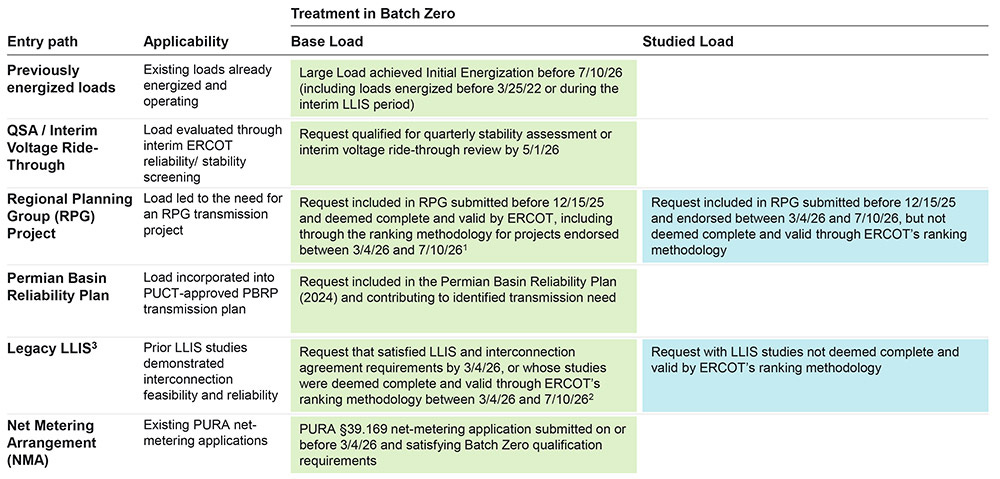
Every surviving project is classified either Base Load — sufficiently mature and committed that ERCOT models its megawatts as known demand, described at the operator’s own meeting as a green light to connect — or Studied Load, which enters a collective reliability study that will not report until the 9th of April 2027, guarantees no megawatts, and may attach system-upgrade costs to whatever it eventually allocates.
Morgan Stanley expects roughly 65 gigawatts to clear into Base Load, more than the market anticipated, and roughly 140 gigawatts to land in what its analysts call “study purgatory” — a phrase I intend to keep, because purgatory is exactly the credit condition it describes: not dead, not alive, accruing time.
Read the designation as a credit officer reads it, because that is what it is: a rating, issued by an entity no rating agency supervises, on collateral no CDS documentation references.
A Base Load letter is the difference between a powered site worth fifteen dollars a watt on Morgan Stanley’s transaction framework and a site worth its scrap value plus hope. The powered-shell cohort — Cipher, TeraWulf, Galaxy and their peers — trades between $1.44 and $5.09 per watt of enterprise value against the fifteen dollars that recent hyperscaler lease transactions imply, and the entire journey from the first number to the second runs through the operator’s classification.
The equity market has noticed; the exhibit exists because the discount is the pitch. What the credit market has been slower to price is the asymmetry on the other side: a Studied Load designation is not a delay; it is a maturity mismatch — debt that amortises on a schedule, collateral that reports in April 2027 at the earliest, and a tenant whose own spending plans are the thing the study’s demand assumptions were built on.
The queue has become a rating agency without knowing it, and the first thing every rating agency learns is that the act of rating moves the thing rated.
Suppose the designation comes through.
Between a green light and a running facility stands the physical world, and the physical world is the section of this story where the energy analyst finally outranks the technologist.
Goldman frames the constraint set as seven Ps — pervasiveness, productivity, price, policy, parts, people, physical environment — and the last three are the ones no capital structure can refinance its way past.
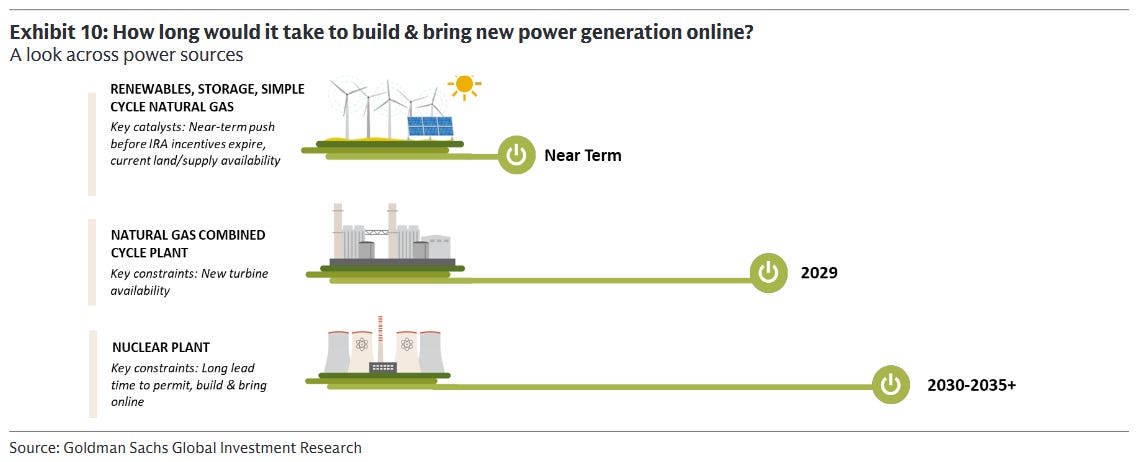
Parts: gas-turbine order books are effectively sold out, with GE Vernova telling its July earnings call it expects more than half of its 2031 capacity contracted by the end of 2026 — a sentence worth reading twice, because it means the marginal molecule of dispatchable power for the early 2030s is being allocated now, five years forward, by queue position at the equipment maker.
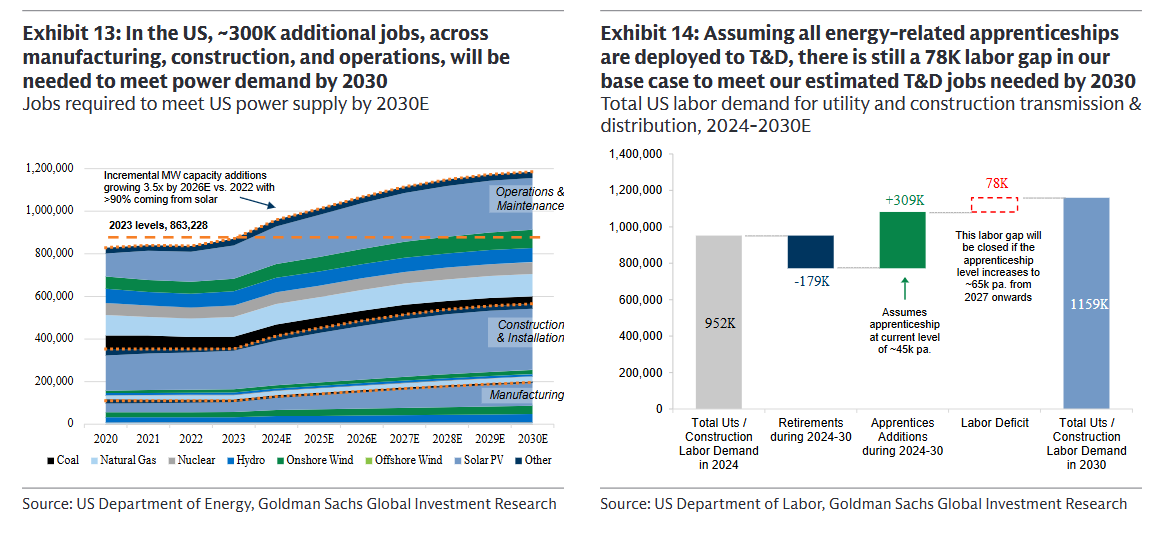
People: more than 500,000 new US jobs are needed to meet power demand growth, over 200,000 of them in transmission and distribution, against which Goldman’s base case finds a 78,000-worker labour gap even if every energy apprenticeship in the country is deployed to the wires.
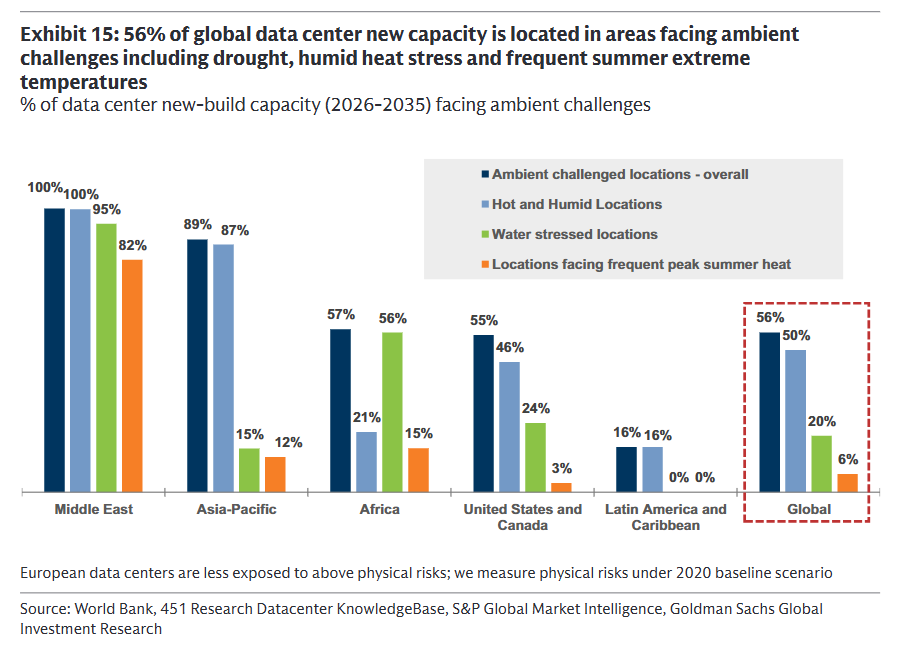
Physical environment is the constraint I find most under-priced, because it converts weather into load. Fifty-six per cent of new global data centre capacity — fifty-five per cent in the US — is being built in locations facing elevated heat, humidity or drought risk, and in those places the cooling choice becomes a water-versus-power trade: minimise water draw, as US community politics increasingly demands, and you deploy chillers that consume more electricity, which Goldman models as a five-point rise in global power-usage effectiveness and eleven points in the US — a direct, quantified erosion of the efficiency gains the demand optimists are counting on.
The IEA’s version of the same arithmetic is blunter still: unless grid risks are addressed, twenty per cent of planned data centre capacity worldwide is at risk of delay, while McKinsey puts as much as half of the capacity due online in 2026 at risk from permitting, connection delays and public opposition.
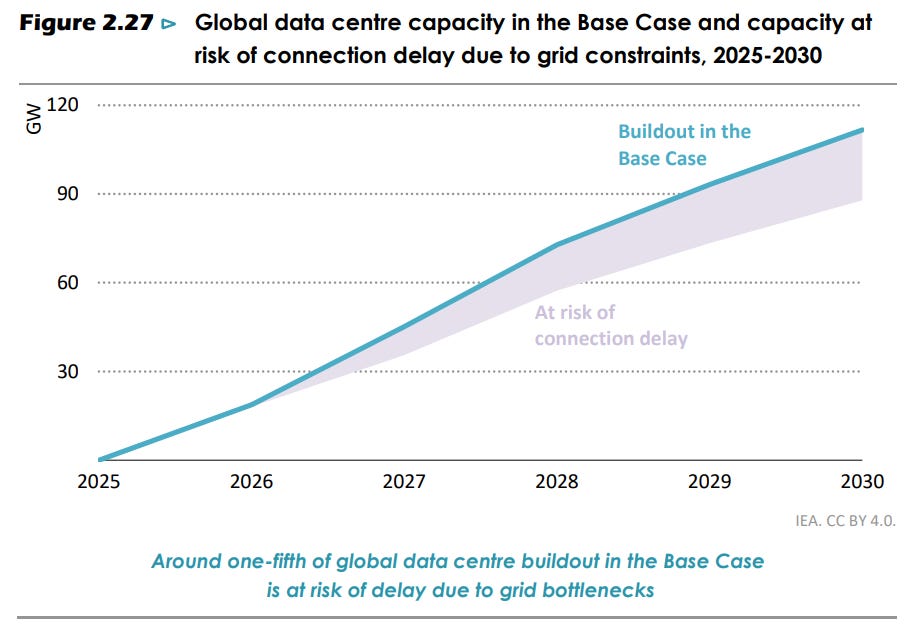
The queue, in other words, does not end at the substation — it continues through the turbine order book, the electricians’ apprenticeship rolls and the water table, and every one of those inner queues has its own study purgatory that no market notice will ever announce.
The politics arrived on schedule, and I read the politics as a pricing event.
More than 300 data centre moratoriums have passed across US jurisdictions since 2023; 300 state bills were filed in the first six weeks of 2026 alone; and Morgan Stanley’s expert sessions land on a conclusion I would frame as the central repricing of the year — community opposition has stopped being a communications problem and become a development constraint that must be underwritten like land, power or labour.
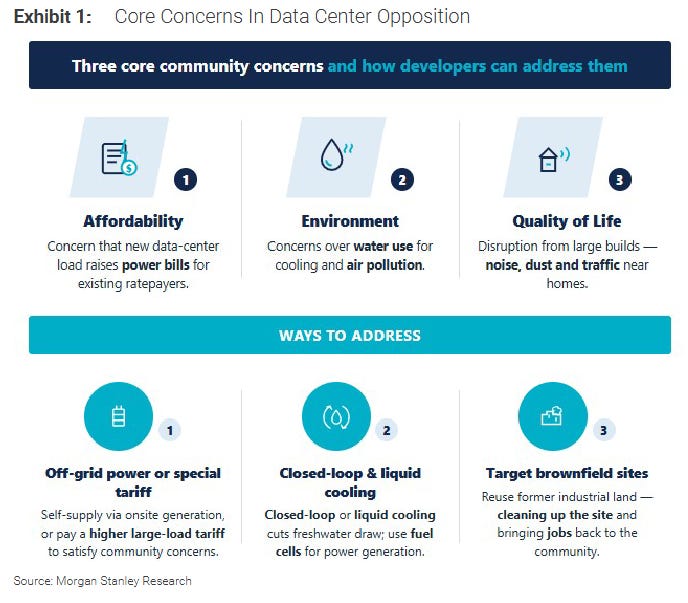
The instruments of that underwriting are proliferating.
Virginia’s Rider T1 order of the 31st of July moves Dominion toward cost-causer-pays for direct-connect transmission — and the same order, by reallocating transmission costs, cut the estimated residential impact from $2.90 a month to 94 cents, which tells you precisely what the fight is about: not whether the infrastructure gets built, but whose bill it lands on.
Texas’s audit demands disclosure of water, subsidies and ownership as the price of a place in line.
Ohio’s gubernatorial politics now feature a proposal to condition approvals on electricity credits for neighbouring households.
New York draws its threshold at 50 megawatts, Delaware proposes 100, Maine 20 — and the thresholds themselves reshape the buildout, because opposition scales non-linearly with project size, which pushes rational developers toward smaller, distributed facilities that stay under the number.
Three weeks on, the bills are being itemised faster than I expected, and the itemisation runs in one direction: toward the front of the queue.
Every mechanism above — the deposit, the audit, the rider, the tariff class — moves cost from the diffuse future to the present holder of the queue position, and cost moved forward in time is exactly what an options trader means by theta.
The queue positions that were free calls in 2024 now bleed carry, and instruments that bleed carry get exercised or abandoned, never held indefinitely — which is why the political turn, usually read as a threat to the buildout, is better read as the thing that forces the buildout to finally reveal its true size.
One relief valve exists, and the IFC’s July survey maps it.
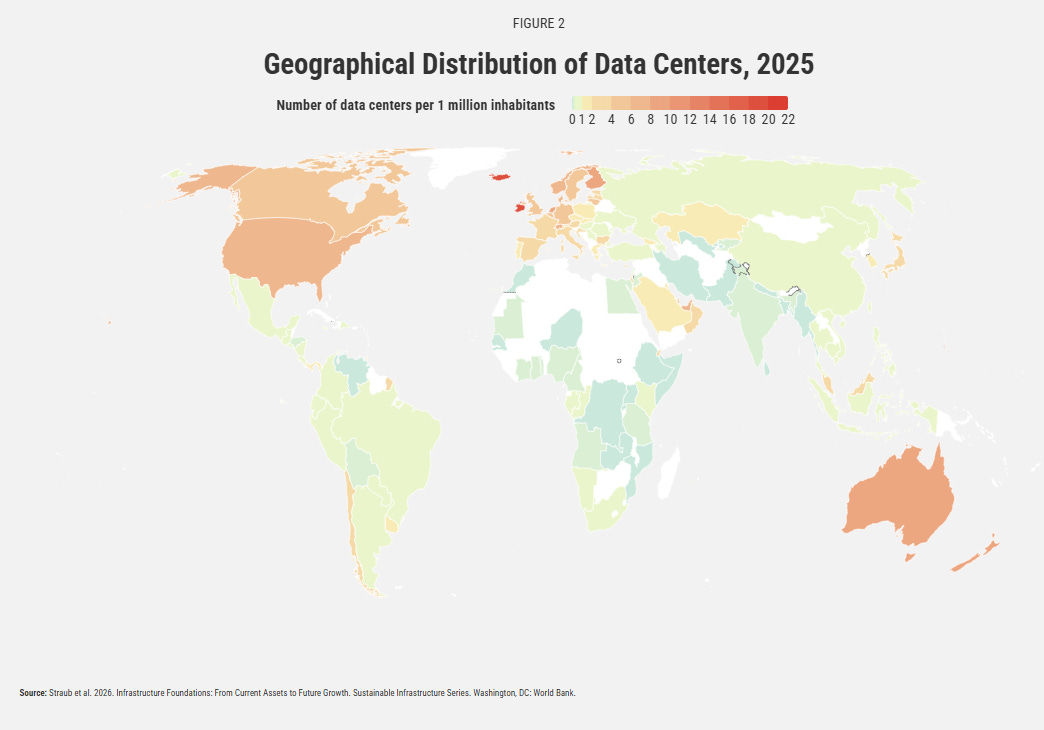
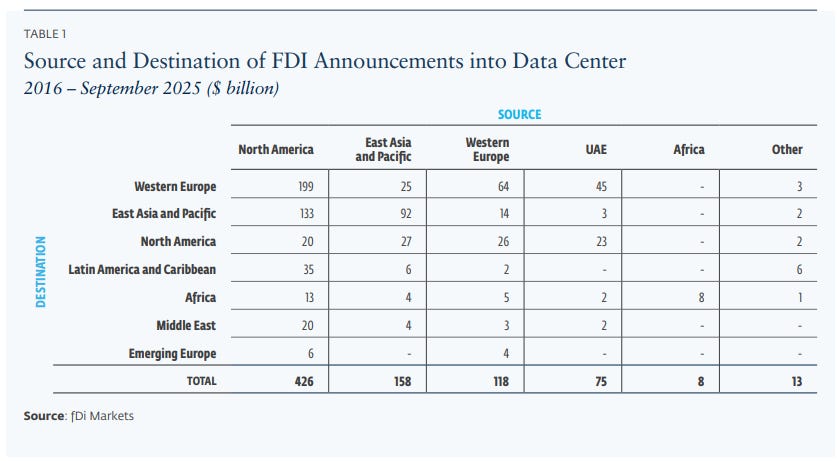
Morgan Stanley’s expert puts the theoretical ceiling on relocation remarkably high: perhaps eighty per cent of workloads — training and batch jobs that tolerate latency — could in principle sit far from users, in cold, sparse, unopposed jurisdictions.
But the relief valve has its own queue, and it is a harder one.
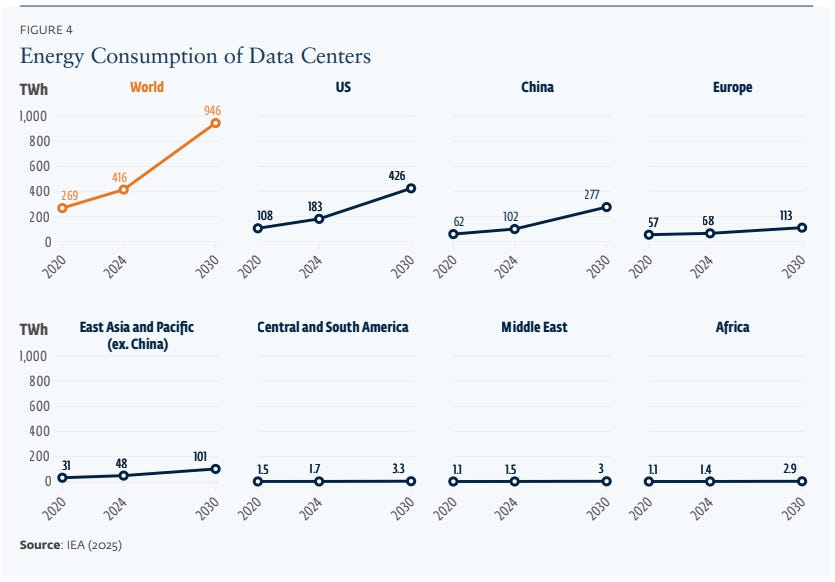
My reading is that the emerging-market line absorbs the workloads that were never going to fight for a Virginia substation — it lengthens the global queue rather than clearing it, and in doing so it exports the same reflexive structure, announcement read as demand, to grids far less able to survive the discovery that it was not.
Now the credit turn, because this is where three weeks of reading kept leading me.
Goldman’s shale analogy is the most useful frame published on this cycle, and its discipline is that it names the three gauges that marked shale’s inflection from the appraisal phase — the years when multiple expansion rewarded the size of the dream — to the execution phase, when the market started paying only for returns: the product moving into oversupply, the innovators exhausting financial flexibility, and corporate returns degrading below their historic range.
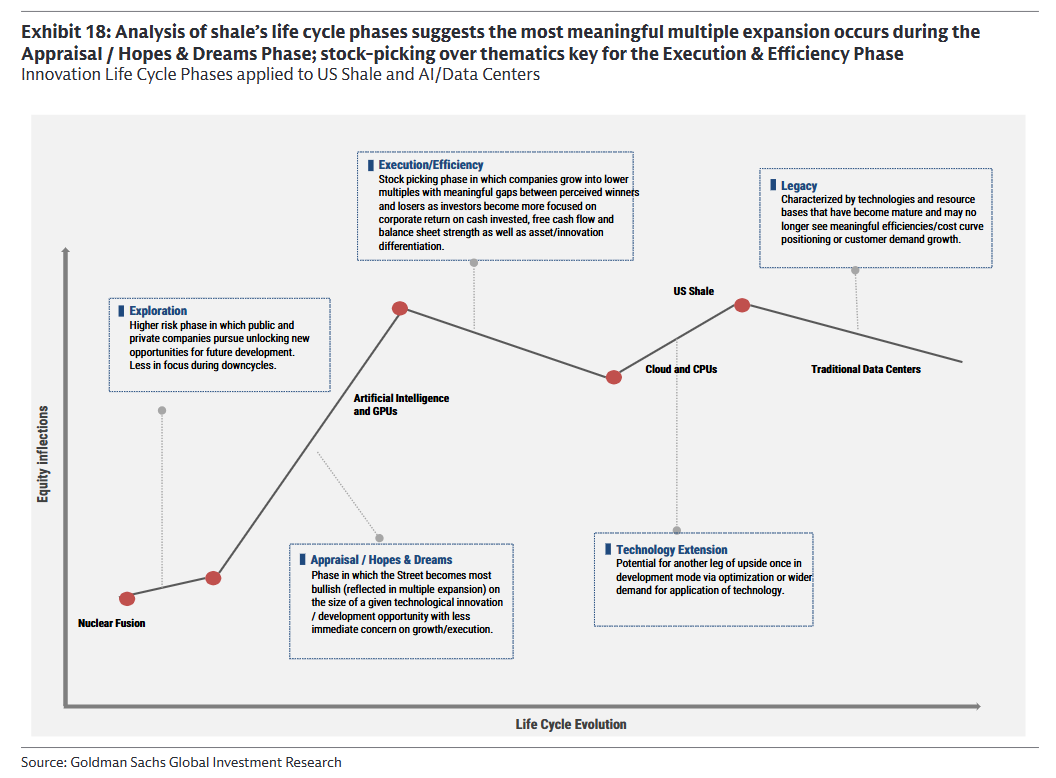
Compute is not in oversupply — vacancy is minimal, and Goldman’s colleagues project agentic AI could multiply token consumption twenty-four-fold by 2030, Jevons doing its usual work.
Returns are moderating but not broken — hyperscaler cash return on cash invested is forecast to drift down toward, but not below, the bottom of its 2014–24 range of twenty-four to thirty-one per cent.
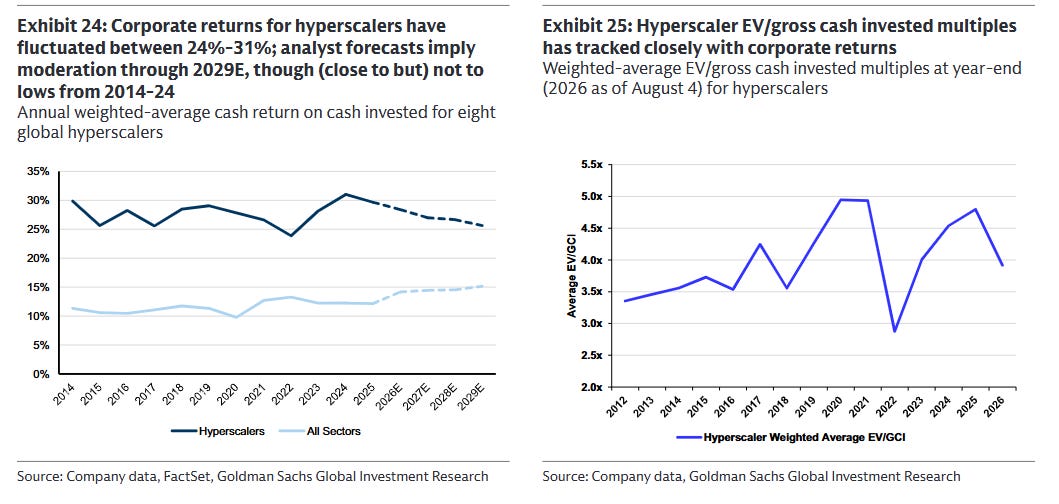
It is the middle gauge that has moved, and moved decisively.
The eight major hyperscalers are now expected to spend $1.2 trillion on capex and research in 2026 and $1.7 trillion in 2027, taking the reinvestment rate — capex plus R&D over operating cash flow plus R&D — above ninety-nine per cent in both years and past one hundred in 2027.
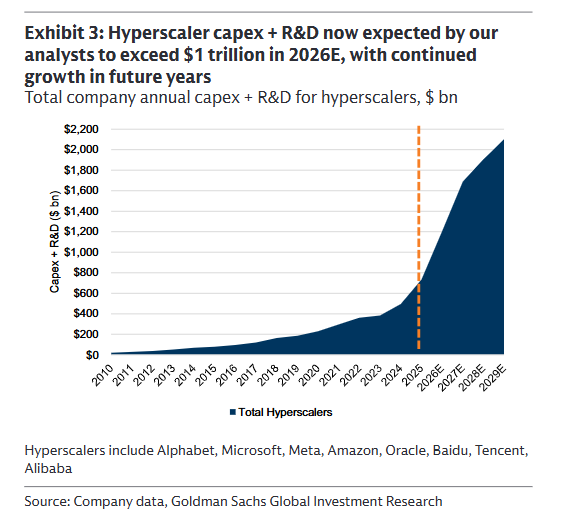
Sit with that ratio, because it is the hinge of the entire capital structure: a sector reinvesting more than a hundred cents of every operating dollar has, by definition, stopped self-financing, and a sector that has stopped self-financing must borrow — which is exactly what the tape shows.
Amazon, Alphabet, Meta and Oracle issued roughly $195 billion of bonds in the first half of 2026, eighty per cent more than the whole of 2025; full-year issuance across five hyperscalers is expected near $250 billion, with $400 billion pencilled for 2027; Moody’s has the six leading builders spending $785 billion this year and nearing a trillion next.
Balance sheets remain strong — under half a turn of net debt to EBITDA on Goldman’s weighted average — but the direction is the information.
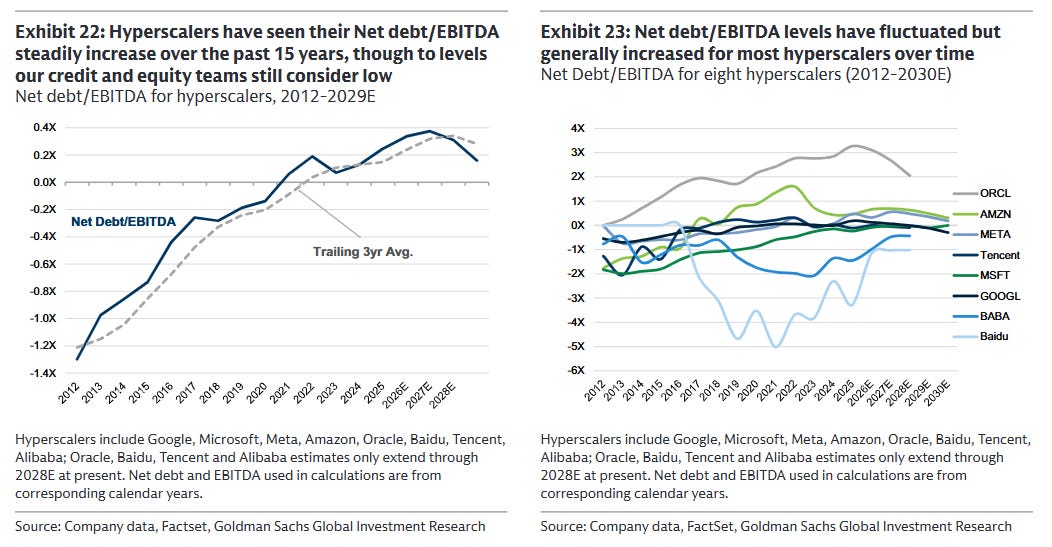
Goldman notes that shale’s management also argued that faster deployment justified thinner capital efficiency, right up until the commodity they were all producing proved commoditised — and the queue is where we find out whether compute rhymes.
So to the instrument that started this: protection.
The CDS complex around the AI builders has gone from a curiosity to one of the most active corners of the credit market — notional trading in contracts referencing Microsoft, Amazon and Oracle reached $4.6 billion in the first quarter of 2026 against $759 million a year earlier — and the price action divides the complex cleanly in two.
Four of the five majors trade between thirty and eighty basis points, wider than their unusually tight starting point but unremarkable for their ratings.
Oracle is the other half: five-year protection near two hundred basis points against roughly forty a year ago, a July downgrade by S&P to BBB-, one notch above high yield, a debt load around $130 billion, and a Morgan Stanley free-cash-flow forecast for 2027 approaching minus $40 billion.
The basket of the five has widened from about 115 to about 162 basis points over recent months, and the honest decomposition is that the basket is mostly an Oracle story wearing a sector costume — which is itself the finding, because it tells you the market is pricing the structure of each balance sheet, not the sector’s thesis.
Here is where I need one piece of credit vocabulary, defined once because the argument turns on it: wrong-way risk is exposure that grows precisely as the counterparty’s probability of default grows — the position that gets bigger as the ability to pay it gets smaller.
The AI credit stack is a wrong-way machine of unusual purity.
Take the powered-shell layer, where the value creation is most spectacular: Morgan Stanley’s analysis of the TeraWulf–Anthropic transaction finds roughly nineteen dollars a watt of net value created against about three dollars a watt of required equity, on fifteen-year leases inside a fifteen-per-cent-yield framework.
The debt raised against such sites is collateralised by the lease; the lease is money-good exactly as long as the tenant’s AI economics hold; and the scenario in which the tenant’s economics fail — the execution phase arriving, budgets rationalising, the reinvestment rate snapping back below a hundred — is the same scenario in which every other tenant is cutting, every powered site is seeking a lessee at once, and the fifteen-dollar watt reverts toward the three-dollar cohort average.
The collateral and the counterparty fail on the same trigger.
That is the textbook definition, and there is no netting agreement against it.
And beneath the corporate layer sits the layer no ISDA references at all: the queue position itself.
A Base Load designation is worth billions and a Studied Load designation is worth years; the difference between them is decided by a grid operator applying reliability criteria, paused by a governor’s letter, and reviewable by a legislature that convenes in January 2027 with, by Texas counsel’s reading, an appetite for expanded statutory authority over the industry.
Protection buyers on Oracle at two hundred basis points, or on the basket at 162, are — whether they have priced it or not — buying protection against outcomes that will be substantially determined in interconnection dockets, and the documentation gives them no claim on those dockets whatsoever.
The reference entity is in New York;
The reference risk is standing in a line in Austin.
Assemble the loop, because every piece is now on the table.
A belief formed: AI demand is effectively unbounded, and power access is the only binding constraint.
The belief shaped behaviour: developers and their financiers filed queue positions on a scale untethered from any buildable reality — 438 gigawatts against an 85-gigawatt peak — because positions were free and the constraint was the prize.
The behaviour altered the fundamental: the swollen queue congested the very access it sought, stretched connection waits toward a decade, forced utilities to size capital plans and regulators to size transmission studies off notional that was mostly option, lifted the community and affordability pressures that produced 300 moratoriums — and, crucially, the queue’s size was then read back as proof of the demand, cited in every bull case, priced into forwards, powering the equity narratives that licensed the bond issuance.
The belief was measuring itself.
And on the 3rd of August the feedback arrived: the state audited the measurement, priced the position, and the queue halved on contact with a deposit requirement — the inflection at which a self-reinforcing loop becomes self-revealing, which is the only kind of self-defeating that matters to a credit desk.
This is the reflexive structure in its cleanest industrial form — perception filed as load, load priced as fact, fact now being re-derived from whatever survives classification — and what makes it actionable rather than philosophical is that the loop’s unwinding has a calendar.
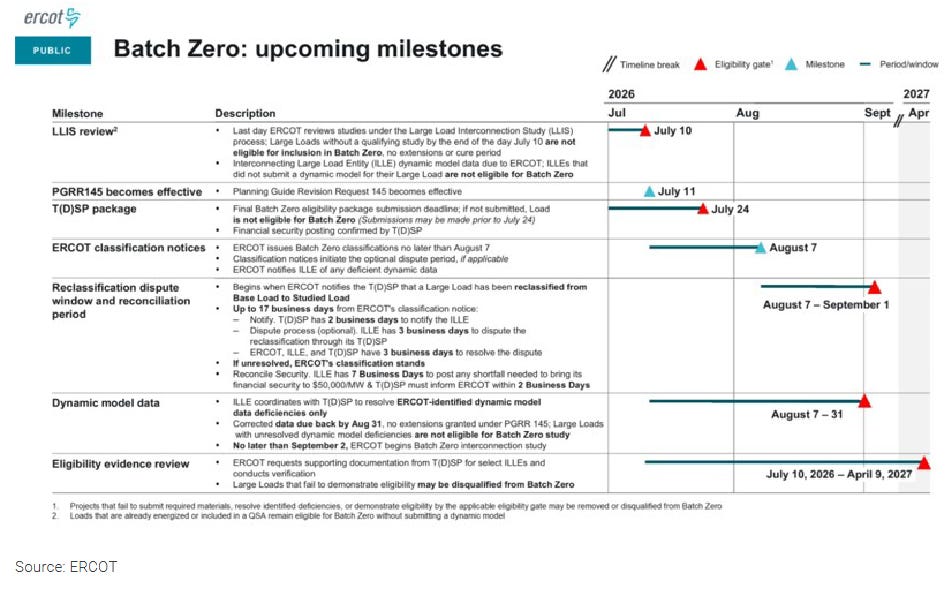
The deficiency-cure deadline is the 31st of August.
Classification, originally due by the 2nd of September, now sits behind the audit, with ERCOT seeking good-cause exceptions while explicitly preserving the 9th of April 2027 for the study report, and Morgan Stanley’s base case putting the pause at one to three months for the higher-quality projects.
Each of those dates marks the options book.
Every prior cycle I can name repriced on the day its inventory was finally counted; this one has published the counting schedule in a market notice.
The other side of this argument deserves to be made at full strength, because it is genuinely strong.
First, the count may confirm rather than break: Morgan Stanley expects more capacity to clear into Base Load than the market anticipated — the sixty-five-gigawatt read — and sixty-five gigawatts of collateralised, green-lit, near-term load is not a bubble deflating; it is the largest confirmed demand shock any power market has ever scheduled, bullish for ERCOT forwards that sit near fifty dollars a megawatt-hour against the ninety-five-plus that Morgan Stanley reckons is needed to bring new baseload generation to the market.
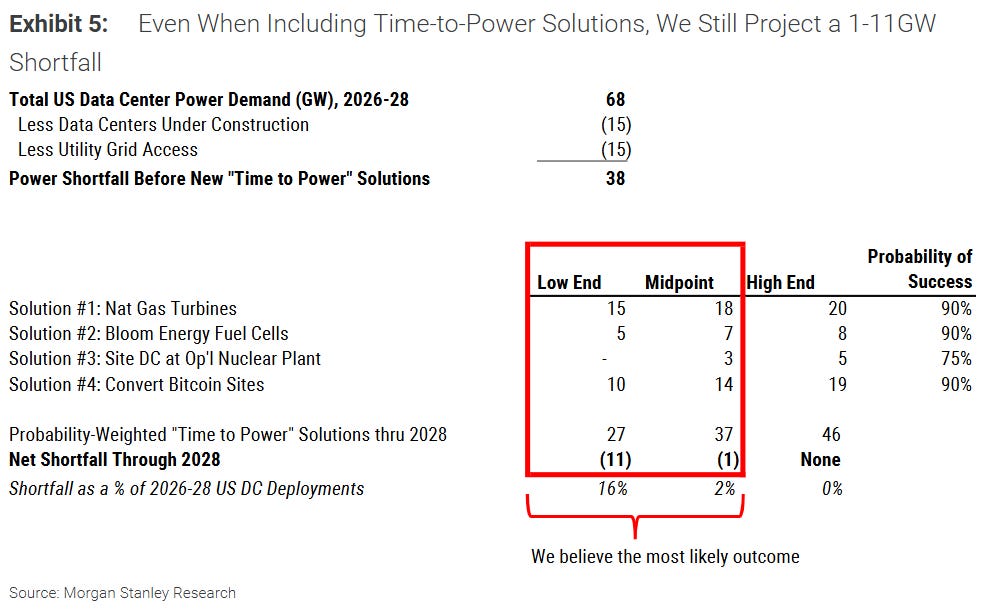
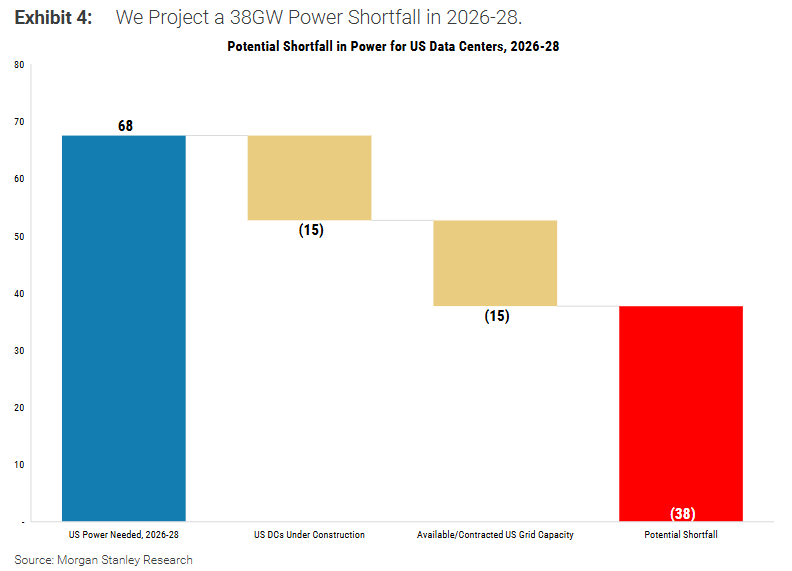
Second, the physical shortfall runs the other way from the glut thesis: Morgan Stanley projects US compute demand exceeding available power by 38 gigawatts over 2026–28 even before the queue is rationed, which is a world of too little grid, not too little demand.
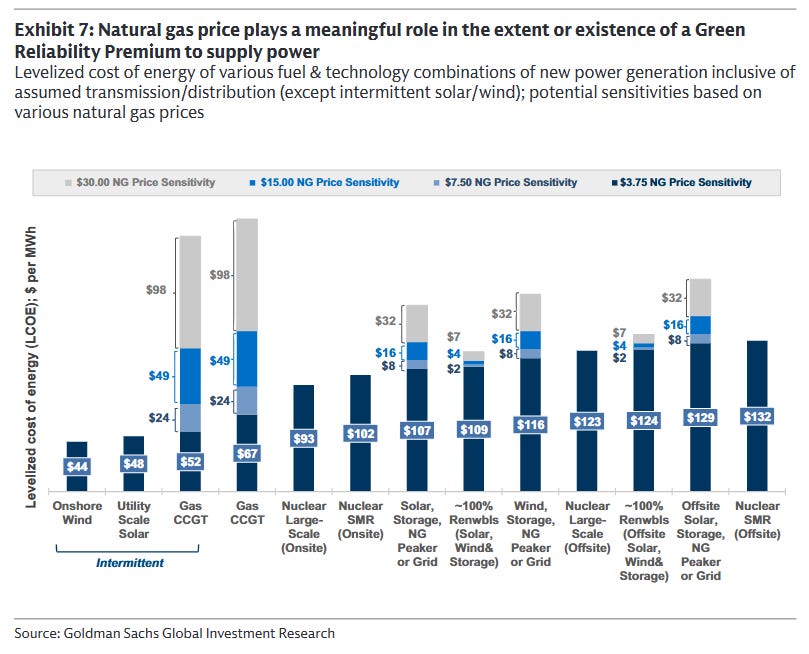
Third, the affordability of the constraint: Goldman’s Green Reliability Premium arithmetic finds that even paying the full premium for round-the-clock low-carbon power on all incremental demand would cost the hyperscalers $45 to $53 billion in 2030 — under three and a half per cent of their projected EBITDA — which says the builders can simply pay their way through the toll booths I have been describing.
And Fourth, demand elasticity: every efficiency gain to date has been met with more consumption, not smaller budgets, and the agentic wave has not yet landed.
I accept most of that, which is why this piece is not a crash call.
What I cannot get past is the order in which the bull case has to happen: the forwards repricing, the shortfall monetising, the premium being paid — every one of those legs needs the queue’s information to be believed first, and the queue has just been caught halving under audit.
Confidence in a measurement does not survive the discovery that the measurement was free to manipulate, even when the corrected number is still large; ask any market that has traded through a data revision.
The demand may well be real.
The instrument that was supposed to prove it has been impeached, and between the impeachment and the re-proof — between now and the classifications, between the classifications and April 2027 — sits a window in which every asset priced off the old queue trades on faith, and faith, in credit, is quoted in basis points.
Now that all of it is on the table, here is what it amounts to.
The AI buildout has constructed, mostly by accident, a single point through which its every claim must eventually pass — not the chip, not the model benchmark, but the interconnection queue, the one register where belief about future demand must be converted into a collateralised, classified, auditable position.
For three years that register was free to write in, and so it recorded everything and verified nothing; the demand models, the utility plans, the powered-shell valuations and the bond issuance all drew on a ledger that no one had ever marked.
The marking has now begun — deposit by deposit, audit by audit, designation by designation — and my verdict, for what three weeks of an energy analyst’s reading is worth against a technologist’s, is that the most important price discovery in the AI trade over the next eight months happens in interconnection dockets, not earnings calls, and that credit, not equity, is the asset class positioned closest to the point of impact and paying the least attention to it.
The playout runs through two desks.
The power desk moves first: if the classifications land near Morgan Stanley’s sixty-five gigawatts of Base Load, the confirmed load has to pull ERCOT’s 2027–28 forwards up from the fifty-dollar handle toward the ninety-five-plus that new baseload requires — and a forward curve that fails to reprice on confirmed load would itself be evidence that the market doubts the load, the gauge reading the gauge. That repricing then forces the contracting wave — take-or-pay power agreements as licence to operate, behind-the-meter gas as bridge, the premium for round-the-clock reliability hardening from a choice into a cost of doing business — which is the structural change: reliability stops being a spread over energy and becomes the product itself, with the queue as its primary market.
The credit desk moves second, and against the same gauge: a clean, large Base Load print validates the lease collateral and should compress the powered-shell financing costs and the wider basket toward the marker I set on the 3rd of August — hyperscaler spreads converging back toward the investment-grade tech index by year-end once the supply is absorbed. A print dominated by study purgatory does the opposite, and does it with wrong-way convexity, because the same news that impairs the collateral raises the probability the tenants retrench.
So the watch-list writes itself, every item on the transmission channel just walked: whether the good-cause exceptions preserve the 9th of April 2027 study date through the autumn, and how many gigawatts clear to Base Load when the paused classifications finally publish — above roughly sixty confirms, materially below forty breaks; whether ERCOT’s 2027 forwards close half the gap to ninety-five dollars within a quarter of the print; whether GE Vernova ends 2026 with more than half its 2031 turbine capacity contracted, the equipment queue confirming what the grid queue claims; and whether the hyperscaler CDS basket makes the year-end convergence or fails it, in which case the premium is doubt about the assets and this cycle has found its execution phase.
The testable premise is straightforward: if the classifications are released by late autumn showing Base Load of at least 60 GW, yet neither the forward curve nor the basket responds, then the market is discounting the queue’s signal—and my view of where price discovery occurs is wrong.
The energy transition spent twenty years learning that a resource is not a reserve; the paper markets spent this summer learning that a convoy is not a flow.
The AI trade is now enrolled in the same course — 438 gigawatts of filed intention, 205 of posted collateral, perhaps sixty-five of green lights, and a governor’s letter standing between each number and the next.
A queue is not a forecast.
It is a confession of what everyone would take if taking were free — and Texas has just started charging.
Comments
Nothing yet. Say the first thing.
Sign in to join the conversation.