
The former foreign minister of Malta evarist bartolo sent me a short message: “have you seen this?” I did not.
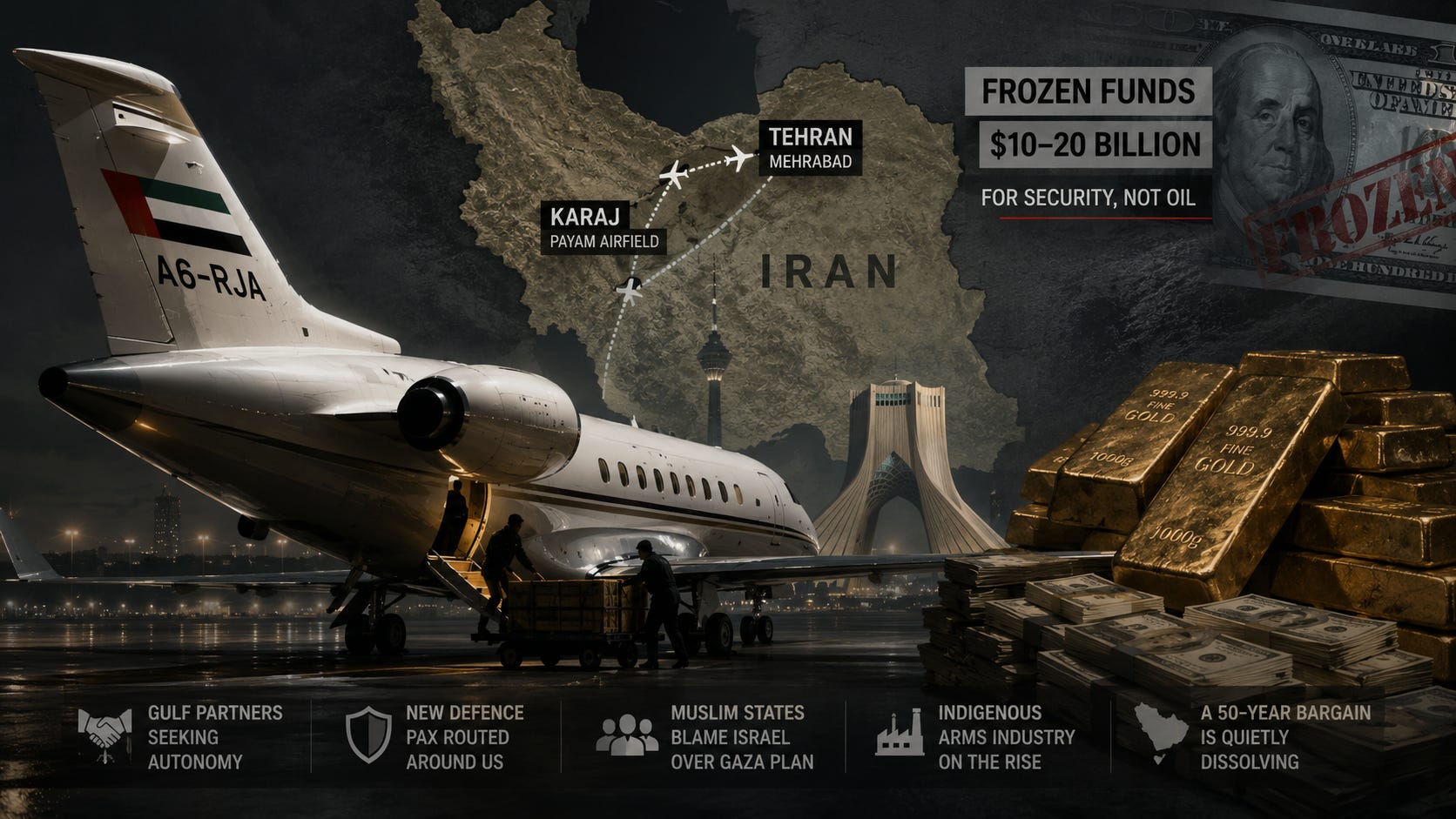
Since then I have been thinking about an aircraft that spent an hour on the ground in Iran and then flew home. It is a Boeing business jet, registration A6-RJA, and on the eleventh and twelfth of August it left Abu Dhabi, crossed the Gulf, touched down at Tehran’s Mehrabad and at Payam airfield near Karaj, idled for roughly sixty minutes and returned. The plane belongs to Royal Jet, which is owned by the government of the United Arab Emirates. The flight logs are not in dispute. Nothing else about the episode is settled at all, and that is what makes it worth an hour of your attention.
Iranian sources told a single account what the plane carried: bullion and cash, perhaps two tonnes of gold worth some $283 million, part of a wider release of frozen Emirati-held funds. The reason given was blunt. The money was Iran’s price for leaving the UAE alone — for aiming its missiles, next time, at someone else. Abu Dhabi denies every word. No funds released, its foreign ministry says, none transferred, none facilitated. I cannot tell you the gold was on the plane. What I can tell you is that the denial is not the end of the story. It is the beginning of one.
The payment nobody will confirm
The August flights did not come from nowhere. Two months earlier, in June, Reuters reported on the word of four sources that the UAE had agreed to release somewhere between ten and twenty billion dollars in frozen Iranian money, three billion of it already delivered, in return for a halt to Iranian strikes on Emirati soil. One source linked the release explicitly to safe passage through the Strait of Hormuz. The UAE denied that too, in the same flat language it would reach for again in August. And whether or not you believe any single figure, the shape of the thing is coherent in a way that invented stories rarely are: it lets everyone save face at once. Iran can call the money reparations. Washington can insist not a cent was paid. Abu Dhabi can buy its own safety and dress the whole arrangement as regional goodwill.
The denials, in this light, are not lies exactly. They are the required liturgy of a state that cannot afford to be caught. A government that wired money to a sanctioned Iranian account would expose itself to the very American machinery that froze the funds in the first place — and so it does not wire the money. It flies it. Gold on a state jet leaves no trace in the dollar-clearing system, no correspondent bank in New York, no record any regulator can subpoena. If the reports are true, the method is not a detail. It is the entire confession. The UAE is behaving exactly as a country behaves when it has decided to do something it must never admit to doing.
What the war taught them
To understand why a wealthy American ally would take that risk, you have to go back to the war. It began in late February, and it fell hard on the Gulf. Iranian missiles and drones emptied Dubai’s hotels and sent expatriates streaming to the airport. Then, abruptly, the strikes on the UAE ceased, and Tehran turned its fire on Kuwait and Bahrain instead. Any government that watches its neighbours take the blows it has just been spared can do the arithmetic without a briefing paper. The projectiles are for sale. The currency of exemption is cash. Iran, sanctioned into poverty, has found a revenue stream more dependable than oil: it sells the promise not to attack, and the region’s richest states are lining up to buy.
The deeper lesson was not about Iran. It was about the United States. The war was one that Washington began and the Gulf states did not choose — one that, in the judgement of analysts at Brookings, revealed America to be an unpredictable and unreliable partner, rejecting regional pleas to avoid the conflict and then inflicting enormous damage on the very states it claimed to protect. This was not the first such lesson. In 2019, when Iranian drones struck the Saudi oil facilities at Abqaiq and Khurais, the first Trump administration failed to respond, and the Gulf drew its conclusions then. The events of this year merely confirmed, under a rain of ballistic missiles, what they had already begun to suspect: that the security they had been sold for half a century might not arrive on the day the sky filled with fire.
It is worth pausing on how strange this is. For decades the bargain was simple and, to Gulf leaders, reassuring: American bases, American carriers, American guarantees, in exchange for oil priced in dollars and a broad deference to Washington’s designs. The bargain was never written down as a treaty — that was always its weakness — but it did not need to be, because both sides understood it and both sides kept it. What broke this year was not a clause. It was the understanding itself. When Abu Dhabi concluded that the guarantee was contingent, that the carriers might not come, that the war could be started over its objections and then billed to its economy, the whole edifice of unspoken trust that had held the Gulf inside the American orbit began, very quietly, to dissolve. You do not fly gold to your enemy while your protector’s promise still holds.
The break in the open
The gold, if it flew, is only the most literal expression of a recalibration now visible in daylight. Consider the middle of August. Days after the flights, the foreign ministers of eight governments — Saudi Arabia, Egypt, Jordan, Pakistan, Indonesia, Türkiye, Qatar, and the UAE, most of them America’s closest friends in the Muslim world — signed a single statement declaring that Israel bore responsibility for obstructing the American president’s own Gaza peace plan. Read that again: eight capitals Washington counts as partners, telling Washington that its flagship initiative was being wrecked by Washington’s closest ally, and that the fault was not theirs to fix.
It did not stop there. A week earlier, on the seventh of August, Saudi Arabia, Türkiye, and Pakistan signed a joint defence pact — a collective security framework routed entirely around the United States. The Washington Post reported the same week that Gulf officials had grown privately frustrated with an administration they no longer trusted to protect their interests. And beneath the headlines, the machinery of self-reliance was already turning: the UAE’s EDGE Group and Qatar’s Barzan Holdings agreed to build missiles, drones, and satellites together, so that, as one analyst put it, no foreign political decision could ever again switch off the region’s essential defences.
Fifty years of a single bet
There is a habit, in Western coverage, of casting the Gulf monarchies as passive — frightened clients clutching at American skirts, victims of Iranian aggression pleading for protection. It has always been a condescending picture, and this year it became simply wrong. What is unfolding is not panic. It is the maturing of a bet these states have been placing quietly for years: that no single patron can be trusted absolutely, and that survival lies in keeping every channel open and committing to none. The Emirates gave this doctrine a name — omni-alignment — and spent a decade practising it, hedging between Washington and Beijing, between Jerusalem and Tehran, betting that flexibility would outlast loyalty.
The uncomfortable truth the Gulf’s own policymakers are drawing in private, according to those who report from among them, is that Iran did not lose this war in any strategic sense. It absorbed the most powerful military on earth and survived, and it demonstrated that it could impose ruinous costs on its neighbours whenever it chose. When your adversary has proven that, and your protector has proven unreliable, you do not wait for the next war to test the arrangement again. You buy time. You pay. You sign pacts with other powers. You build your own missiles. And you fly gold across the Gulf in the belly of a government jet, and you deny, and you deny, and you deny.
None of this means the Gulf is defecting to some rival camp. There is no rival camp to defect to; that is precisely the point. China will not garrison Abu Dhabi, and Russia will not put its ships between Iran and Bahrain. What the monarchies are doing is subtler and harder for Washington to counter than a defection would be. They are declining, gradually and deliberately, to remain dependent. A patron can always outbid a competitor. It has no ready answer to a client who has simply decided that dependence itself is the danger — that the guarantees are unreliable, the financial umbrella is really a set of handcuffs, and the prudent course is to acquire, piece by piece, the means of looking after oneself. The Gulf spent fifty years avoiding exactly this outcome. The war persuaded it that avoidance had become the more expensive path.
Censored into silence elsewhere. Every share is a crack in the wall.
The sound of a promise breaking
Even the Strait itself has become a ledger of broken faith. In June, Trump and Iran’s president signed a memorandum declaring the American naval blockade lifted and safe passage guaranteed — for sixty days only. By early August the blockade was back, reimposed amid fresh attacks, the guarantee expired on schedule like a parking meter. This is the environment in which the Gulf states are making their calculations: a Washington whose commitments carry an expiry date, whose wars arrive uninvited, and whose protection, when the missiles came, was somewhere else.
I keep returning to that hour on the tarmac because of how ordinary it is. No treaty was signed, no war declared, no speech given. A plane landed, waited, and left. If the reports are right, the most consequential foreign-policy shift in the Gulf in a generation is being conducted not in communiqués but in cargo — in metal that moves because money cannot, in silence because speech would be fatal. Washington built a system designed to make disobedience unaffordable, and for fifty years it worked, because there was nowhere else to go. There is somewhere else to go now. And the people who used to have no alternative are, one flight at a time, quietly finding one.
Watch the denials, in the months ahead, more closely than the announcements. The announcements are for you and me. The denials are where the truth is kept.
No posts
Comments
Nothing yet. Say the first thing.
Sign in to join the conversation.