
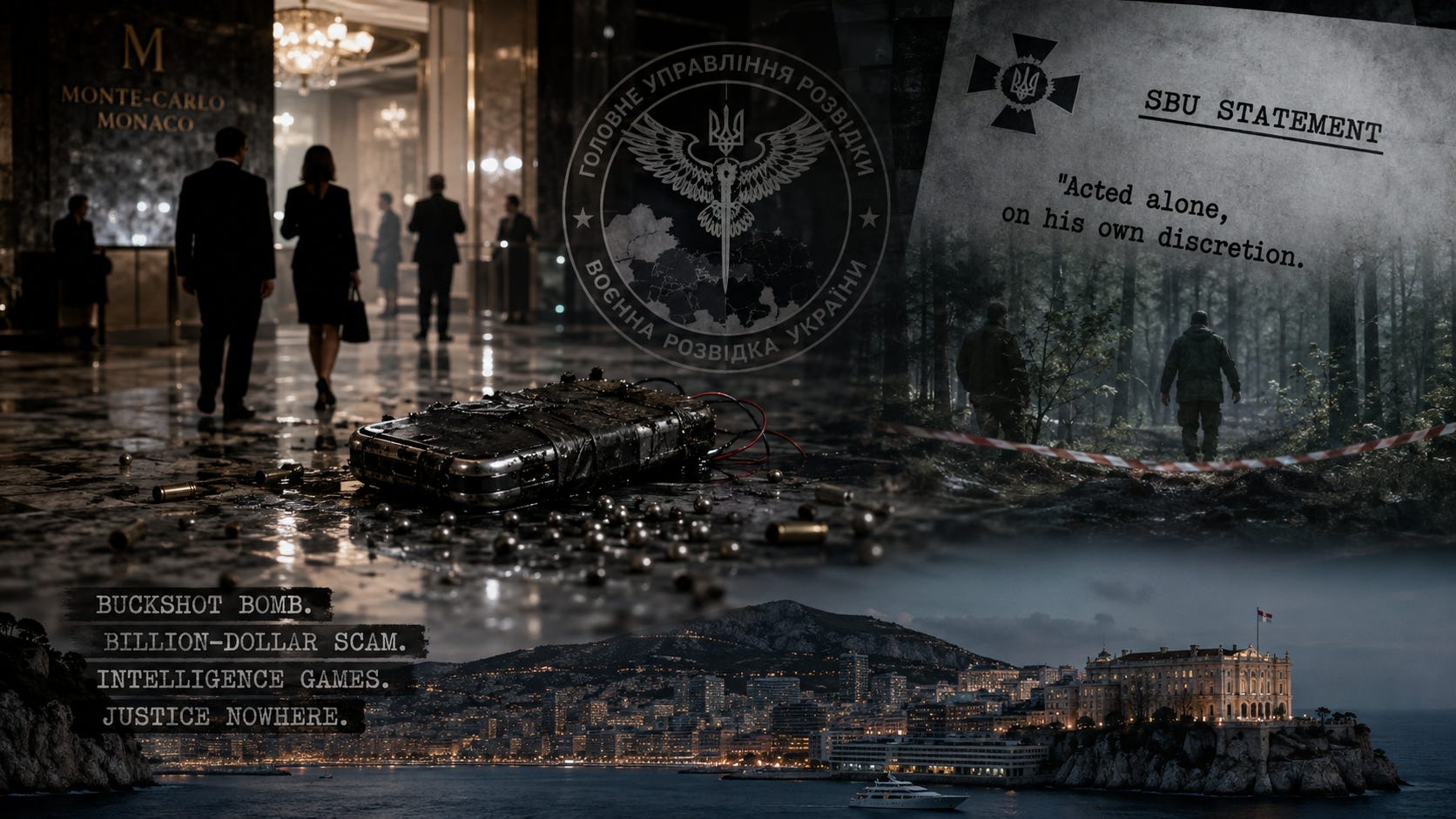
On the evening of 29 June 2026, Vadym Iermolaiev walked home from dinner into the lobby of his apartment building on the Rue Révérend-Père-Louis-Frolla, a few metres from the line where Monaco stops and France begins. He had his partner and their thirteen-year-old son with him. Someone had left a backpack at the entrance. Inside it was a charge packed with buckshot and bolts — shrapnel engineered to kill in a confined space — and it was detonated by remotecontrol at the instant the family reached it.
Iermolaiev lived, with burns and shrapnel wounds. His partner’s legs were amputated soon after she reached hospital. The boy was hurt less badly. From the first hours, Monaco’s prosecutors were careful to specify what the attack was not. The Minister of State, Christophe Mirmand, called it the first attack of its kind in the principality’s history. The chief prosecutor, Stéphane Thibault, ruled a terrorist motive out. This was, officially, an attempted murder — a targeted killing that failed to finish its target.
What followed over the next eleven days is the part that deserves attention, because it is the part the official account has worked hardest to seal shut.
The witness who came home to die
The person who left the backpack was named by French police as Anastasiia Berezovska, thirty-nine, a Ukrainian citizen who had disguised herself as a man and fled in a car with German plates, crossing into France and then Italy. On 1 July — the day after the bombing — she boarded a bus and travelled home to Ukraine, to her town of Zhytomyr, west of Kyiv. Ukraine’s state border service later insisted she entered lawfully, through a regular checkpoint, with no Interpol alert against her name at the crossing. Interpol issued its Red Notice on 4 July. By then the point was moot. On 6 July her body was recovered from woods near the village of Yuriv, sixty kilometres west of the capital. She had gunshot wounds to the head. Her belongings were gone. So were her shoes.
Before Monaco, Berezovska bred dogs in Zhytomyr and carried a 2021 conviction for drunken public rudeness — she had, a court found, insulted another woman while intoxicated. She was not a professional. She was, in the vocabulary of clandestine work, a cut-out: the expendable outer layer of an operation, the part designed to be lost.
Two men were arrested for killing her. And here the story stops being a crime and becomes a problem for a government.
The man who pulled the trigger worked for military intelligence
One of the accused, Vladyslav Reut, thirty-three, appeared in a Kyiv courtroom on 10 July. Reut is not a gangster picked up in a bar. He studied law at Kyiv’s national university and served in Ukraine’s military intelligence directorate, the GUR, in unit A2772 — a training centre for special-operations forces. This was established not by Moscow’s propagandists but by the investigative desk of Radio Liberty and reported by Luke Harding in the Guardian from Kyiv. In court, Reut described the killing in the flat cadence of a man recounting a job. His alleged accomplice — Vitalii Zhykovych, a former Kyiv-region police officer — “fired the first shot at her in the back of the head. She fell down. He came up and fired another shot. I was standing a few metres away.” Four shots in all. Then, Reut said, Zhykovych made him dig the hole, stripped the body of its possessions, and took the dead woman’s trainers. Zhykovych’s lawyer says his client denies everything.
The Security Service of Ukraine, the SBU, moved with a speed that several observers found remarkable in itself. It announced the arrests. It published grainy footage of what it called a “torture chamber” in the basement of Zhykovych’s home — then quietly clarified that Berezovska had not, in fact, been tortured there. It offered a tidy narrative of motive and agency: the two men had wired cryptocurrency and bank transfers into her accounts, which is how investigators found them. And the serving intelligence officer among them, the SBU stressed, had acted entirely on his own. He had not told his superiors about his contacts with the woman, or the money, or anything else. He had, in the official phrase, acted “at his own discretion.”
Consider what that sentence asks of you.
You are asked to believe that an active officer of a state military-intelligence agency — an institution whose entire reason for existing is hierarchy, tasking, and deniability — independently financed and helped execute the sole witness to a bombing on the soil of a European state, and did it as a private enthusiasm, without a word to anyone above him. You are asked to accept the lone-wolf theory not out of the fog of an unsolved case but from the security service investigating it, delivered pre-emptively, before any court has tested a syllable of it. There is a name, in the study of covert action, for an account that resolves every awkward question in the state’s favour and arrives fully assembled within days. It is not “the finding.” It is “the line.” Whether that is what this is remains the open question — and the speed with which the official answer moved to foreclose it is the reason to keep the question open.
What France is examining, and the war inside the story
The French have not closed it. According to Le Figaro, citing several concurring sources, investigators in France have been examining the hypothesis that the attack itself was orchestrated by Ukrainian intelligence. President Macron pressed Zelenskyy directly to get to the bottom of the affair and punish those responsible. Zelenskyy, asked about it by the Guardian, said only that he expected “further reports“ and would update the public. Mykhailo Tkach, the Ukrainska Pravda investigative journalist — no one’s idea of a Kremlin mouthpiece — put it this way: it would be hard to imagine a worse scenario, and an explanation would be required at the highest level, particularly of the GUR.
There is a complication inside the official story that deepens the question rather than settling it. The agency announcing the cover-up is not the agency implicated by it. The SBU — the domestic security service — is the body fingering an officer of the GUR, its bureaucratic rival, and some observers read the whole swift, clean production as an expression of the animosity between the two services as much as a pursuit of the truth. That does not exonerate the Ukrainian state. It does the opposite: it means the account on offer was assembled by one arm of the security apparatus about another, each with its own reasons to shape what the public is allowed to conclude. The lone-wolf theory is not the neutral output of an investigation. It is a claim made by an interested party about its competitor, and it should be read as one.
Who was Iermolaiev, and what world did the bomb come out of
He was, for most of his life, a specimen of a particular and now-vanishing type: the Dnipro developer-oligarch, a man who made a fortune in the lawless years after the Soviet collapse in a city where, as CNN’s account of the period put it, the line between local authority and criminal element was never drawn with any confidence. Through his Alef conglomerate he reshaped the skyline of Dnipro — shopping malls, business centres, a pedestrian boulevard. Forbes once ranked him among the country’s richest men, with a fortune it put at above $220 million. He was, by the account of people who knew him, almost aggressively apolitical, a man with “zero political views.” In 2019 he renounced his Ukrainian citizenship and took a Cypriot passport. After Russia’s full-scale invasion he settled in Monaco, joining what Ukrainska Pravda has acidly called the “Monaco Battalion“ — the ultra-wealthy who chose the Riviera while their compatriots were shelled.
In December 2023, Zelenskyy signed personal sanctions against him. Kyiv’s charge was that Iermolaiev had kept his alcohol business running in annexed Crimea after the invasion and paid millions in taxes into the Russian treasury — trading, in effect, with the enemy. Iermolaiev called the accusation “absolutely surreal“ and said he had donated money to Ukraine’s army. Both may be true at once; men of his kind rarely meet a border they cannot do business across. A regional analyst quoted by France 24 suggested his sanctioning owed as much to a lobbying campaign by a younger, hungrier rivalas to any principle. This is not a world of clean motives, and no honest account of the bombing can pretend otherwise.
The load-bearing thread: a billion dollars a month
There is a second explanation, and it may be the one that carries the weight. Iermolaiev’s son, Artur, was accused by Estonian prosecutors of running a criminal organisation built on telephone fraud — call centres operated out of Dnipro. He was arrested in Cyprus in December 2025 while trying to board a flight to Dubai, extradited to Estonia, and found to have headed a scam operation that had swindled its victims of more than €100 million. Then, in April 2026, came the part that raises an eyebrow: a plea bargain, a fine of just €8.5 million against a hundred-million-euro fraud, a suspended sentence, and a quiet exit from the country.
The scale of the economy behind that case is not marginal. A study by the Geneva-based Global Initiative Against Transnational Organized Crime estimates Ukraine’s scam call-centre industry generates as much as $1 billion a month, employing roughly 60,000 people — about two-thirds the headcount of the country’s legal banking sector. The centres operate in all twenty-four of Ukraine’s oblasts, and the industry is now, by some estimates, more profitable than drug trafficking. Its epicentre is Dnipro. Researchers link the largest networks to traditional organised-crime formations — Dnipro-based groups and the “Khimprom” organisation, which once specialised in synthetic drugs. The war has been good for the business: criminal networks migrated west and south from the front-line regions, and, as Czech police noted, some centres are deliberately moved closer to the fighting precisely to deter European law enforcement. In December 2025 a Eurojust-coordinated operation dismantled a network spanning Kyiv, Dnipro and Ivano-Frankivsk that had defrauded more than 400 victims of over €10 million.
This is the ecosystem the bne IntelliNews analysis placed at the centre of the bombing, reporting that the attack was likely connected to Iermolaiev’s own call-centre operations in Dnipro. Ukrainska Pravda, citing law-enforcement sources, reported that French investigators believe the attack followed a breakdown in a territory-sharing arrangement and unpaid debts between Iermolaiev and organised-crime figures in Dnipro. Monaco’s investigators have confirmed none of it. A person who knew Iermolaiev socially told the Guardian the attack was criminal, not political — a matter of protection money unpaid. “Vadym or members of his family didn’t want to pay someone,” the source said. “The woman was disposable.”
The woman was disposable. Hold that sentence up to the light, because the whole affair turns on it, and it is true in more ways than the source meant.
She was disposable to whoever sent her to Monaco with a backpack — the expendable hand on the device. And she was disposable to whoever met her when she came home, wired her the money, drove her to a forest, and put four rounds into a shallow grave. Both men accused of that killing had paid her. One of them served the state. The elimination was not the panicked improvisation of a criminal covering his tracks; it was fast, clean, and professional, and it removed — permanently, before any French magistrate could reach her — the one person who could have named who commissioned the bomb, and why.
The jurisdiction built not to ask
There is a reason this happened in Monaco, and it is not only that the rich live there. Monaco is a jurisdiction engineered, over a century, to be the place where questions about the origin of money are not asked. When those questions have been forced, the machinery has a documented habit of protecting the wealthy man at its centre. The last time a post-Soviet fortune collided with the principality’s courts, in the long war between the Russian billionaire Dmitry Rybolovlev and the art dealer Yves Bouvier, the collision exposed something the principality would have preferred buried: text messages showing that Monaco’s own justice minister, Philippe Narmino, had accepted private helicopter rides and an all-expenses-paid ski trip from the billionaire’s circle. The affair, dubbed MonacoGate, drew in a former minister of the interior, a former head of the police department, and a former public prosecutor. And in the end the whole edifice of charges was erased — struck down on procedural grounds after the European Court of Human Rights found the key evidence had been unlawfully obtained. Everyone walked.
That is the place where the bomb went off. Not a sleepy tax haven surprised by violence, but a jurisdiction with a proven talent for ensuring that inconvenient questions about wealthy residents do not reach a verdict. The bomb in the lobby did not shatter that order. It briefly illuminated it — showed, for a single evening, the machinery humming under the marble. Then the machinery resumed.
Congratulations if you made it that far! Feel free to share with someone who needs this.
What is proven, and what is being sold
It is worth stating the key facts without hedging, because they survive every competing theory. A bomb built to kill was detonated by remote control in a European city. The woman who placed it fled to Ukraine and was executed within a week. The two men accused of killing her had both been paying her. One of them was a serving officer of Ukrainian military intelligence. The killing removed the only witness who could explain the attack. And the account that asks the world to file all of this under “a rogue officer acting alone” was produced, within days, by a rival branch of the same security apparatus.
What is not proven is the thing that matters most: whether the order came from within the Ukrainian state, from a faction of it, or from the criminal economy that has grown up beside the state and, in Dnipro, is sometimes indistinguishable from it. That question is now far harder to answer than it was on 5 July — and it is harder for a specific, engineered reason. The person who could have answered it is dead, shot in the back of the head by men who had been paying her, one of them an officer of an agency now assuring the world it had nothing to do with any of it.
Following that evidence is not carrying water for Moscow, and the reflex to treat it as such is itself part of how the question gets buried. The pro-Kremlin outlets that seized on the bombing within hours — the Iermolaiev-as-martyred-enemy-of-Zelensky framing — want the story simple because a simple story is useful to them. It is not simple. A government does not get to be the sole author of the explanation for a crime committed by its own officer, publish that explanation before trial, and expect it to be received as the truth rather than as what it is: an interested party’s first draft, offered in place of an answer.
Monaco will not press for a better one. It is not built to press. The witness is buried. The officer, we are told, acted alone. The case is, for all practical purposes, closed.
It should not be.
No posts
Comments
Nothing yet. Say the first thing.
Sign in to join the conversation.