
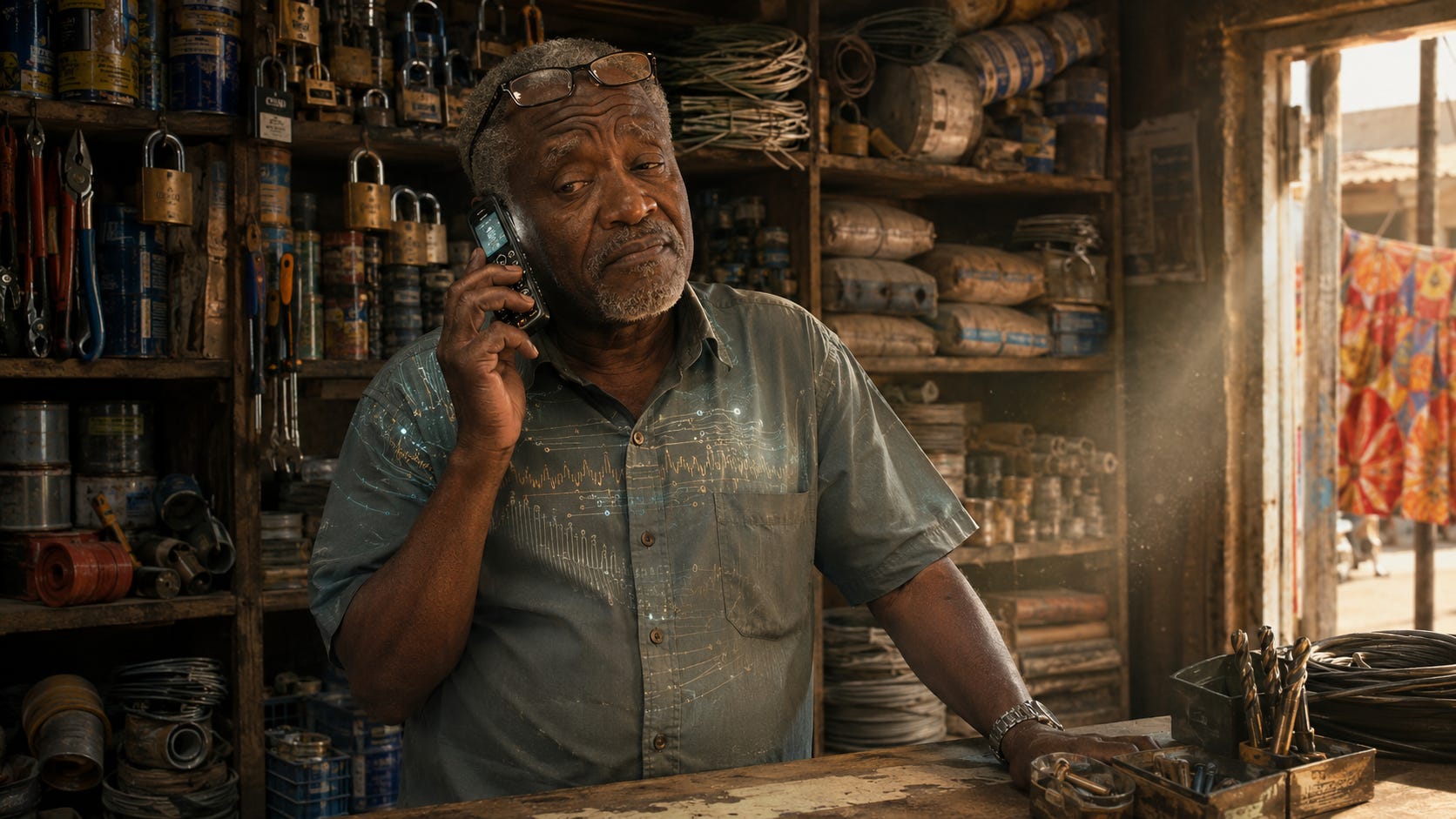
Let me tell you about a man who does not exist.
Mzee Kassim runs a hardware shop in Kariakoo. He is busy. He has been burned by salespeople before. When you call him and start pitching, he sighs and says, “Ah, wauzaji nyie hamchoki jamani.” If you survive that, he asks what your price is. If you dodge the question, he hangs up.
This week, 467 people called him. If you were one of them, you already know the voice. If this is the first you are hearing of it, here is the setup.
Kassim is Sema, the voice AI Agent we build at Neurotech, playing a character. On Tuesday we gave him his own Tanzanian phone number and posted the rules:
You have 60 seconds to sell him something. Anything. A coach comes on afterwards and scores your pitch out of 100 on four things: how you opened, whether you asked about his business, how you handled his objections, and whether you asked for a next step. Clear 75 and TZS 500 —>1,000 airtime lands on the number you called from.
📞 +255 699 920 072
No app. No signup. No data bundle. You dial, a Kiswahili voice answers, and you are in Kariakoo.
For those who called: thank you. A word on how I read what follows, because I think it matters. Sema records, transcribes and scores every call, and we expose all of that through an MCP server. I pointed Claude at it, had it pull the 467 sessions, and asked it to count, cluster and surface the patterns. I then went into the individual transcripts myself to check the quotes and the scores. So the numbers below were computed by an AI over conversations run by an AI. I find that funny, and also exactly the point of the whole experiment.
In 48 hours the line took 467 calls and 24 hours and 25 minutes of Swahili conversation. A full day of talk time in two calendar days. 164 different people. 53 of you called three times or more. One person called 15 times.
And you did not arrive empty-handed. You brought your actual businesses. Kassim was pitched mandazi, mahindi, maziwa, kuku wa Sasso, ubuyu, keki, maji ya Dodoma, makufuli, screen protectors, routers, GPS trackers, vipuri, magari, viatu, vitambaa, mafuta ya ngozi, kusuka nywele, a nutrition clinic, printing, stationery, a livestock marketplace, an escrow marketplace, websites, three POS systems, mentorship, advertising, and loans from two different microfinance companies.
Roughly forty product categories. Nobody coordinated that. That is just what Tanzania sells.
182 pitches reached the scoreboard. Median score: 69. Only 64 cleared 75. One in three.
The top score was 95. A nervous caller selling a marketplace with escrow, who stumbled through the explanation twice but answered every objection and walked away with “namba yako ni ngapi nikupigie baadaye.”
The 90 was Victor from Tabata, selling mandazi to a man who sells cement. Kassim told him straight: “mimi siuzi mandazi.” Victor did not blink. He asked about the shop, refused to promise a delivery he could not make, and closed with a line the coach called the best of the call: “Ukiweka order mapema, mzigo wako utakuwa mezani kwako asubuhi.” Ten out of ten on objection handling.
If you scored under 75 and you are wondering why, the transcripts are clear. The winning calls all do the same four things every sales trainer teaches and almost nobody does. Say your name and company in the first ten seconds. Ask one real question about his business before you pitch. Answer the price question without flinching. Ask for a next step.
The losing calls failed in the first fifteen seconds. Straight into features, no name, no question. Kassim’s “wauzaji nyie hamchoki” appears in the transcripts 101 times. “Niko busy sana hapa dukani” appears 51 times. The callers who heard that and asked for a better time scored higher than the ones who kept talking.
This is the part I did not expect.
Of the 21 people who played three or more scored rounds, 17 improved between their first and last attempt. One caller went 30, 30, 90. Another went 32, 72, 73, 86. Someone started at 9 and was at 80 on the second call.
The coach does not just score you. It tells you exactly what to fix before the next call: “andika maswali matatu ya wazi kuhusu biashara ya mteja.” And you went away, wrote the questions, and called back.
I thought we were running a marketing stunt. Reading the transcripts, it looks more like the cheapest sales school in the country. A phone call and TZS 2,000.
I write anti-hype, so here is the honest list, including one thing about this very post.
The payout. “Salio” shows up in 42 call notes and not always happily. Numbers misheard, a caller reading out a different number, the AI saying “nashindwa kukutumia salio kwa sasa” when the hook failed. If we promised instant, it has to be instant. If you cleared 75 and the airtime did not arrive, reply to this with the number you called from and we will sort it. This is the first fix.
The arguments. One caller spent 30 minutes, our full cap, litigating his win record and a bonus he believed he was owed. The transcript includes “tapeli mkubwa wewe.” The AI kept its tone. I am not sure I would have.
The hang-ups. 65 calls under 30 seconds. You dial, hear a machine, drop. Fair. Many of you also opened with “wewe ni mtu au mashine?” I respect that.
The greetings. 12 calls were just “salamu tu.” People ringing to say habari to the machine and leaving. No product conclusion. I just like it.
The analysis. Because Claude did the first pass over the transcripts, every figure here is only as good as the transcription underneath it. Some calls transcribed badly, a few failed, and the scoring model did not always use the same rubric, so treat the counts as close rather than exact.
The voucher is bait. Here is the experiment.
Almost every AI product being built today assumes you have a smartphone, internet, and comfortable English. That is a minority of this continent.
A phone call assumes none of it. It works on a TZS 20,000 Tecno. It works on 2G in Kigoma. It works if you never learned to read. It works in the language you actually think in.
So the question was simple: if the only barrier is “can you make a call,” do people come?
467 calls. 164 people. A man phoning 15 times to beat his own score. You came.
And you did not come as “users.” You came as mama ntilie, hardware suppliers, loan officers, developers and one very determined mandazi seller, each bringing a real business into a real conversation with an AI, in Swahili, and leaving with a score and a note on what to fix.
That is what inclusion looks like when it is not a slide. Same capability, oldest channel we have, your own language.
Bado ni experiment. I am not going to oversell it.
We are fixing the payout first. We are adding harder customers. A hotel manager quietly joined on Wednesday night; 17 of you have met him, and he is brutal.
Then we put the same engine behind real business lines: ferry bookings, clinics, SACCOs, logistics. Businesses whose customers would rather call than type. That is what Sema is for. Kassim is the demo.
If you have not tried it yet, the number is live. Muuzie Kassim kitu. Beat 75.
📞 +255 699 920 072
If you have tried it, reply and tell me what broke. That is the feedback I need more than the praise.
No posts
Comments
Nothing yet. Say the first thing.
Sign in to join the conversation.