
“That’s what I’m f---ing talking about.”
Alysa Liu had completed a crazy ice figure skating performance at the 2026 Winter Olympics and become the first American woman to win that event in twenty-four years… the magnitude of this feat cannot be overstated.
She’s on the ice, she’s just posted a career best, and the thing she does right after killing it is not the usual " I worked hard for this.. I deserved it… or the humble, oh my god, I didn't think I could win… naah,
She looks straight at the camera and says that.
I am not a big fan of sports, let alone winter games, but even then, to me, a noob watching her perform it was clear as day that what I was watching was someone simply having fun.
You probably read the title of this article and instantly had an idea of what this would be about; that phrase has become a bit of a cliché, right alongside the other hall of famers like
“Better late than never”
“What doesn’t kill you makes you stronger”
“The early bird catches the worm”
I think I just puked in my mouth a bit writing those…
But honestly, the title is actually one of the most useful things you’ll ever hear about how to get good at anything, and almost nobody understands why, including, probably, the people who say it.
So let me ruin it by explaining it.
Hi , if you’re enjoying the work, consider upgrading to support the publication
Getting good at anything is a numbers game, that much should be obvious to you by now. Pick any skill, and there is a number of reps, iterations, and failures survived after which it would be statistically impossible for you to be bad at said skill.
The problem is that number is never small and the more impressive the skill, the higher that number gets.
And so the only way to hit this magic number is to consistently show up.
The mistake everyone makes is to think that they can raw dog this by simply being “disciplined,” and that is why most people quit eventually, because what you actually need is dedication.
A type of blind faith… and the best way to do that is to have fun.
When you enjoy doing the thing, you are not pounding through the boring middle, grinding towards some future payoff… the middle is the payoff.
Imagine dancing in your room, at no point do you wish for the song to end so that you can stop dancing. The dancing is the payoff, you do it till you are swimming in your own sweat.
Fun keeps you in the game way longer than you ever would have been otherwise. it opens your mind up to risk you notice more, you experiment, you’re not anxious and clogged up.
On the contrary, when you are try harding, you become outcome-obsessed, treating every attempt like a heart surgery… you choke, you play it safe. You optimize for not-looking-stupid instead of for learning
So yeah, have fun, get more reps, take better reps, quit less, arrive at “good” almost by accident
I think I’m about to lose the inspirational-poster crowd now.
Fun gets you good, 90th percentile even, but world-class… thats another thing entirely.
Progression through any skill is a sigmoid curve… looks like the letter S.
Flat and miserable at the start when you suck and nothing works. We will call this beginner hell.
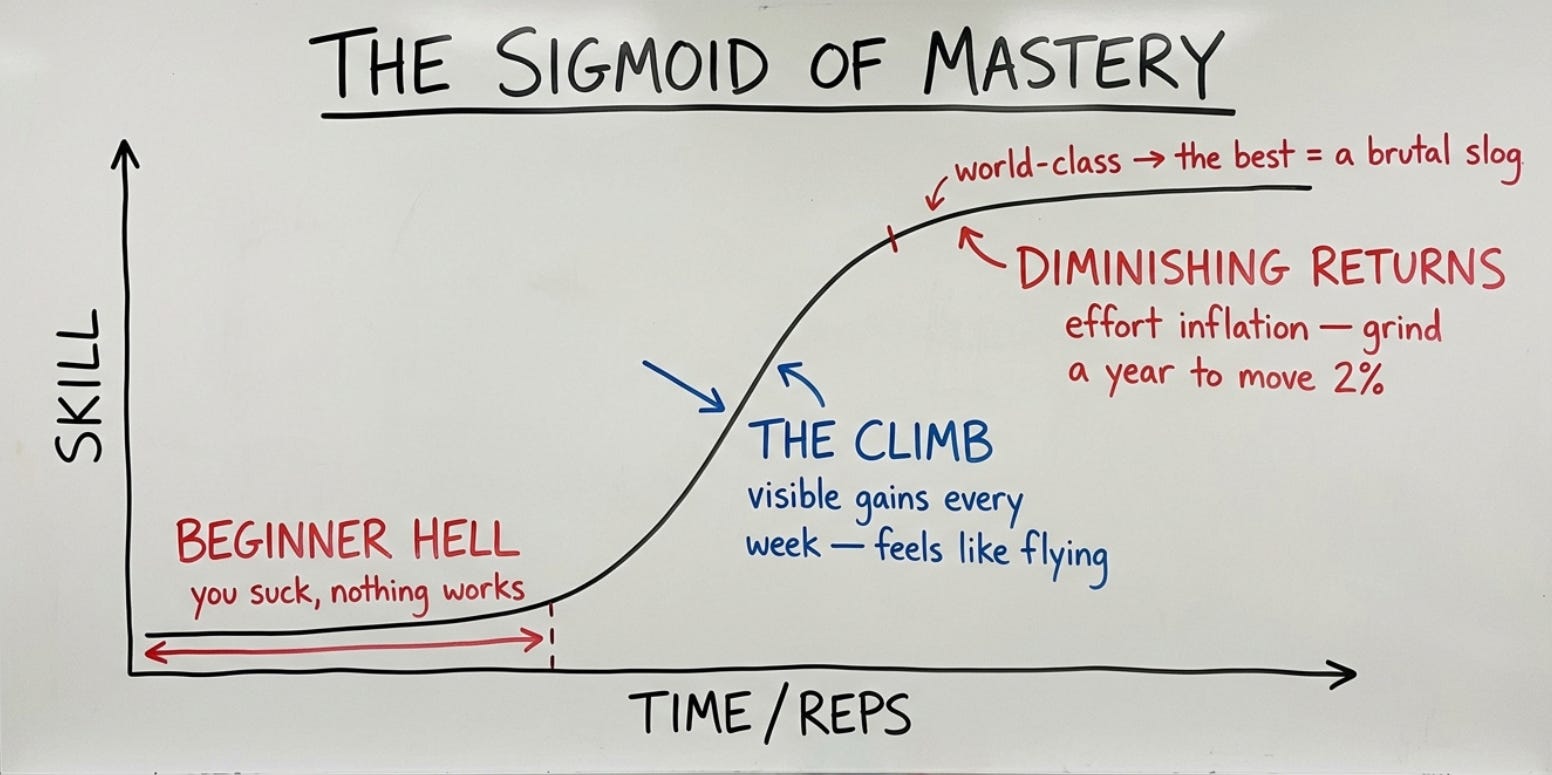
Then a glorious steep middle where every week you’re visibly better than last week and it feels like flying... you start to think to yourself that maybe you are the chosen one… but then you reach the top , the S flattens out again.
At this point, it seems like everything you do has diminishing returns, call it effort inflation. You could grind for a year to move a metric by just two percent.
To get to this point you already proved that you are good at what you do, but the sheer chasm that exist before you humbles you.
The distance from “world-class” to “literally the best” is a brutal, joyless, injury-riddled, obsessive slog.
And eventually you hear a voice whisper in your ear… “you are not that guy”
At this point everyone makes one of two mistakes.
They decide to optimize for fun, the problem with this is that to inch out progress you need progressive overload, and that’s not fun, so optimizing entirely for fun puts you in a direct course to stagnation
They decide to optimize for progress at all costs, the problem with this is obvious, you will burn yourself out faster than you can ever imagine.
The only way through this phase is to build a system that perfectly balances fun and progressive overload… and you can do that in 3 simple steps…
Humans… we are simple creatures. We will do almost anything if you slap a scoring system, a feedback loop and a visible sense of progress on it.
That’s why video games are so successful and why a person who “cant focus” will all of a sudden play nine hours leveling up pixels on a monitor.
But there is another mechanic that makes games so addictive… difficulty. They are always just a little too hard for you.
No one wants to play a level they beat a million times, that’s boring.
But you also dont want to keep fighting a boss you can’t beat even after watching every single tutorial on YouTube (im looking at you, Malenia)
A good game keeps you glued to that razor thin line right between the two, where you fail just enough to stay hungry and win just enough to stay hooked.
That line is exactly how you solve the fun vs overload problem. Apply video game logic to whatever it is you are trying to get good at
Start by tracking your progress, note down any incremental change. Create streaks these work even better if they are visual like on a calendar on your wall or a journal, it makes it easier to visualize your progress.
Create arbitrary challenges that make practice feel less like practice and more like actual execution
And every single time the thing starts feeling easy and cozy, you crank the difficulty.
Increase the weight, pick a harder problem, add a constraint, find a better opponent… whatever you do, don’t let it get too easy and comfortable.
Comfort turns fun into boredom and your progress dies with it.
Also, be careful what numbers you decide to track because that makes the difference between a game that amplifies the fun and one that sucks the soul out of you. Which brings me to the next point.
Comparison is the thief of joy, there is another one-liner that you have probably heard too many times. But again, its true.
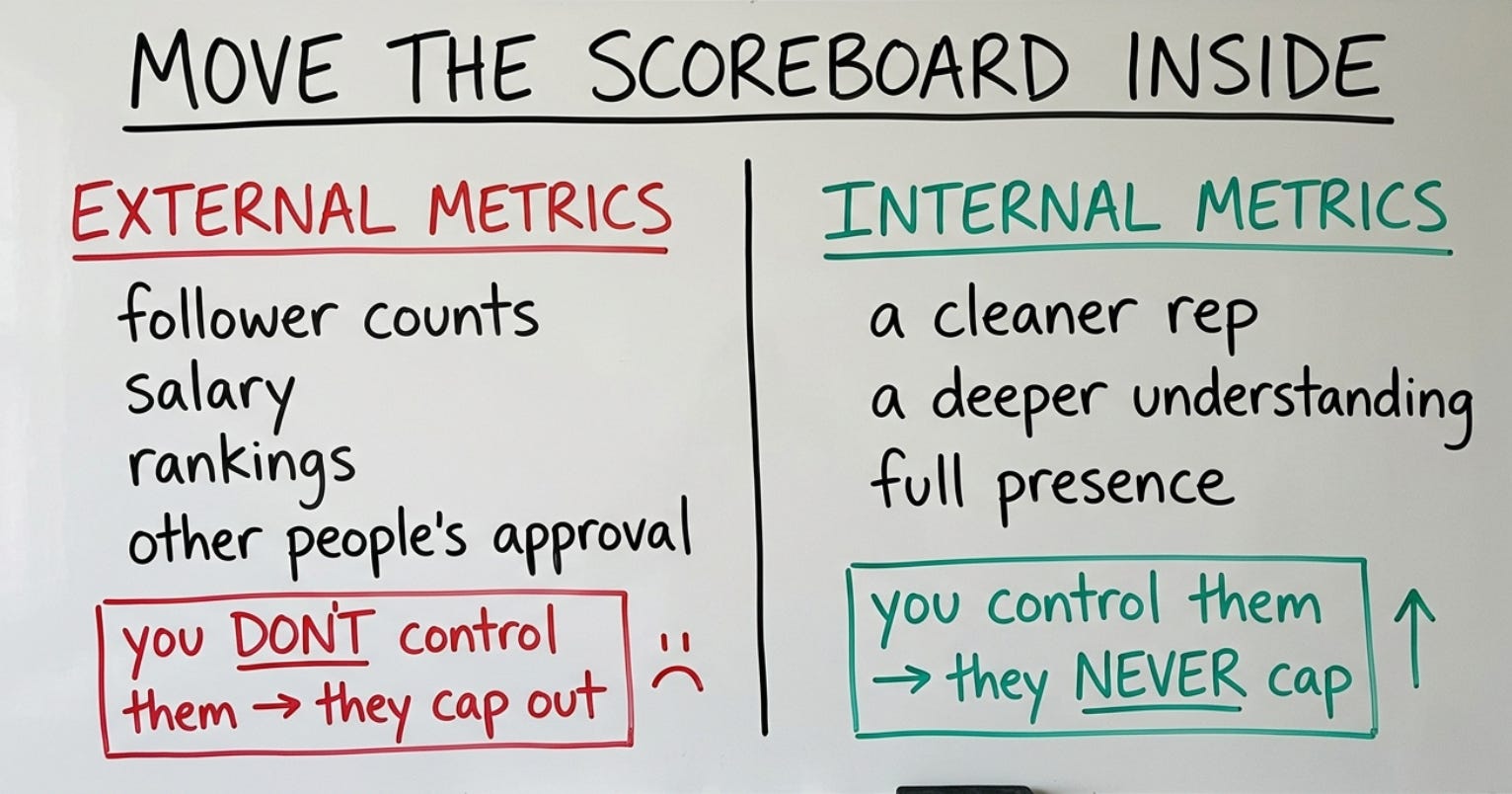
Many of us run our entire lives on external metrics, follower counts, salaries, performance audit rankings i could go on and on and on.
The desire to seek other people’s approval is hardwired into our brains, thats why its so hard to let go of it.
When we were monkeying around in the savannah, what your tribe thought of you was super important… excommunication back then meant death.
We needed each other and so people-pleasing became the default. But now times have changed and that instinct works against us
External metrics are bad for two main reasons,
One, you don’t control them, you could do everything right but if the judge had a bad morning that day, you still won’t make playoffs.
Two, they have a ceiling, they cap out. The moment you hit those targets, the moment you make everyone else happy, you realize that the finish line already moved again.
Internal metrics fix both. You can move the target further or closer, and when you hit it no one can deny you that victory.
They never cap, there is always a cleaner rep, a deeper understanding…. and these are also the exact metrics that lead to mastery, because they point to your attention to the craft instead of the crowd
It goes back to what liu said
“Peak happiness out there on the ice”
That’s an internal metric through and through, she didn’t even care to mention the score or the cheers of the crowd.
She was measuring the experience, and the score followed, the same way it always does when you stop staring at it.
After all is said and done, you have to eat.
The mainstream idea is that you pick a lucrative field, grind it, then use the money to buy a few hours of fun on weekends.
I don’t believe that lie… a life of financing your joy with your misery? Count me out.
I think we can flip that, no, I KNOW it, I know I can and I believe you can too.
Find the thing you would do for zero dollars an hour, the thing where to you the reps are the reward.
And then obsessively, relentlessly engineer a way to get the world to fund it
And this isn’t about money… not entirely, at least.
Getting paid to do what you love removes the single biggest fun killer there is, the guilt and time-scarcity of doing it “on the side.”
When the thing you love is the thing that pays rent, you get to do it all day, every day, for years, and remember what we established at the beginning of this essay, years of joyful reps is the hack.
So stop thinking of getting paid as some reward you get when you achieve mastery, instead, think of it as the way you afford to get good
No one remembers number two, which is unfortunate because in most competitions, the difference between first and second is a rounding error.
The top of that sigmoid curve is a fucking bloodbath, and you could wallow in those trenches for years just to become “the guy who almost won that one time”
That’s the booby trap of external competition.
But… as Naval Ravikant put it: “Escape competition through authenticity.”
The more you optimize for your own weird internal sense of what’s good, your specific taste, your specific joy, that thing about your craft that makes your ears tingle, the more you drift off the shared course and chart your own path. (the write path, wink)
In truth, nobody can out-compete you at being you because authenticity is the single most defensible competitive advantage there is.
Be the weirdo on the ice, completely unbothered by the scores, having the absolute time of your life while everyone else is suffocating under the weight of the moment.
Out-fun them all.
—kaguura
Thanks for reading this far , genuinely. If you want more of this in your inbox, subscribe, I’d love to have you.
And if you’re already subscribed, consider upgrading to access the full archives.
Check out some of my other posts :
No posts
Comments
Nothing yet. Say the first thing.
Sign in to join the conversation.