
The difference between a blank page and a well-written essay is about 4 hours.
I will let you sit with that for a bit because it comes as a shock to most people, it certainly would have been to me one year ago.
Ok, here is how I used to write my essays, and you will probably relate to this. First I would have an idea, mostly in the form of a title.
I would open up a blank Notion doc, have the title at the top, and then start writing.
Most times I wouldn’t have any real direction and I would figure it out as I wrote. I would lose the plot somewhere in the middle, stare at that blinking cursor for about an hour then finally give up and leave the half-finished draft for tomorrow.
Tomorrow never came, and that’s how so many pieces died off.
That was my system, and looking back I’m even surprised that I was still able to consistently put out some articles.
Anyway, being a software engineer, I decided to treat my writing problem less like a creative one and more like a technical problem.
Instead of trying to align my chakras and walking for 3 hours every day just to think of what I want to write about, I created a system that leveraged my strengths and offset my weaknesses as much as possible, and dare I say, I think it worked.
So let me break it down for you, and you can steal it for yourself.
To best demonstrate this I will use my own writing as an example and walk you through it, I will be using this article.
I'm building a 90-day writing circle for people who refuse to publish slop. Annual subscribers get first access at a discount when it opens, so lock it in now
What I noticed with myself and most creatives is that ideas are never really the problem. At any given time, you could conjure up multiple banger essay titles, the sources of inspiration in this era are near infinite.
Stanford lectures on YouTube, slop philosophy videos on TikTok, podcasts, books, essays, X, Substack….. I think you get the point.
If you are like me, anytime you interact with this media, a lightbulb goes on in your mind and you think to yourself, “yeah I could write something about that…”
So, I’m not going to bore you with how to get ideas, what I want to focus on instead is figuring out what ideas are worth your time.
The way I go about this is simple, I take a notepad (I’m a sucker for writing things down on paper).
I write out my idea, for this essay the main idea was that AI will not take people’s jobs.
I write out my arguments (the angel’s advocate) and then write out all arguments that are against the thesis (the devil’s advocate).
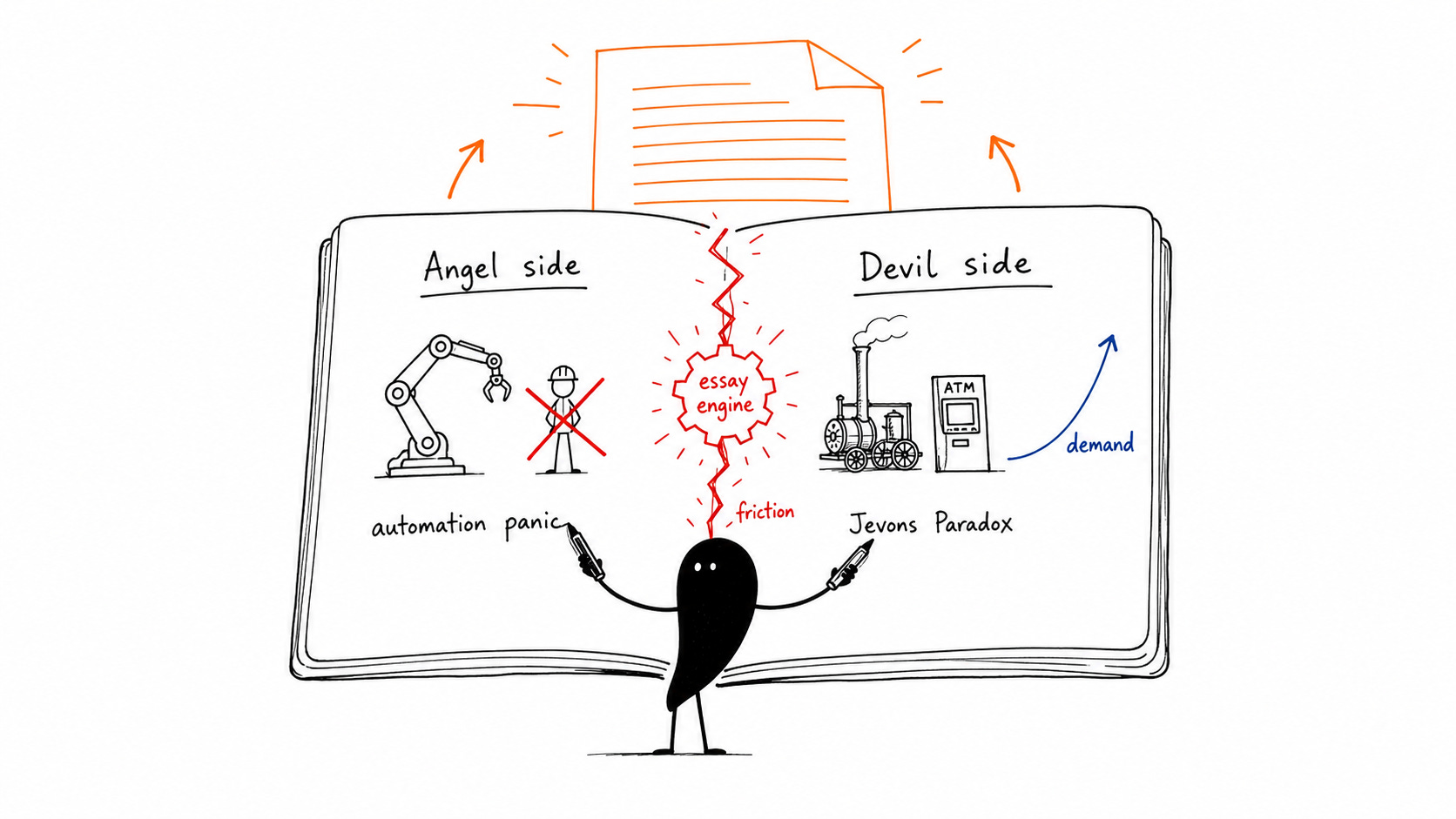
If your argumentative thesis is one-sided and has no counterarguments, it’s not worth writing about.
It is best to take your time doing this because it also helps you navigate the counterarguments while writing your essay later down the line.
Think of it this way, if you wrote an article based on the thesis “why we should not kill people” it would be hard to make it interesting because that is the consensus (unless your target audience is psychopaths).
But if your thesis was “why we should kill people”… well I can’t even think of what you would write about and you would probably end up in a mental asylum, but more people would definitely read your article.
Your essay should live in the high-voltage friction right between boring consensus and institutionalized madness.
Now that you have figured out whether your idea is worth pursuing into a complete long-form essay, the next part is explicitly stating what it is you want your reader to get from your essay.
If you don’t map out the exact value of your essay before you write it you will end up mumbling around and leaving your reader at a worse-off place than you found them.
I aim for 3. One takeaway is a tip, two is a comparison but three takeaways form a complete mental model.
In my article, I had 3 main points that I wanted the reader to understand and they all worked to hold up the main idea of the essay.
1. Alpha Decay.
2. Pilot in the Loop.
3. The Human Premium.
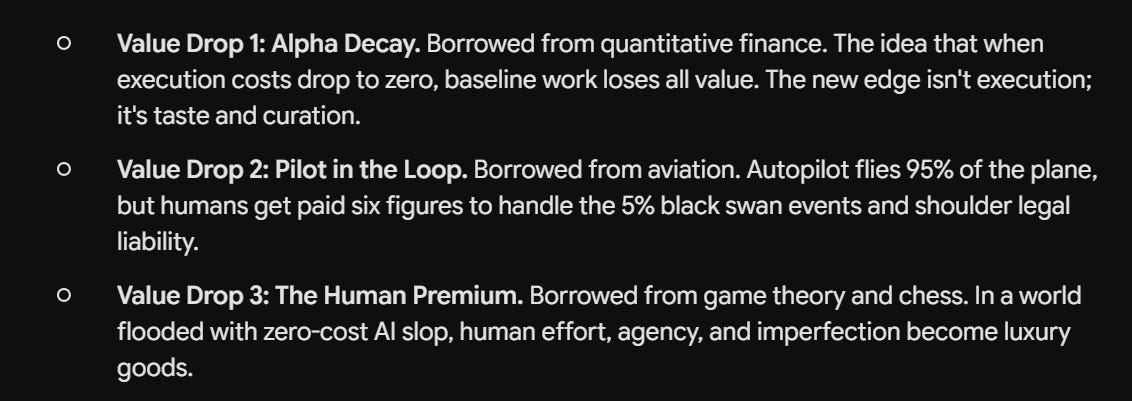
By writing these down I gave myself a clear destination of where I wanted the reader to end up, the second half of my essay practically wrote itself.
Now you have a destination for your reader. The next problem is figuring out how the hell you’re going to get them there.
I will tell you right now, this is the trickiest part, and also one of the most important. This is where you map out your argument and choose what you want to put in and what wont make the cut.
Think of it like pre-production.
Most essays I read make one of two mistakes.
They base their entire argument on one anchor (mostly an anecdotal experience).
They go on and on and on, giving you a grocery list of historical points and ideas and the writer completely forgets to tell us his own point of view or why we should even care.
These are mistakes I made as well, (you can go through my articles from a year ago and see what I mean).
My solution is to have one main driver, the core to your thesis, and have it supported by two anchors.
The Main Driver: It is the primary vehicle carrying the essay’s argument.
Anchor Point 1: A real-world case study, historical anomaly, or cultural event that grounds your theory in physical reality.
Anchor Point 2: A mechanic pulled from an entirely separate discipline…. it could be quant finance, evolutionary biology, astrophysics, game theory….. whatever.
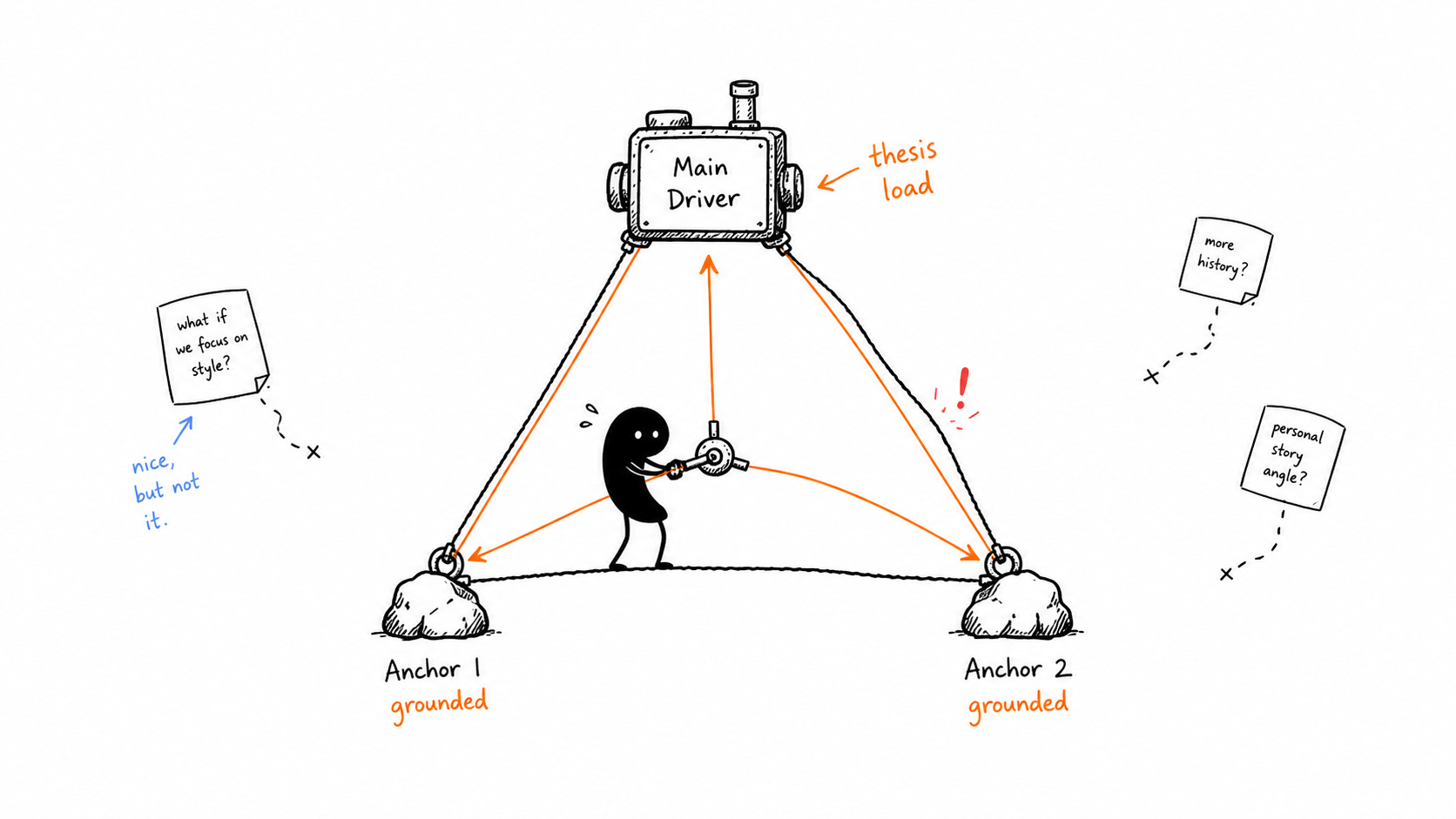
For my essay, here is how that looked.
Main Driver: Jevons Paradox, cheaper executin increases demand rather than simply eliminating workers.
Anchor 1: Historical technology shifts, the steam engine and ATM rollout.
Anchor 2: Modern scarcity (alpha decay, autopilot, and human-made media.)
These anchors act like cutaway scenes. They let you step away from your main argument, zoom into a completely different universe, and show the reader that the structural pattern you are describing exists everywhere.
Now, up until this point you have everything you need to write a banger essay.
A thesis that you know you can defend, a destination you want to take your readers to and the means by which you want to take them there.
Everything after this is less about what you’re saying and more about how you make it enjoyable to read.
I more often than not treat my essays like a screenplay. In truth I have a deep-seated admiration for screenwriters because they operate under familiar constraints.
Essays are mostly consumed via the internet where attention spans are abysmal, so you have to figure out how to communicate your intent with limited real estate.
Screenplays face a similar issue, the dialogue can’t be too long and detailed, it will turn viewers off, so you have to let the scene and the actors’ micro-expressions and the set design do most of the talking.
So screenwriters, beyond writing text, direct focus.
And so do you and I.
Instead of babying your reader and explaining every minute detail, respect their intelligence and let them figure it out… Here are some quick things you can do to achieve that.
Be suspicious of adverbs: Adverbs tell your reader how to feel instead of just letting them feel it.
Use analogies: This is the secret sauce, analogies save so much real estate while also conveying a message in one line that would require 3 paragraphs otherwise, I have used them in this article as well.
Break the flow: This is the equivalent of having multiple angle shots in films to break the monotony of a scene. Vary the length of your sentences, throw in some comic relief if you have to.
Add visual hierarchy: Graphs, supporting images, pull quotes, bold on the load-bearing sentences. The screen is a hostile environment for text. Anything you can do to give the eye a place to rest is welcome.
Every one of these choices does the same thing, it moves information into the reader’s head with the least friction possible, and it trusts them to meet you halfway.
Almost none of what makes writing hard is in the actual writing. The difficulty exists in the not knowing.
Not knowing if your idea is good enough, not knowing where you are going, not knowing how to get there.
That’s what that godforsaken cursor represents: a lack of direction. This system fixes that by front-loading all the heavy-duty thinking and having it down on paper before any of your actual writing starts.
By the time you open up that blank doc, all that is left is the typing. And typing when you know what it is you want to say should take about 4 hours.
Now go write something worth reading.
—Kaguura
Thanks for reading this far , genuinely. If you want more of this in your inbox, subscribe, I’d love to have you.
And if you’re already subscribed, consider upgrading to access the full archives.
Check out some of my other posts :
No posts
Comments
Nothing yet. Say the first thing.
Sign in to join the conversation.