
This is not a course. I want to make that clear right now.
If you opened this expecting a magic checklist, an automated posting schedule, or a trick to hack the Substack algorithm, you are going to be disappointed.
The internet is full of generic growth advice, but there is a massive gap between theories and what works when you are building an audience from absolute zero.
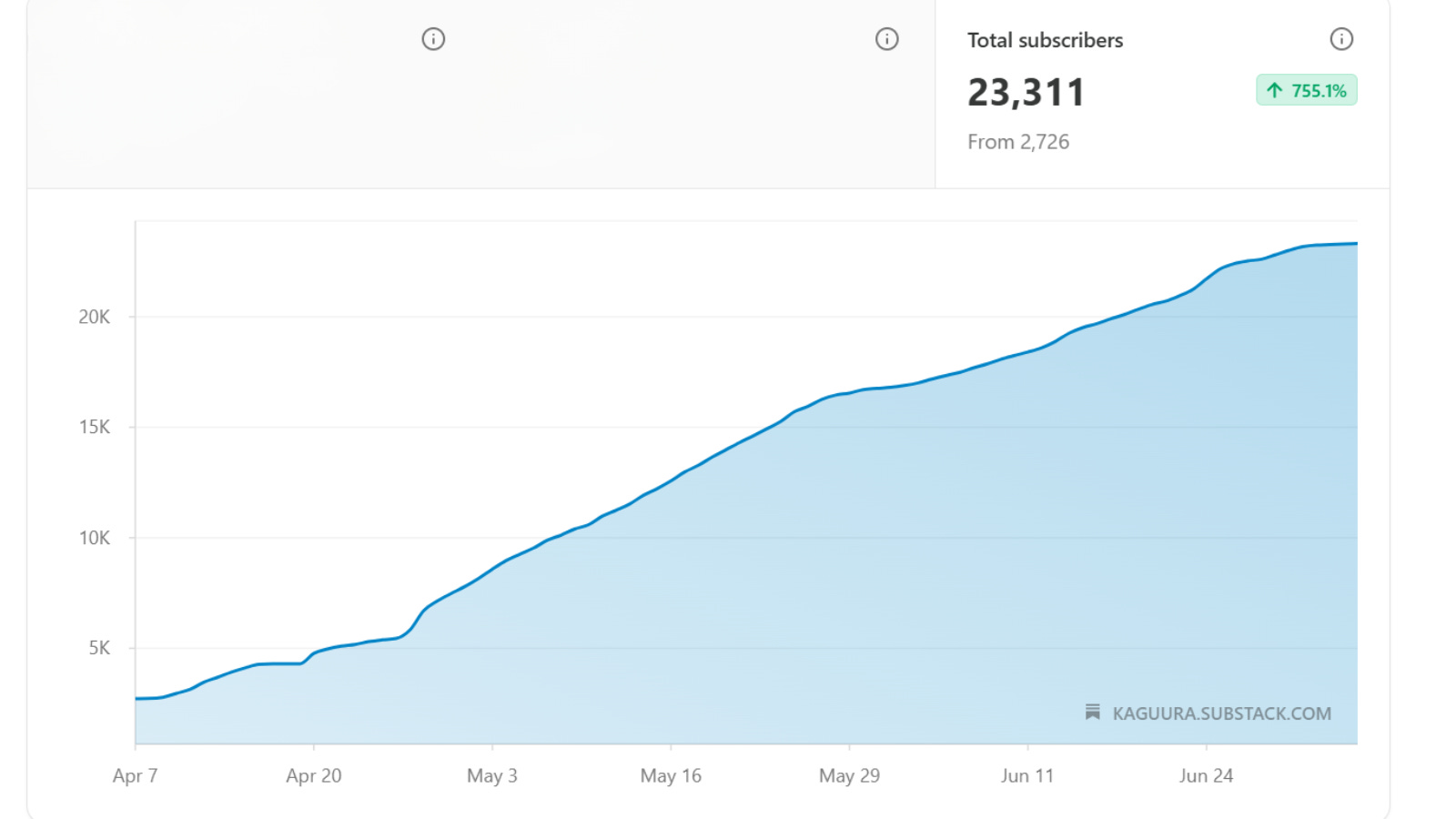
This article exists because 43 of my own subscribers sent me separate DMs asking the exact same question: “How did you grow this fast?”
The reality of Substack is simple: it is not a technical puzzle. It is just software driven by human intuition, connection, and a lot of luck.
This article is a transparent breakdown of how I set myself up for that luck and grew by 5,000+ subscribers a month.
Thank you for reading. Let’s get into it.
Here is the number one truth that growth coaches leave out of their funnels: You have to get good at writing. There is no way around this wall. No growth hack, perfect posting schedule, or formatting trick will save an essay that has nothing interesting to say.
When I started on Substack a year ago, I already had some writing practice. Years back, during my university days, I ran a free WordPress site where I wrote deep-dives about music. It never gained an audience and it never made a dime, but I loved doing it.
My Substack was created with a singular, selfish intent: to serve as a clean place for my thoughts to live outside of my own head. Audience growth was completely secondary; practicing the craft was the entire point.
If you take only one directive away from this entire playbook, let it be this: No amount of algorithm gaming or daily consistency can fix bad writing.
Most people who start a newsletter are fully literate. They know how to form sentences, but they don’t understand why other people’s work sounds punchy and professional while their own text feels heavy, slow, and amateur.
The difference isn’t talent. It’s writing etiquette. Here is the exact checklist of what to do and what to ruthlessly cut out to fix your reader retention.
Mistake: Writing to a crowd. Beginners use phrases like “Hey guys,” “Welcome back everyone,” or “As many of you know.” This immediately dilutes the connection.
Rule: Write to one single person. Use the word “You.” When someone opens your newsletter on their phone or laptop, they are reading it alone. Your text should feel like a private, direct letter sent from one friend straight to another. Talk to the reader as an individual, not as a metric on a dashboard.
Mistake: Propping up weak, boring verbs with adverbs (words ending in “-ly”). Phrases like “he ran quickly,” “she argued passionately,” or “I strictly believe.” * The Rule: Cut the adverbs and use a heavier verb. Adverbs usually show that you don’t trust your own writing. Instead of “ran quickly,” write “sprinted.” Instead of “argued passionately,” write “demanded.” Strong, singular verbs give your text immediate authority.
Mistake: Letting your sentences be acted upon instead of taking action. For example: “The article was noticed by Michael Burry,” or “The mistake was made by the team.” This creates heavy, slow prose.
Rule: Use active voice. Make the subject do the heavy lifting. Write: “Michael Burry noticed the article,” or “The team made a mistake.” Active voice creates momentum and pulls the reader down the page.
The Sentences: Long, winding sentences confuse people. Keep them brief. Give the reader’s brain a break.
The Language: Don’t use fancy, high-level words just to look smart. If you use a word like “utilize” when you could just say “use,” you lose the reader. Write exactly how you talk in real life when you’re explaining a smart idea to a friend at a bar.
The Imagery: Abstract ideas don’t stick. Don’t just talk about general “economic hardship.” Talk about “shoveling dirt for $10 a day.” Give the reader concrete images they can actually picture in their mind.
The editing process is simple math: Second Draft = First Draft – 10%. When you sit down to edit your draft, your job isn’t to add words to look sophisticated.
Your job is to locate the “warm-up fluff” at the beginning, the repetitive sentences in the middle, and the safe, boring filler you used while your brain was getting up to speed, and ruthlessly cut it out.
If a sentence doesn’t actively move your point forward, it is actively killing your retention.
Digital reading is highly visual. If a subscriber opens your email and sees a massive, unbroken wall of dense text, their brain treats it like schoolwork and they will close the tab instantly. You have to use spacing as visual punctuation.
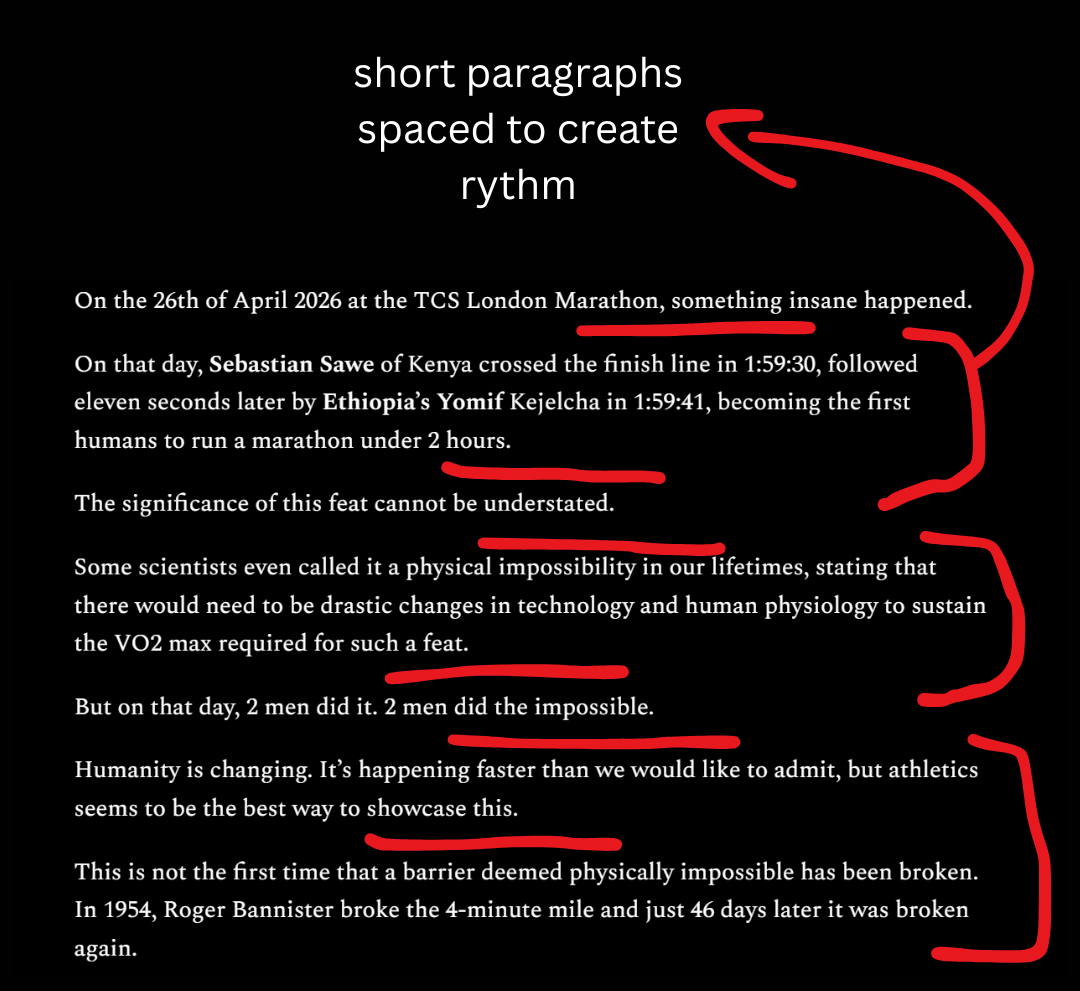
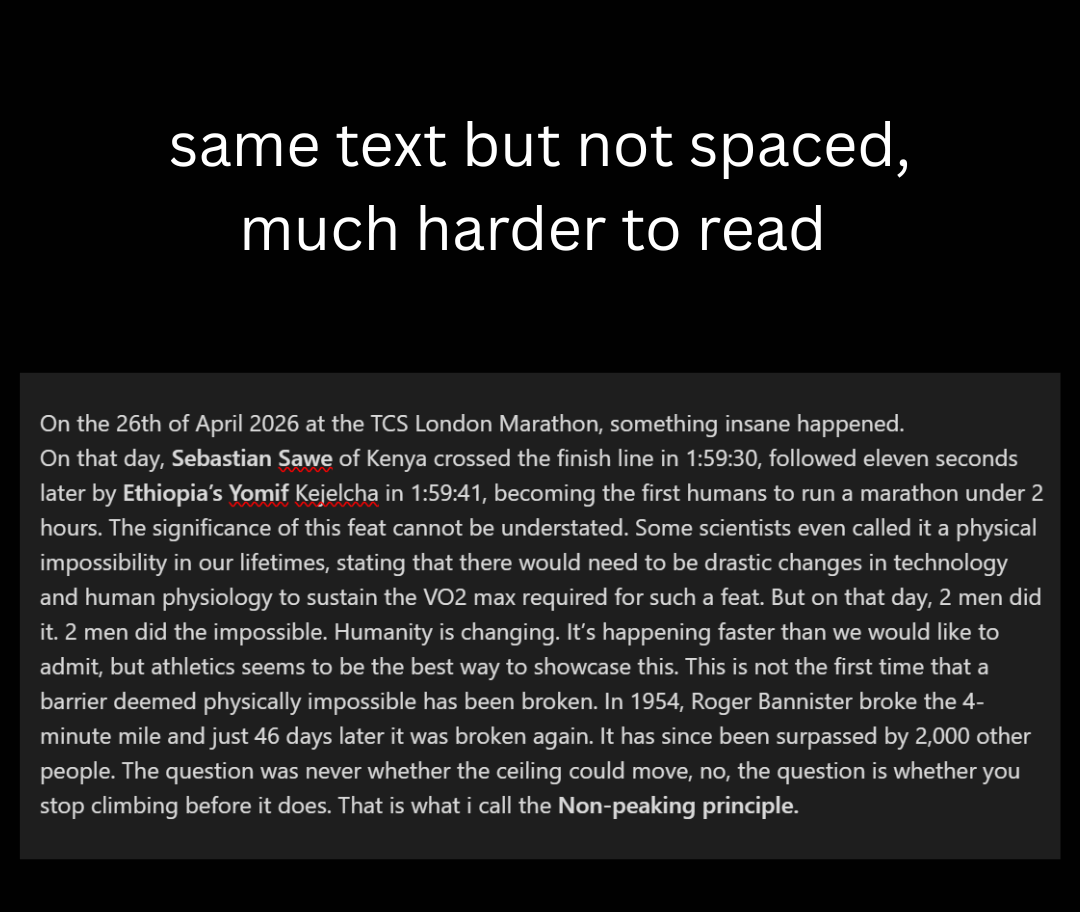
Do Not Copy the LinkenIn Robots: Avoid the artificial style of making every single sentence its own line. It looks cheap, robotic, and desperate for attention.
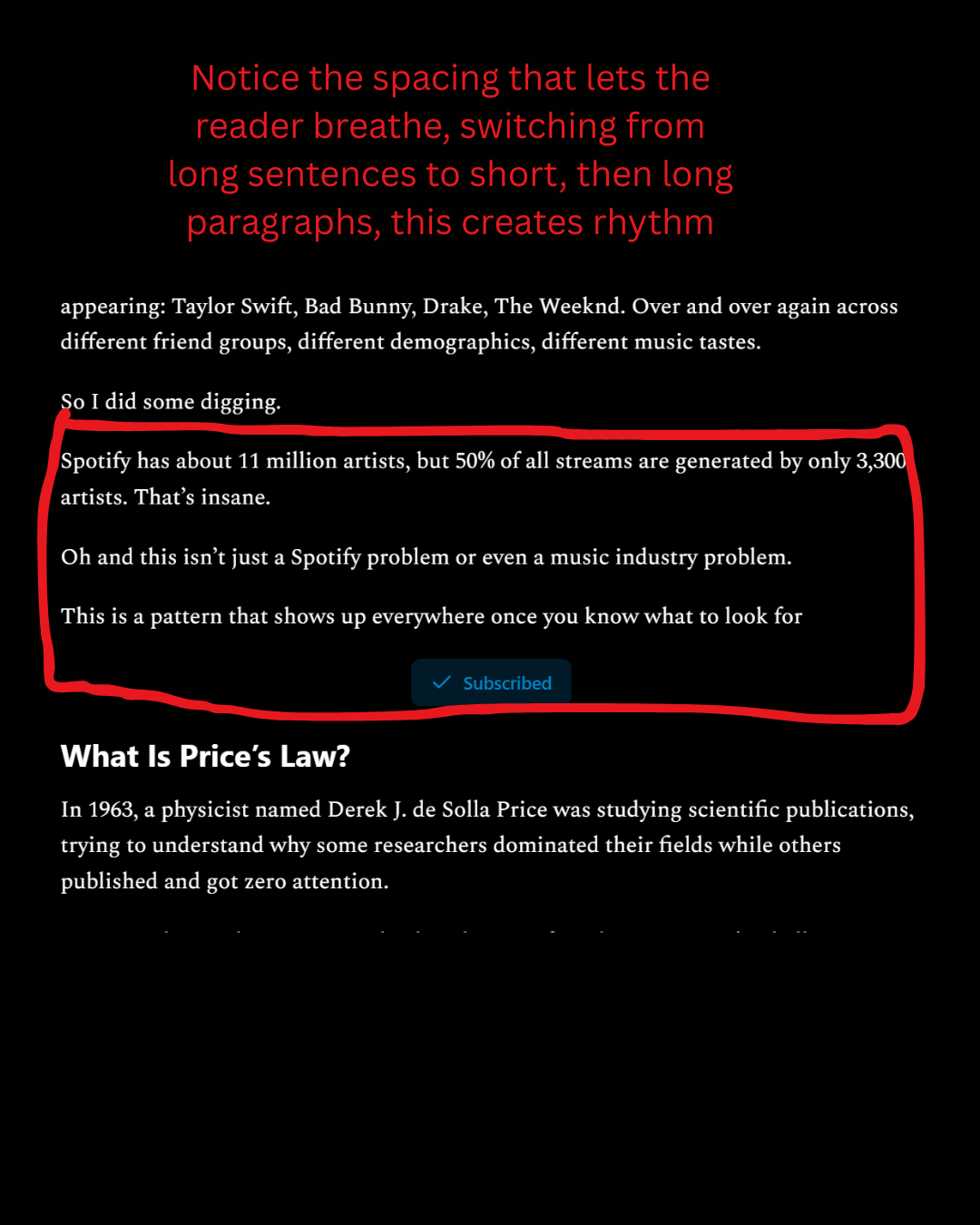
Vary Your Paragraph Length: Create a rhythm on the page. Use a short, punchy sentence to speed up the reader’s pace. Then, follow it with a three-to-four-sentence paragraph when you need them to slow down, anchor their attention, and take in a more complex idea. The visual white space on the screen gives the reader room to breathe.
You cannot become a high-signal writer if you only consume short-form internet garbage. You can’t write clean prose if your brain is fed on a strict diet of short tweets, corporate LinkedIn posts, and basic marketing blogs.
A massive portion of writing etiquette cannot be taught through a checklist, it has to be absorbed through osmosis.
When you read exceptional fiction, classic literature, or great long-form journalism, you are subconsciously downloading formatting, rhythm, structure, and tone directly into your brain.
You begin to instinctively understand how a story flows, how tension is built, and how a sentence lands with real impact.
If you read shallow content, you will write shallow content. If you read deeply researched, beautifully paced books, you will naturally start executing those exact same reflexes when you sit down in front of a blank keyboard.
On Writing: A Memoir of the Craft by Stephen King (The ultimate masterclass on the operational habits of writing).
The Copywriter’s Handbook by Robert Bly (The definitive guide on clear, persuasive, action-driven text).
Confessions of an Advertising Man by David Ogilvy (The blueprint for writing copy that commands human attention).
The Shapes of Stories by Kurt Vonnegut (A short lecture series mapping out the timeless structures of human storytelling).
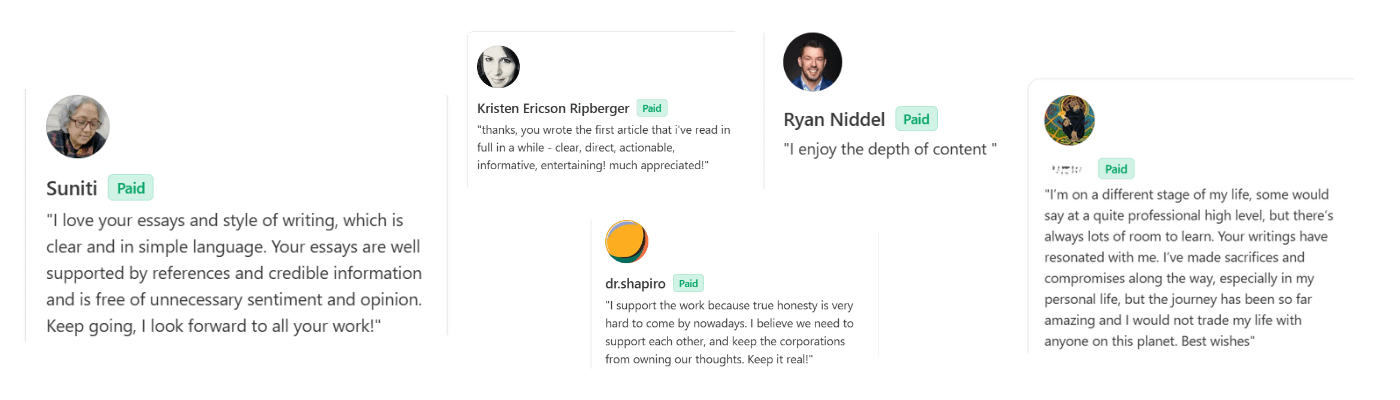
If you’re enjoying the work, consider upgrading to support the publication
An essay needs to be long enough to fully explain a complex idea, but short enough to respect the reader’s time. Through trial and error, I found the sweet spot to be around 1800 words, published once a week.
While longer posts can go viral, 800-2000 words gives you enough room to build a great story arc that hits hard and ends cleanly before the reader gets bored.
do not treat word count as a vanity metric
If a concept can be cleanly executed in 900 words, stretching it to 2,000 just to hit an arbitrary goal is actively adding the “warm-up fluff” we promised to kill.
Your metric shouldn’t be length; it should be intellectual density.
If you want a reader to finish your essay without closing the tab, you should map it out like a mini Hero’s Journey:
The Calm Story: Start far away from the technical theory. Begin with a simple, relatable human story or historical example. This gives the reader a low-overhead, easy entry point into your text so they can get used to your voice.
The Plunge into Despair: Once the reader is comfortable, turn things upside down. Introduce a major problem, an unfortunate truth, or a paradox that shatters that calm story. Drop them into the pit of the issue. This creates immediate tension, making it almost impossible for them to scroll away because they want to know the solution.
The Solution: Do not leave your reader in the pit. This is where you bring in your framework, your technical advice, or the core rule (like Price’s Law) as the tool to save them. Break down the concept clearly, showing them how to fix the problem.
The Higher Ground: Finish your newsletter at a higher point than where it started. The reader should close the tab feeling like they learned something valuable and are better equipped to face the world.
Kill the Warm-Up Intro: The biggest mistake beginners make is spending the first three paragraphs explaining why they decided to write the post or giving unneeded background. Cut that out. Drop the reader straight into the middle of the action or a problem.
Fix Your Spacing: Already talked about this, im repeating because its that important. The images shown previously in 2.4 show this very well
A/B Title Testing: Substack lets you test two different headlines. Do not use this to write cheap clickbait. Use it to learn what people actually care about. Test a title that promises a clear solution against a title that highlights an interesting paradox, and see which one your audience actually respects.
On Substack, you have exactly three ways to appear on someone’s screen: your Newsletter, your Notes, and your Comments.
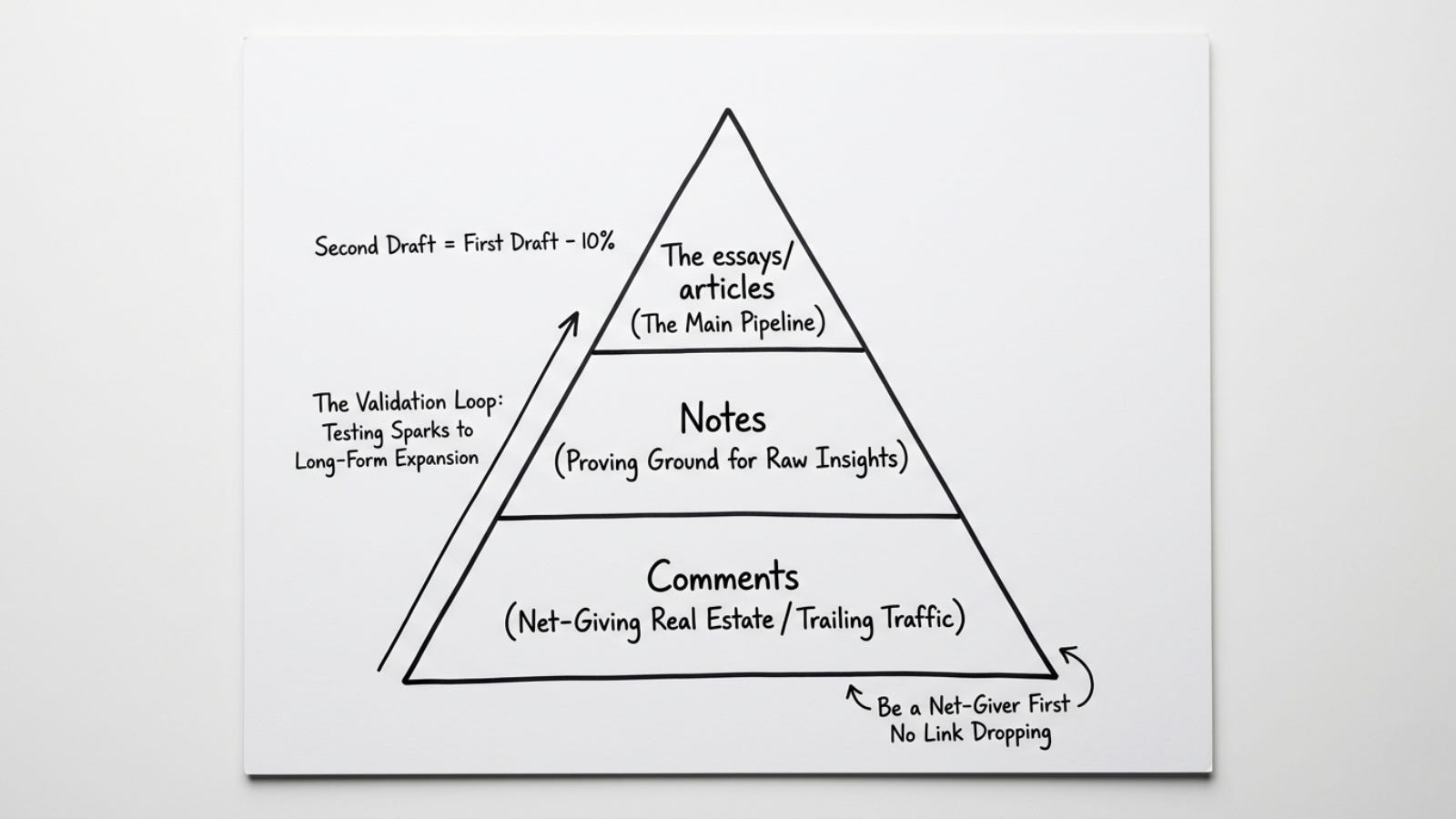
If your newsletter is your main intelligence center, Notes are your raw proving ground. Because Notes appear on a “For You” feed, they bypass your subscriber list and put your mind directly in front of strangers.
Keep your Notes short—usually under two paragraphs. Do not write them to chase viral clout. Use them as a low-overhead conversation starter to test your raw insights.
If a casual, three-sentence observation generates a real, emotional response in the replies, it means you hit a genuine human chord. You immediately take that validated spark and expand it into your next 2,000-word long-form essay.
⚠️ Do not copy these text structures word-for-word like a robot. If your text reads like a growth-hack script, the modern reader will smell the corporate marketing fluff and dismiss you. Use these models strictly as training wheels to understand structural pacing. The actual raw thoughts must be 100% yours.
The Human Truth: This is a broad-net, highly relatable observation about your space. It isn’t clickbait. It’s a clean statement about an everyday reality that makes a scrolling reader pause and think, “Wow, someone finally said it.”


The Structural Blueprint: State a common, over-complicated obsession in your broad niche. Break it down with a simple, grounded human reality… Deliver a punchy closing thought.

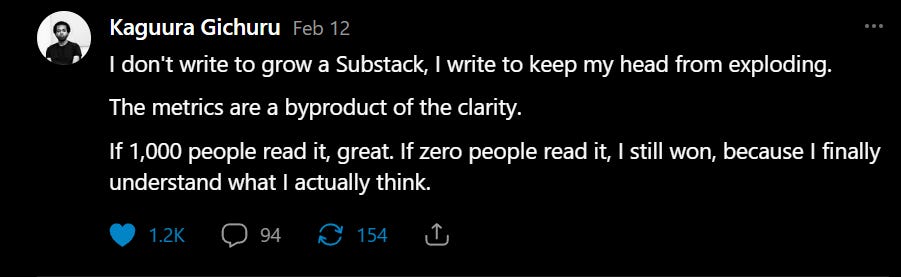
The Value Drop: This shows you actually possess real-world utility. You take an established concept, a piece of history, or an economic law and break it down simply. You aren’t showing off; you are being helpful.
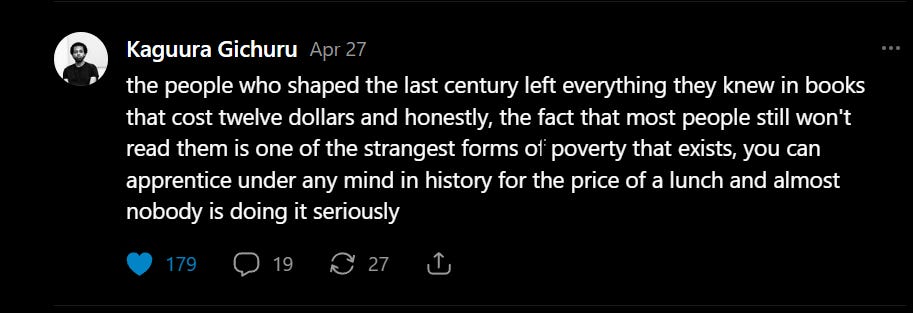
The Structural Blueprint: Introduce a specific event or framework. Strip away the textbook jargon. Explain exactly how it applies to the reader’s life today in 1–2 simple sentences.
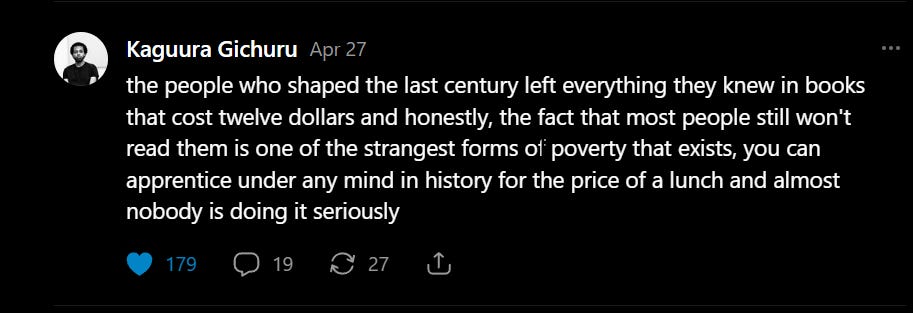
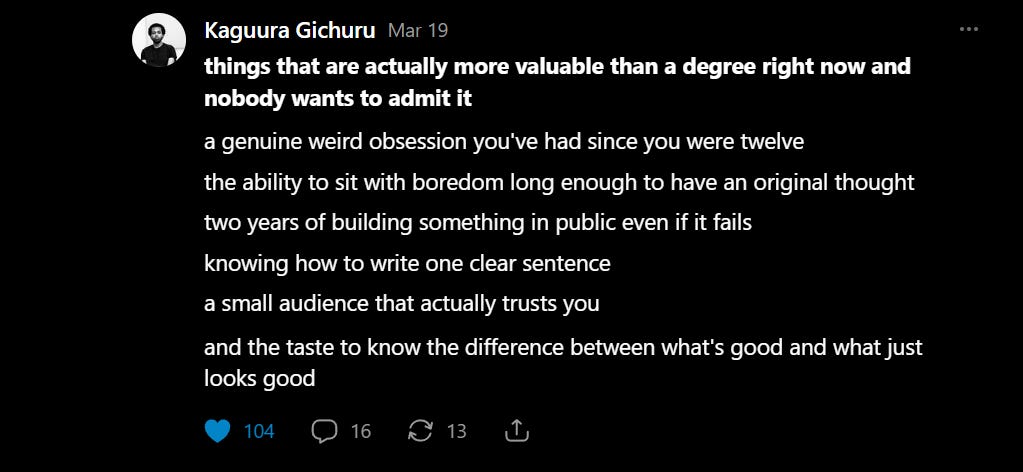
The Honest Filter: This is your raw, uncompromised perspective on your niche. It is explicitly designed not to get mass engagement. It intentionally repels casual scrollers who want easy answers, while deeply connecting with the exact high-signal subscribers who see the world the same way you do.
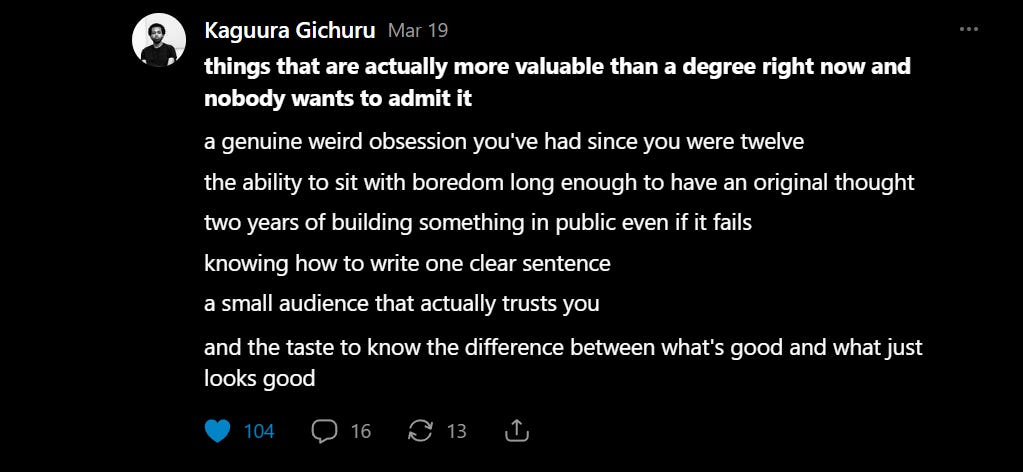
The Structural Blueprint: Locate a piece of soft, popular advice that you hate. Share the uncomfortable, blunt reality. Force the reader to make an honest choice between real substance and empty shortcuts.
You should never sit in front of a blank screen trying to manufacture “content” for Notes. That is how people end up writing fake, engineered slop.
When you publish your weekly essay, you have already done the hard thinking. Your essay naturally holds all the raw material you need for the week. You are just sharing different windows into the exact same house.
The Awareness Note: Extract the simple, everyday story or vignette you used to open your essay.
The Education Note: Take the core rule or lesson from the middle of your essay and summarize it cleanly.
The Conviction Note: Take the underlying belief or frustration that made you want to write the essay in the first place and share it directly.
This isn’t gaming a system. It’s making sure your ideas get full mileage instead of dying 24 hours after you hit send.
The most challenging stretch of this journey isn’t starting, and it isn’t managing a massive audience once you’ve arrived. It’s that quiet space in the middle.
When you have fewer than a couple hundred subscribers, your Notes won’t naturally catch fire because the network effects haven’t kicked in yet.
It’s completely normal to feel a bit invisible here. Most writers step away during this phase because they assume their strategy is broken.
It’s usually not broken at all; they just haven’t figured out how to use the quiet phase to train their creative muscles.
If you are stuck in this dip, here is exactly how to run the engine day-to-day:
Use the Feed as an Ideation Sandbox: Set aside about 30 minutes a day to browse Notes and comments, but do it entirely for idea generation. See what sparks your curiosity, what makes you dynamic, or what gaps other people are leaving wide open. Use their energy to feed your own notebook.
Ship Fast to Kill the Doubt: The best way to train your creative circuits is to ship a Note the exact second an idea pops into your head. Don’t overthink it, and don’t hold it hostage trying to make it perfect. If an idea turns out to be flat, it will disappear into the feed within a few hours anyway. Nobody is going to scroll through 30 pages of history to find a cringe post you made when you only had two subscribers. Let the feed swallow the misses.
The 3-Month Verbatim Rule: When an idea does work, you own that real estate. Do not be afraid to present that exact same insight using different words a few weeks later. In fact, if a Note does incredibly well, you can literally repost it verbatim three months later. If you’ve grown by a few hundred or a few thousand subscribers since then, you actually owe it to your new audience to share the older ideas that resonated most. They haven’t seen them yet.
Leaving comments on larger publications is the fastest way to grow a new page from zero. But if you do it with a transaction mindset, it backfires completely.
To make this work, you must apply the philosophy of being a net giver: your personal brand is just the sum of the value you give away for free without keeping score.
The Empty Praiser: Writing “Great post!” or “Love this!” is useless. It’s conversational white noise. It adds no value to the reader or the author.
The Thread Hijacker: Writing “I actually wrote a whole breakdown on this on my page, come check it out…” is immediate social suicide. It looks desperate, spammy, and cheap. The author will delete it, and readers will actively avoid you.
Instead, treat the reply section of a prominent publication as prime editorial real estate. Find creators completely outside your immediate category. Pick one specific point the author made, and contribute to the space by writing a miniature, standalone insight in the replies.
Acknowledge the Nuance: Show you actually read the text and understand the author’s point.
Add Grounded Value: Bring in a simple real-world example, a quick counter-intuitive historical point, or a highly visual analogy that builds on top of their original thought.
Clean Exit: End with a sharp sentence and leave. Do not pitch your link.

This is a comment I left on an article, and it got a lot of engagement
When you consistently provide unpretentious, high-signal value in the replies without asking for anything in return, you aren’t gaming anything.
You are earning attention. Strangers reading the thread will naturally respect your brain, click your profile picture, and navigate back to your free page on their own accord.
You lease the traffic of giant accounts by simply being the most helpful person in the comments.
While Notes and comments put you in front of scrolling strangers, Substack’s most powerful growth tool happens automatically behind the scenes: The Recommendation Feature.
When another writer recommends your page, Substack suggests your newsletter to their new readers the exact second they sign up.
We already talked about why cheap, transactional shout-out swaps make you look desperate. To get respected writers to recommend you, you have to build real rapport.
If you want to completely ruin your reputation and clutter your page, follow this exact checklist:
What NOT to Do When Trying to Earn Recommendations:
Don’t try to game the algorithm: Do not use recommendations as a hollow growth hack. Only recommend publications that you genuinely enjoy reading yourself. If you don’t actually care about the content, your readers will notice.
Don’t slide into DMs for blind swaps: Cold-messaging people you don’t know to ask for recommendation swaps is incredibly cringe. At the very least, interact like a normal person and build some actual rapport first before you even think about making an ask.
Don’t recommend a massive list: Do not recommend too many Substacks. I have seen writers recommending 20+ publications on their profile. At that point, you aren’t curating quality anymore, you are just soliciting random links to subscribers who originally signed up just to read your work. Keep it tight and highly selective.
The Golden Rule: Be a net-giver first. Go ahead and recommend other Substack pages you love, completely out of pocket and without expecting a single thing in return. When you actively champion good work without keeping score, people notice.
Build the rapport naturally by being normal and helpful, and if the alignment is obviously there, you can make a clean, direct ask.
When two writers genuinely respect each other’s craft, sharing the traffic happens as a natural byproduct.
Most writers title their essays like they are submitting a boring paper to a school board. They use vague, poetic phrases or dry titles that don’t mean anything to someone scrolling by.
On a busy feed, your title is 90% of the battle. If your title is soft, nobody clicks. If nobody clicks, your funnel breaks before it even starts. You have to flip your titles from topic-focused to outcome-driven.
The Poetic Mistake: “Sifting Through the Noise” or “Reflections on the Modern Landscape.”
What they did wrong: They valued looking artsy over being clear. Nobody knows what this actually means when they see it sitting on a fast-moving feed. It gives the reader zero incentive to stop scrolling, so they just fly right past it.
The Dry Textbook Mistake: “An Analysis of High-Growth Newsletter Models in 2026.”
What they did wrong: They treated their newsletter like an academic chore instead of an engaging conversation. It’s boring, stiff, sounds exactly like a homework assignment, and completely kills any natural human curiosity.
The Turned-Up, Honest Style: “I Analyzed 1,000 Short Posts. Here Are the 3 Simple Layouts That Actually Get Free Sign-ups.”
Why it works: It uses an exact, real-world metric, promises a specific shortcut to skip a major headache, and sounds like an honest text from a smart friend who just figured something out.
Use Numbers or Specific Details: Put clear numbers, timeframes, or specific metrics right in the headline. Numbers break up lines of text and force a scrolling human eye to stop.
Show the Value Instantly: Tell the reader exactly what headache they get to skip by spending five minutes reading your post.
Write Like a Real Person: Never sound like an SEO robot. Write the title exactly how you would text a smart friend when you’re sending them the answer to a problem they’ve been losing sleep over.
Before someone even reads your first sentence, they look at your packaging. Substack gives you some great tools to make your page look good, and ignoring them is just leaving money on the table.
This isn’t about turning your page into a fake corporate LinkedIn profile, it’s just basic digital hygiene.
Get a clean, high-quality profile picture. It sounds obvious, but a good photo gives you massive first-impression points. Your bio and “About” page shouldn’t be super vague or deeply poetic either. Tell people exactly who you are, what you look at, and why they should care. If a stranger lands on your page and can’t figure out your angle in five seconds, they will leave.
Substack lets you customize a lot of your publication’s website.
When you pick your header images for your articles, try to keep a consistent theme. Having a good-looking, clean page builds trust.
Go into your dashboard, play with the settings, and find a look you like. But listen to me: for the love of all that is green on earth, do not spend 20 hours trying to pick a color palette.
Messing with fonts and hex codes is just a fancy way to procrastinate. Set it up cleanly in an hour, and then get back to writing articles that are actually worth reading.
The moment someone enters their email address, Substack sends them an automated welcome message. This is prime real estate that most writers waste by leaving the default template active.
What to Avoid: A boring message that just says: “Thanks for subscribing to my newsletter! Look out for my next post in your inbox.”
What to Do Instead: Write a short, warm, and direct letter. Tell them what your publication stands for, what days you send your main articles and drop a link to 2 or 3 of your absolute best past articles. Give them instant value right when they walk through the front door.
Amateurs love to complain about “the algorithm.” They treat it like a hidden enemy trying to suppress their art.
They think, “I just spent three weeks writing a 5,000-word masterpiece that could literally bring about world peace. Why did the software let it die with twelve views?”
Here is the cold reality of how all media networks work: They don’t care about the philosophical merit of your ideas. They care about keeping people on the platform.
If you write one massive, earth-shattering article and then vanish for a month, you are actively working against the platform’s model.
Substack wants active, consistent people on its network.
Active accounts keep users inside the app, start real conversations, and drive growth. When you “publish and dip,” you break the loop.
The system realizes you aren’t a reliable source of reader attention, and it stops showing your work to strangers on the feed.
To scale your publication, you have to accept the real exchange rate of the internet. You can’t just pull attention out of a community without putting active energy back into it.
The Transactional Mistake: “I put my writing out there. Now the system owes me an audience.”
The Real Operator Mindset: “I am using Notes and Comments every week to actively help this place stay interesting and valuable. In exchange, the platform will route new readers to my main page.”
You don’t need micro-hacks, loop tricks, or weird engagement groups to win. You win by understanding that consistent, high-value presence is the only way to show a network you are worth recommending.
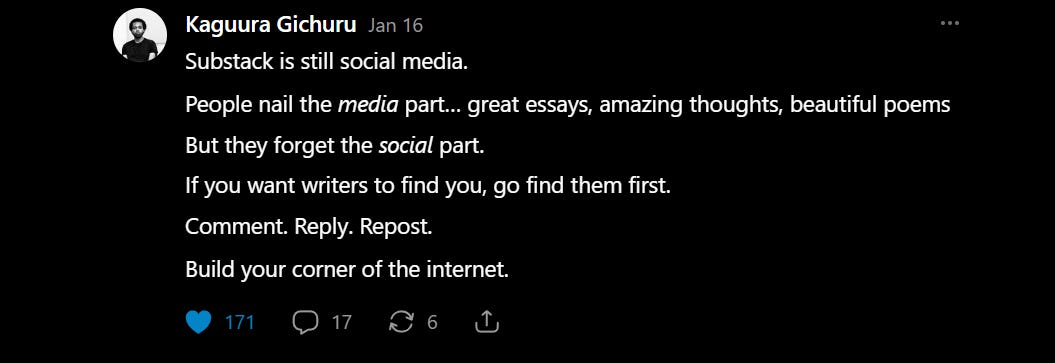
Because networks favor activity and movement, collaborating with other writers is your highest-leverage growth tool.
When you do a cross-post, recommend another writer, or share a thread with someone in your broad niche, you aren’t just swapping readers.
You are signaling to the system that your page is an active hub where real people are talking. The system notices that multi-account traffic and naturally pushes your work wider.
You don’t beat the software by out-smarting it; you beat it by being the most consistently helpful writer inside it.
I write about philosophy, psychology, business, and everything in between. Some of it's free, some isn't. Upgrade if you don't want to miss any of it.
Every generic internet growth guru will tell you the exact same thing: “You have to pick a hyper-specific, microscopic niche if you want to make money.”
They are dead wrong. If you pick a niche that is too small, you cap your audience before you even write your first sentence.
Even worse, you sign a creative death warrant. You trap yourself in a tiny room where you will run out of things to say within three months.
To understand how this trap works in the real world, let’s look at a writer named Zaha.
Zaha teaches yoga at a local studio in Budapest. She decided to launch a Substack newsletter with a very specific business goal: she wanted to get more local clients into her physical studio classes. Naturally, she followed the standard internet advice and picked a hyper-localized, hyper-specific niche. She titled her publication Budapest Yoga.
For the first two months, she wrote exact, practical articles about yoga postures, breathing exercises, and class schedules in Budapest.
Quickly, Zaha hit a wall. She got incredibly bored.
Her real intellectual obsession wasn’t just physical posturing—it was the deeper, esoteric side of the practice.
She wanted to write about chakras, mental energy, the psychology of human love, and raw personal stories about how meditation saved her during her darkest personal moments.
But she felt stuck. She couldn’t write an intense, deep essay about spiritual energy loops under a newsletter titled Budapest Yoga without confusing the local clients who just signed up to learn how to stretch their hamstrings.
By choosing a tiny niche, she locked herself out of her own publication.
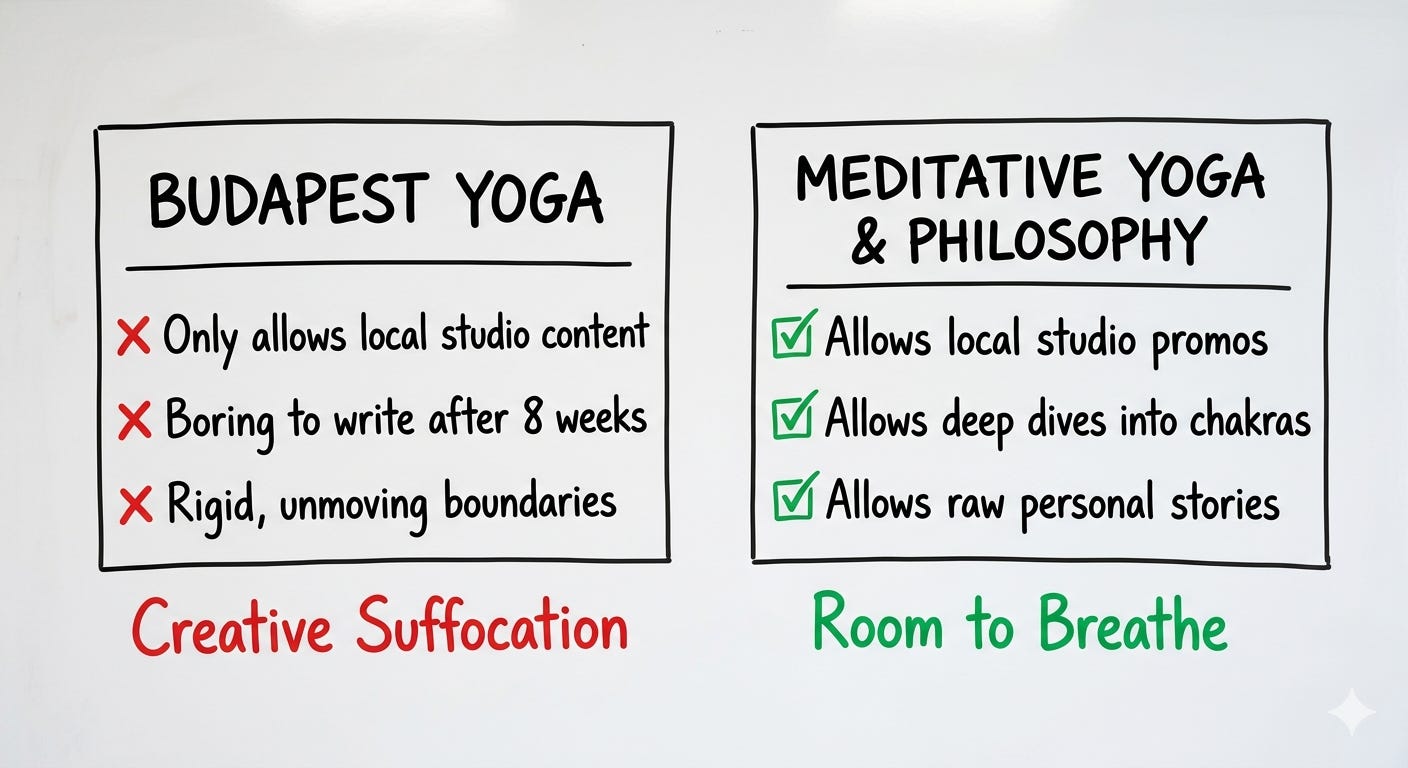
Zaha didn’t need to scrap her business goals. She just needed to zoom out.
Instead of naming her publication after a physical geographic location and a single physical activity, she should have positioned her work under a Broad Niche: Meditative Yoga & Philosophy.
(And to be clear, “Budapest Yoga” is still a perfectly fine name for a local studio, but we are using it here to make a point about scale, i actually prefer it to Meditative yoga and philosophy since its shorter and more concise).
This simple shift changes everything:
She can still get clients: She can easily drop a quick note at the bottom of her free essays inviting local Budapest readers to come to her studio.
She has endless creative freedom: Because the umbrella is broad, she can seamlessly write about chakras, spiritual energy, and philosophy one week, and practical stretching routines the next. It is close enough to the core topic that readers don’t feel alienated, but wide enough that Zaha never gets bored.
When you are first starting out, changing your publication name or tweaking your niche is easy because you don’t have a massive audience that signed up for one specific thing.
Use that to your advantage. Experiment ruthlessly at the beginning, because your room to play shrinks the larger your audience grows.
Before you write your next post, sit down and answer these 2 questions honestly. Don’t think like a marketer; think like a human being who has to write this newsletter every single week for the next three years.
The 6-Month Boredom Test: If you had to write 25 separate, 2,000-word articles only about the exact title of your newsletter right now, would you want to scream by week 12?
The Dinner Party Test: When you are hanging out with friends and get deeply excited talking about your field, are you talking about the dry technical mechanics (like Zaha’s stretching routines), or are you talking about the deeper, weirder principles behind it (like the philosophy and energy)? Your newsletter needs to match the things that actually keep you awake at night.
The Rule: Choose a massive pasture, but keep a very distinct, unique perspective within it. Give your mind room to evolve, because a bored writer will always create a boring newsletter.
Most people have a completely warped idea of what a “personal brand” actually is. Let’s strip away the corporate buzzwords. A personal brand is simply Personal Public Relations (PR).
It is the exact same tool a massive corporation uses to manage its public reputation, just scaled down to an individual mind.
When people hear the word “authenticity,” they usually panic and make one of two critical mistakes:
The Over-Sharer Trap (Cringe TMI): They think being authentic means showing everything. They write long, uncomfortable posts detailing their morning routine, their daily anxieties, or a random fight they had with a neighbor. It feels messy, desperate, and forces the reader into an awkward parasocial relationship.
The Corporate Robot Trap (Cringe Polish): They swing too far the other way. They try to look hyper-professional by using sanitized, safe language and posting clean, soulless updates that sound like a corporate human resources memo. It has zero human warmth.
To find the perfect balance between being a real human and keeping your professional edge, use the House Guest Rule.
Think of your personal brand like inviting a guest over to your actual home for dinner:
If you invite someone over, you clean up the living room. You wipe down the counters, throw away the trash, and put on some good music. You don’t leave your dirty laundry on the couch just to prove that you are “authentic” and real. That’s just sloppy.
At the same time, you don’t rent a sterile, million-dollar Airbnb for the night, pretend it’s your house, and act like a robot butler. That’s fake, and your guest will smell the lie instantly.
Your Substack page is your digital home. When you publish a Conviction Note or a personal story, you are letting people into your living room.
You should absolutely share real personal experiences, your genuine struggles, and how your brain actually functions. But you present it with dignity, focus, and a clean layout.
Show them your real home, but clean up the trash before they walk through the front door. Don’t bore people with the microscopic, messy details of your daily life, and don’t lie to them with a corporate mask.
Be a real human who exercises high standards.
Let’s look directly at the math: if you choose to lock all your content behind a paywall when you only have 100 or even 1,000 subscribers, you are stopping your own growth before it starts.
To get people to hand over their hard-earned money month after month just to read your text, your writing has to be lightyears better and more predictive than everything else available on the internet for free. If it isn’t, a paywall just acts as a giant “Keep Out” sign for new readers.
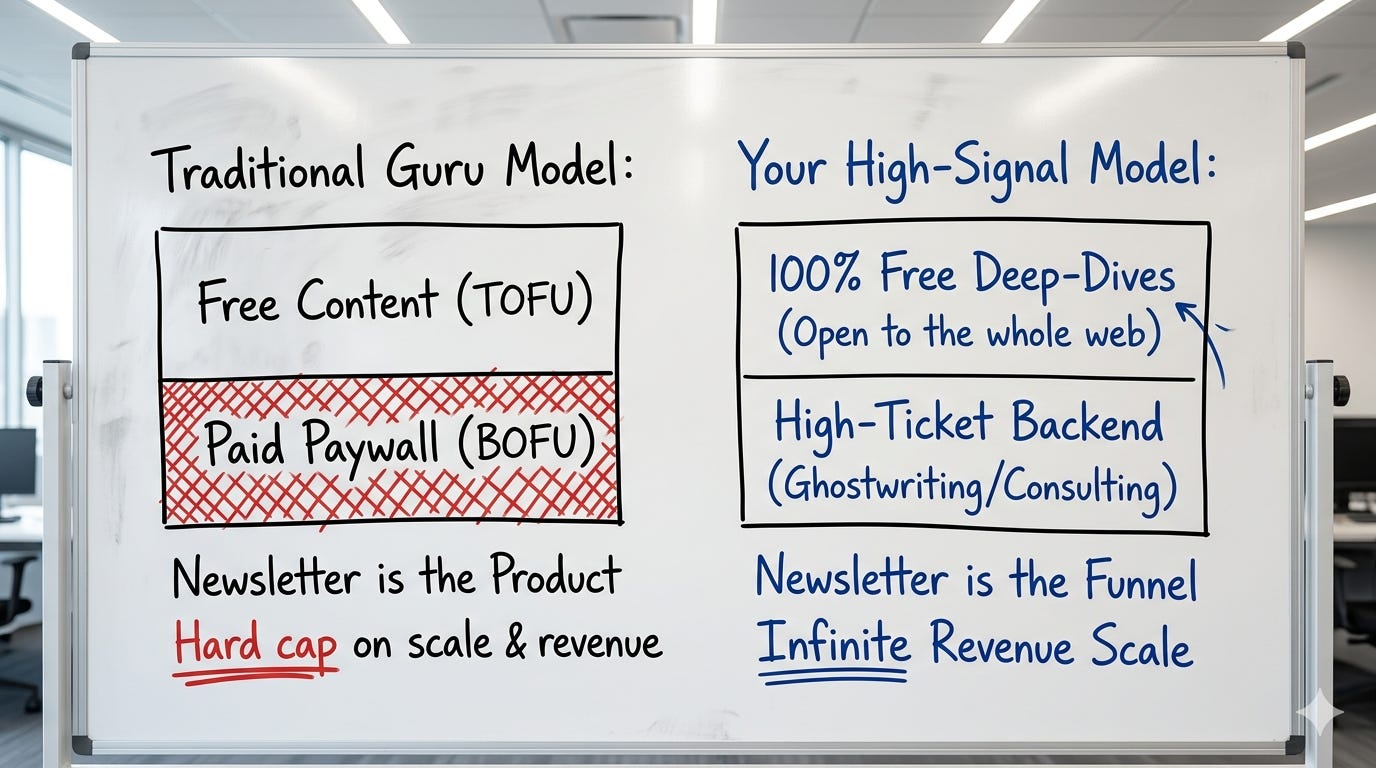
When you paywall all of your newsletter too early, you are treating the words on the page as the final product.
This forces you into a low-ticket volume game where you are constantly hustling to defend a $5 or $10 subscription to a casual crowd. You become a content landlord chasing pocket change.
The creators who actually pull off a successful paid tier don’t just block off their essays and call it a day; they build a massive foundation of free value first. When they do launch a paid tier, they treat it like an exclusive club where the writing is just the baseline, attaching actual, tangible value to the subscription:
Digital Resources: Complete video courses, Notion templates, or their personal workflow systems.
Exclusive Perks: Early-bird access to book releases, private Q&A calls, or a community forum.
They are selling an ecosystem of resources, not just words. But even with those perks, blocking off your best ideas is a massive strategic mistake when you’re scaling. Why? Because paywalls kill virality.
Think about it like this: if I had put my most viral long-form essay behind a paid paywall before it took off, it never would have spread. It would have died in darkness.
Because that article was 100% free and open to the web, anyone could share it, link to it, and restack it without friction.
That single open essay made me over $2,000 in a single month just from gifts and paid consultations.
That might not sound like a million dollars to a corporate guru, but it is significantly more than a handful of $5 paid subscriptions would have ever generated.
And that isn’t even the best part. Because that masterpiece was free for the whole world to see, it acted as a massive billboard for my brain. It triggered my best month ever for warm traffic landing straight in my DMs—founders, operators, and executives asking for my high-ticket ghostwriting and consultancy services.
The compounding value of that single piece of work was only unleashed because I removed the lock from the door.
Instead of begging a handful of readers for the price of a cup of coffee every month, you leave the front door wide open so you can land back-door deals that actually move the needle. Here is what your free newsletter should actually be selling:
High-Tier Ghostwriting: This is what i personally do… brands and executives want an online presence, but they don’t have the time or skills to write text that cuts through the noise. When they read your free essays, they see living proof that you know how to command attention. You charge them thousands a month to write their content for them.
Strategic Advisory & Consulting: Founders don’t want another textbook. They want a sharp mind to look at their specific business bottleneck and give them a direct solution. Your free essays act as a weekly demonstration of your pattern recognition.
Paid Speaking Opportunities & Book Contracts: When you keep your writing completely free, your best ideas travel further and land in front of industry gatekeepers. Event organizers will fly you out and pay you premium flat fees to deliver keynote talks because your free essays proved you can hold an audience. Traditional publishers and literary agents will slide into your DMs with major book deals because they can already see your ideas have market validation and a built-in audience ready to buy on day one.
These are just a few examples. The possibilities here are near endless.
Stop trying to collect pocket change at the gate when you can use your craft to command serious capital at the back door. Your newsletter isn’t the product—it’s the pipeline.
Viral spikes look like accidents, but they are just math. Growth happens when great writing meets strategic placement. This is the exact story of how my account leaped from 2,000 to 13,000 subscribers in a single month.
For four months, I had an essay about Price’s Law sitting on my page. It had a modest 50 likes. It wasn’t getting traction, but because it followed the rules of a strong story arc, it was a high-value asset just waiting for the right spark.
The spark happened when I started commenting completely outside of my usual niche.
I went into entirely different topic bubbles and left smart, standalone thoughts in the replies of large publications.
I caught completely new fish. One of those comments pulled the right eyes back to my page, and the Price’s Law essay finally hit the right circles. Ironically, the essay about the power law became a power law itself, exploding from 50 likes to 11,000 likes and 250k impressions in a matter of weeks.
The peak of this growth wave came from a two-word notification.
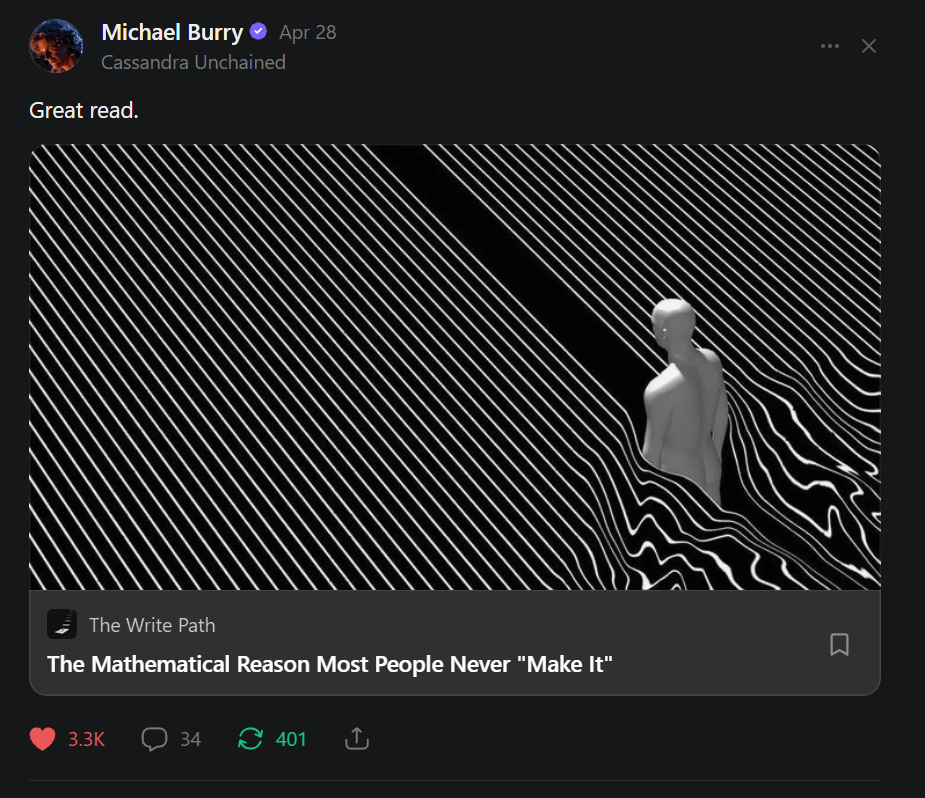
Because the essay was written with high standards and real depth, it caught the attention of Michael Burry, the famous investor from The Big Short. True to his quiet, no-nonsense style, he restacked my essay on his feed and wrote just two words: “Good read.”
That single co-sign instantly drove 2,000 likes to the post and brought thousands of new subscribers to my page. It proved the ultimate point of this entire playbook: You do not write to please an algorithm.
You write to build an asset so sharp that when a high-status mind encounters it, they feel compelled to share it.
Let’s be completely honest about something most growth coaches will never admit: Luck matters. Sometimes, you just get lucky. Maybe that is exactly what happened to me.
But here is what wasn’t luck: the years I spent practicing my writing, and the weeks I spent putting out articles even when they were getting single-digit likes. Luck happens out of nowhere, but being ready for it is entirely up to you.
Think about it. Michael Burry reads a lot of articles on Substack. Plenty of other massive, influential leaders do the same thing.
Getting a shout-out from someone at that level changes everything. But smart people only share things they genuinely enjoy.
They are just like you and me, we only watch movies we like, listen to music we like, and repost things we actually respect.
If a big name lands on your page because of a lucky break, but your writing is lazy and your layout is a mess, they will close the tab instantly.
The luck disappears. It doesn’t matter how lucky you get; it only matters how ready you are to make the most of it when it finally happens. Consistency gets you on the field, but your skill is what wins the game.
Lets look at a real, live example of an article that connected with a wide audience, and break down the simple writing choices behind it. Here is the article so you can follow along
The Title: The Mathematical Reason Most People Never “Make It” The Sub-title: The uncomfortable truth about effort, outcome, and the math that connects them all
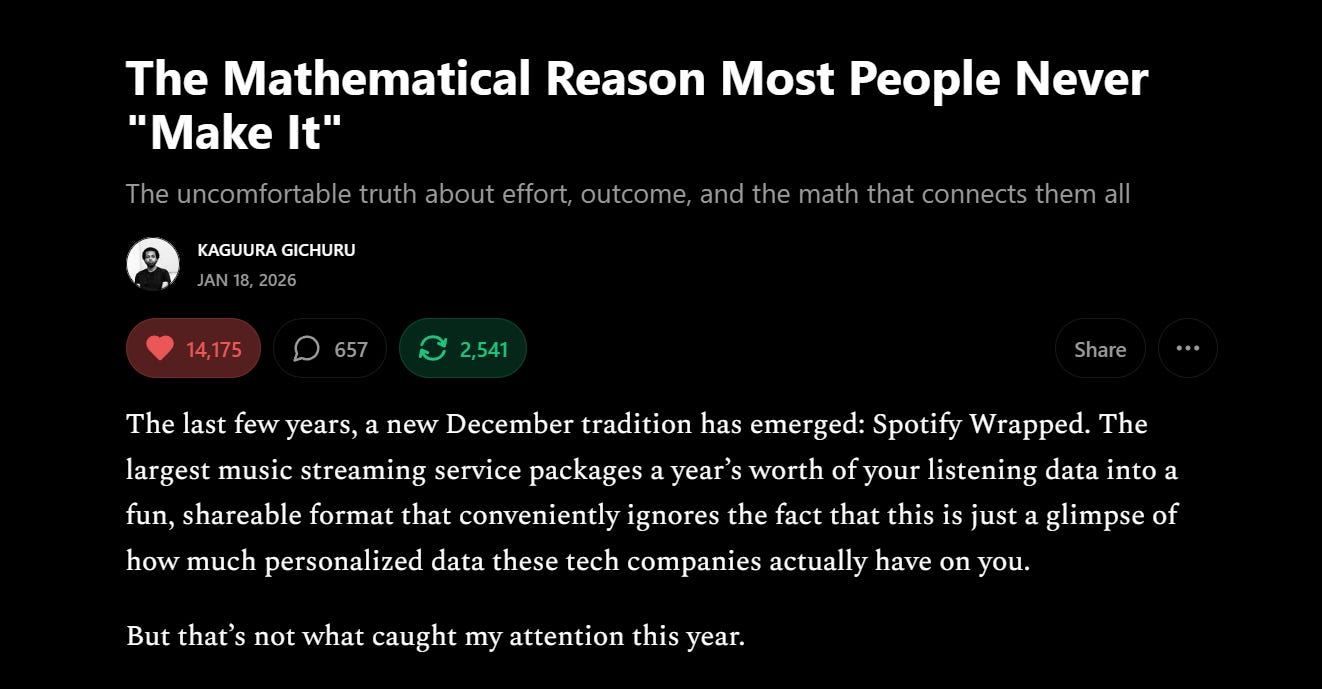
If you look at the title, it doesn’t just name a topic like “An Explanation of Price’s Law.” A title like that reads a bit like a school textbook, which can make it hard to grab someone’s attention when they are scrolling through a busy inbox.
Instead, this setup pairs a concrete concept (“Mathematical Reason”) with a feeling most people have felt (“Making It”).
The sub-title promises an honest, slightly tough look at how effort doesn’t always equal outcome. It works because it creates a bit of healthy curiosity.
The reader knows exactly what the piece is about, but they want to see how the math actually ties into their own life.
“The last few years, a new December tradition has emerged: Spotify Wrapped… I started noticing something in everyone’s top 10 artists. The same names kept appearing…”
Instead of diving straight into data, history, or formulas, the article starts with something almost everyone recognizes: Spotify Wrapped.
Starting with a familiar, everyday story gives the reader an easy way into the piece. There is no heavy lifting required to start reading.
By pointing out a common observation, how the same few artists show up on everyone’s year-end lists, it feels like a normal conversation between friends before transitioning into the bigger data points.
“Price’s Law states that the square root of the number of people in a domain does 50% of the work… Competence is rarer than we pretend it is… Mathematics doesn’t give a fuck about fairness or ethics.”
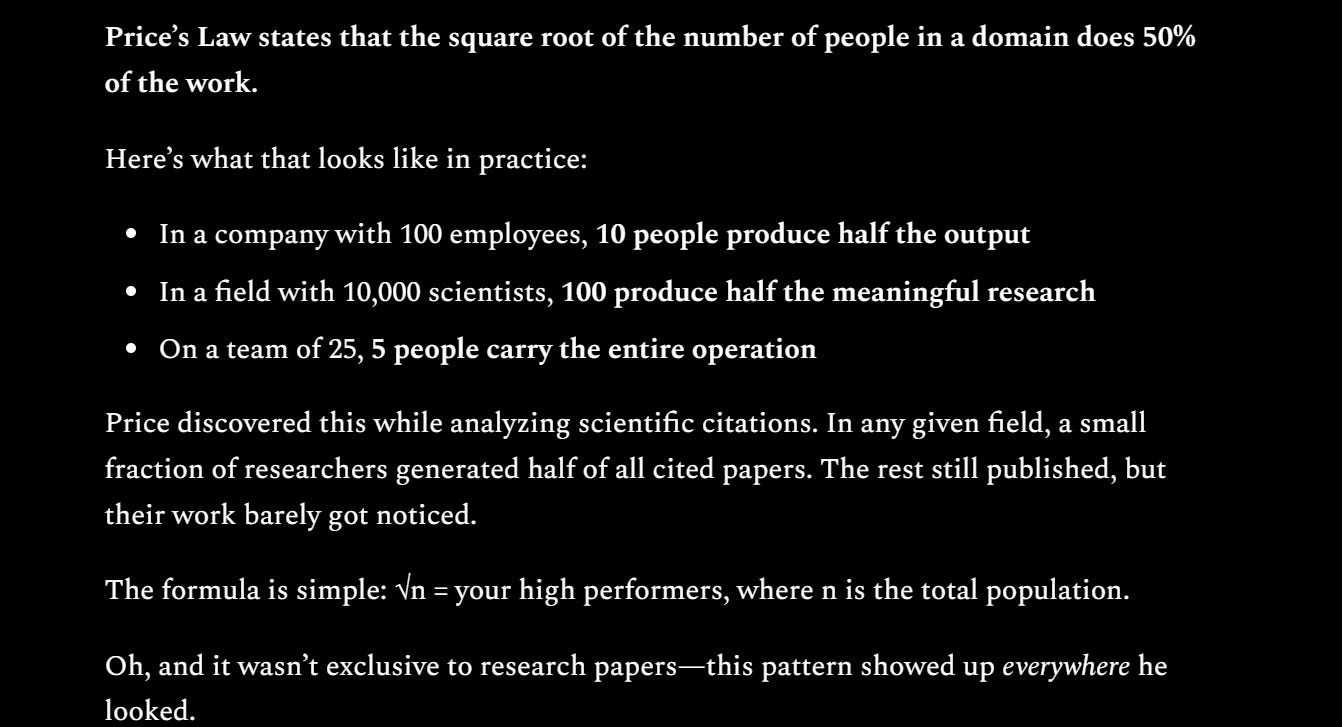
Once the reader is engaged, the article introduces the main framework: Price’s Law. But notice that it doesn’t get bogged down in deep academic history.
It explains the math using simple, real-world examples that anyone can picture—like a team of 25 people where 5 do the heavy lifting, or a few massive companies generating the bulk of the economic output.
The language is kept plain and direct. Saying things like “Mathematics doesn’t care about fairness” is just an honest way of stating a fact.
It cuts through the noise and helps the reader see the world as it is, which naturally makes them think about where they fit into their own work or industry.
“So here’s the playbook: Produce volume early… Identify your √n… Double down ruthlessly.”
It is usually best not to leave a reader hanging with a big problem without offering some clear ways to navigate it.
The second half of the article breaks down how this mathematical pattern applies to three normal parts of a working life:
Content: Sharing actual, transparent numbers from Substack to show that out of hundreds of posts, only a small handful drive the real growth.
Skills: Explaining why focusing on a couple of your best skills (and combining them) is often better than trying to fix every single weakness.
Time: Looking at how a small portion of your week usually moves the needle the most, while the rest is just keeping the lights on.
By breaking the concept down into these familiar categories, the article stops being just an abstract theory and becomes something the reader can actually test out in their own routine.
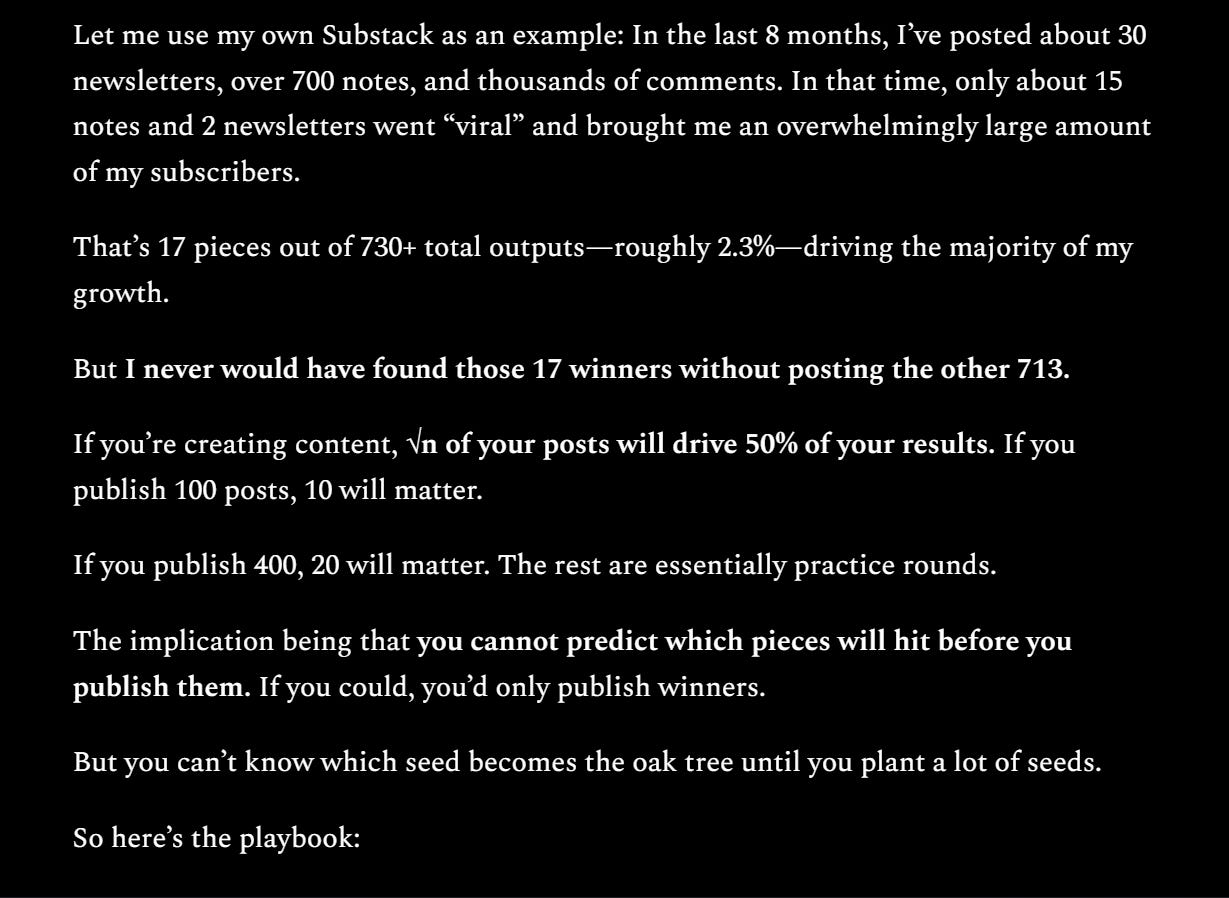
“The early game is exploration… The late game is exploitation… Explore the noise until you have signal. Then exploit that.”
The piece ends by answering a natural question: If only a few things work, why do the rest of the work at all? It explains that you have to explore and try things early on just to collect the data to find what works best later.
From a growth perspective, keeping a piece like this entirely free and open to the internet means it can circulate naturally.
Because it was easy to share and didn’t sit behind a hard paywall, it picked up thousands of likes and restacks.
That kind of visibility is what naturally brings curious founders, operators, and high-ticket clients into your world through the front door, without you ever having to pitch them aggressively.
Start where the reader is: Use a common, shared experience to open your thoughts before dragging people into deeper concepts.
Give the text room to breathe: Notice how many of the paragraphs are short and easy on the eyes. Leaving plenty of white space makes reading on a screen feel a lot less tiring.
Keep it human: Speak plainly. You don’t need big words or corporate phrases to share a useful idea. Just say it clearly.
Political or social standing aside, this piece is a masterclass in storytelling.
It shows what I talked about earlier: the very most important thing when it comes to newsletters, or writing in general, is knowing how to tell a story.
Let’s see how this writer used storytelling to talk about a charged political piece. Here is the full article so you can follow along.
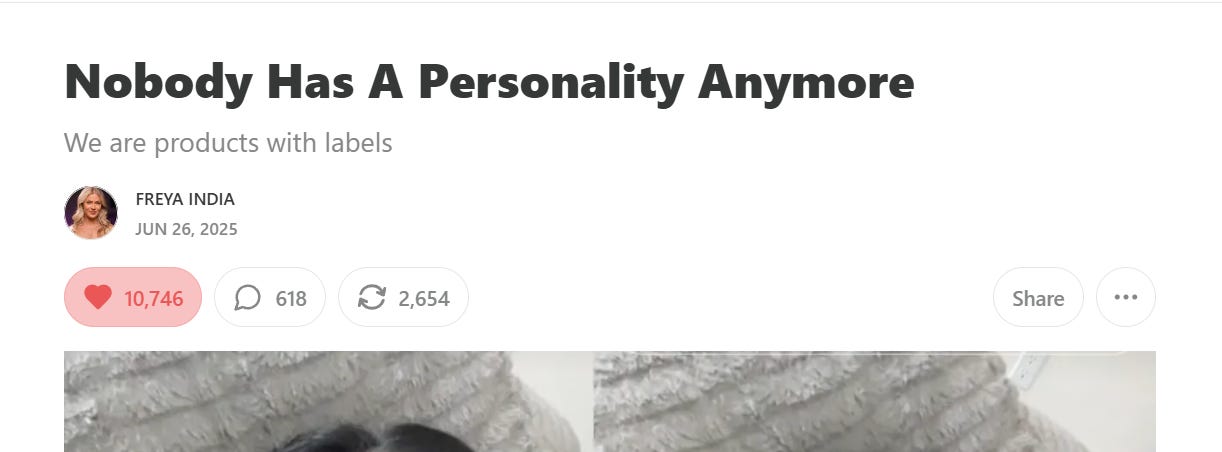
The Title: Nobody Has A Personality Anymore: We are products with labels The Opening: “Therapy-speak has taken over our language… Nobody has a personality anymore… Now they are being taught that their normal personality is a disorder.”
We talk a lot about having a conviction tone and leaning into what you actually believe.
Freya doesn’t play it safe or write a boring, balanced essay about psychology. She points directly at something everyone sees on their feeds every day—“therapy-speak”, and calls it out immediately.
By turning a normal modern habit into the “enemy,” she grabs you by the collar right from the start.
She’s putting words to a hidden frustration a lot of people feel but haven’t said out loud. It’s the exact opposite of wasting the reader’s time with a long introduction.
The Low: “Now you are always late to things not because you are lovably forgetful… but because of ADHD… You are not an amalgam of your ancestors or curious constellation of traits but the clinical result of a timeline of childhood events.”
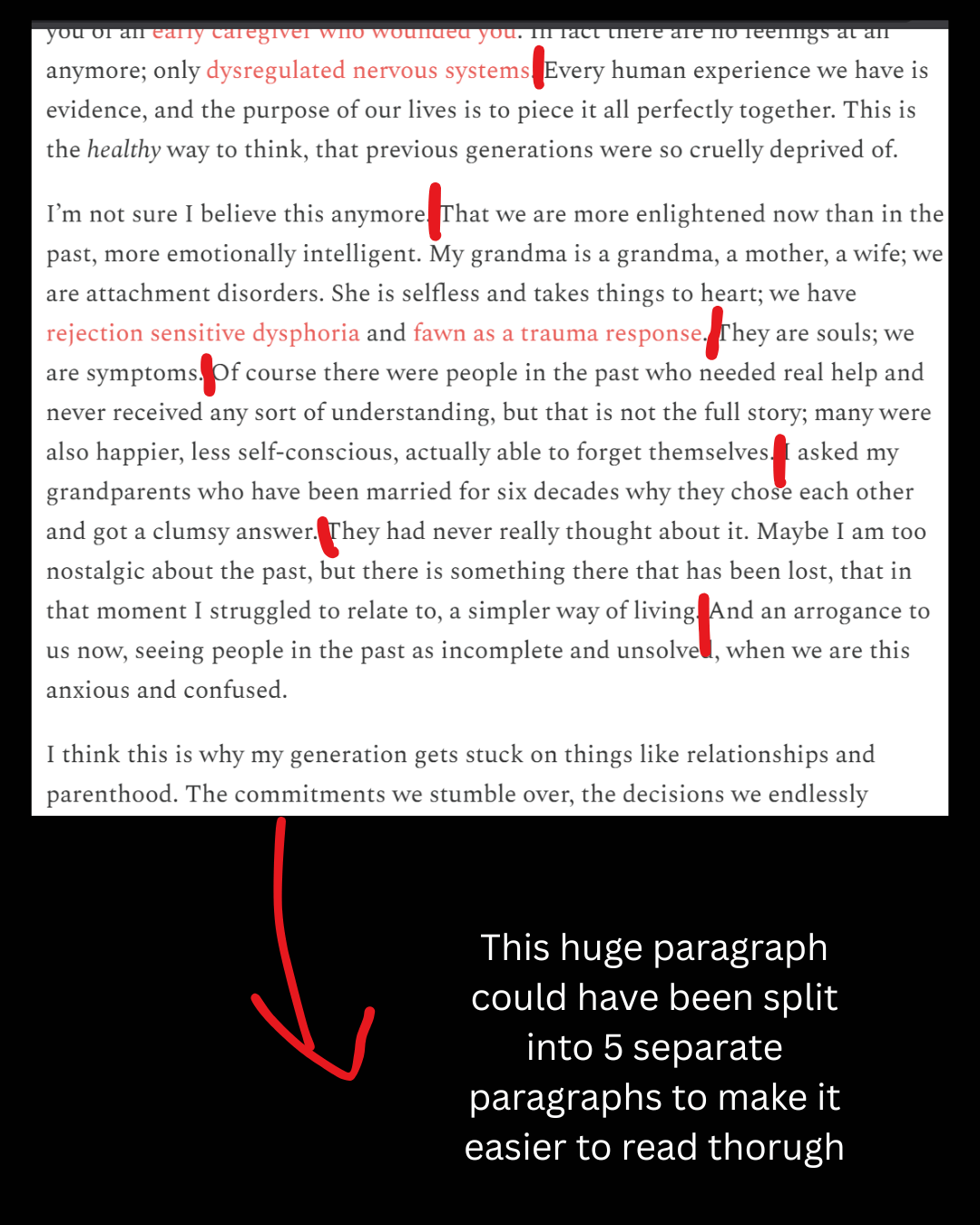
The High: “My grandma is a grandma, a mother, a wife… I asked my grandparents who have been married for six decades why they chose each other and got a clumsy answer. They had never really thought about it… maybe there’s something human in that.”
This mid-section is a perfect live execution of taking the reader on a plunge into a real problem, and then lifting them up with an anchor.
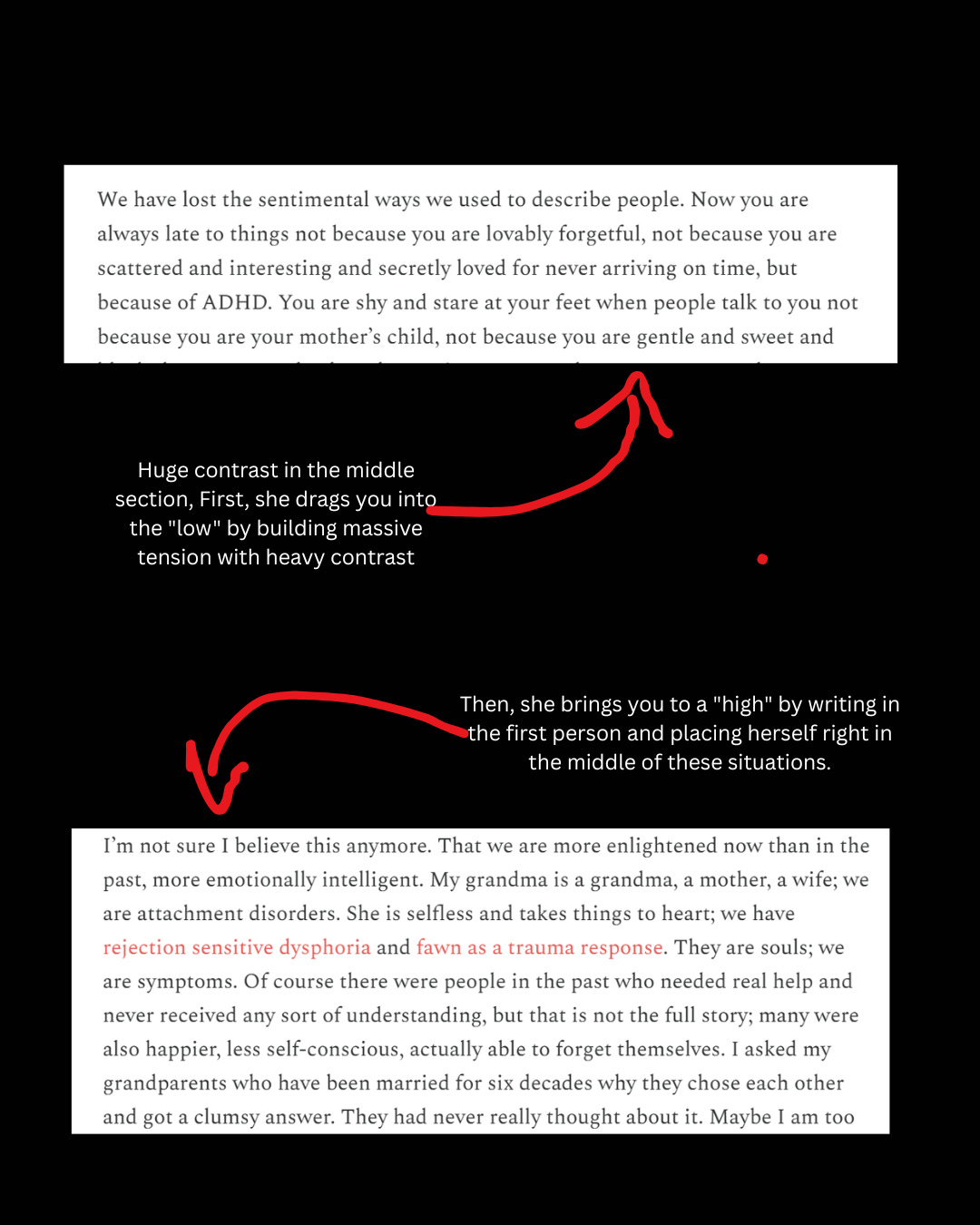
First, she drags you into the “low” by building massive tension with heavy contrast. She matches warm, human descriptions (“lovably forgetful,” “curious constellation of traits”) right next to cold, clinical labels (“clinical result,” “BetterHelp applications”). It forces the reader to feel the weight of what we lose when we over-explain everything.
Then, she brings you to a “high” by writing in the first person and placing herself right in the middle of these situations.
Remember our House Guest Rule? We always want to be a real human while keeping our professional edge, meaning you share personal things to serve the point of the article, not just to vent.
Freya India uses her grandparents here perfectly to ground her argument.
She isn’t just over-sharing messy personal details for cheap clicks; she shares a specific, clean family vignette to serve as an anchor for the reader.
By showing that her grandparents built a beautiful 60-year marriage without analyzing their attachment styles, she makes the modern, hyper-analyzed way of living look exhausting.
She brings herself into the room as a witness, which makes her entire argument feel human instead of academic.
The Finish: “So free yourself to experience, not explain. Be brave enough to be normal… Leave yourself unsolved. Who knows; it’s a mystery… Holding on to your personality is a declaration that you are human.”
She ends the piece on the higher ground. There is no corny 5-step checklist or internet-marketer formula here.
She doesn’t try to solve the mental health industry. She just invites the reader into a better, freer way of living.
Framing the act of not analyzing yourself as a form of true courage and rebellion is brilliant.
The final lines let the reader take a deep breath, walk away feeling lighter, and completely change how they look at their own daily habits.
Density Over Word Count: This piece doesn’t use massive words or corporate jargon to sound smart. It respects your time. Just like our Word Count vs. Density Rule says, the value comes from how potent the idea is, not how long the page is.
The Formatting Flaw (What Could Have Been Better): If you look at the raw post, the writer actually uses very huge, dense paragraphs. By standard digital writing rules, this is usually a mistake because big walls of text can scare readers off and tire out their eyes on mobile devices. But here’s the lesson: the storytelling and the raw quality of the writing were so compelling that it carried the piece anyway. It completely bypassed the formatting flaw to generate tens of thousands of likes, massive interaction, and huge buzz—all without ever resorting to cheap interaction bait.
Authentic Buzz Over Engagement Bait: This piece didn’t get shared because of a gimmicky “Reply below with your thoughts!” line at the end. It blew up because it offered a deeply human, contrarian perspective that forced people to think, argue, and share it organically. Focus on the depth of the idea, and the numbers will take care of themselves.
The value of a premium guide isn’t just telling you what to do—it’s saving you months of wasted time by telling you what to ignore. When people get desperate for growth, they start doing weird things to try and trick the system. It backfires every time. Here is what you should stay far away from:
Restack Swapping:
The Problem: This is when you message a buddy saying, “Hey, I’ll share your short post if you share mine.” It is super cringe and everyone can see right through it.
Why it fails: You are just faking numbers. Smart readers notice when the same four people constantly repost each other’s work. It makes you look like a cheap internet salesman instead of a real writer.
Recommendation Swapping:
The Problem: Putting another writer’s page on your profile only because they promised to do the same for you.
Why it fails: Your recommendations are a promise of quality to your readers. The moment you trade them like favors, you break that trust. If you recommend a bad page just to get a favor back, people will realize your standards are low.
Link-Dropping in the Comments:
The Problem: Going into the comment section of a big writer and posting a link to your own page saying, “I wrote about this too, check it out here!”
Why it fails: It’s like walking into someone else’s shop and yelling at their customers to come buy from you instead. It is rude, desperate, and tacky. The author will delete it, and readers will actively avoid you.
Over-Engineered Threads:
The Problem: Spending hours formatting complicated, multi-part posts on Notes that read like corporate marketing scripts.
Why it fails: People don’t open the app to read robotic, over-polished sales scripts. These posts might get a few empty likes from other growth-chasers, but they bring in zero real subscribers who actually want to read your long articles.
Algorithm Chasing:
The Problem: Writing about trending news, internet drama, or hype topics you don’t care about just because the platform is pushing them that day.
Why it fails: It ruins your unique voice. You end up attracting low-quality readers who only care about the trend. The moment the hype dies, they leave, leaving you with a dead list and a confused brand.
The “Hi Substack” Begging Post:
The Problem: Writing short posts like, “Hi feed, connect me with other writers who talk about business!”
Why it fails: It treats a crowd of real humans like a machine you are trying to activate. Serious people scroll right past this because it proves you have absolutely nothing original to say on your own.
The biggest time thief in my early days was holding my drafts hostage because I wanted them to sound perfect.
Over-editing ruins your unique voice. The modern internet reader is starved for raw, human reality.
Write it, clean up the fluff using the 10% rule, and put it out. Skill builds up over time, but only if you publish the work.
If you forget everything else in this playbook, just remember this core engine:
The Distribution Loop: Your long essays are your main product. They must stay 100% free so they can spread across the internet without friction. Use short posts (Notes) to test your raw ideas and see what hits, and leave smart comments on big accounts to get your name in front of their audiences.
The Backdoor Revenue: Your free articles act as a massive billboard for your brain, drawing high-tier clients, consulting leads, speaking gigs, and book deals straight to your back door. You don’t win by trying to trick a piece of software; you win by being the most helpful, honest, and original writer in the room.
The Input Engine: You cannot pour from an empty cup. Most people fail at writing because they try to put out content constantly without ever taking anything in. To write sharp articles, you have to read deeply—old books, history, biographies, and the best writers in your space. Reading is the actual fuel for your ideas. Once you finish reading this guide, close this tab, go read a high-quality book or essay, and fill your tank back up.
Write clear, outcome-driven headlines: Use clear numbers and specific details so a scrolling reader instantly knows why your article is worth their time.
Slice your essays into short posts: Take your weekly long article and chop it into three short notes (one for awareness, one for education, and one for your core beliefs) to save your energy.
Leave smart, valuable replies: Treat comment sections like prime real estate. Give away good points for free without asking for anything in return.
Clean up your digital home: Get a sharp profile picture, write a direct bio, and make your landing page look clean and intentional.
Follow the 10-Post Rule: Put your head down and publish 10 straight articles before you dare look at your numbers or subscriber counts.
Don’t hide your writing behind an early paywall: Locking up your best ideas before you grow is commercial suicide. It stops your articles from going viral.
Don’t participate in cheap growth loops: Stay far away from swapping reposts, swapping recommendations just for favors, and dropping links to your page in other people’s comments.
Don’t over-edit your unique voice: Stop holding your drafts hostage trying to make them perfect. Clean up the fluff and hit publish.
Don’t spend 20 hours picking a color palette: Fiddling with codes and fonts is just a fancy way to procrastinate. Focus on making the articles worth reading.
Don’t over-share your messy personal life: Remember the House Guest Rule. Be a real human, but keep your professional edge. Clean up the living room before you invite people in.
Let’s take 15 minutes right now to get your dashboard organized so you can close the settings tab and focus entirely on your ideas. Here are the only essential things you need to check off before you publish:
[ ] Enable Voluntary Support (Day 1): Turn on your paid subscription option immediately, even if you plan to keep 100% of your essays free. You aren’t hiding your best insights behind a paywall; you’re leaving the front door wide open. This simply gives your most engaged readers a way to support your journey voluntarily if they choose to, letting the backend fund the operation.
[ ] Open the Discovery Doors: Check your settings to ensure your publication is discoverable within the Substack ecosystem. As you build genuine relationships with other writers by sharing honest insights, they will naturally start recommending you. Let the built-in network features do that passive connecting for you.
[ ] Write a 3-Sentence Welcome Email: Strip out the default Substack text. Write a brief, personal message that welcomes new subscribers and sets clear expectations. Tell them exactly how often you publish (e.g., “One deep essay every single week, and absolute respect for your inbox space”). Most importantly, link them directly to your single highest-signal past article so they instantly see your style.
[ ] Clean Up Your Digital Front Porch: When designing your landing page, less is always more. Choose one clean background color, pick a highly readable font, and clear away any unnecessary widgets. Your landing page should have just one inviting focus: a clear headline and a clean box for their email address. Everything else is just noise.
Here is your challenge:
Before the end of this week: Publish exactly one essay. It does not matter how long or short it is. Just clear out the fluff, get it on the page, and hit send.
For the next six months: Commit to this simple weekly routine:
Publish 1 long essay every single week.
Write 3-5 short Notes every week
💡 Why this specific routine? Notes build your ability to shorten your thoughts—they teach you how to pack a big concept into a sharp, punchy sentence. Essays make you a master at explaining them, they force you to connect those small points into a solid, clear argument.
Now close this tab, go read something great, and go write your first post.
—Kaguura Gichuru
No posts
Comments
Nothing yet. Say the first thing.
Sign in to join the conversation.