
Hi there ~
I hope you’re well?
Before I dive into the main content of this newsletter— regarding both the U.S.-Iran MOU and its impact in Lebanon and elsewhere in West Asia, and the reverberations from last Tuesday’s primary elections in New York City— I want to send solidarity and support to all our friends and colleagues from Venezuela whose communities may have been badly affected by Thursday’s earthquakes.
And I also want to recognize the meticulous work done by the UN Independent International Commission of Inquiry on the Occupied Palestinian Territory, under its chair Srinavasan Muralidhar. He concluded that, “The evidence shows that Palestinian children have been deliberately targeted and killed by the Israeli security forces.” The Commission’s report noted that since October 7, 2023 Israeli forces have killed at least 20,179 children in Gaza, and injured at least 44,143.
Muralidhar noted that, “Even after the October 2025 ceasefire, children continue to be killed and seriously injured, with continued disregard by Israel for the ceasefire and for the protection owed to Palestinian children under international law.”
It is just ten days since Pres. Trump signed the 14-point Memorandum of Understanding with Iran. In Paragraph 1 of the MOU the parties agreed to:
the immediate and permanent termination of military operations on all fronts, including in Lebanon, and [undertook] from now on not to initiate any war or any military operation against each other, and to refrain [from] the threat or use of force against each other and ensuring the territorial integrity and sovereignty of Lebanon.
The U.S. has already violated two key parts of that paragraph. Yesterday, it initiated a series of apparently limited, but still severe, attacks against coastal-defense emplacements along some of Iran’s southern coast. Iran then responded, apparently proportionately. As of the time of my writing this, those skirmishes seem to have been contained.
Regarding Lebanon, Secretary of State Rubio yesterday presided over the signing by the Lebanese and Israeli ambassadors of a “framework agreement” under which Israel agreed to withdraw its occupation forces from one small part of the Lebanese land it has been occupying, and not to enter another small portion of land it had been threatening, while the Lebanese government would send Lebanese Army troops to occupy those positions and “clear” them of any presence by the Hizbullah resistance forces.
Haaretz reporters noted that Israeli PM Netanyahu said the agreement allowed the Israeli military to “continue to remain in the vast majority of the ‘buffer zone’ it holds in southern Lebanon, and it would retain ‘operational freedom’ in the area until Hezbollah is disarmed.”
So much for Lebanon’s territorial integrity and sovereignty…
Lebanon is a litmus test for whether the Iran-U.S. MOU of June 17/18 can usher in an era of peaceful, rights-respecting cooperation across all of West Asia. It is also a key battleground between two models of diplomacy in the region:
The model in use since December of 1973 in which the key mediating/adjudication role was always played by the U.S. Even though all the parties involved in those many negotiations were quite aware that, because of its close entanglement with Israel, Washington would not be in any way a “fair” arbiter they would downplay or ignore that fact because of their own strong desire to win Washington’s favor. That whole series of negotiations— from the Arab-Israeli disengagement agreements of 1974-75, and through to the even more disastrous “Gaza ceasefire” of last October— would increasingly sideline the role of the UN and international law. Finally, the whole Gaza-related “Board of Peace” ploy of last October even succeeded in subordinating the UN Security Council to the whims of Pres. Trump. And—
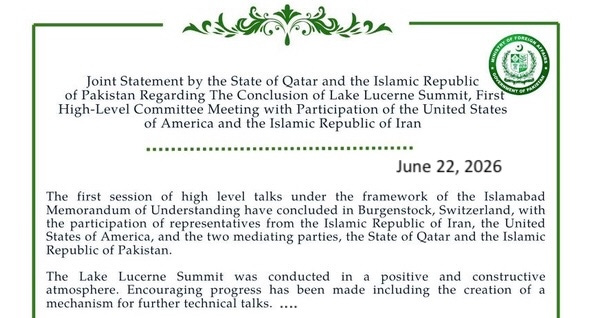
The newer model of regional diplomacy, as embodied in the MOU, in which the key mediating/adjudicating role is played by a coalition of mid-size powers who express clear recognition of the UN’s guiding role. This shift away from a U.S.-dominated diplomacy was clearly needed, since in the ferocious attack on Iran of last February the U.S. was not just a party to the aggression but actually the main party to it. Hence, no credible mediating structure could involve Washington as a “mediator”! The key mediating/adjudicating role for the MOU was initially played by Pakistan, which last week was joined by Qatar. Read the whole statement those two powers issued after the high-level meeting they hosted in Switzerland last weekend, involving American VP J.D. Vance and Iranian FM Abbas Araghchi, here. In pursuing this diplomacy Pakistan’s leaders have also intensively involved their counterparts in Saudi Arabia, Egypt, and Turkey, and have enjoyed quiet support from China. (See my earlier analyses of those diplomatic steps here, here, and here.)
In Lebanon, proponents of each of those two different models of diplomacy are currently trying to dominate the course of events. Secretary Rubio seems to have chosen (or to have been assigned by Trump?) the job of testing to see whether the “old”, Washington-dominated approach can still work there, with his attainment yesterday of an agreement that works to sideline (or destroy) Hizbullah and its allies.
But in parallel, participants in last week’s Lake Lucerne summit, who included VP Vance, created a new body called a “Deconfliction Cell” that would establish some form of a hotline-style arrangement through which Washington and Tehran could communicate— under the auspices of the Pakistani and Qatari mediators— any concerns they had about possible MOU violations in either the Persian Gulf arena or the Lebanese arena.
(I have seen no reports that this “Deconfliction” arrangement has yet been used in either place.)
Regarding Lebanon, the “old-style, U.S.-dominated” diplomacy clearly seeks to appease/reward Israel and exclude/destroy Hizbullah. For its part, the newer, “Lake Lucerne” approach does not include either of the directly fighting parties— Israel or Hizbullah— within the diplomacy. But it seems clear from the structure of the Deconfliction Cell that under this approach the Iranians would rely on the Americans to ensure compliance by Israel, while the U.S. would rely on Iran to ensure that of Hizbullah.
The Iranians, for their part, have made clear throughout the past ten-plus weeks of diplomacy that they see the survival of Hizbullah and the complete withdrawal of Israel from Lebanon as core Iranian interests, in defense of which they are prepared to forego the comfort of an early ceasefire in their “main” fight against the U.S. aggressors. They also see the successful pursuit of the Lake Lucerne/Deconfliction procedure in Lebanon as a key indicator that can demonstrate Washington’s continuing, broader compliance with the whole MOU process, going forward…
I know Lebanon’s internal politics is a complex matter that many people find hard to understand. Back in 1985, I wrote this book, which summarized what I’d learnt from the seven years I spent living in and reporting from Beirut, and also from numerous follow-up interviews etc.
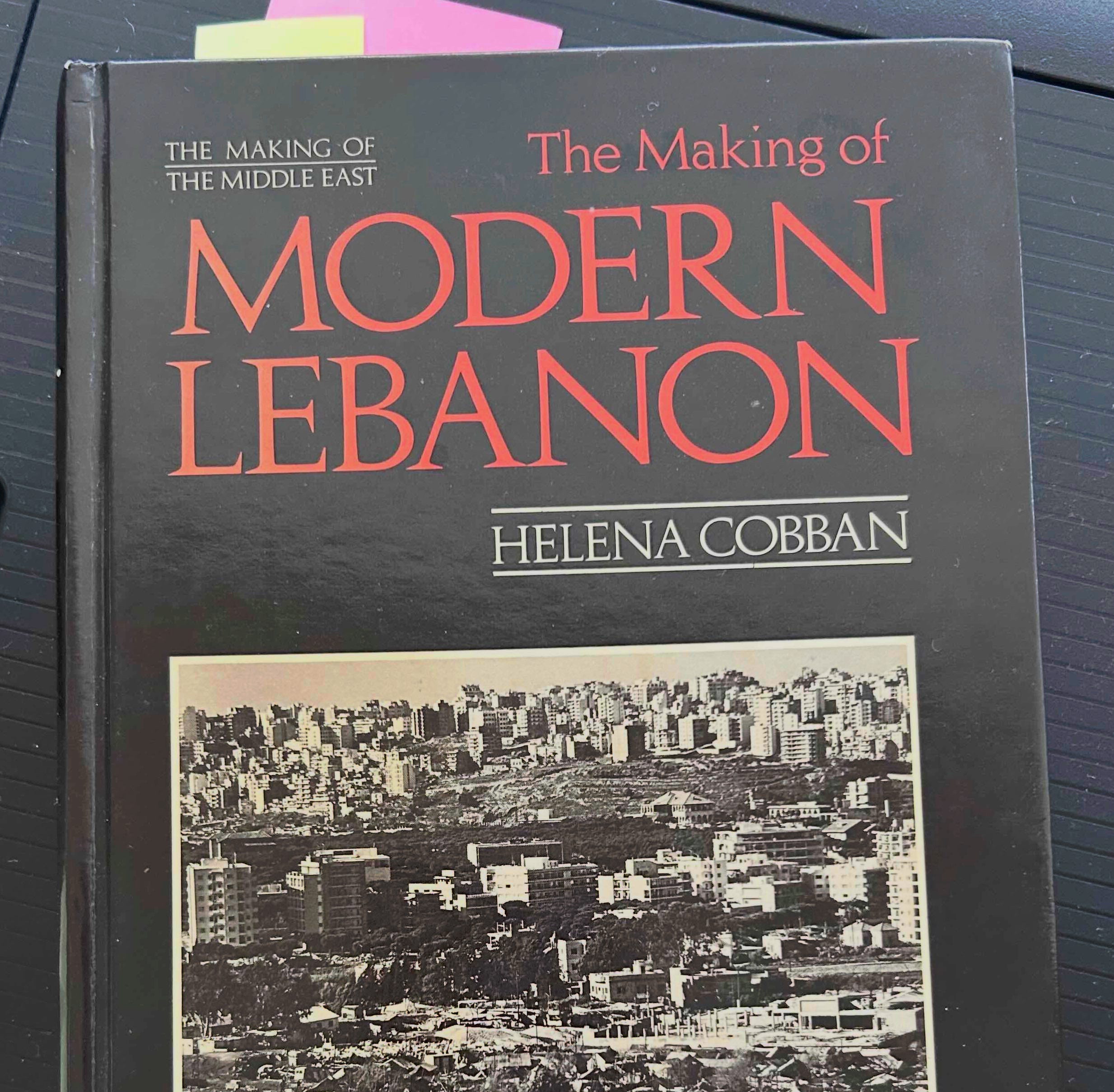
I was just re-reading the portion near the end, pp. 193-208, where I tracked what happened to the earlier, U.S.-mediated agreement that, in the aftermath of Israel’s large-scale 1982 invasion of Lebanon, U.S. mediator Phil Habib pressed Lebanese Pres. Amin Gemayyel to conclude with Israel.
Habib nailed that deal, which was a full-scale “peace agreement,” in May 1983. It lasted just ten months before fierce popular pressure inside Lebanon forced Gemayyel to rescind it…
How long might Marco Rubio’s latest “framework agreement” for Lebanon last? Who knows?
Last weekend I was in New York City, where there was a lot of excitement and activity around the Democratic Party primary elections that were held Tuesday.
It was so exciting to see that three of Mayor Zohran Mamdani’s allies won their Congressional primaries— and many of his other allies won primaries in state-level races. Given the strength of the Democratic Party in these districts, it is now almost certain that Mamdani allies Brad Lander, Claire Valdez, and Darializa Avila Chevalier will win their seats in Congress this November.
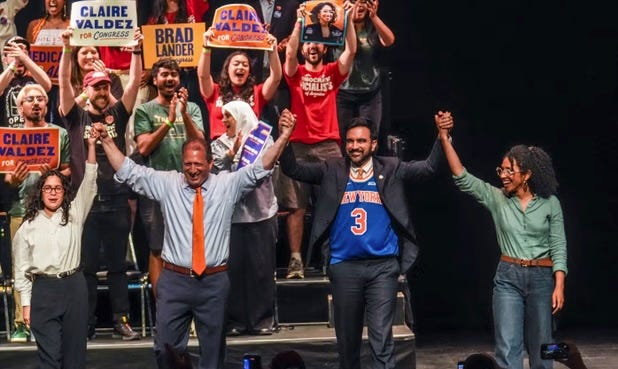
All three of these nominees are unafraid to name Israel’s actions in Gaza as “genocide.” Two of them challenged— and beat— fairly well-established Democratic Party incumbents who’d been overtly and covertly supported by the heinous pro-Israel lobby, AIPAC. For his part, Brad Lander, who is Jewish, has been outspoken in arguing that the fight against Israel’s warmongering in West Asia and the fight against anti-Semitism at home are two parts of the same struggle.
Over the months ahead, these three, along with the existing anti-genocide figures in Congress and others set also to join them after this year’s elections, will be planning to transform the whole of the Democratic Party, which for so long has been a bastion of pro-Israel activity…
We have many other battles to fight here in the United States, too. The Trump administration is continuing its attacks against whole new classes of immigrants, and is cutting back even further on support for health-care insurance and affordable housing. The Supreme Court has been issuing ever more hostile, anti-immigrant rulings. And it’s just eight days until July 4, when Trump plans to preside over a loud and very (small-p) prideful celebration of the 250th anniversary of the founding of this big colonial-settler state here in America.
Personally, if I have one wish or intention regarding this anniversary it is that going forward we can build an America here that is strongly supportive of the most disadvantaged among us; that is generous to the country’s many Indigenous nations; that is fair and welcoming to refugees fleeing violence elsewhere; that supports the environment of this great landmass and the world; that eschews ostentation and seeks to spread the nation’s wealth fairly— and above all, one that enthusiastically participates in the building of a world based on peaceful , rights-based cooperation among all the world’s nations, rather than on militarism, coercion, and violence.
The unprovoked assaults that our government launched against Iran in June last year and then again, much more damagingly, last February were both completely illegal. They should put a decisive end to any notion that the United States should be viewed as a “leader” of the modern world, far less entrusted with the leadership of any diplomatic effort within it.
All of us who want to build a more just and rights-based world owe a debt of thanks to the leaders in Iran whose foresight, planning, and dedication allowed them not just to withstand the U.S.-Israeli assault of last February but also to emerge from the initial months of that battle with a significant (though not complete) victory over the aggressing nations.
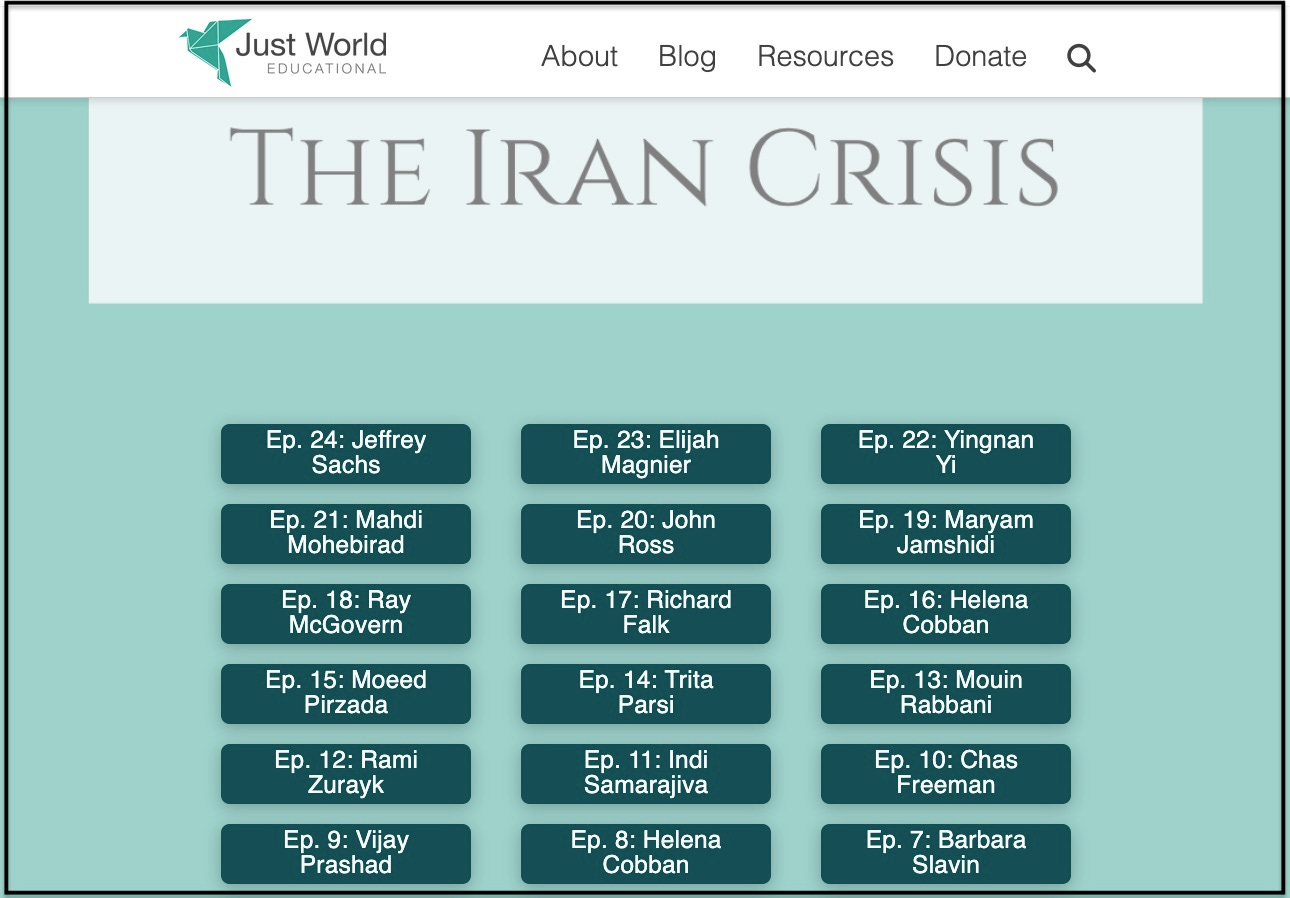
As president of Just World Educational, I felt deeply privileged to conduct the whole series of conversations— from February 25 through June 5— that have made up our “Iran Crisis” project thus far. You can access the multimedia records of all those great conversations here.
Right now, my board colleagues and I are trying to decide whether to compile the records of that project into a small publication— as we did earlier with our 2022 project on Ukraine, and our 2024 project on “Understanding Hamas”— or whether to place more focus to returning to the ever-crucial issue of Gaza.
Whatever we decide to do, it will of course take resources! Our big thanks to all those of you who have given recently— and even more so, to those of you who make regular monthly donations! If you haven’t given recently, or if you’d like to increase your level of monthly giving, you can learn how to do all this, easily, by clicking the button below:
Finally, talking of Gaza, I want to add one last thought to what I wrote above about the prospect that the new “MOU-style” model of middle-power-led diplomacy can now, after the defeat of Washington’s regime-toppling project in Iran, finally win out over model of “U.S-dominated” diplomacy that has been pursued in West Asia for the past 53 years.
One clear lesson in this is that “soft power”, including the power that accrues to the convenor of a negotiation, is also real power. The fact that Washington has been able to dominate diplomatic processes across West Asia for so many decades has itself been a component of American power all across this vital region, and has therefore added to its power in world politics.
Iran’s (relative) victory in the war thus far has challenged this hegemony.
The Iranians have stated that their intention is to challenge the whole, corrupt “Board of Peace” institution in Gaza. For their part, the leaders of Hamas and other resistance groups in Gaza have expressed their support for the Iran-U.S. MOU of June 17/18, and their hope that the new regional balance of power that it represents can soon be felt in Gaza and the rest of Palestine, as well. So there’s a lot more that JWE can hope to explore and discuss in that regard, as well…
That’s it for this week, then. I hope you stay well!
~ Helena
Comments
Nothing yet. Say the first thing.
Sign in to join the conversation.