
What is intelligence, really? What might once have seemed a rhetorical question has become deeper and more pressing with the latest AI breakthroughs. Our instinct is to answer by looking in the mirror: We might concede some animals are intelligent, but not all, and none as much as us. Plants don’t even make the shortlist. They are alive, yes, but intelligent? Capable of acting with intent? Surely not.
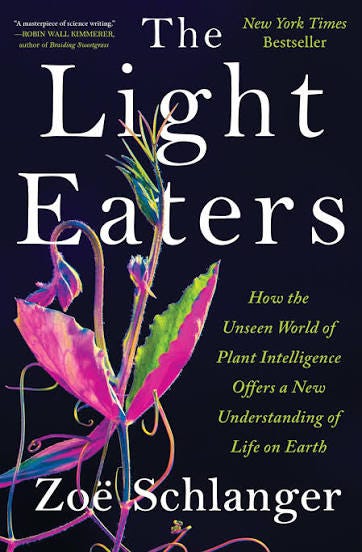
Zoë Schlanger’s The Light Eaters takes that assumption apart.
We think plants aren’t intelligent because we can’t find a brain. But we can infer intelligence from behavior. And when we take a closer look at plants’ behavior, things get interesting.
Plants perceive their environment with a surprisingly wide sensorial range. They can hear (or feel) the vibration of a caterpillar chewing on a leaf. Some plants emit clicks, a bit like bats, raising the intriguing possibility that climbing vines might use echolocation to find a support. Plants can see: they respond to the quality and direction of light with startling precision. They have no nervous system, yet they have a signaling network that works just the same way, propagating information through electricity and glutamate receptors similar to those in animals. They don’t have a brain like humans, but perhaps their brain is distributed, like in the octopus. Our own neural architecture starts to look less like a unique miracle and more like one of several possible solutions.
Plants act, and act strategically. When attacked by caterpillars, corn, tobacco and cotton plants release a tailor-made gas to attract a specific wasp that parasitizes the caterpillars. As Schlanger puts it, plants are geniuses at synthesizing chemical compounds. Other plants form alliances with ants, providing shelter in exchange for pest control.
They communicate, and here the discoveries get fascinating. In the 1980s a scientist found that trees can warn each other of a caterpillar attack, allowing neighbors to start secreting toxins before the caterpillars arrive. Even more striking: some plants modulate the alarm. When the threat is mild, they warn only their genetic kin; when it is severe, they broadcast to everyone in the area. Birds do something similar with different song phrases. We assume plants can’t communicate, when the truth is we just aren’t smart enough to understand them, much like I can’t understand Japanese or Mandarin.
Scientists have found that plants selectively bred for large-scale farming are much worse at communication. Which means they are worse at defending themselves, and therefore need more pesticides. In modern farming, we have abandoned traditional customs like companion planting, which also used to bolster plants’ resilience. Perhaps the agricultural-industrial revolution is making our food supply less secure. Maybe we should re-learn from nature.
The social life of plants is just as intriguing. Sea rockets on the dunes of Lake Michigan recognize whether nearby roots belong to their siblings; if so, they restrain their own root growth to limit competition. Sunflowers kins planted densely together tilt their stems to share light with each other – which can raise yields by 50%. (This reminded me of a project at GE on AI-controlled wind farms, where turbines could adjust their blade tilt so as not to steal too much wind from those behind them. Once again, nature got there first.)
There is more. Some weeds start mimicking nearby crops to escape the farmer’s hand — rye started as a weed, then became so good at mimicking wheat that it became a crop in its own right. The Chilean vine Boquila trifoliata reshapes its leaves to mimic the host plant’s shape, color, texture, vein pattern and even serration. We still don’t know how it does it.
Underneath all this, the book makes an important point about science. Darwin proposed that plants have something like a brain at the tip of their roots; the idea was rejected, forgotten for decades, but now seems quite plausible, though we still don’t know if he was right. Scientists who first talked of plants as potentially intelligent and conscious were ostracized. Schlanger notes that “Science’s biggest flaw and biggest virtue is that it almost always mistakes agreement for truth.” Indeed. Schlanger built her career covering climate change, where consensus is treated as sacred and unquestionable, but the irony does not seem to register. The underlying lesson, however, is one we should take seriously.
Nature sits awkwardly across our ideological foibles
Schlanger’s writing is at times too flowery, reaching for literary fiction. The book’s opening lingers on her own story longer than it needs to. Occasionally her ideology shows through, with predictable tropes on racism and sexism. There’s been plenty of both in science, but hers feel more like obligatory gripes than revealing examples. One passage I found amusing: planting together a “mixed culture of distantly related rice” lowers yields because the plants spend too much energy fighting each other and have little energy left for production. Schlanger quietly sidesteps the implications for multiculturalism in human societies. Nature sits awkwardly across our ideological foibles: plants can be gender fluid, but they can also be as tribal as humans. But these are just mean quibbles on my part. This is an excellent and eye-opening book.
She closes with a question that sounds absurd at first but then stays with you: should plants have legal personhood? It may sound crazy, like reverting to ancient animistic beliefs. But a more open-minded attitude to animals and plants can remind us of how little we understand about intelligence and consciousness, and that we are all part of a complex, interconnected, finely balanced ecosystem. Our ancestors understood this a lot better than we do.
Our view of intelligence is too narrow and anthropocentric. We barely understand our own intelligence — something nature spent millions of years perfecting — and yet we are supremely confident that, in a few decades, we have built something far more powerful in AI. This is hubris, and The Light Eaters helps put things in perspective. It also delivers a reassuring message: nature is impressively resilient. A great read for this tail end of summer.
Comments
Nothing yet. Say the first thing.
Sign in to join the conversation.