
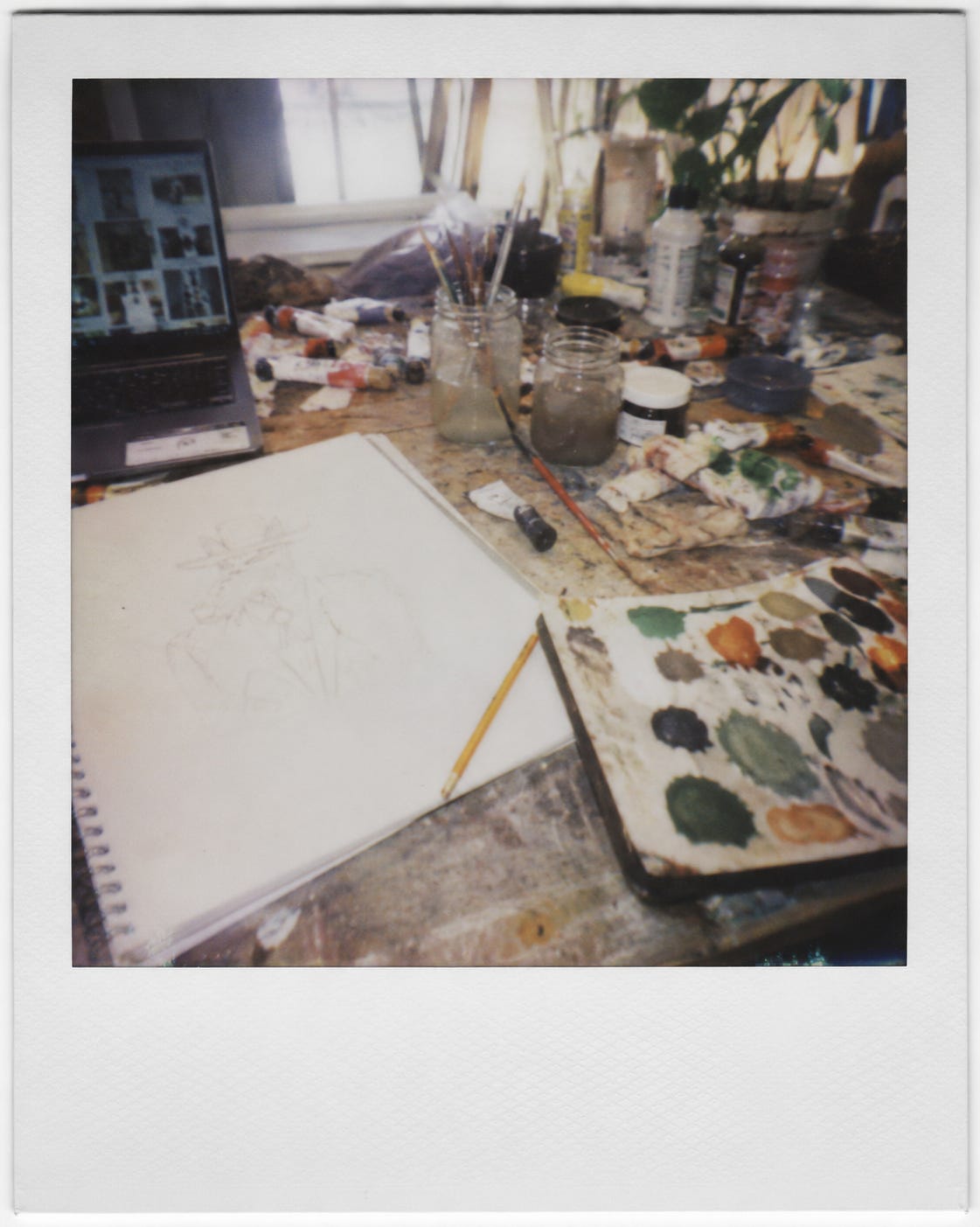
This week I started a new piece for a gallery show, and about two days in, I had the thought I always have and always hope I won’t have again: I don’t know how to do this.
Not “this is hard.” Not “this will take time.” The actual, panicked thought that I’ve somehow lost the ability to make art, that the well is dry, that whatever I used to have is gone and I’m about to be found out. I’ve had this thought before every single show I’ve done for over twenty years. Animation studios, film sets, art directing TV, books I’ve published — doesn’t matter. I’m experienced at this by any reasonable measure. And none of it has made the thought go away.
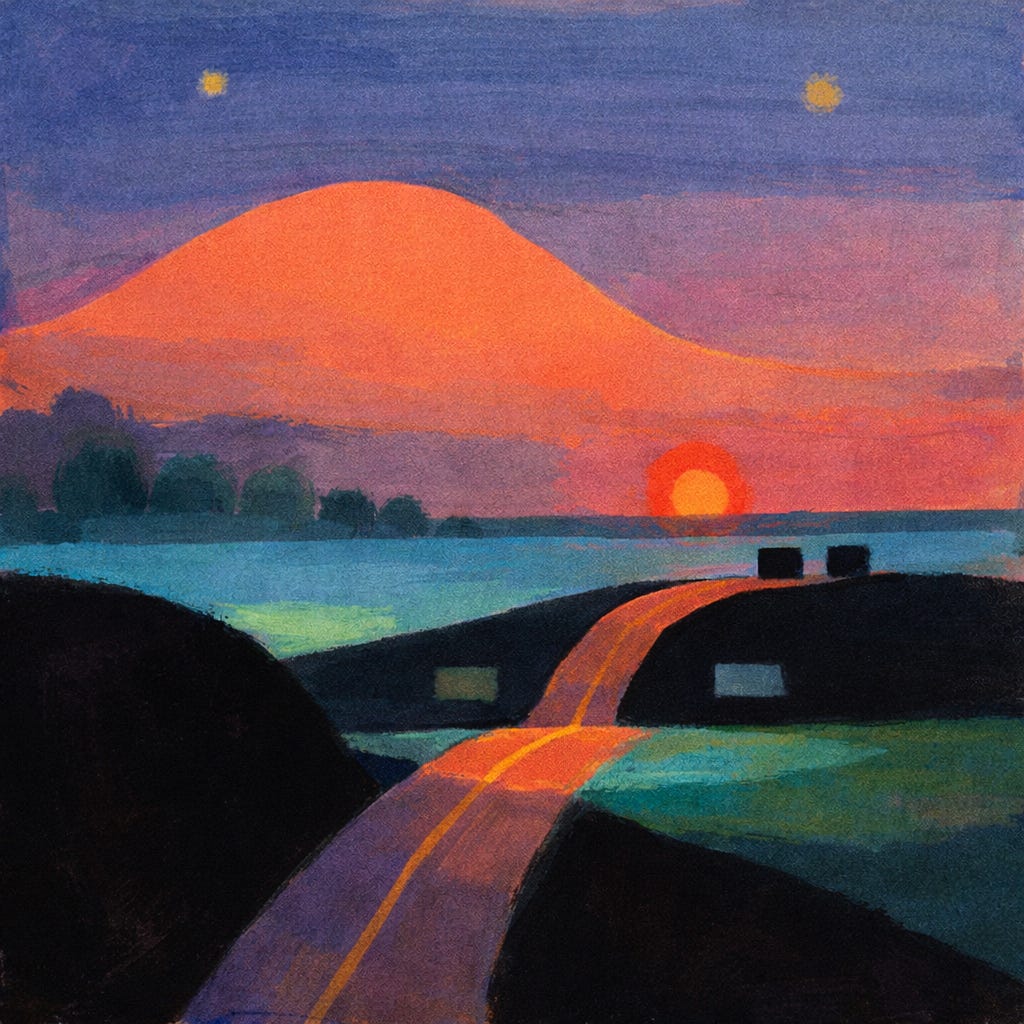
You’d think it would. I think it should. I think there’s supposed to be a version of me, several thousand hours in, who gets to skip this part — who shows up, knows what he’s doing, and just does it. Instead I get the same opening night every time: doubt, dread, a small voice telling me this one, finally, is the one where I don’t pull it off.
Here’s the thing nobody really says out loud about making art, or maybe any serious creative work: the technical part isn’t the hard part. I know how to draw. I know how to build a piece, solve a composition problem, push pigment around until it does what I want. That part, after this long, is almost automatic. The real labor — the thing that eats the hours and the sleep and the good mood — is psychological. It’s the argument happening in your head while your hands are working. Most conversations about art jump straight to inspiration or technique, like those are the hard parts. They’re not. The hard part is staying in the room with your own doubt long enough to finish the thing.
I keep thinking about Sisyphus this week. He’s the guy from Greek mythology who got punished by the gods with what might be the worst job ever invented: push a boulder up a hill, forever. Every time he gets it to the top, it rolls back down, and he has to start over. No finish line, no version where the hill is finally conquered. Just the same climb, again and again.
There’s a popular way of telling this story where Sisyphus comes out okay in the end — like he makes peace with the boulder, finds some kind of meaning in the pushing itself, regardless of whether he ever gets it over the hill. That’s not the part I’m thinking about. I’m thinking about the boring, infuriating mechanics of it: you push the thing up, it rolls back down, and tomorrow you do it again, fully aware of how it ends. That’s what starting a new piece feels like after twenty years of doing this professionally. I’m not arriving at some higher plateau where the hill finally flattens out. I’m, every time, back at the bottom, looking up.
What’s strange is I don’t think this means I’m doing something wrong. I used to think the doubt was a symptom — proof I’d picked the wrong piece, or wasn’t talented enough, or had finally run out of ideas. Now I think the doubt might just be what it feels like to work at the edge of what you know how to do, instead of repeating something safe. If a new piece didn’t make me start over, psychologically, from zero — if it didn’t make me a beginner again — it probably wouldn’t be a new piece. It’d just be a rerun.
I wish I could end this by telling you I’ve figured out the trick. I haven’t. I don’t have a system that makes the dread quieter, or a morning ritual that talks the inner critic down, or some hard-won wisdom that finally inoculates you. What I have, after a lot of years of this, is something smaller and less satisfying: I recognize the shape of the fight now. I know this particular flavor of “I’ve lost it” shows up around day two or three of something new, and that it’s never, historically, been a reliable predictor of anything. That’s not peace. It’s more like knowing a recurring opponent. I still have to show up to the match.
So if you’re in the middle of your own version of this — staring at a blank canvas, a blank page, a blank anything, convinced this is the time you finally don’t have it — I can’t tell you it gets easier. I don’t think it does. I think you just get a little better at noticing what’s happening in your head while it’s happening, which is its own small kind of progress. The boulder’s still going back down the hill. At least you know the hill by now.
No posts
Comments
Nothing yet. Say the first thing.
Sign in to join the conversation.