
Hi there, and welcome to The Next - my take on health, wellness, and company building.
In the last few years I’ve founded 3 health brands (Kettle & Fire, Perfect Keto, Surely non-alc wine). I’m now working on Truemed, which unlocks HSA/FSA dollars for effective lifestyle interventions. Previously, I worked in tech and had no experience in CPG, DTC, or any other 3-letter industries.
If you missed past episodes, I recommend checking out 'The Great American Poisoning,' my manifesto on what’s happening with our chronic disease crisis. Otherwise, let’s dive in!
One of the ideas most worth taking seriously is that most value comes from compounding. I’ve seen this at Kettle & Fire: just this year, we’ll add more revenue than we did in the first 5 years of the business, combined.
Compounding only comes over very, very long periods of time. We all know this intellectually: Einstein allegedly called compound interest the 8th wonder of the world, 70% of Warren Buffett's net worth came after age 70, etc. But knowing something intellectually and taking it seriously are two completely different things.
I reflected on this recently in conversation with a friend at a 4 person firm. A recent hire he made is a fine employee, but he doesn’t enjoy working with them. He wanted to know - is it okay to hire decent people you don’t personally like that much? Or should he focus on building a team of people he likes?
One hire may be a small decision, but the reality is that anything that increases the risk that he does not love running this company is a risk that is not worth taking. Most returns come from doing the same thing for a long time: in my friend's case, his biggest risk is that he doesn’t do this company for 20+ years. Keeping the employee he doesn’t like increases the risk that he quits, which increases the odds that he kills the compounding effect. So, he should part ways with the employee.
Walt Disney understood this intuitively. Allegedly, as he was building Disneyland, he insisted on using real gold for various finishes and crownings at the theme park. When his executives confronted him over this excessive spending, he pointed out that yes, gold was expensive now. But on an 80-year timeline, gold would last longer, look better, and have lower maintenance costs. Gold was the right decision.
Most people understand compounding in their investment portfolios but completely ignore it in their daily decisions. They'll obsess over taxes or expense ratios on index funds, but tolerate energy-draining relationships, jobs they're lukewarm about, or living situations that kill their happiness. If you really believe that the magic happens over decades, small daily irritations become big risks to achieving your goals.
For the last 6ish weeks, I’ve consumed more sugar than I have for at least a decade. A glass of OJ in the morning, some coconut water, berries, dried mango, and a few spoonfuls of honey before noon.
Why? Because I’ve recently been diving deep into the heterodox nutrition work of Dr. Ray Peat.
Ray Peat and his bioenergetic approach to nutrition have been confusing the hell out of people since the 1970s. Peat spent his life telling people to drink lots of orange juice and coffee, eat ice cream for health, and avoid polyunsaturated fats (and thus things like salmon) like they are radioactive waste.
Peat literally consumed 1,600 calories a day of sugar (!!), the equivalent of drinking a gallon of orange juice and chasing it with a pint of ice cream. He lived a healthy life until he died at 86, which was quite respectable given his thyroid was destroyed in a childhood medical accident.
Peat’s theory was that everything was downstream of energy and metabolism. Your cells are like tiny engines: if they're not running efficiently, everything falls apart. Poor energy production leads to inflammation, which leads to disease, which leads to many of the chronic conditions we see today.
Given this view, one should eat to maximize metabolic rate. This meant eating lots of fruits and juices, dairy, saturated fats, root vegetables, and lots and lots of gelatinous meats and bone broths (my kind of guy!). It also meant avoiding seed oils (Peat was one of the original seed oil disrespectors), PUFAs in all forms, leafy greens (hard to digest), grains and legumes, and fermented foods (thanks to the presence of lactic acid). This was basically his food pyramid:
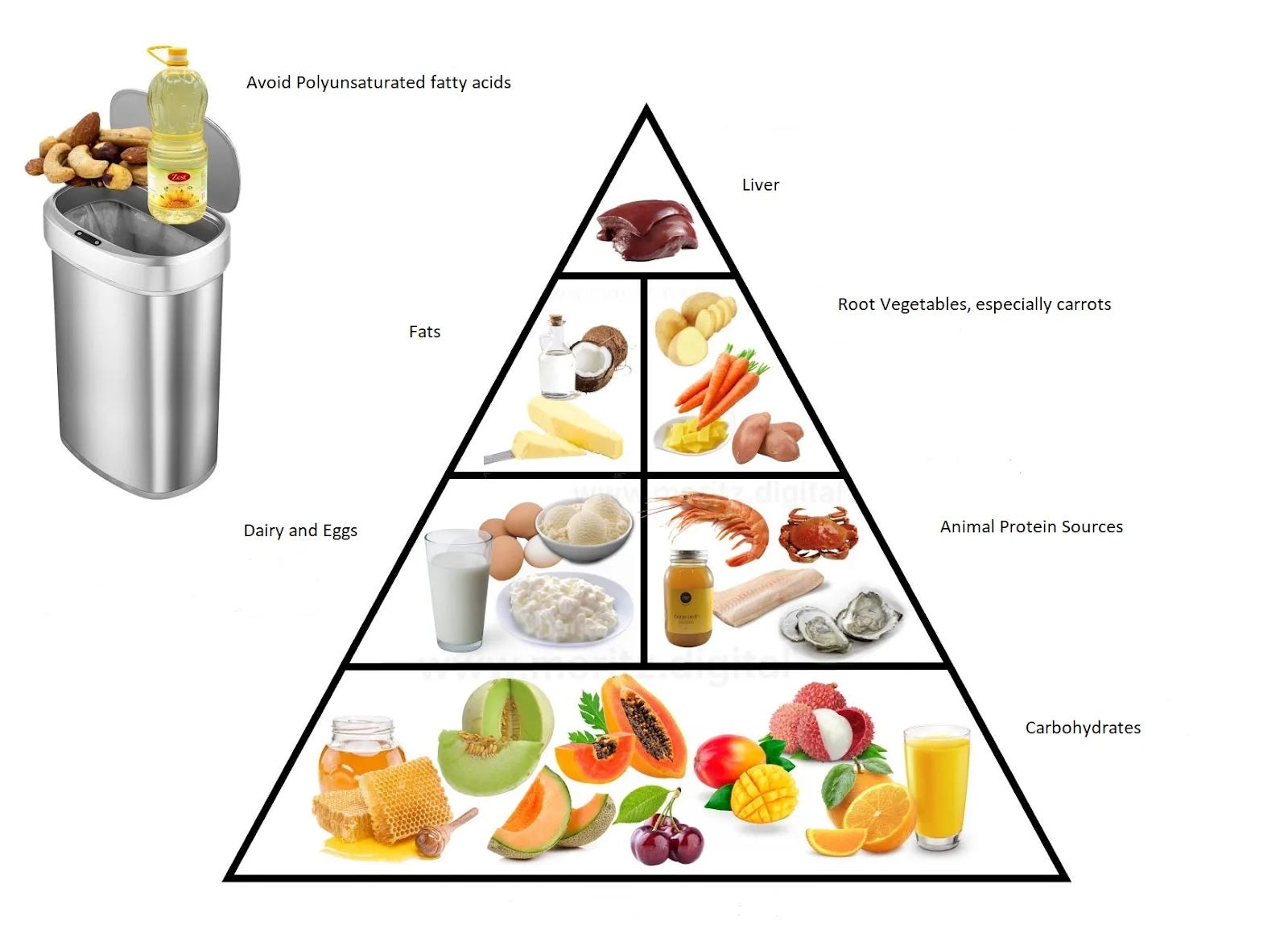
Peat was also extremely focused on the thyroid. Peat saw the thyroid (specifically the hormone T3) as the chief regulator of your metabolic rate, dictating how fast your cells burn fuel. Low thyroid function, Peat argued, is a hidden epidemic, sapping energy and contributing to everything from weight gain to depression.
Peat had a simple way to check thyroid function: body temperature! His belief was that low body temperature suggests impaired thyroid function, which I find especially interesting given Bryan Johnson’s focus (and bragging) about his low body temp. Notably, Bryan also supplements his thyroid.
In my limited experience so far, I feel… surprisingly good? I’ve noticed fewer late-in-the-day energy crashes, and just feel generally high energy. Friends have also lost weight eating this way, and feel great.
I'm not telling you to start chugging orange juice and eating ice cream for breakfast (as fun as that sounds). But I will say that his work has challenged many of my assumptions around nutrition and diet. I’m still digging into the bioenergetic approach, and am excited to go way deeper here in the coming months. If you have anything I should read on this, please let me know!
Related: this post by my friend Michael Johnson has my vote for most interesting health post of 2025.
One of the biggest hidden opportunities in the current health movement is developing new pesticides.
Usage of pesticides and herbicides (like glyphosate, the most widely used herbicide in the US) has exploded in recent decades. Between 2012 and 2016, an average of 281 million pounds were sprayed in the US (1). Given its widespread usage, it’s no wonder that glyphosate residue has been found in 95% of oat-based products in recent years (2).

A number of studies have found associations between occupational glyphosate exposure and increased rates of cancer and immune diseases (3, 4), while other studies found that elevated glyphosate levels in urine were related to an increased rate of metabolic syndrome (5). Still other studies have found glyphosate exposures to be associated with health risks like neurodegenerative diseases (Alzheimer’s and Parkinsons), intestinal diseases (Crohn's disease), cardiovascular disease, and endocrine/reproductive problems.
Lastly, glyphosate-related settlements from Bayer-Monsanto have surpassed $11B recently (6), after many years of court battles about glyphosate’s toxicity and mechanism of action. Despite the studies above (and the court settlements), others disagree that glyphosate has any health issues.
Where this leaves me (and why this is in the biz stuff section): I think there are huge opportunities to develop better pesticides.
Regardless of what side you may come down on for glyphosate (and I certainly come down on the side of “avoid as much as you can”), there are millions of consumers now concerned about glyphosate exposure and toxicity.
Glyphosate is the most sprayed pesticide in the US, and has sales of close to $20B internationally each year. I think we are in the early innings of understanding just how bad these pesticides are - after all, there’s a reason that pesticide companies are hoping to get shielded from liability - and I’d love to support and/or invest in them.
Some of my favorite things since the last newsletter (note: I don’t get paid to recommend anything here):
📰 Article - The anonymous writers/researchers Slime Mold Time Mold are back with their latest hypothesis: a novel theory of psychology!
Even if you don’t find psychology interesting, it’s worth reading the above link just to get a sense of what clear thinking looks like. The authors argue (correctly, in my view) that psychology is pre-paradigmatic, meaning psychology has no proposed models that explain even a fraction of human behavior. A friend uses the analogy of alchemy vs chemistry: both attempt to describe the world, but only one of them has created a paradigm that is predictive, testable, and explains many of the observed phenomena we see today. I strongly recommend reading at least the first part of this excellent series.📚Book rec - I’m only about 50% into it, but so far Bad Pharma is a very engaging (and concerning) read. The more I dig, the more astoundingly bad our healthcare system appears. I’m hopeful change is coming, but it’s remarkable that things have gotten to this point. Americans are both the sickest population in the world, and spend more than anyone else on healthcare!
⌚Cool product - I get asked a surprising amount about what underwear I wear. Well, I think I found my favorite pair from the (terribly named) Industry of all Nations. Studies have shown that polyester (what most underwear is made of) harms sperm production and should really be avoided. Going 100% cotton is an easy way to do so!
🎵 Music - I really enjoyed this set of soulful house (though skip the first 3ish minutes).
🏀 Random - I wrote a thread on nattokinase, a compound I think will play an increasingly large role in cardiovascular health and arterial plaque reduction in the coming years. I’m currently on day 5 of a 90-day experiment taking Toku daily, and will report back on my results. In similar notes, this article also points to a potential microbial cause of heart disease!
🔥Hot take - We have very little understanding of what SSRIs do long term, or other impacts they may have. Strangely, they seem to inhibit bone regrowth, there are clear suicidal and violent ideation warnings on these, aaaand 17-24% of adult women (and 7-8% of men) are on these very powerful drugs.
I’m not anti-drug by any means, but it is remarkable to me how we are just like yeah, let’s put 40M Americans on these things and see what happens. They also don’t work for many patients, with 41% of people seeing no change in their mood or symptoms after 12 weeks of use. And they are insanely hard to titrate off of once you start, with withdrawal symptoms that can last months or even years.🙋♂️ Ask - Truemed is hiring a head of marketing. If you have any recommendations (or want to join a talented team advocating for lifestyle interventions), I would love an introduction!
***
I’ve been increasingly thinking about AI and how it will impact all of my businesses (and society at large). If any of you have strong recommendations as to books to read, people to follow, articles to check out… please send by replying to this email. I’m trying to get as smart in this area as I possibly can. See you next month!
Justin
No posts
Comments
Nothing yet. Say the first thing.
Sign in to join the conversation.