
Hi there, and welcome to The Next - my take on health, wellness, and company building.
In the last few years I’ve founded several health brands (Kettle & Fire, Perfect Keto, Surely non-alc wine). I’m now working on Truemed, which allows tax-free HSA/FSA funds to go to lifestyle interventions. Previously, I worked in tech and had no experience in CPG, DTC, or any other 3-letter industries.
If you missed past episodes, I recommend checking out The Great American Poisoning, my manifesto on what’s going on with our chronic disease crisis. Otherwise, let’s dive in!
Most members of society have never been a part of building something from scratch. For many, they are escorted from one well-trodden path to another by a cadre of guidance counselors, career coaches, and well-meaning friends and advisors.
There are many upsides to this process. People have stability, and they can plug into existing infrastructures and be productive. But it comes with a very real cost. Most people have never seen something start and grow from scratch. And because they’ve never seen new things grow from nothing, they miss that often, big changes start very, very small.
I experienced this early in my career in San Francisco. I had just moved, and met someone at Stripe who was just building out the BizOps team. At that time, Stripe was 40ish people, and my new friend offhandedly offered me a role on his team. I would have been employee #46, at what is now a $91B company that today powers something like 3% of US GDP.
I experienced the same at Kettle & Fire. What started out as a small side project has turned into a much larger enterprise: 100+ employees, 20k+ stores, many product lines, and a factory. We recently became the largest bone broth brand in the country, nearly 10 years after founding (more on that below).
https://x.com/DKThomp/status/1948076404266188982
Lately, I’ve seen a deep skepticism from the class of pundits who are default skeptical that big changes can come from small beginnings. Is Derek right that frying Outback Bloomin’ Onion in beef tallow will not itself solve the chronic disease crisis? Of course.
But where Derek Thompson is wrong is in a failure of imagination. Will Americans' current push for a healthier nation fail? Maybe. But, it may also succeed! And if it succeeds, it will happen by putting one foot in front of the other, stacking one incremental win on top of another.
This is how all great things happen: slowly, then all at once. I enjoy reading about the great projects of the last 100 years: The Manhattan Project, Apollo, the Panama Canal, etc. As you read more about these great works, you gain an appreciation of just how long it took to complete them. The Manhattan Project was 5 years of 130,000 people (!!) eking out small victory after small victory. This is how great things happen.
Americans are sick. We are the sickest population of humans to ever walk the earth. Fixing the Great American Poisoning will require many small steps. It’s the biggest problem in the country, and for the first time in my lifetime, progress is happening. Great things start small!
I’ve written before about how American baby formula is toxic.
The Infant Formula Act of 1980 was passed in response to nutritionally inadequate formulas making babies sick. Unfortunately, this act incorporated outdated nutrition science from the 1970s. These regulations require that at least 2.7% of formula calories come from linoleic acid, the problematic fat found in seed oils. According to the FDA, it is illegal to sell formula in America without linoleic acid, despite tons of evidence that it causes all kinds of issues.
Bad formula is a root cause of America's childhood obesity epidemic. A systematic review of the research shows that formula-fed babies experience "excessive and rapid weight gain" compared to breastfed infants.
Which makes sense! Breast milk is a marvel of evolutionary design: it contains antibodies that protect infants from disease, stem cells that help with growth and development, and even contains proteins that infants cannot digest to attract beneficial bacteria that colonize the baby’s gut. Wild!
No formula can replicate this complexity. Breast milk contains over 1,000 proteins, whereas formula typically contains around 30. The composition of breast milk even changes throughout a single feeding and as the baby grows. Breast milk is diurnal, meaning that morning milk contains compounds that help the baby wake up, while nighttime milk contains melatonin to aid sleep.
Studies consistently show that breastfed babies have higher IQs, lower obesity rates, fewer allergies, and better immune function than formula-fed babies. For mothers, breastfeeding reduces the risk of breast cancer, ovarian cancer, and postpartum depression, along with a whole host of other benefits (more on breastfeeding benefits here and here).
Despite that, breastfeeding is hard. 75% of American babies drink formula after 6 months. Not only is formula mandated to have toxic ingredients, but a few months ago, Consumer Reports found that half of the tested formulas had harmful levels of lead, arsenic, or PFAS. Half!!
Babies are the worst possible candidates for toxic exposure – they're tiny (massive dose per pound), their organs are still developing, and they consume the same thing multiple times daily for months. Sadly, many tests have found multiple toxic compounds in many of the most popular formulas:
Arsenic: linked to developmental delays and lower IQ
Lead: ADHD, behavioral problems, lower IQ
PFAS: "Forever chemicals" that never leave your body, linked to cancer, developmental delays, and hormonal issues
Glyphosate: The Roundup chemical associated with neurodevelopmental problems by 24 months
These contaminants are strictly limited in the EU, but not in the US (which may be why so many families recommend European formula).
So, should Americans just buy European products? Unfortunately, even when a European product meets or exceeds U.S. safety standards, it’s usually kept out by strict FDA labeling and import laws. There are also high tariffs and import quotas that drive up prices once low-tariff limits are exceeded.
This is messed up. If we want to fix chronic disease in the US, I think it may be true that improving baby formula may be the best place to start.
Given that, I decided to support my friend Julia Lipton as she partners with OpenLabel Research and Light Labs to test many popular baby formulas for:
Heavy metals
Glyphosate & metabolites
BPA/BPS/BPF
Phthalates
Mycotoxins
Pesticide residues
Actual nutrients vs. label claims
Once we have the results, we’ll publish them for free at https://www.fixtheformula.org/ (which you can donate to, if you want to help crowdfund this initiative). My hope is that this allows parents to make better decisions, and hopefully make our food system just a tad better.
I get it: breastfeeding is hard and inconvenient. As a society, I think we should incentivize and promote it much more than we do today. While the first step is testing, my hope is that over the long term we create much more awareness (and thus demand) for better, cleaner formula in the US. Until then, I suspect breastfeeding and alternative marketplaces like It’s My Leche are optimal.
As of this month, it’s now been 10 years since we launched Kettle & Fire.
I’ll write a much more in-depth post on the journey at some point (and can even publish weekly team update emails + monthly emails to our investors if folks are interested), but I’m taking some time off this week and in a reflective mood, so here it goes.
We never intended to build a big company with Kettle & Fire. The initial intent was to build a side business that could cover my monthly burn and be a small side hustle for my brother Nick and me to operate. Our stretch goal was to make $10k/mo.
After testing the idea and finding that the internet was full of strange folks who wanted to buy bone water online, we got to work. Nick called 500+ potential manufacturing partners to find someone who could make our product, and - after striking out repeatedly - cold emailed Mark Cuban (yes, that one) to see if he knew of anyone. Someone on his team then introduced us to the manufacturing partner who we still work with today.
When we launched, the business was called Bone Broths Co. Bonebroths.com was $8, so we bought it and shipped the world’s blandest brand. It was only after 7 months of realizing people actually wanted what we were selling that we went through a rebrand and became Kettle & Fire.
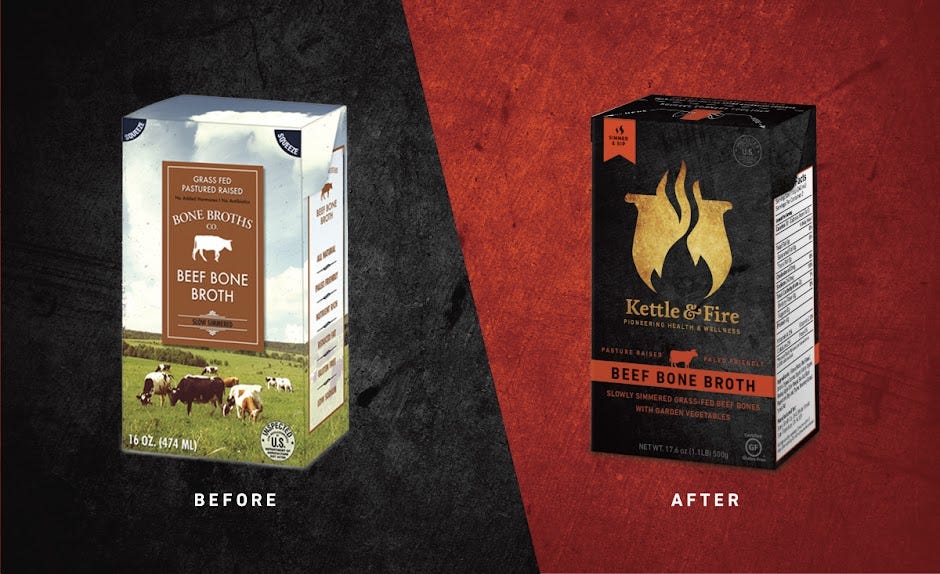
The first 8 months of sales were almost entirely online. We sold each box for $11.99, and blanketed the internet, paleo influencers, and Thrive Market with the brand. At the time, we were the first bone broth to sell non-frozen product online, using only bones that were incredibly well sourced (grass-fed, grass-finished, organic… all the good stuff). And after pushing online sales for 8 months, a buyer from Whole Foods reached out to bring us into 50 stores in the Rocky Mountain region.
When we got into Whole Foods, we were entirely self-funded (and by “self-funded” I mean I borrowed 20k from my parents and poured pretty much every dollar I had into our first production run). We sold each carton for $9.99 at retail, and made the (incredibly stupid) decision to *not* do anything to promote the brand in retail. After all, we figured, if the product wasn’t good enough to sell on its own, we probably shouldn’t be in stores!!
Moronic. No matter how good the product, every great consumer brand has to invest in marketing in some way, shape, or form. This is even more true if you’re selling through retailers and don’t own the end relationship with your customer. Fortunately, our stupidity didn’t hurt us too badly, and we did well enough to expand to every Whole Foods in the country 18 months after founding.
From there, it was a whirlwind: we raised money, got into thousands more stores, launched a soups line, invested in our own production facility (which almost killed us), doubled the team, and sold a heck of a lot of bone broth.
Today, Kettle & Fire is in 20k+ stores, has 50+ employees, and has invested in a better food system through our regenerative and wild-harvested lines. We’ve built a brand we are incredibly proud of, and it continues to grow today. I just can’t believe it’s already been 10 years 😂.
The days are long, but the years are short. Much of the early years working on Kettle & Fire felt long, hard, and exhausting. Most days, I had no clue what I was doing. Yet in the end, with a bit of luck, fortunate timing, and the hard work of a lot of talented people, we made it work. I’m incredibly proud of what we and the team built: an overnight success 10 years in the making.
At some point in the future, I’m planning to publish every weekly email I sent to the team, as well as every investor update and our fundraising decks across both of our funding rounds. If there’s anything else you’d like to learn or see about the Kettle & Fire story, let me know!
Some of my favorite things since the last newsletter (note: I don’t get paid to recommend anything here):
📰 Article - Charlie Munger has a quote I often think about: that “In business we often find that the winning system goes almost ridiculously far in maximizing and or minimizing one or a few variables.” Alpha School (in Austin, TX) is the school you’d build if you decided to go ridiculously far in building and optimizing a school purely for rate of learning. This review of Alpha School is a great look into what the school is like, with performance takeaways that can be applied to many areas of life.
📚Book rec - I absolutely loved reading Liftoff and Reentry about the earliest days of SpaceX. SpaceX is a remarkable story, and I suspect has a good shot at becoming the most valuable company in the world. I cannot recommend reading these books enough.
⌚Cool product - I’ve been using (and loving) Interface0 as a power AI tool. It’s made me 2-3x more productive using the various AI tools: would highly recommend playing with it. Here are some reasons why I think it’s so useful!
🎵Music - Got two sets for you all this month! This set from Marsh is excellent, as is this one that’s got Keinemusik vibes that I suspect many of you will be into.
🏀Random - Did you know that nearly every aluminum has a thin plastic lining on the interior of it? This video is the best example of that I’ve seen. Just be aware that 99% of the time when you’re going aluminum to avoid plastic, well, you’re failing.
🔥Hot take - Society should view news consumption as a risk factor akin to smoking or being disconnected. Many studies have shown regular news consumption will increase anxiety and depression, and - with few exceptions - it makes little difference in people’s lives. With a media environment that’s stacked against you, optimizing for clicks and engagement and not your mental health, it’s something best avoided. For many, experimenting with a low-information diet, I’m guessing, would lead to hugely positive changes.
🙋♂️ Ask - If you know of anyone interested in (1) traveling to beautiful places and (2) spending extended time around other builders and founders, check out Edge City Patagonia in Oct/Nov. I had a blast at their event in June in CA, and met so many awesome people. Just say that Justin sent you if you end up applying!
***
Enjoy the last month of summer. I’ll be in the Bay Area for much of the next month - say hi if you’re around!
Justin
No posts
Comments
Nothing yet. Say the first thing.
Sign in to join the conversation.