
This week, the big theme is simple: the platforms are keeping more activity inside their own walls, but local intent has not disappeared.
That means your job is not just to chase rankings or cheaper leads. It is to make your local business easier to understand, easier to trust, and easier to choose wherever the prospect makes the decision.
Why Google’s zero-click shift does not mean local SEO is dead
What Google clarified about AI Max and ads inside AI Search
Why Performance Max testing is finally getting more useful
How real people actually prompt AI tools
Why one local SEO Reddit audit should make every business owner uncomfortable
Ten quick hits on schema, Facebook ads, GBP data, Reddit visibility, and Gemini
Google searches ended without a click 68.01% of the time in the U.S. during the first four months of 2026, according to the study. That is up from 60.45% in 2024. The same report says the share of searches generating at least one click fell by 9.51 percentage points over that period.
That sounds rough if your entire marketing plan depends on someone clicking a blue link.
But the local takeaway is more useful than “SEO is dead.” Search Engine Land notes that some categories still benefit from SEO, including branded searches, local business queries, and high-intent transactional searches.
That is the part local businesses should pay attention to.
If someone searches “best dentist near me,” “med spa open now,” or your business name plus reviews, they are not casually browsing. They are close to making a decision. Google may keep more of that journey inside Search, Maps, AI Overviews, AI Mode, or a Business Profile, but the decision still has to land somewhere.
The Real Reason This Matters:
Your website is no longer the only place where customers form an opinion
Google Business Profile, reviews, photos, service pages, third-party mentions, and local citations all become decision inputs
Fewer clicks make it more important to win the impression before the visit
Key Takeaway: Local SEO is becoming less about earning every click and more about being the trusted answer wherever the decision happens.
Action Step: Search your top service plus city, then search your brand name plus “reviews,” “cost,” “near me,” and “open now.” Write down what a customer can learn before clicking your website. That is your real local search presence.
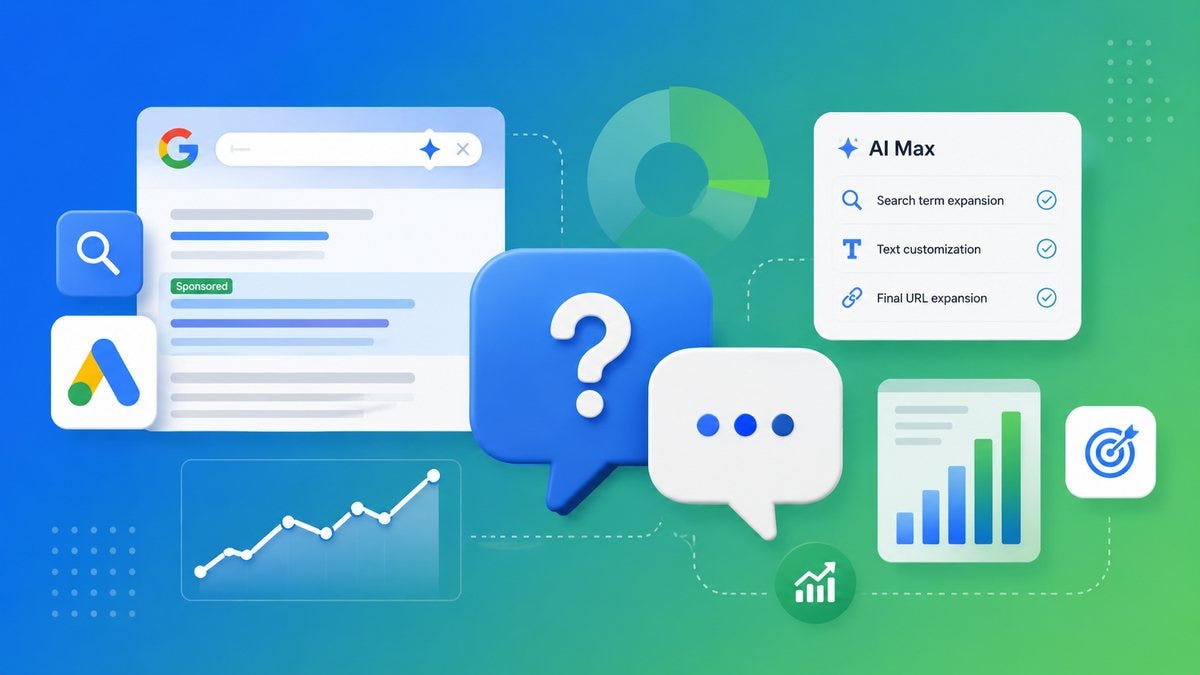
Google Ads Liaison Ginny Marvin joined a PPC Chat Q&A and clarified several post-Google Marketing Live questions about AI Max, AI Search ads, measurement, and first-party data.
The headline for local advertisers: AI Max is not required to appear in AI-powered search experiences. Search Engine Land reports that broad match campaigns can remain eligible for ads in AI Overviews and AI Mode, while AI Max expands eligibility by applying broad-match behavior to phrase and exact match keywords and enabling keywordless matching.
That matters because many advertisers assumed AI Max would become the mandatory doorway into Google’s newer AI ad surfaces.
The Real Reason This Matters:
AI Search inventory is becoming part of paid search, not a separate future concept
Local advertisers still need clean conversion data before expanding automation
Broad match, AI Max, and Performance Max will punish weak lead-quality signals faster than manual campaigns did
Key Takeaway: AI Search ads are not just about adopting a new campaign setting. They are about feeding Google better business outcomes.
Action Step: Audit your primary conversions. If every call, form fill, and low-intent click is treated equally, fix that before giving Google more room to roam.
Google added new Performance Max asset testing tools, which gives advertisers more ways to understand what creative is helping or hurting automated campaigns.
For local advertisers, that is useful because PMax has always had a visibility problem. It can produce results, but it has not always been obvious which headlines, images, videos, or landing-page combinations are actually moving qualified leads.
This update does not magically make PMax transparent. But it does point in the right direction: more testing, more signal, and fewer mystery boxes.
The Real Reason This Matters:
Creative quality matters more as Google automates targeting
Local businesses often reuse weak stock images, generic offers, and vague headlines
Better asset testing can help separate real lead drivers from campaign filler
Key Takeaway: In automated campaigns, your creative becomes part of your targeting.
Action Step: Pull your PMax assets and label each one as specific, local, trust-building, offer-driven, or generic. Replace the generic assets first.
Search Engine Land’s piece on how real people actually prompt AI is a useful reset for anyone overcomplicating GEO.
The article covers survey data showing that many AI prompts still look a lot like traditional search queries, but with more personal context added over time. That means local businesses should not abandon keyword research. They should extend it.
A patient might not ask “dermatologist Atlanta.” They might ask, “What dermatologist near Buckhead treats acne scars and has appointments after work?” That is still search intent. It is just more specific, more conversational, and more tied to proof.
The Real Reason This Matters:
AI visibility depends on whether your content answers real customer situations
FAQ pages should reflect actual objections, symptoms, services, and locations
Reviews and service pages can provide the details AI tools use to build recommendations
Key Takeaway: GEO is not magic. It is better customer-language coverage.
Action Step: Take your top 10 service keywords and rewrite each one as a real customer question with location, urgency, budget, pain point, or preference included.
The old tracking model was simple enough: search, click, visit, convert. That model is getting messier.
Search Engine Land’s guide to tracking AI search visibility when attribution falls short makes the right point: discovery and decision paths are harder to connect when AI answers, summaries, and recommendations influence people before they ever visit your site.
For local businesses, this is not just an analytics issue. A customer may see your reviews in AI Mode, compare your Business Profile in Maps, ask ChatGPT for a second opinion, then call directly from Google.
The Real Reason This Matters:
Last-click reporting will miss more of the influence path
Branded search, direct calls, GBP activity, and review velocity become important supporting signals
AI visibility should be measured as influence, not only as traffic
Key Takeaway: If you only measure clicks, you will miss part of the decision.
Action Step: Build a simple monthly scorecard with branded searches, GBP calls, direction requests, review count, review themes, organic leads, paid leads, and booked appointments. Trends matter more than any single metric.

WordStream’s AI Max vs. Broad Match explainer is worth a read if Google’s new ad language is starting to blur together.
The practical issue is not whether AI Max or broad match is “better.” It is how much control you are comfortable giving up, and whether your account has the conversion quality to support that decision.
For a local business, the wrong setup can find more people who are willing to fill out a form, but not more people who are ready to book, buy, or show up.
The Real Reason This Matters:
Google is getting better at matching intent beyond exact keywords
That only helps if the campaign knows which outcomes are valuable
Local campaigns need negative feedback loops for junk calls, bad-fit forms, and low-value leads
Key Takeaway: Automation expands reach. Your data decides whether that reach is useful.
Action Step: Before testing AI Max, define your “qualified lead” rules in plain English. Then make sure your CRM, call tracking, or offline conversion import can send those signals back.
Spicy Take
🌶️ The Best Business Can Still Be Invisible
A fresh r/localseo thread about auditing a local tradesperson’s online visibility should make every local owner a little uncomfortable.
The audit described a plumber with years in business, a decent reputation, and real-world credibility. But the online signals were weak: thin Google Business Profile, limited photos, inconsistent directory data, low review response activity, and no schema markup.
The uncomfortable part is this: the business may be good at the work and still lose calls to a weaker competitor with stronger visible signals.
That is not fair. It is also not new.
The spicy take: “we do great work” is not a marketing strategy unless the internet can prove it for you.
Key Takeaway: Quality work has to become visible proof. Reviews, photos, service details, citations, schema, and local content are how search engines and AI systems see the business.
WordStream updated its visual guide to advertising on Facebook. If your Meta campaigns are messy, start with structure before blaming the algorithm.
Jon Loomer also tested Push Delivery to This Ad. Useful feature, but do not force spend behind a weak ad just because the button exists.
Search Engine Journal reported that Google Analytics is adding Google Business Profile data. If calls and direction requests become easier to see next to website behavior, local reporting gets more useful.
Google’s new guidance on SEO, tools, and AEO/GEO sparked discussion this week. Treat Google’s guidance as important, but do not ignore your own lead, call, and revenue data.
SE Ranking data covered by Search Engine Journal found Reddit gained top positions across every niche after the May core update. If customers discuss your category on Reddit, those threads may shape search perception.
Search Engine Journal reported that Google is adding Business Profile tools and business notebooks to Gemini. That is another sign Google wants local business management closer to AI workflows.
This week’s issue has one clear thread: clicks, campaigns, and AI answers are getting harder to separate.
That makes clean tracking, qualified-lead definitions, review systems, local proof, and better Business Profile data more important, not less.
“Help Me Get More Leads” Call with Justin: In 15 minutes, you’ll get personalized insights, a no-pressure digital assessment of your business, and practical next steps to increase qualified leads, phone calls, and appointments.
👉 Book Your "Help Me Get More Leads" Call
Thanks for reading Local Marketing Minute! This post is public so feel free to share it.
Comments
Nothing yet. Say the first thing.
Sign in to join the conversation.