
This week, the big theme is clarity.
Nothing fixes a website that cannot clearly explain what you do, where you do it, why someone should trust you, and what they should do next.
Why local businesses need better service pages before more blog content
How Google’s AI future may care more about your business entity than one optimized page
How ChatGPT recommendations can turn into real site visits
What Google Ads bidding changes mean for local lead-gen accounts
A Reddit dental-practice thread that says the quiet part out loud about lead generation
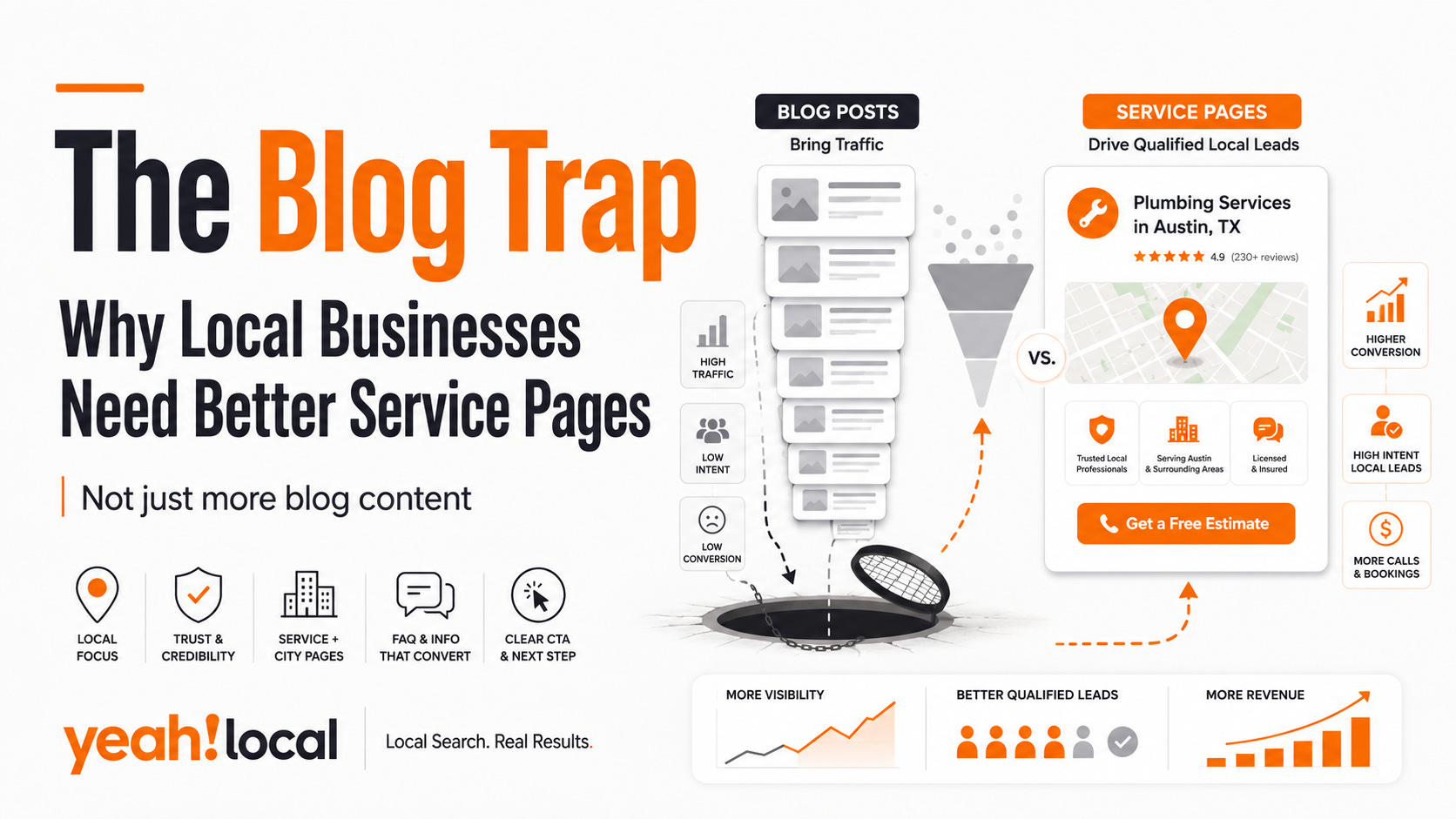
This week’s Deep Dive is The Blog Trap: Why Local Businesses Need Better Service Pages, Not More Content.
The point is not that blogs are bad. A good blog can answer questions, build authority, support internal links, and help prospects understand your process. But for most local businesses, blog posts are not the pages that bring in the highest-intent leads.
The buyer searching “primary care Alpharetta,” “concierge doctor near me,” “attic insulation Atlanta,” or “Botox Sandy Springs” is not primarily asking for a general article. They are looking for a provider that does the specific service in the specific place they need it.
That is where too many local websites are weakest. The blog gets attention. The service page gets the call.
This matters even more now because AI search systems need clear, structured, trustworthy information to generate local answers. If your website does not clearly connect service, location, expertise, proof, process, and next step, you are asking Google and AI tools to infer what competitors may be stating directly.
The better structure is simple: service, city, trust, answers, next step. Blogs can support that structure. They should not replace it.
The Real Reason This Matters:
Blog traffic can look good while the money pages stay too vague to convert.
Local buyers usually search by service plus city, not by broad educational topics.
AI search makes clear service and location pages more important, not less important.
Key Takeaway: Your blog should support your local SEO strategy. It should not be asked to do the job of service pages, city pages, FAQs, proof, and conversion paths.
Action Step: Before writing another blog post, open your top service page. Check the title tag, H1, service details, local relevance, FAQs, reviews, internal links, and CTA. If the page does not clearly answer “what, where, why you, and what next,” fix that first.

Search Engine Land covered a Google patent that points to a bigger shift in search: AI systems may be building a fuller understanding of entities, including businesses, people, products, places, and concepts.
The local version is straightforward. Google is not only trying to understand what one service page says. It is trying to understand who your business is, what you do, where you do it, how trustworthy you are, and how the public web describes you.
That makes the new Deep Dive even more practical. Service pages, reviews, Google Business Profile categories, photos, third-party mentions, local citations, author bios, schema, and customer language all help machines form a clearer picture of the business.
The Real Reason This Matters:
Local SEO is shifting from “Can this page rank?” toward “Can this business be understood and trusted?”
Generic service pages are weaker when AI systems need clear entity-level proof.
Reviews, third-party mentions, accurate listings, FAQs, and consistent service language all feed the same visibility system.
Key Takeaway: Your business needs a clean identity layer. Not just keywords.
Action Step: Audit one high-value service across your website, Google Business Profile, reviews, citations, and social profiles. Fix mismatched service names, outdated locations, vague descriptions, and missing proof.
Semrush published a useful piece on category entry points in AI search. The core idea: AI search does not only respond to short keywords. It responds to situations.
A local customer does not always ask, “dermatologist near me.” They might ask, “What should I do if acne scars are not improving after treatments?” or “How do I pick an emergency plumber when water is already leaking?”
Those are category entry points. They are the moments that make someone think about a service and start comparing options. They also fit naturally on stronger service pages, FAQs, and supporting articles when the site structure is clean.
The Real Reason This Matters:
Service pages built only around keywords can miss the real buying situation.
AI tools are good at matching messy, specific questions to useful explanatory content.
Local businesses can earn visibility by answering the moments before the obvious search.
Key Takeaway: Build content around customer situations, not only service terms.
Action Step: For one profitable service, list five moments that happen before someone searches for that service. Turn those into FAQs, short articles, video scripts, or service-page sections.

Search Engine Land reported on Similarweb data showing users who saw a brand recommended by ChatGPT were 2.5 times more likely to visit that brand’s website than a direct competitor within a week.
The study looked at U.S. desktop behavior across finance, travel, and beauty. It also found that AI-influenced visitors viewed more pages and spent more time on site than other visitors.
For local businesses, do not overread the exact categories. The useful takeaway is that AI recommendations are not just vanity mentions. They can change what people search for, which sites they visit, and which brands feel familiar before the first call.
The Real Reason This Matters:
AI recommendations can create branded demand, not just informational traffic.
A customer may hear about you in ChatGPT, then verify you through Google, reviews, maps, and your website.
If your brand is missing from AI answers, competitors can become the default option earlier in the journey.
Key Takeaway: AI visibility and branded search are starting to overlap.
Action Step: Ask ChatGPT, Gemini, and Perplexity for recommendations in your service category and city. Track whether your business appears, which competitors are named, and what source each tool seems to trust.
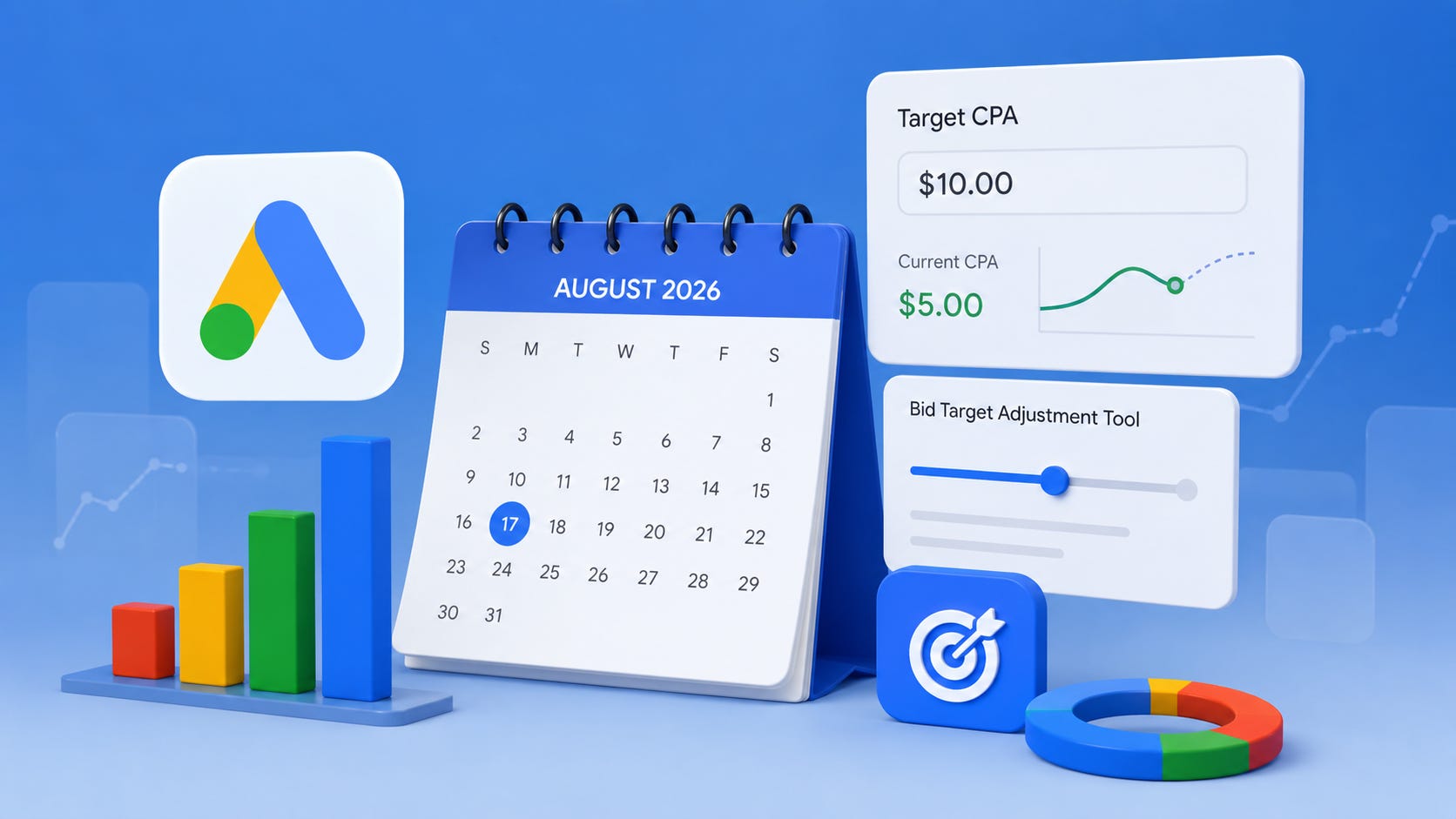
Google Ads is changing how target-based bid strategies behave when campaigns are limited by budget. The update takes effect August 17, and a new Bid Target Adjustment Tool is expected July 6.
The plain-English version: if your campaigns use target CPA or similar bidding, Google wants performance to align more closely with your stated target when budgets are constrained.
That can be helpful if your targets are realistic. It can also expose lazy setup. If the account is optimizing toward soft conversions, low-quality calls, or form fills that never turn into appointments, a cleaner bidding system may still chase the wrong outcome.
The Real Reason This Matters:
Local accounts often have small data sets, which makes bad conversion signals more damaging.
Budget-limited campaigns may behave differently after the update if targets are stale.
The right target CPA depends on lead quality, booking rate, close rate, and actual revenue, not just platform-reported conversions.
Key Takeaway: Smart bidding still needs a smart business signal.
Action Step: Before August 17, review target CPA settings, qualified-call rules, form conversion definitions, and offline conversion imports. If the account treats every lead as equal, fix that before changing budgets.
Spicy Take
🌶 More Leads Are Not Always the Highest-ROI Move
A fresh r/PPC thread from a dental practice co-owner is the kind of post local marketers should read twice: a six-step playbook for recovering unscheduled treatment.
The practice had spent about $25,000 on incremental Google and Meta ads in 2024. The ads produced new patients, but the practice still had $164,000 in accepted-but-unbooked treatment sitting in the PMS. After segmenting the list and using dentist-name follow-up, they reported $24,800 booked in the first 90 days.
That is the uncomfortable part. Sometimes the fastest path to revenue is not another campaign. It is fixing the follow-up, scheduling, recall, or reactivation gap that is already inside the business.
The spicy take: “Get more leads” is not a strategy if the business is leaking the demand it already paid to create.
Key Takeaway: Before increasing ad spend, check whether existing leads, patients, and accepted-but-unbooked work are being followed up properly.
SE Ranking’s fresh AI traffic study found that AI search engines sent 0.3343% of total U.S. website traffic in April 2026. Small number, useful baseline.
Search Engine Land reported that many B2B brands rank in Google but show up in only about 3% of AI-generated answers. The local lesson: rankings and citations are now separate checks.
Jon Loomer covered Meta’s AI disclosure checkbox and attribution updates. If you use AI-assisted creative, keep review workflows clean before scaling.
Search Engine Land noted that OpenAI says ad dismissals in ChatGPT have fallen as relevance improved. ChatGPT ads are not a local staple yet, but the direction is clear.
Search Engine Land covered a test of “Strongest match” labels on Search ads. If this expands, ad relevance and landing-page fit may become even more visible to searchers.
Search Engine Roundtable noted that Google added more details about broad search in Local Services Ads. Service businesses should review lead quality before celebrating more reach.
Search Engine Roundtable reported that Google Search Console AI Performance reporting is reaching more users. Check whether your properties have access.
This week’s issue has one clear thread: better local visibility starts with pages that make the business easier to understand.
If your service pages are vague, your city coverage is thin, your proof is scattered, or your ad account cannot tell a good lead from a bad one, more content will not clean that up for you. It will probably make the weak spots easier to ignore.
Book a “Help Me Get More Leads” Call with Justin: In 15 minutes, I’ll give you a practical, no-pressure assessment of what is helping or hurting your lead flow and what to fix next.
Thanks for reading Local Marketing Minute! This post is public so feel free to share it.
Comments
Nothing yet. Say the first thing.
Sign in to join the conversation.