
My brain has not been much better than fish food this week after my travels culminated in a trip to Las Vegas. It had been twelve years since the last go-round and that is most likely for the best. I have pretty successfully incinerated a chunk of brain cells over the past month; let’s hope it isn’t reflected in these ramblings. Can’t get much worse, says you! It took me until about Wednesday to be able to read an article and internalise the message therein. The net result has been that either nothing has happened in the world as far as I am concerned, or I have completely missed any new developments.
It goes against my natural instinct to be bullish. I don’t fully understand why, but it most likely stems from some insecurities motivating a deep desire to sound smart. Thanks, Dad. This fits with the old saying that “Bears sound smart, but bulls make money.” Not to feel like they’ve been left out, the tech nerds came up with their own version, “Pessimists sound smart, optimists make money.” Cheers for that, tech nerds. Morgan Housel, author of The Psychology of Money, has an entire chapter labelled “The Seduction of Pessimism” that details why we, as humans, are inherently seduced by bearish arguments even when economic history consistently favours optimism.
“I have observed that not the man who hopes when others despair, but the man who despairs when others hope, is admired by a large class of persons as a sage.” - John Stuart Mill, writing in 1828
There has been plenty of research done supporting the argument. In a 1983 study called “Brilliant but Cruel: Perceptions of Negative Evaluators” it was found that reviewers who wrote negative, critical evaluations were perceived as significantly more intelligent, competent, and expert than those who wrote positive evaluations. The resulting takeaway is that scepticism and criticism are perceived as signals of high critical thinking, whereas optimism and praise are often misinterpreted as evidence that you are a clown.
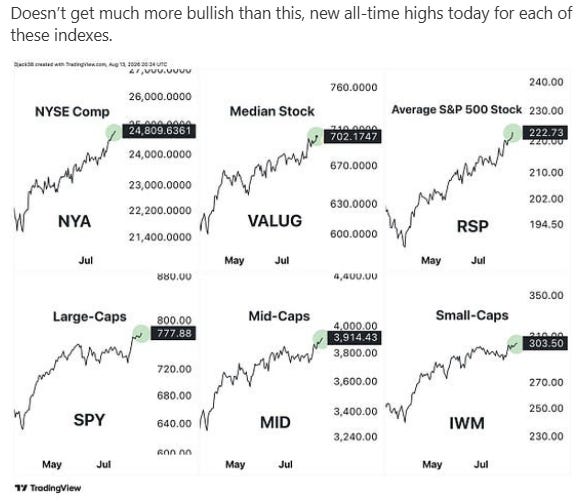
In the podcast I include below, one of the listener questions asks what investment advice sounds wise but is actually terrible for most people. And among the list of answers provided, one was that age old-adage: “to buy low and sell high.” The analogy Housel provided is that this is akin to planting seeds for an oak tree and then chopping it down after a year of growth. It completely undermines the potential for that tree to grow exponentially larger, and encourages a mindset that stymies potential market gains. I came across the first chart included above on Friday morning in the aftermath of listening to the aforementioned podcast, showing the smorgasbord of stock market indices breaking to new highs.
There is plenty of evidence supporting the point made in the chart. Contrary to human intuition, and the “buy low, sell high” mantra included above, a new high in the stock market has historically been a pretty good signal of continued strength. From 1970 to now, buying the S&P 500 at a new all-time high yields positive returns one year later 73% of the time. A separate study looking at a longer time period, from 1926-2024 found that over a 12-month horizon, average returns following an ATH were 10.4%. Another study looked at what would have happened if you sold stocks at new monthly all-time highs and switched into U.S. Treasury bills, (i.e. cash) instead of staying invested in stocks, only re-entering the stock market when it is below its peak found the following:
If you stayed Invested in Stocks: $100 grew to $103,294 from 1926-2024, in inflation adjusted dollars. Whereas if you switched to Cash at All-Time Highs: $100 grew to $9,922. The net result is that selling at ATHs destroyed 90% of potential lifetime wealth growth. Granted the research has been done by a fund advisor in whose interest it serves to ensure we stay invested, but you get the broader message.
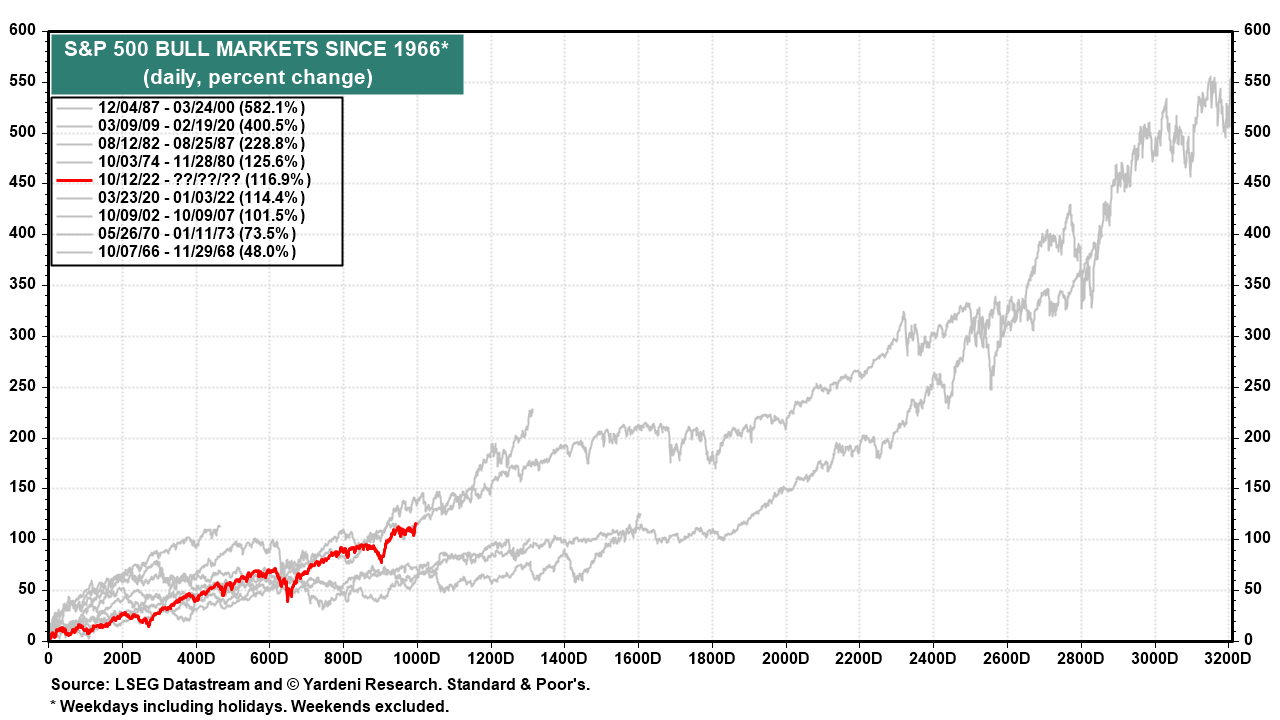
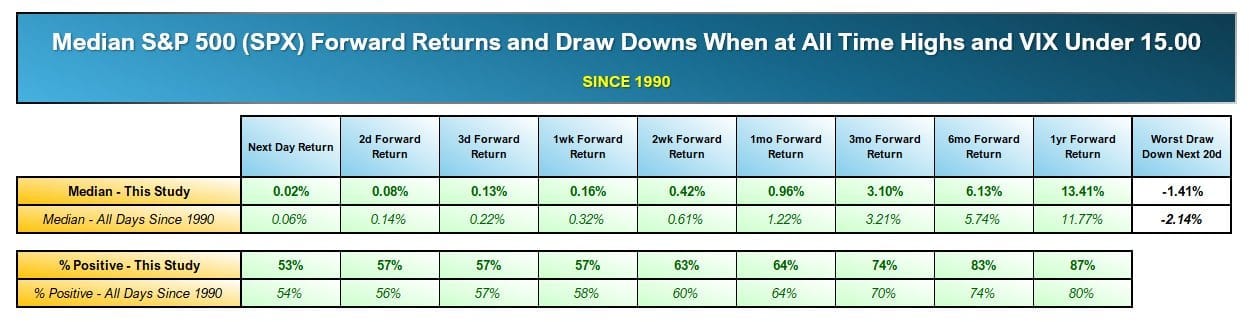
The charts I include here offer further supporting evidence for the bull market. Firstly, the average bull market in the postwar era typically lasts around 5 years and has a cumulative total return somewhere in the +150%-180%. If we take October 2022 as the starting point for this cycle, we are at 3.8 years and a cumulative total return of +127%. Still time and gains to be had if history is anything to go by. We have also recently seen a dramatic decline in volatility and fears as the war in the Middle East has faded from public interest. The decline in the VIX (the volatility index which acts as a proxy for market fears) to under 15.00 is typically a harbinger of positive forward returns.
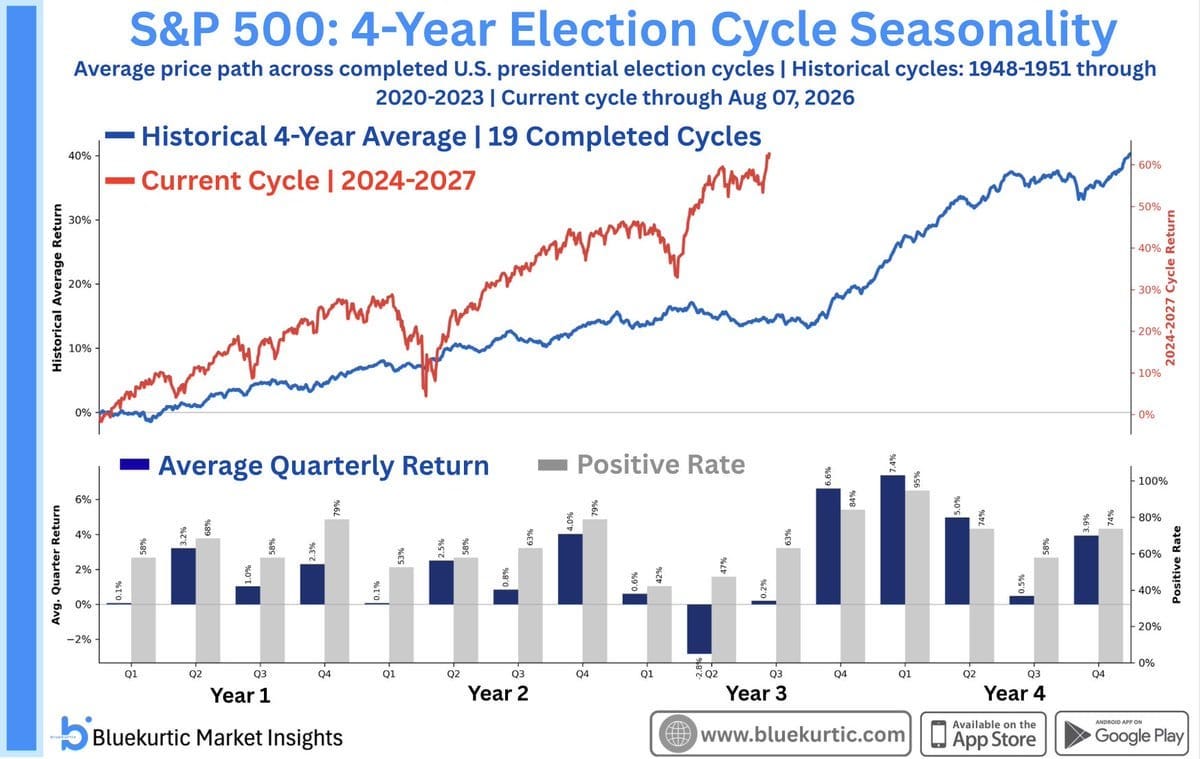
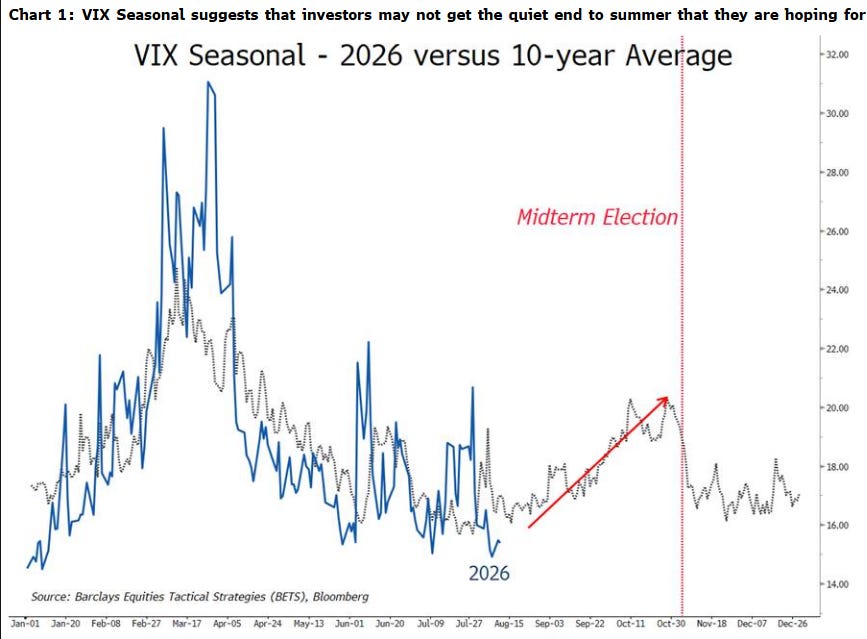
And now to try and sound smart. We are getting into what is typically one of the weakest parts of the year for stocks, which accompanies an uptick in volatility. That the midterm elections loom in November, and as things stand it is as good as a 50:50 bet in prediction markets that the Democrats can regain the senate, this uncertainty does not lend itself support to the equity rally gathering steam from here. What it does is set us up for an extra strong seasonal surge into year-end once the election dust settles with Q4 and Q1 in this part of the election cycle historically the most positive.
Keep the replies coming.
Donal
As mentioned above.
Comments
Nothing yet. Say the first thing.
Sign in to join the conversation.