

0:00
-1:33
Contracts are designed for the divorce, not the marriage.
Every anesthesia professional knows how this usually goes. You read the compensation, the call schedule, the PTO, the sign-on, maybe the tail language if you are lucky, and then you hit the restrictive-covenant section and tell yourself you will come back to it later. That is how people end up boxed out of their own hospital, their own town, or their own income stream. Tracy Young, MSNA, MBA, CRNA, co-founder and COO of Essential Anesthesia Management, recently captured the anesthesia version of the problem by describing non-competes as a moat around lucrative contracts. That framing is blunt, but in this market it is often closer to the truth than people want to admit.
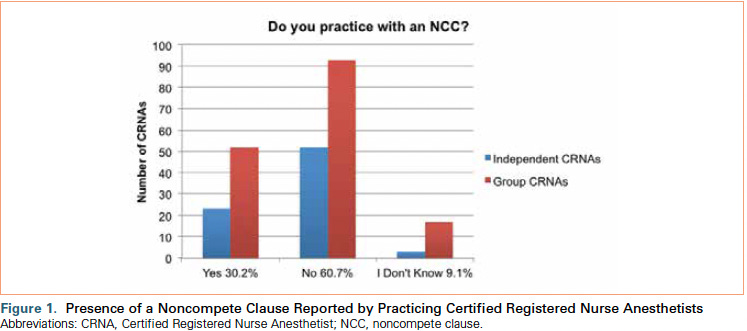
The reason this deserves real attention is that the knowledge gap is not theoretical. In the Meseroll et al. survey published in AANA Journal, the chart on page 5 showed that 30.2% of practicing CRNA respondents reported having a non-compete and 9.1% did not even know whether they had one. The same study found low overall knowledge, and independent CRNAs reported more experience declining jobs, changing jobs, and losing employment because of these clauses.
And anesthesia is uniquely vulnerable to this problem because our employment relationships are tied so tightly to site contracts. Groups merge. Hospitals rebid. Subsidy disputes happen. AMCs replace legacy groups. Hospitals try to hire the same clinicians under a new arrangement. Meseroll’s paper was already warning in 2015 that many CRNAs only learn what their contract really means during an acquisition, merger, or contract turnover. That is still exactly how these fights play out.
The paragraph most people skim is often the one with the greatest power over the next year of their life.
Restrictive covenants are old. The roots go back to English common law, including Dyer’s Case in 1414 and Mitchel v. Reynolds in 1711, which shaped the modern “rule of reasonableness.” That basic framework still drives most litigation now: the employer usually has to show consideration, a legitimate business interest, and reasonable limits on activity, time, and geography. An anesthesia-specific legal review from Anesthesia Business Consultants described the framework the same way years ago, and that remains the basic playbook today.
That history matters because the modern anesthesia non-compete usually is not about a CRNA opening a competing office down the street and stealing a referral base. In anesthesia, the real asset is often the staffed site itself: the hospital contract, the ASC relationship, the call structure, the coverage model, and the workforce attached to that site. So when a group puts a non-compete into a CRNA or physician anesthesiologist contract, it is often trying to protect control over that business relationship, not just protect some classic trade secret.
That is why these clauses tend to become a live issue during acquisitions, mergers, rebids, subsidy disputes, and contract turnover. The old doctrine came from a broad restraint-of-trade framework, but in anesthesia today it often gets used as a site-control tool. It can be used to try to stop a CRNA from staying at the same hospital after the old group loses the contract, to make it harder for a hospital to hire clinicians directly, or to give the outgoing group leverage when a replacement company wants to keep the same workforce in place.
That is also why anesthesia professionals should not read these clauses like generic boilerplate. In our world, they are often tied to who controls coverage, who keeps the revenue stream, and who gets to keep staffing the rooms when a contract changes hands. Once you understand that, the language in the contract makes a lot more sense, and the risk becomes much easier to spot before it turns into a lawsuit.
There is also substantial and often invisible cost behind an anesthesia contract that most frontline clinicians never see. Before a group ever staffs the first room, it may have already spent significant nonclinical time and money preparing to win and launch that contract. That can include recruiter fees, advertising, leadership hours spent planning and building the bid, unpaid administrative time, legal review and negotiation, compliance preparation, credentialing and onboarding, startup scheduling and call-design work, and the ongoing expense of managing the relationship once the contract is live.
From the company’s side, those are exactly the kinds of investments it will point to when arguing that it has a legitimate business interest worth protecting. And to be fair, that argument is not made up out of thin air. In anesthesia, the business interest often is not just abstract goodwill. It is the real cost of bidding on, starting, stabilizing, retaining, and managing the contract itself.
That still does not mean every non-compete should hold up. It only means the employer may have a stronger argument than if it were simply trying to block ordinary job movement for no real reason. The court still has to decide whether the restriction is reasonable in scope, geography, and duration, and in healthcare it still has to weigh hardship to the clinician and the effect on access to care.
Healthcare adds another layer that ordinary business disputes do not always have. Courts are often asked to balance the employer’s business interest against clinician hardship and the public’s interest in access to care. Arizona’s Supreme Court said exactly that in Valley Medical Specialists v. Farber, holding the covenant there unenforceable because public policy concerns outweighed the practice’s protectable interests.
A non-compete is the clause that tells you where you cannot work, or for whom you cannot work, after you leave. A non-solicit is different. It usually tries to stop you from recruiting the former employer’s employees, patients, or clients. A confidentiality provision is different again. It governs what information you cannot use or disclose after you leave. Meseroll et al. correctly treated all of them as part of the broader restrictive-covenant family. Arizona CRNA-oriented contract guidance explains the same distinction in practical terms.
Where this gets messy in anesthesia is the overlap. When the “client” is a hospital and the workforce is the only realistic way to keep rooms open, a non-solicit or no-hire clause can do the work of a non-compete without ever using the label. That is one reason the St. Joseph’s/NAPA litigation mattered so much. The hospital challenged a two-year non-solicitation clause in the services agreement that barred either side from inducing the other’s employees to leave; the court allowed antitrust claims to proceed, NAPA’s TRO request was denied, and the cases later settled. In other words, the fight was not just about clinician employment contracts. It was also about the service-agreement language sitting above them.
That is also why people get burned when they think, “The non-compete is probably void, so I’m fine.” Maybe. Maybe not. If you stay quietly, that is one thing. If you start coordinating a group move, connecting coworkers to the incoming employer, arranging interviews, or acting as the bridge for a mass departure, you may have moved the fight from a non-compete theory to a non-solicit or interference theory. And the answer is not the same in every state. California is strongly hostile to post-employment restraints and AMN Healthcare applied that policy to an employee nonsolicit, but New Mexico expressly preserves one-year nonsolicits as to patients and employees, and Oklahoma still lets a former employee work in the same business while prohibiting direct solicitation of established customers.
Confidentiality is the other trap people underestimate. Not every staffing detail or workflow is automatically a trade secret just because the employer says so. But both trade-secret law and contract law do protect genuinely secret business information when the owner took reasonable steps to keep it secret and the information has independent value. AMN Healthcare shows how quickly a departure fight can expand into allegations about confidential information and trade secrets, and the federal trade-secret definition is broad enough to include financial, technical, and business information when those requirements are met. That is why forwarding internal schedules, compensation grids, staffing models, internal emails, surgeon-volume data, or site-specific operational playbooks to the incoming group can create a very different kind of exposure than simply taking a new job.
And I would never assume the incoming group or facility will clean that up for you just because somebody casually said, “We’ll handle it.” In Beaumont, the rival employer allegedly agreed to cover legal fees, damages, and expenses, and the injunction still issued anyway. A promise to “cover the fallout” is not the same thing as making the problem disappear.
A non-solicit or no-hire clause can do the work of a non-compete without ever using the label.
A site-based non-compete usually says you cannot work at Hospital X, or at any facility serviced by the former group. A geographic non-compete says you cannot work within a defined radius of one or more covered sites. On paper, the site-based clause sounds narrower. In the real world, either one can be brutal.
If you live in a one-hospital town, a “single facility” restriction can function like a total local ban. If you live in a metro area and float between multiple sites, the geographic version can be worse, especially if the radius is measured from every location you touched. In Beaumont, the trial court found a three-year restriction tied to a 20-mile radius reasonable. That is not a minor inconvenience if your practice footprint is already concentrated around one health system.
And a site-based clause is not automatically safer just because it avoids a mileage number. In Louisiana, an anesthesiologist’s non-compete that barred practice at “any health care facility regularly serviced” by the employer was held unenforceable because the contract failed to specify the geography required by statute. So yes, a vague facility clause can fail. But that is not a strategy. That is a lawsuit.
Sometimes that argument works. Sometimes it absolutely does not.
This is the question anesthesia clinicians get wrong over and over. They assume that if the old group loses or terminates the hospital contract, the old “you can’t work here anymore” language should collapse with it. In some jurisdictions and fact patterns, courts do become skeptical once the employer no longer has the underlying site relationship. But Beaumont is the cautionary example of why no one should bet their mortgage on that assumption.
In Beaumont, Anesthesia Associates gave written notice in March 2025 that it would terminate its CHRISTUS contract effective August 1, 2025. That same day, four CRNAs began working at CHRISTUS facilities for a competitor. Anesthesia Associates filed suit on August 1, 2025, obtained a TRO that day, later obtained a second temporary injunction on September 12, 2025, and on April 16, 2026 the Texas Ninth Court of Appeals affirmed the temporary injunction. The court accepted the employer’s argument that it still had protectable goodwill and business interests even after the site contract ended. In plain English, the covenant outlived the hospital contract.
There is a counterexample, and it matters. In the Fort Sanders litigation in Tennessee, the anesthesia group sought a massive subsidy increase, gave notice it would stop providing services, and then sent cease-and-desist threats when the hospitals moved to keep clinicians at the sites. The Tennessee Court of Appeals affirmed the trial court’s refusal to enforce the covenants, with the opinion discussing the threshold requirement of a legitimate business interest and the public-interest consequences of losing anesthesia coverage. That is a real win for clinician mobility and patient access. It is also proof that these cases are intensely fact-specific.
That is the real takeaway. Public interest can matter. Contract loss can matter. Lack of a legitimate business interest can matter. But none of those things automatically save you. Sometimes the judge sees workforce protection as anti-competitive. Sometimes the judge sees it as protection of goodwill and operational investment. That uncertainty is exactly why these clauses are dangerous.
This is where legal doctrine and real life diverge.
In a state that truly voids the non-compete itself, the outgoing group usually has a much weaker argument that it can simply block you from staying at the same facility after a takeover. But weaker is not the same thing as powerless. The leverage often shifts to nonsolicits, confidentiality, trade-secret claims, no-hire language in the hospital-services agreement, repayment provisions, liquidated-damages clauses, and plain old litigation friction.
Sometimes the most important restrictive covenant is not even in your employment contract. It is in the agreement between the hospital and the group. That was one of the core issues in St. Joseph’s v. NAPA, where the challenged non-solicitation clause sat in the services agreement itself and was alleged to foreclose competitive alternatives for keeping anesthesia providers at the hospital.
Even void clauses can still create enough friction that legislatures have started targeting the conduct itself. California is the clearest example. Section 16600 voids employment non-competes broadly, and Section 16600.1 makes it unlawful to include a non-compete clause that does not fit a statutory exception. Legislatures do not write statutes like that unless employers have been trying to use unenforceable language as leverage anyway.
This is not a 50-state survey, and anyone pretending it is can only do it by oversimplifying. But there are a few states anesthesia professionals should know cold.
California remains the cleanest broad anti-non-compete example. Section 16600 says contracts restraining lawful work are void to that extent and must be read broadly in the employment setting, and Section 16600.1 makes it unlawful to include a non-compete clause that does not satisfy a statutory exception. California courts have also applied that policy to employee nonsolicitation provisions, as in AMN Healthcare.
Rhode Island deserves special attention because it now has protection that matters directly to CRNAs. Katz Banks’ March 2026 nationwide update notes Rhode Island’s general wage-threshold restriction on non-competes, but the more important point for anesthesia is Rhode Island’s APRN-specific statute. Rhode Island defines APRNs to include CRNAs, and its 2024 APRN law says contract restrictions on an APRN’s right to practice are void as to that restriction. The statute specifically voids geographic practice restrictions and limits on providing care to, or soliciting a professional relationship with, current patients, while leaving the rest of the contract intact.
New Mexico is one of the most anesthesia-specific statutes in the country because it expressly includes CRNAs in the definition of “health care practitioner.” It makes provider non-competes unenforceable upon termination and voids out-of-state law and forum provisions for New Mexico clinical services. But it also shows exactly how employers preserve leverage when the formal non-compete dies: the statute expressly preserves repayment obligations, confidentiality and trade-secret provisions, one-year nonsolicits as to patients and employees, and reasonable liquidated-damages clauses.
Maryland took a threshold approach. Licensed direct-patient-care healthcare workers at $350,000 or less cannot be bound by these provisions; above that threshold, the cap is one year and 10 miles from the primary place of employment, for agreements executed on or after July 1, 2025. That matches the 2026 Maryland practitioner summaries circulating online, but the statute is the source that matters.
Texas now limits non-competes for nursing, dentistry, and physician assistants in agreements entered into or renewed on or after September 1, 2025. For nursing, the covenant must have a buyout no greater than annual salary and wages, last no more than one year, stay within five miles of the primary practice location, and be clearly stated in writing. Older covenants still live under prior law, which is precisely why Beaumont still matters.
Arizona is not a ban state. It is a reasonableness-and-public-interest state. Farber is still the landmark Arizona case on strict scrutiny of healthcare restrictive covenants, and Arizona CRNA-focused contract guidance still emphasizes the same practical factors: geography, duration, legitimate business interest, and the public’s need for access to care.
North Dakota is still broadly hostile to non-competes. Oklahoma shows why clinicians have to read carefully even in states that are hostile to full non-competes: the former employee may work in the same or similar business, but direct solicitation of established customers can still be barred. “Ban state” and “no post-employment risk” are not the same sentence.
And the larger trend is still a patchwork. Katz Banks’ March 2026 update notes that the successful 2025 legislative changes were concentrated heavily in healthcare-worker restrictions rather than sweeping across every industry. That is exactly why anesthesia professionals cannot rely on general workplace chatter or old social-media advice. The answer is still state-specific and profession-specific.
This is the part too many clinicians miss. You do not need to lose the final case to lose a huge amount of money.
Non-compete litigation usually starts with emergency relief, not final trial. The outgoing employer files for a TRO or temporary injunction and tries to take you off the schedule while the merits fight is still in front of the court. In Beaumont, that is exactly what happened. Anesthesia Associates filed on August 1, 2025 and got a TRO the same day. The trial court entered a first temporary injunction on August 20, effective September 4. The appellate court reversed that first injunction as void on September 4 because the order failed to set the full case for trial on the merits. Then the employer came back, obtained a second temporary injunction on September 12 with a June 8, 2026 merits setting, and the appellate court affirmed on April 16, 2026. Even the clinicians’ procedural win did not end the fight.
That is roughly eight and a half months of active injunction litigation before you even get to the merits setting that was placed on the calendar in the second injunction order. And during that time, the whole point of the employer’s motion is to stop you from working where you were trying to stay.
The hard-dollar exposure can get ugly fast. In Beaumont, the federal order states that before and after suit the rival employer offered $30,000 for each CRNA, but Anesthesia Associates refused and allegedly demanded $400,000 per CRNA to drop its injunctive demand. Using BLS’s May 2023 Texas CRNA annual wage estimate of $216,280 as a conservative benchmark, eight and a half months out of the local market is roughly $153,000 in gross income disruption per CRNA before you even start talking about commuting, relocation, or your own attorney’s fees. And that is before considering the contract-defined $30,000 liquidated-damages exposure.
At the institutional level, the St. Joseph’s complaint against NAPA alleged the outgoing group initially demanded more than one and a half times the annual salary of each anesthesia provider to waive the non-competes, a number the hospital said exceeded $20 million, before later describing a “discount” to $12 million. Those are complaint allegations, not final findings, but they illustrate the leverage these provisions can create during anesthesia contract turnover.
The fee numbers themselves are often not cleanly available in public dockets. But the structure of these cases tells the story anyway: TROs, temporary-injunction hearings, emergency appeals, multiple filings, and sometimes parallel state and federal litigation can all hit long before there is any final decision. The cost is not just legal fees. It is lost work, lost negotiating leverage, and months of uncertainty while somebody else argues over whether you can stay in the room.
You do not need to lose the final case to lose a huge amount of money.
A lot of clinicians still talk as if the FTC ban solved this. It did not.
The FTC issued a final non-compete rule in 2024, but it never became an operative nationwide protection. The FTC now says the rule is not in effect and not enforceable. The Federal Register explains why: one court set the rule aside, the FTC later voted to dismiss its appeals and accede to vacatur, and the Commission then removed the Non-Compete Rule from 16 CFR part 910 in February 2026. State law remains the battlefield.
There are legitimate employer interests in some cases. Real trade secrets exist. Real confidential strategy exists. Real business goodwill exists.
But in anesthesia, these clauses are often doing something much more practical and much less noble: controlling labor during contract turnover. They are frequently less about protecting a secret sauce and more about deciding who gets to keep staffing the site when money, subsidies, or market share change hands. Meseroll’s work showed the profession has long underappreciated the risk, and the modern cases show the risk has only become more operationally important.
Read the restrictive-covenant section before you negotiate almost anything else.
Ask exactly what triggers it. Is it resignation only, or termination without cause too? Does it survive if the group loses the contract? Is it tied to one named facility, every facility you touched, or a radius around all of them? Is there a real buyout, or just liquidated damages plus the employer’s separate right to seek an injunction? What nonsolicit, confidentiality, no-hire, repayment, venue, and attorney-fee language survives even if the non-compete itself is weak? And what does your state say for CRNAs, APRNs, nurses, or direct-patient-care clinicians specifically, not just for physicians in general?
And if a site is about to turn over, keep your mouth disciplined. Deciding to stay is one thing. Recruiting coworkers, sharing internal documents, or functioning as the relay point between the outgoing staff and the incoming group is where an employment move can mutate into a solicitation, confidentiality, or trade-secret fight.
The worst time to learn your non-compete law is after you are off the schedule, sitting at home, and paying someone by the hour to explain the paragraph you skimmed.
This is general education, not legal advice. If you are signing one of these agreements or a hospital contract is turning over, get a healthcare employment attorney in your state before you give notice or start coordinating anything.
Comments
Nothing yet. Say the first thing.
Sign in to join the conversation.