
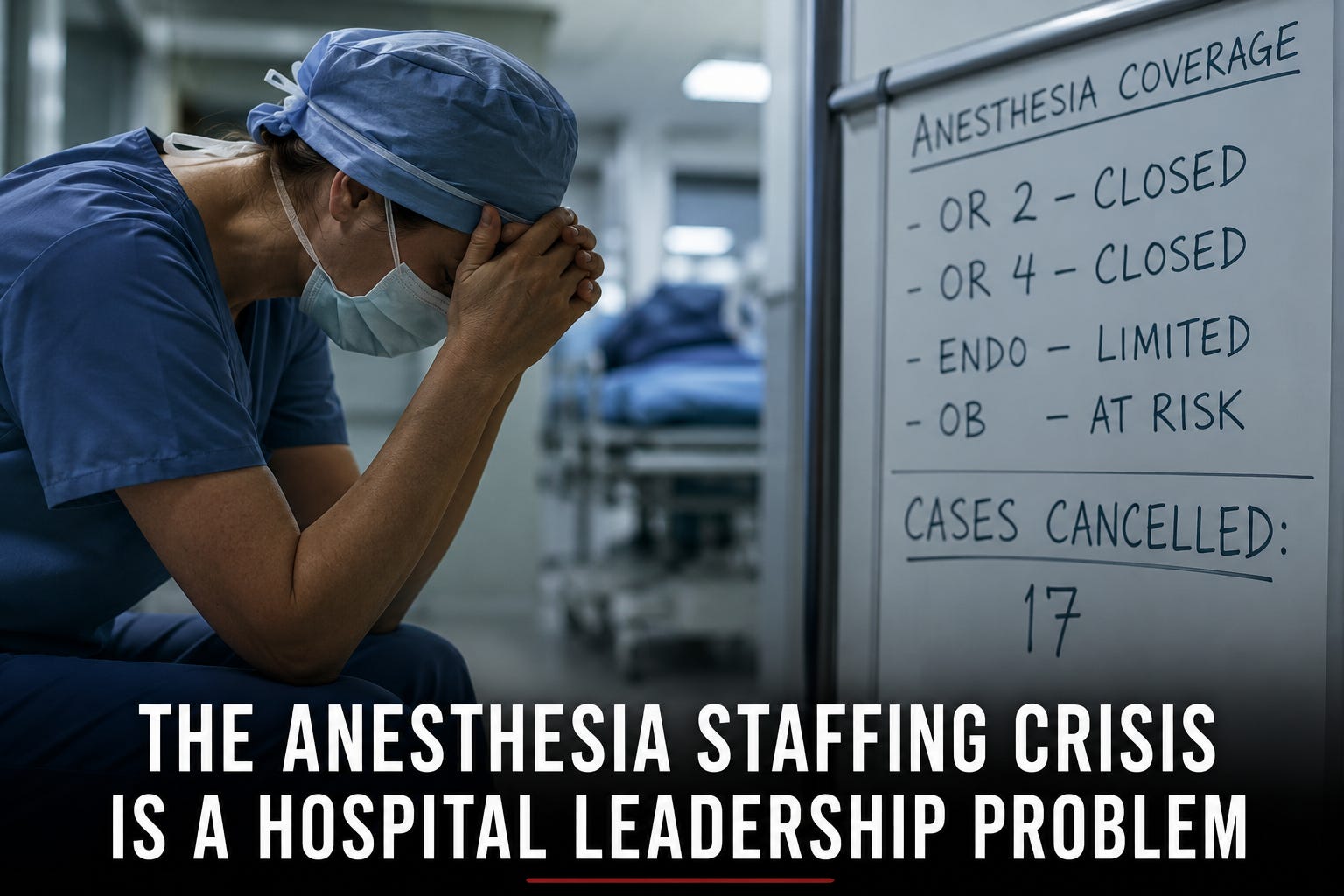
For hospitals and surgery centers, anesthesia staffing is no longer a departmental headache. It is a leadership issue.
Anesthesia is the access point for the surgical and procedural enterprise. When anesthesia coverage is stable, operating rooms run, endoscopy schedules move, obstetric services remain available, surgeons stay engaged, and patients receive care closer to home. When anesthesia coverage weakens, the effects are immediate and expensive: closed rooms, late starts, canceled cases, frustrated surgeons, delayed care, exposed obstetric services, and margin loss that affects other service lines.
Operating rooms are also among the most expensive assets in a hospital to leave idle. One JAMA Surgery analysis estimated operating room time at approximately $36 to $37 per minute in California hospitals.[1] That number will vary by facility and market, but the principle is the same everywhere. An unused room is not neutral. It is lost access, lost revenue, lost surgeon confidence, and lost community capacity.
The OR is the economic engine of most facilities, but it needs gas (anesthesia services) to run efficiently.
The anesthesia shortage is real. But it is not the whole explanation.
A 2024 Anesthesiology review described a post-COVID anesthesia workforce supply-demand imbalance that disrupts procedural schedules, raises costs, and worsens burnout.[2] HRSA projects a shortage of 10,660 anesthesiology physicians by 2038, with non-metro communities expected to experience a much larger physician shortage than metro areas.[3] The CRNA workforce is under pressure as well. AANA has reported increased demand for CRNAs as hospitals and health systems work to keep ORs running, especially in rural and underserved settings, and notes that approximately 12% of CRNAs report plans to retire by 2027.[4] BLS also projects strong growth for APRN roles that include CRNAs, reflecting continued demand for this workforce.[5]
Still, workforce supply alone does not explain why some facilities are more stable than others.
The old arithmetic no longer works. Hospitals cannot simply post a job, add a sign-on bonus, and expect the market to solve the problem. New clinicians, including both CRNAs and physicians, are choosing practice settings based on workload, call burden, predictability, culture, compensation, professional respect, and whether they can actually use their training.
A sign-on bonus may buy attention. It cannot repair culture.
A sign-on may get clinicians in the door, but a practice environment built around 50-hour expectations, excessive call, unnecessary restrictions, and a culture that treats anesthesia professionals as interchangeable labor rather than highly trained clinical assets will send people back out of it. What clinicians used to consider “full time” 10 years ago is closer to 1.33 FTE in todays market.
The most expensive phrase in anesthesia staffing may be, “That’s how we’ve always done it here.” It turns leadership decisions into inherited habits.
In anesthesia, this happens frequently. Supervision terminology, medical staff bylaws, payer billing rules, state scope-of-practice law, federal facility rules, liability concerns, and clinical privileges are often treated as if they are one thing.
They are not.
CMS “opt-out” is a good example. Opt-out does not define CRNA scope of practice. It does not determine what CRNAs are educated, licensed, credentialed, or privileged to do. Opt-out or not does not require one specific anesthesia staffing model.
Instead, opt-out addresses whether a Medicare-participating facility must meet a federal CRNA supervision condition as part of participation. The federal hospital Conditions of Participation state that, unless exempted through the state opt-out process, a CRNA must be supervised by the operating practitioner or by an immediately available Physician Anesthesiologist.[6,7] That language matters, but it is often misunderstood. In a non-opt-out state, the federal requirement does not, by itself, require Physician Anesthesiologist involvement, Physician Anesthesiologist medical direction, or Physician Anesthesiologist presence for every CRNA case. When the operating practitioner satisfies the supervision requirement, that does not transform the case into a medically directed anesthesia case or create case-level clinical control or liability for the CRNA’s anesthetic. It remains a facility participation requirement that is often mistaken for scope of practice, billing policy, medical direction, or local privileging authority.
Many anesthesia staffing problems begin when leaders confuse facility participation rules with clinical scope, billing rules, privileges, liability, and local culture.
When that confusion exists, the result is predictable. Facilities restrict qualified clinicians, increase coverage costs, reduce flexibility, and build expensive staffing models around perception rather than operational reality. Then they wonder why recruitment and retention are difficult.
A sustainable anesthesia model uses every clinician to the full extent of education, licensure, credentialing, privileging, and demonstrated competence.
That does not mean every case should be assigned the same way. It means case assignment should be rational.
Patient acuity matters. Procedure complexity matters. Clinician training, experience, confidence, and demonstrated competence matter. Site resources matter. Escalation pathways matter.
Initials alone should not be the staffing model.
Physician Anesthesiologists bring valuable expertise in many settings. CRNAs also provide full-scope anesthesia care and are essential to coverage, especially in rural, community, and ambulatory environments. A mature anesthesia strategy recognizes both realities.
Collaboration does not have to mean supervision.
It can mean clear standards, mutual respect, consultation pathways, escalation triggers, and the right clinician with the right patient in the right location.
That is not political language. It is operational language.
Comparative evidence does not prove that one anesthesia staffing model is best for every patient, every case, or every facility.
A Cochrane review found variable results across available studies and concluded that the evidence was not strong enough to determine whether meaningful differences in care existed between anesthesia provider groups.[8] That does not mean staffing model does not matter. It means the question is more nuanced than many policy debates suggest.
The leadership question is simpler and more practical:
Which model can reliably deliver safe, compliant, timely, and financially sustainable procedural access for this community?
That answer may differ by hospital, service line, geography, payer mix, call burden, obstetric volume, surgical acuity, and available workforce.
A tertiary hospital with complex cardiac, transplant, neurosurgical, and high-acuity trauma services may need a different anesthesia structure than a rural critical access hospital, an endoscopy center, or a community facility trying to preserve obstetrics and emergency surgical access.
The problem is not variation.
The problem is pretending one inherited staffing model is the only acceptable model, even when it does not match the facility’s workforce reality, service line needs, or financial constraints.
For rural and community hospitals, this issue is not theoretical.
A Journal of Rural Health study found that 81.2% of rural counties had no Physician Anesthesiologist, 55.1% had no surgeon, and 58.1% had no CRNA.[9]
In those markets, anesthesia policy is not just an internal staffing issue. It may determine whether obstetrics, endoscopy, emergency surgery, pain procedures, and basic procedural care remain local.
When anesthesia coverage becomes unstable, the community does not simply lose an operating room. It may lose local maternity care. It may lose timely colonoscopy access. It may lose emergency surgical capability. It may lose the ability to keep routine care from becoming delayed, transferred, or fragmented.
That is why anesthesia staffing belongs on the leadership agenda.
Not just the anesthesia department agenda.
Not just the recruiter’s agenda.
Not just the medical staff committee agenda.
The leadership agenda.
Hospitals often put enormous effort into recruitment while underinvesting in retention.
That is backwards.
A national CRNA workforce survey found that greater autonomy in anesthesia delivery and higher compensation were associated with greater job satisfaction, while increased work hours reduced the probability of being very satisfied.[10] Broader APRN research has also linked autonomy, meaningful work, administrative support, salary, and better practice environments with job satisfaction and retention.[11,12]
In plain terms, people stay where the practice environment is functional.
They stay where workload is realistic. They stay where call burden is shared fairly. They stay where scheduling is predictable. They stay where their professional judgment is respected. They stay where leadership understands that unnecessary restrictions are not harmless. They affect morale, recruitment, retention, and cost.
A sign-on bonus can rent attention. It cannot compensate long-term for a poor culture, excessive call, lack of respect, or exclusion from decisions about the work itself.
That last point matters. Too often, anesthesia workforce strategy is built outside the anesthesia workforce. Administrators, consultants, medical staff leaders, and finance teams may debate models without directly asking the clinicians they hope to recruit and retain what would make them join, stay, and build stability.
That is a leadership failure.
Hospital and surgery center leaders should start by asking better questions.
Where is procedural demand highest by location, acuity, day, and time?
Do you need more anesthesia providers or better block utilization?
Which rooms are being closed because of anesthesia coverage?
What is the first-case start performance?
How often are cases canceled or delayed because of staffing?
What is the subsidy per covered site?
What is the true cost of call coverage?
How long does it take to recruit one CRNA or Physician Anesthesiologist?
What is the turnover rate after you recruit them?
What restrictions are legally required, and which are simply cultural preferences?
Are we staffing around “this is the way we have always done it here,” or around actual demand, utilization, acuity, and available workforce?
Those questions move the conversation from ideology to operations.
They also help leaders separate what is required from what is preferred, what is evidence-based from what is habitual, and what protects patients from what simply protects tradition.
Hospitals and surgery centers cannot bonus their way out of a poor practice environment.
Cash ≠ Culture
They need anesthesia models that protect access, respect professional capability, distribute workload realistically, and align policy with evidence. They need to stop treating anesthesia staffing as a narrow departmental problem and start treating it as a core access, finance, quality, and community service issue.
The facilities that succeed will not be the ones that simply pay the highest temporary rate. They will be the ones that build practice environments where clinicians want to work, where patients can access care, where surgical and procedural platforms remain reliable, and where staffing models are designed around reality rather than inherited assumptions.
That is why anesthesia staffing is not only an anesthesia problem.
It is a hospital leadership problem.
1. Childers CP, Maggard-Gibbons M. Understanding Costs of Care in the Operating Room. JAMA Surgery. 2018;153(4):e176233. link
2. Abouleish AE, Pomerantz P, Peterson MD, et al. Closing the Chasm: Understanding and Addressing the Anesthesia Workforce Supply and Demand Imbalance. Anesthesiology. 2024. doi:10.1097/ALN.0000000000005052. link
3. Health Resources and Services Administration. Health Workforce Projections. National Center for Health Workforce Analysis. link
4. American Association of Nurse Anesthesiology. 2025 Job Market Outlook for CRNAs. link
5. U.S. Bureau of Labor Statistics. APRN Occupational Outlook Handbook. link
6. Electronic Code of Federal Regulations. 42 CFR 482.52: Condition of participation: Anesthesia services. link
7. Centers for Medicare & Medicaid Services. State Operations Manual, Appendix A: Survey Protocol, Regulations and Interpretive Guidelines for Hospitals. link
8. Lewis SR, Nicholson A, Smith AF, Alderson P. Physician anaesthetists versus non-physician providers of anaesthesia for surgical patients. Cochrane Database of Systematic Reviews. 2014;CD010357. link
9. Cohen C, Baird M, Koirola N, et al. The Surgical and Anesthesia Workforce and Provision of Surgical Services in Rural Communities. The Journal of Rural Health. 2021. link
10. Negrusa S, Hogan P, Jordan L, et al. Work patterns, socio-demographic characteristics and job satisfaction of the CRNA workforce: Findings from the 2019 AANA survey of CRNAs. Nursing Outlook. 2021;69(3):370-382. link
11. Han RM, Carter P, Champion JD. Relationships among factors affecting advanced practice registered nurses’ job satisfaction and intent to leave: A systematic review. Journal of the American Association of Nurse Practitioners. 2018;30(2):101-113. link
12. Poghosyan L, Kueakomoldej S, Liu J, Martsolf G. Advanced practice nurse work environments and job satisfaction and intent to leave. Journal of Advanced Nursing. 2022;78(8):2460-2471. link
Comments
Nothing yet. Say the first thing.
Sign in to join the conversation.