
0:00
-1:34
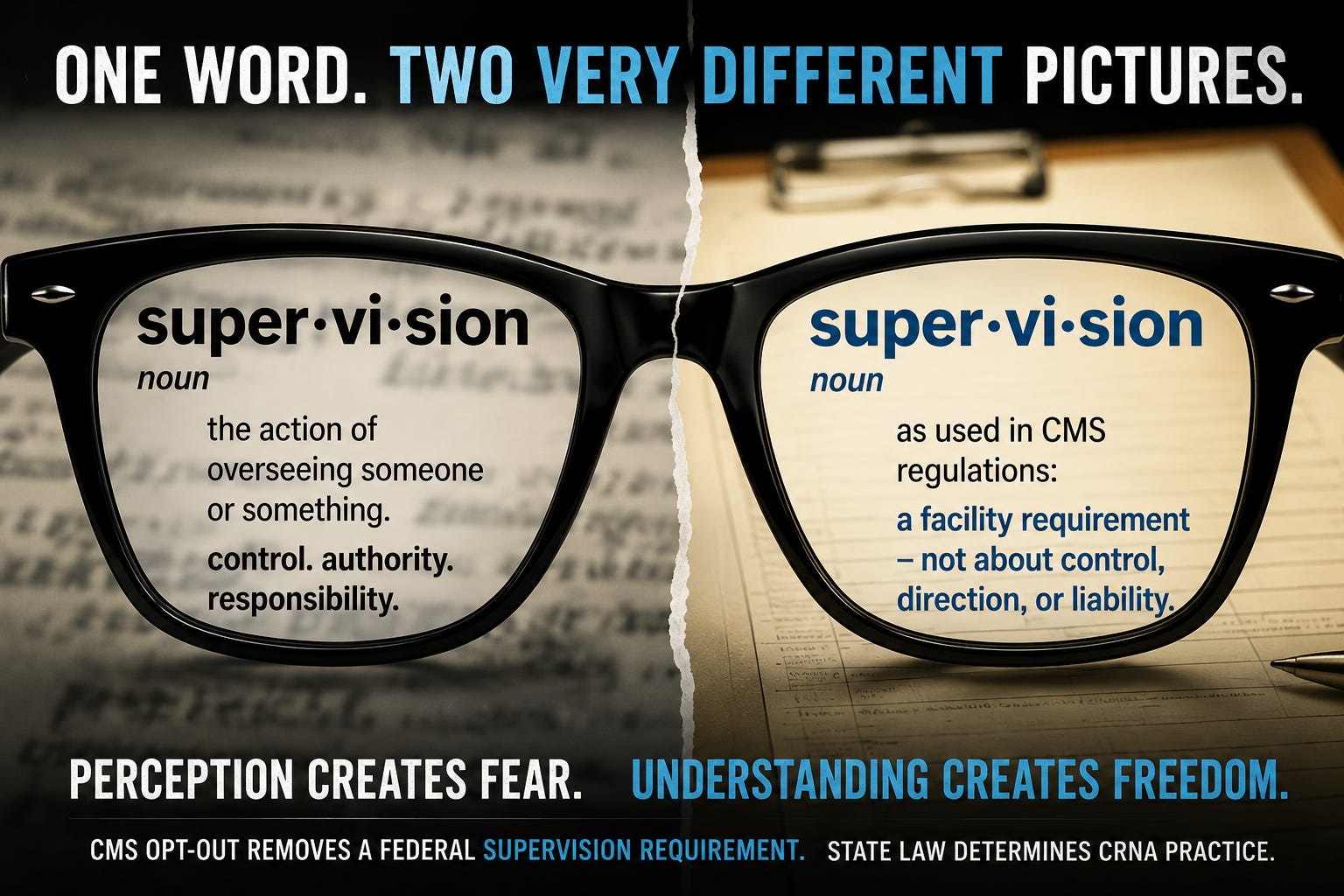
Most people learned what “supervision” meant at their first job. Maybe it was a fast-food restaurant, a grocery store, or some other hourly position. The supervisor told you what to do, controlled how you did it, and was responsible for what happened during the shift.
That is the ordinary meaning people bring to the CMS opt-out discussion. They hear that a CRNA must be “supervised” and assume someone else must control the anesthetic, direct the CRNA’s decisions, and accept responsibility for the CRNA’s actions.
That is not what the CMS regulation says.
CMS is the Centers for Medicare & Medicaid Services. Hospitals that participate in Medicare must comply with federal Conditions of Participation. One of those conditions says that, unless a state has opted out, a CRNA administering anesthesia must be under the supervision of either the operating practitioner or a physician anesthesiologist who is immediately available if needed.
A state opts out when the governor sends CMS a letter requesting exemption from that specific federal supervision requirement. The governor must consult with the state boards of medicine and nursing and attest that opt-out is in the best interests of the state’s citizens and is consistent with state law.[1]
Opt-out does not create independent CRNA practice. It does not expand state scope of practice, issue privileges, change professional billing, or require a hospital to adopt a particular anesthesia model.
Those issues continue to be governed by state law, licensure, credentialing, delineation of privileges, medical staff bylaws, and the policies of each individual facility. The governor cannot use opt-out to override state law. The state’s legal framework must already be compatible with removing the federal supervision requirement.
Before opt-out, CRNA practice is determined by those state and local requirements. After opt-out, CRNA practice is still determined by those same requirements. The clinical authority does not come from the opt-out letter.
As of July 2026, 26 states have formally exercised the CMS opt-out, either statewide or for specified facilities. Guam has also opted out. Vermont became the 26th state in July 2026, meaning more than half of the states have now chosen to remove this federal supervision requirement.
The word “supervision” is where the problem begins.
The CMS regulation does not say the operating practitioner controls the CRNA’s anesthetic. It does not say the operating practitioner chooses the anesthetic technique, approves the anesthetic plan, directs medications, dictates clinical decisions, or can overrule the CRNA’s judgment.
It also does not say that the operating practitioner becomes liable for the CRNA’s actions simply because CMS uses the word “supervision.”
State law, employment relationships, contracts, privileges, hospital policies, and the actual conduct of the people involved can create duties and affect liability. The CMS supervision requirement does not create those relationships.
When CMS directly addressed surgeons’ concerns about liability during its anesthesia rulemaking, it stated that changing the federal supervision requirement made no legal change in the scope of malpractice liability. CMS explained that liability remained dependent on state law and the facts and circumstances of the individual case.[4]
In other words, the presence of the word “supervision” does not automatically create liability. It is not a malpractice rule.
The same applies to control. The CMS requirement does not make the operating practitioner the CRNA’s boss. It does not create an employer-employee relationship, an agency relationship, or authority over the CRNA’s clinical judgment.
CMS guidance tells hospitals to establish their own policies for supervision by the operating practitioner and to base those policies on generally accepted standards of anesthesia care. CMS does not provide a federal checklist of actions the operating practitioner must perform. It does not require the operating practitioner to evaluate the patient for anesthesia, formulate the anesthetic plan, select medications, monitor the anesthetic, sign the CRNA’s record, or participate in the CRNA’s clinical decisions.[2]
Depending on state law and hospital policy, the operating practitioner’s role may be as limited as ordering or requesting anesthesia services and performing the procedure while the CRNA provides the entire anesthesia service. CMS has long recognized that a CRNA can furnish the entire anesthesia service without medical direction while still being considered under the supervision of the operating surgeon.[4]
That distinction is important. Supervision under the facility rule is not the same thing as medical direction of the anesthetic.
CMS’s current coding guidance recognizes that CRNAs may provide anesthesia independently or under the supervision of an operating practitioner or physician anesthesiologist. It also separately recognizes non-medically directed CRNA services. A CRNA can therefore provide the entire professional anesthesia service without medical direction even when the facility is located in a non-opt-out state.[3]
The professional anesthesia bill does not become medically directed simply because the facility satisfies the CMS supervision requirement through the operating practitioner. Opt-out status and professional billing status are separate issues.
None of that is obvious to the average hospital administrator, surgeon, board member, or risk manager.
They see the word “supervision” and interpret it the way most people would. They assume supervision means control. They assume control means responsibility. They assume responsibility means liability.
That interpretation is understandable, but it is not found in the CMS regulation.
This is also where the supervision language becomes politically useful for those who oppose CRNA practice. The word can be presented as proof that federal law requires physician control, physician oversight of the anesthetic, or physician responsibility for the CRNA. The regulation does not establish any of those things, but most people will never read far enough into the rule to understand the distinction.
They simply hear “supervision.”
That perception influences hospital decisions. A facility may be legally able to use a non-medically directed CRNA model under state law but remain hesitant because administrators believe the federal supervision language creates a relationship or liability that does not actually exist.
Opt-out removes that source of confusion.
It does not force a hospital to use a CRNA-only model. It does not prohibit medical direction, remove physician anesthesiologists, or prevent collaboration. A hospital may continue using exactly the same anesthesia model it used before the state opted out.
What opt-out does is remove one federal barrier to local control. It allows each facility to select the anesthesia model that fits its patients, workforce, finances, surgical services, and community without a vague federal supervision requirement distorting the discussion.
In many facilities, nothing about the actual delivery of anesthesia changes when a state opts out. The CRNAs have the same licenses, the same credentials, the same privileges, and the same responsibilities the day after opt-out that they had the day before.
What changes is the federal word. “Supervision”
That word never created independent practice, clinical control, medical direction, or automatic liability. It created the perception that those relationships might exist.
Removing it takes away one more argument that hospitals do not have the authority to make their own decisions. It allows state law, hospital credentialing, delineation of privileges, and local policy to determine the anesthesia model without the baggage attached to the word “supervision.”
That is what CMS opt-out is really about.
Electronic Code of Federal Regulations. 42 CFR § 482.52, Condition of Participation: Anesthesia Services.
https://www.ecfr.gov/current/title-42/chapter-IV/subchapter-G/part-482/subpart-D/section-482.52Centers for Medicare & Medicaid Services. State Operations Manual, Appendix A, Survey Protocol, Regulations and Interpretive Guidelines for Hospitals. See § 482.52, Anesthesia Services.
https://www.cms.gov/regulations-and-guidance/guidance/manuals/downloads/som107ap_a_hospitals.pdfCenters for Medicare & Medicaid Services. Medicare NCCI 2026 Coding Policy Manual, Chapter 2, Anesthesia Services.
https://www.cms.gov/files/document/02-chapter2-ncci-medicare-policy-manual-2026-final.pdfHealth Care Financing Administration. Medicare and Medicaid Programs; Hospital Conditions of Participation: Anesthesia Services. Federal Register, January 18, 2001.
https://www.govinfo.gov/content/pkg/FR-2001-01-18/html/01-1388.htmCenters for Medicare & Medicaid Services. Medicare and Medicaid Programs; Hospital Conditions of Participation: Anesthesia Services. Federal Register, November 13, 2001.
https://www.govinfo.gov/content/pkg/FR-2001-11-13/html/01-28439.htm
Comments
Nothing yet. Say the first thing.
Sign in to join the conversation.