
Dean Rovang - Staying Curious · justdean.substack.com · ORCID 0009-0006-1351-5320
In the spring of 2025, the Secretary of Energy assembled a team to re-examine climate science on behalf of the United States government.
He did not assemble a cross-section of the field. The 2025 Climate Working Group consisted of five people — John Christy, Judith Curry, Steven Koonin, Roy Spencer, and the economist Ross McKitrick — every one of them known for decades of skepticism toward the mainstream assessment of climate risk. And none of this began in 2025. In January 2014, the American Physical Society convened a workshop to reconsider its own climate statement — three mainstream physicists on one side, three skeptics on the other, in what participants themselves likened to a red-team, blue-team exercise. The physicist who chaired it was Steven Koonin; two of the three skeptics he seated were John Christy and Judith Curry. The APS listened and kept a statement affirming that climate change is real, human-caused, and serious.
Koonin drew the opposite lesson. He published a Wall Street Journal essay declaring the science “not settled,” and spent the next decade arguing that what the field needed was a formal red team to challenge the consensus. By 2017 the idea had institutional momentum: the EPA floated a red-team exercise of its own, and the Heartland Institute compiled a list of candidates — four of the five eventual Working Group members among them. The coordinator of the 2025 panel, from the Cato Institute, put the goal in his own words: to reorient the climate debate by “confronting the gatekeepers head-on.” The Working Group is that red team, finally convened with a federal mandate — and three of the five people in the room had been in the 2014 one.1
Here is what the group was given: a federal letterhead, a mandate to critically review the science, and the highest possible stakes. Their report was cited extensively by the EPA in its 2025 proposal to roll back the 2009 endangerment finding — the legal foundation for regulating greenhouse gases in the United States. The EPA finalized that repeal in February 2026. Whatever else one says about the exercise, it was consequential.2
None of what follows depends on questioning their motives or their credentials; it turns only on what they wrote. So it is worth asking, with some care: given a free hand and every incentive, what did five of the most capable critics of climate science choose to contest?
They contested climate models — their spread, their tuning, their warm biases. They contested extreme-event attribution. They contested sea-level projections. They contested the plausibility of the most extreme emissions scenario, RCP8.5. They contested the economics of damages.
Notice what that list has in common. Every item on it is a projection or an attribution — the parts of climate science that involve modeling the future or disentangling causes of individual events. These are the genuinely hardest parts of the field — the places where real uncertainty lives. That is what makes them the honest frontier of the science; it is also what makes them the easiest place to manufacture the appearance of a debate — reached not by resolving the open questions, but by mishandling them. If you were building a case that the science is unsettled, this is precisely where you would go, because it is the only place you can go.
Now notice what is not on the list.
Nowhere in the report’s 141 pages did the working group contest the deep-time relationship between carbon dioxide and global temperature, reconstructed across the past 66 million years. Nowhere did they dispute that these two quantities have moved together across that entire span — through hothouse and icehouse, through the slow cooling of the Cenozoic, through the eight glacial cycles of the past 800,000 years. Nowhere did they offer an alternative account of why every independent archive we can read — deep-sea sediments, Antarctic ice, geochemical proxies assembled by different teams with different methods on different continents — recovers the same relationship, with the same slope, again and again.
They didn’t contest it because there is nothing to contest. There is no contrarian version of this graph. In eight years of following the public argument over climate science, I have never seen one, and the one time the U.S. government empaneled its most determined critics to produce the strongest available case, they didn’t attempt one either.
That silence is the most informative thing in the report.
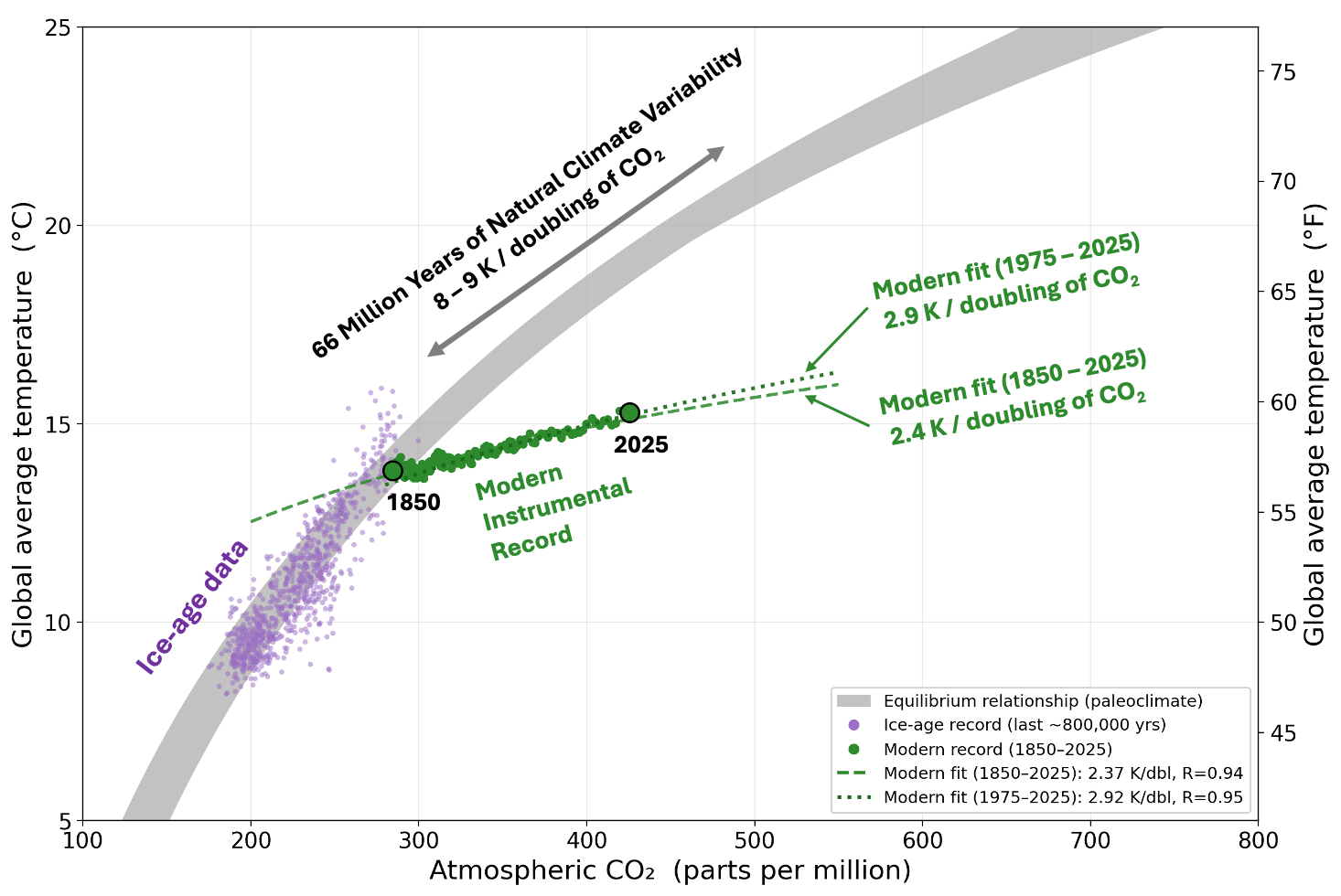
Figure 1. Earth’s equilibrium relationship between CO₂ and temperature over the past 66 million years (gray band), with the last 800,000 years of ice-age data (purple) and the instrumental record since 1850 (green). The dashed and dotted lines are straight fits through the modern record alone — about 2.4 °C per doubling of CO₂ across the industrial era, 2.9 over the last fifty years. Built only from published data; no models.
The figure above is the ground they wouldn’t fight on. The gray band is Earth’s equilibrium relationship between CO₂ and temperature, reconstructed from 66 million years of geological evidence. The purple cloud is the last 800,000 years of ice-age data — hundreds of thousands of years of the planet moving up and down that band as ice sheets grew and collapsed. The green points are the instrumental record since 1850: the departure. Every element of it is built from published primary sources, and I will happily send anyone the data files and the scripts that draw it. It contains no models of the future. It contains no attribution claims about any storm or fire. It is, deliberately, made only of the material the working group left alone.
And here is the thing: that material is sufficient. You do not need a climate model to see that CO₂ and temperature have been coupled for longer than primates have existed. You do not need to attribute a single hurricane to see that the modern excursion has no counterpart in the record. You do not need RCP8.5 — or any scenario at all — to see that we have left the band and that the physics which held for 66 million years has not been repealed on our account.
You do not even need a model to read the sensitivity — the number the whole fight is supposedly about. Fit a straight line through the modern record, no simulation, just the measurements, and its slope is already about 2.4 degrees for every doubling of CO₂ across the industrial era, and 2.9 over the last fifty years. That is only the fast, observed part of the response, the slow feedbacks still to come — and it is steepening.3 The report argued at length about what the climate models get wrong about sensitivity. This number owes nothing to a model, and it is already high enough to matter.
The working group’s strategy, whether by design or instinct, was to relocate the argument to the frontier — to the contested edges where the field’s honest uncertainty lives — and to present the existence of that frontier as evidence that the foundation is unsettled. It is an old move. Every science has a frontier; that is what makes it a science. But a frontier is not the foundation. The foundation here is not even in dispute among the people who study it: that carbon dioxide and temperature are coupled, that the deep-time record shows the full, slow response of the whole Earth system, and that the shallow modern slope is simply the fast part of that same response, with the slow feedbacks still to come. Scientists can explain why the modern and paleoclimate slopes differ — it is not a contradiction but a matter of timescale. That is the bedrock.
Confronted with it, given a federal mandate and every motive to find a crack, five hand-picked critics produced no rival account. They didn’t try.
I’ll note, for completeness, how the exercise ended. The scientific community’s response was swift — eighty-five scientistsdocumented cases where the report mischaracterized the very studies it cited, in at least one case (by the author’s own account) getting a paper’s conclusion backwards. Secretary Wright disbanded the group in September 2025. In January 2026, a federal court found that it had been convened in violation of the Federal Advisory Committee Act, the 1972 law requiring federal advisory committees to be balanced and open to the public. And by the time the EPA finalized the repeal, it had set the report aside altogether — resting the final rule on a legal argument rather than the group’s science. The report had become too damaged to use: the administration that commissioned it could no longer lean on it. The rollback is now headed into years of litigation, where the record will be examined with exactly the scrutiny the report could not survive the first time.4
But I don’t want to rest on the procedural failures, because they invite the wrong conclusion — that a better-lawyered version of the same panel might have succeeded. The deeper point is that it could not have. The strategy of manufactured controversy has a boundary, and the boundary is drawn by the evidence itself: you can stage a debate only where genuine uncertainty gives you material to work with. That is why the deep-time relationship went unmentioned, and that is why I keep drawing this one picture.
The people with the strongest motive on Earth to unsettle the foundation just spent a federal mandate demonstrating — by their silence — that they know exactly where the solid ground is. It isn’t any single record. It’s that independent lines of evidence — deep time, the ice ages, the modern instrumental record — all converge on one relationship between carbon dioxide and temperature, and that climate scientists understand the whole of it, from the slow response of the deep past to the fast departure of the present. That is the ground they wouldn’t fight on. They walked around it; I’d suggest we stand on it.
The figure in this essay is fully reproducible from published primary sources — Judd et al. 2024, the EPICA Dome C ice cores, Berkeley Earth, and the CMIP6 historical concentrations. The complete data manifest and build scripts are available to any reader on request.
Appendix: How the equilibrium band was derived
The gray band in Figure 1 is not drawn by hand. It is computed from independent regressions of global temperature against CO₂, each fit to a different paleoclimate archive by a different research group:
● Judd et al. 2024 (PhanDA), Cenozoic — 8.24 K per CO₂ doubling (R = 0.97)
● EPICA Dome C ice core — 8.77 K per doubling
● Clark et al. 2024 — 9.05 K per doubling
● Snyder 2016 — 9.91 K per doubling
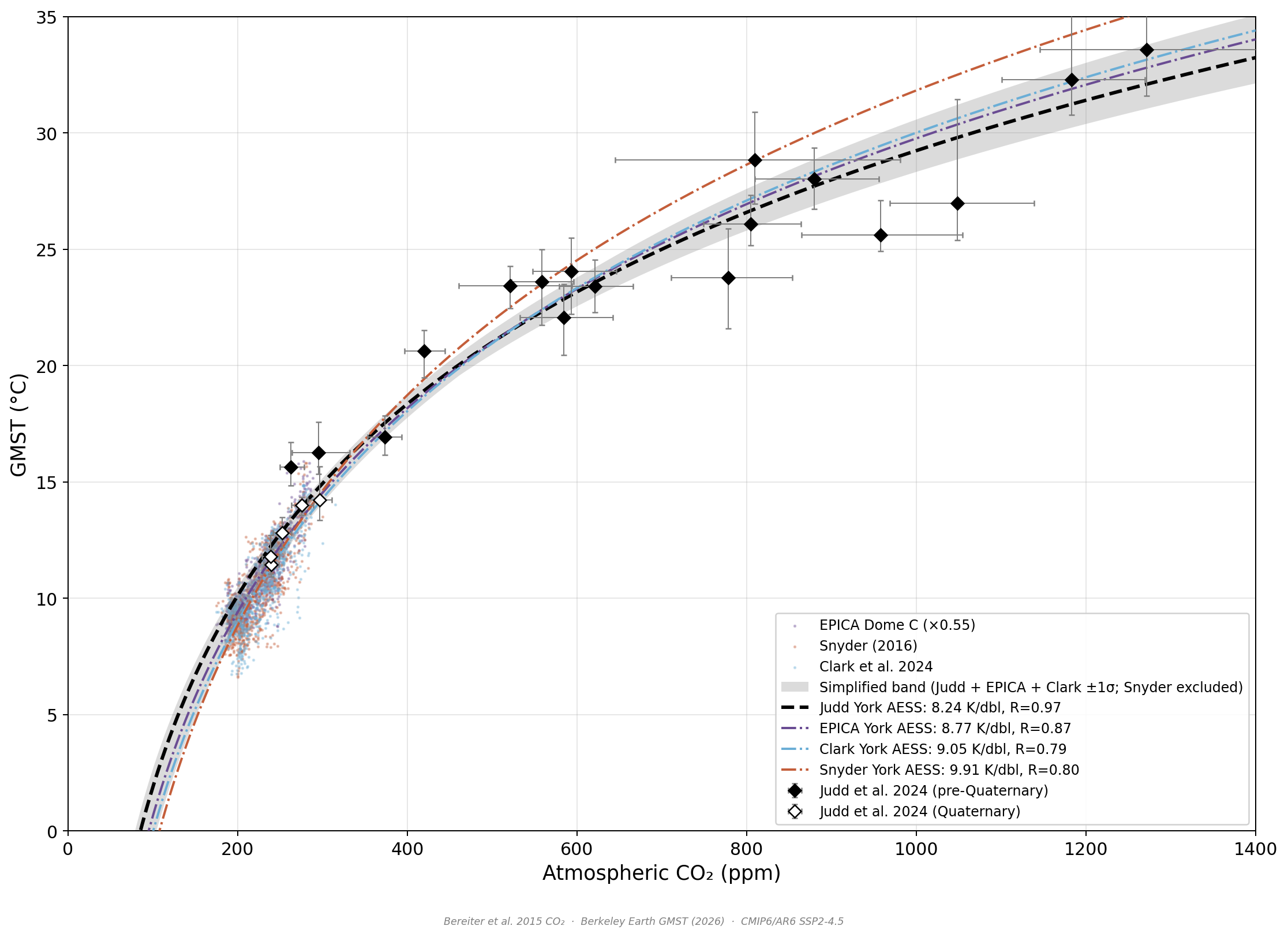
Figure A1. The four York regressions and all Cenozoic Judd data — the last 66 million years — over the full range (CO₂ 0–1400 ppm, temperature 0–35 °C), with the equilibrium band overlaid. The band is the shaded envelope of the three agreeing fits (Judd, EPICA, Clark) taken to ±1σ in slope; Snyder is shown but excluded.
Three of the four — Judd, EPICA, and Clark — agree closely, spanning 8.2 to 9.1 K per doubling. The band is their envelope: each of the three central fits is taken to plus-or-minus one standard deviation in slope, and the three uncertainty ranges are combined into a single shaded region. This is deliberately the uncertainty-widened envelope, not the raw envelope of the central lines — the central lines happen to cross near 600 ppm, and a raw envelope would pinch to nothing there, understating the uncertainty exactly where it should not.
The fourth fit, Snyder 2016, is shown in the figure but excluded from the band, by a stated rule: it is a high-side outlier. Its steeper slope traces to a larger reconstructed glacial–interglacial temperature amplitude and to a single-variable regression that loads slow feedbacks onto the apparent CO₂ sensitivity. It runs above the band from roughly 400 ppm onward. The exclusion criterion is distance from the consilient cluster in either direction, not disagreement in a particular direction — a cold-running outlier would be treated the same way.
Two caveats the figure makes visible. First, the three ice-core fits (EPICA, Clark, Snyder) are calibrated on ice-age CO₂, which never leaves roughly 180–300 ppm; everything to the right of about 300 ppm is extrapolation for them. Judd is the exception — its Cenozoic data extend to about 1,300 ppm, so it interpolates across the whole range and anchors the high-CO₂ edge of the band. Second, the band is an equilibrium relationship — where temperature settles once the slow feedbacks finish — not a trajectory. The modern record departs from it not because the relationship failed, but because those feedbacks take centuries to millennia to complete.
Notes
1. On the 2014 review: American Physical Society, “Climate Change Statement Review Workshop” (transcript), January 8, 2014 — the three skeptic-side participants were Richard Lindzen, John Christy, and Judith Curry, with Steven Koonin chairing. Koonin’s commentaries followed: “Climate Science Is Not Settled,” Wall Street Journal, September 19, 2014, and “A ‘Red Team’ Exercise Would Strengthen Climate Science,” Wall Street Journal, April 20, 2017. In 2017 the Heartland Institute sent the EPA a red-team candidate list on which four of the five eventual Working Group members — Christy, Curry, Koonin, and Spencer — appeared. The coordinator’s account of the plan is from Travis Fisher, “Why I Helped Organize the Department of Energy’s Climate Report,” Cato Institute, August 2025.
2. Report: U.S. Department of Energy, “A Critical Review of Impacts of Greenhouse Gas Emissions on the U.S. Climate,” July 2025 (141 pp.), by John Christy, Judith Curry, Steven Koonin, Ross McKitrick, and Roy Spencer. The EPA cited it extensively in its August 2025 proposal to rescind the 2009 endangerment finding, then finalized the repeal on February 12, 2026 — but the final rule stated it was “not relying on” the report “in light of concerns raised by some commenters,” resting the repeal on a legal argument instead.
3. These are raw slopes of global temperature against CO₂ alone — effective observed rates, not a clean CO₂ sensitivity. Other greenhouse gases (methane, nitrous oxide, halocarbons) add forcing that steepens them, while industrial aerosols masked part of the past century’s warming — a mask now easing as air pollution falls, which steepens the recent slope in particular. The point is not the precise value but that the directly observed rate is already substantial and still rising.
4. The 85-expert rebuttal linked above is the Climate Experts’ Review of the DOE Climate Working Group Report, A. E. Dessler and R. E. Kopp, eds. (2025), DOI 10.22541/essoar.175745244.41950365/v2; Zeke Hausfather’s account of how his work was misused is at The Climate Brink, 3 August 2025 (linked above). On the ruling: the U.S. District Court for the District of Massachusetts (Judge William Young), in a suit brought by the Environmental Defense Fund and the Union of Concerned Scientists, held the group’s Federal Advisory Committee Act violations “established as a matter of law” (reported late January 2026); Secretary Wright had disbanded the group in September 2025.
Comments
Nothing yet. Say the first thing.
Sign in to join the conversation.