
Dean Rovang - Staying Curious · justdean.substack.com · ORCID 0009-0006-1351-5320
I spent my career as a research engineer, not a climate scientist. So when Emily Judd and her colleagues published a new reconstruction of Earth’s deep climate history in 2024, I did what engineers do with a striking dataset: I started plotting it. They had already found the thing that matters — that across 66 million years, global temperature and atmospheric carbon dioxide have moved together in a remarkably steady relationship. What I did was keep adding layers to their picture, one at a time, to see whether it held.
The first addition was a test. If that ancient relationship is real, a completely separate record ought to fall on it. So I took the temperature and carbon dioxide of the last 800,000 years, read from Antarctic ice cores — a different archive, different methods — and dropped it onto the same axes. It landed right on Judd’s relationship, and a line fit through it had the same slope. I checked it against every other reconstruction of that period I could find, and they told the same story. Two independent windows into the deep past, in agreement.
Then I added the part those ancient records leave out: us. The carbon dioxide and temperature of the last century and a half, measured directly rather than reconstructed from proxies. The only question was where those modern points would fall. If today were ordinary for the Earth, they would land on the relationship with everything else. They do not. For the first time in the entire record, the line breaks away.
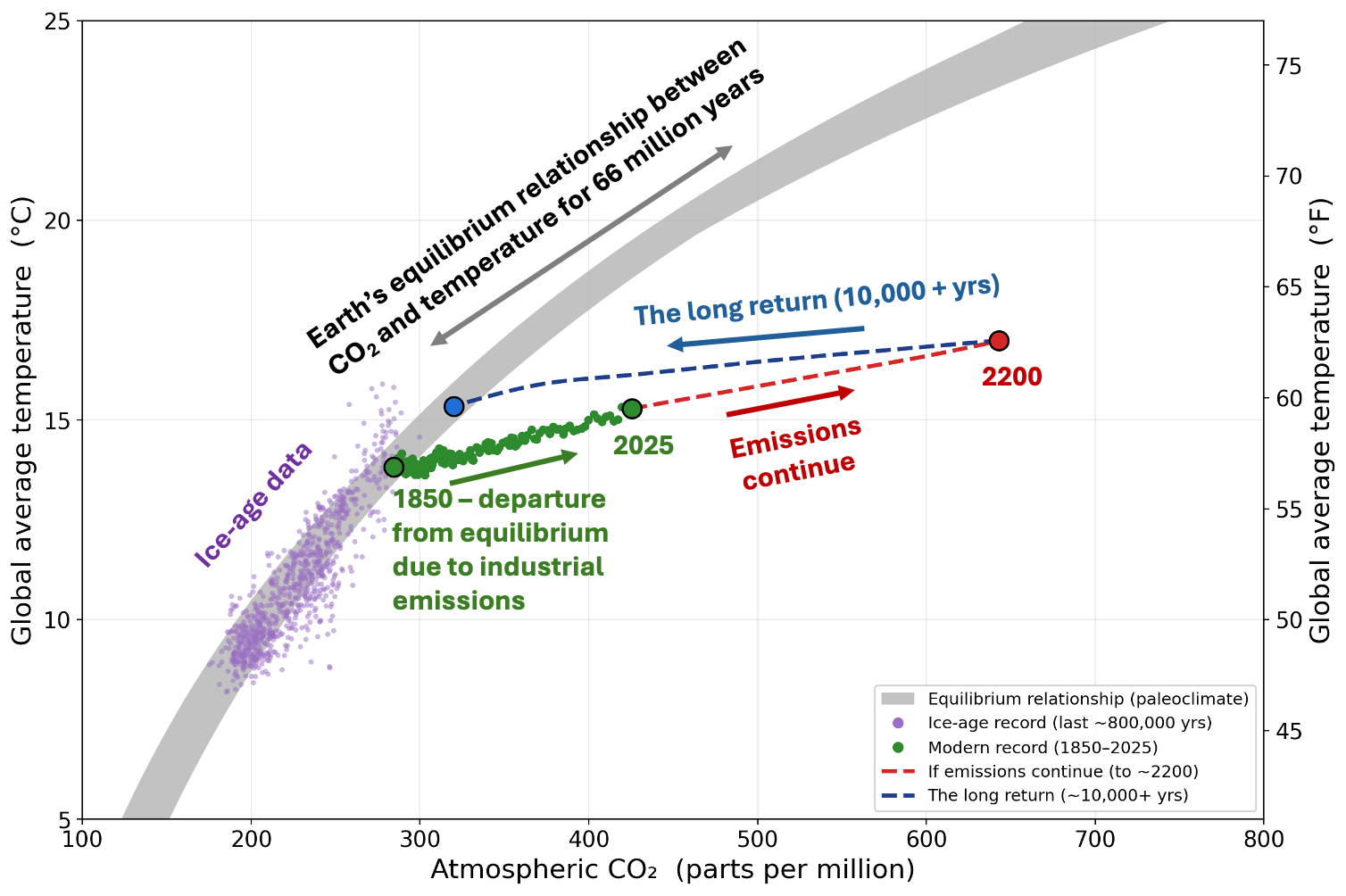
Plotting temperature against CO₂ rather than against time reveals a relationship Earth held for 66 million years — and our departure from it.
Sources: Judd et al. 2024; EPICA Dome C ice cores (incl. Bereiter et al. 2015) and Clark et al. 2024; Berkeley Earth (modern temperature); modern CO₂ from CMIP6 historical concentrations (Meinshausen et al. 2017) spliced to NOAA GML; SSP2-4.5 from Meinshausen et al. 2020.
I will admit my first reading of that gap was wrong. I thought it measured committed warming — degrees already in the pipeline. The distance from the band is not a forecast of temperature; it is the signature of a system shoved out of a balance it kept for 66 million years. Closing that gap — letting temperature climb the rest of the way to the band — would take holding carbon dioxide steady for many thousands of years while the slow parts of the climate caught up.
The scientists I first showed this to were politely unmoved — and they were right to be, because I was offering them the wrong claim. The value here was never a new measurement. It is a way of seeing — one that reorganizes the problem for someone who has only ever heard “the climate has always changed,” even if it adds little for someone steeped in the models.
We are literally conducting a planetary experiment, adding carbon dioxide at an unprecedented rate and measuring the response to that forcing. We will continue to move up and to the right until we stop adding carbon dioxide to the atmosphere. Whether we choose to limit the burning of fossil fuels or burn it all will determine the distance we travel from nature’s equilibrium.
Yes, the climate has always changed — and the proof is right there in the band, the long sweep of past climates, some far hotter than today. The picture concedes the point completely. But the same picture shows that we have left the band, and the thing that has no precedent is not the temperature or the carbon dioxide level — both have been higher. It is the speed. Coming out of the last ice age, carbon dioxide rose about 75 parts per million, and that took roughly 7,000 years. We have driven it up by about 100 parts per million in about the last sixty. That is on the order of 150 times faster than that natural rise. Even the closest analog — the Paleocene-Eocene Thermal Maximum (PETM), a warming 56 million years ago driven by a massive release of carbon — unfolded over thousands of years; Jessica Tierney and her colleagues, writing in the Proceedings of the National Academy of Sciences in 2022, say plainly it was not as abrupt as what we are doing now. So the record that shows the climate has always changed is the very record that shows today is different.
And the picture shows one last thing almost no one mentions: how long this lasts. After the PETM, the planet took many thousands of years to draw the carbon back down and cool. On the diagram, that recovery is a long arc bending back toward the relationship — a return I call the Anthropocene Loop, sketched from Clark and colleagues on how slowly the carbon clears and temperatures fall. But “closing the loop” needs care. The loop rejoins the band — the equilibrium relationship Earth has lived on through the whole Cenozoic — in about ten thousand years. Returning to preindustrial levels takes another fifty to a hundred thousand years or more, as silicate rock weathers the carbon away. The loop is a return to equilibrium, not a return to the past. It is notional in its details, but that lesson is not. We are not nudging the thermostat for a season or a generation. We are setting it for longer than all of recorded history.
Seen this way, three things that are usually argued become hard to avoid: that the change is real, that it is serious, and that it is ours. That we have left a relationship the planet held for 66 million years is in the picture. That the return to it runs for thousands of years is in the picture. That the break begins around 1850, at the dawn of the industrial era, is in the picture.
Another thing the picture does is quieter but just as valuable: it makes the vocabulary of climate science visible. A term like climate sensitivity — how much temperature rises for each doubling of carbon dioxide — can seem abstract with time on the horizontal axis. On this chart you can see it. The equilibrium band is the Earth’s temperature response to carbon dioxide over thousands and tens of thousands of years; our departure from it is the fast part of that response, temperature lagging while carbon dioxide races ahead. Definitions you can see, rather than memorize.
How far we travel from that ancient balance is still being decided — now, by us. For the first time in 66 million years, it is a choice. That is not a reason for alarm. It is a reason to see clearly what we are choosing.
Comments
Nothing yet. Say the first thing.
Sign in to join the conversation.