
The three leading robotaxi players in China are Baidu’s Apollo Go, Pony.ai, and WeRide. They are reportedly operating full-scale commercial, fully driverless fleets in several cities.
Their ambitions are global, with plans to expand into the Middle East, Europe, and Southeast Asia.
The Western automotive industry has come to assume (and fear) that China—already dominant in EVs—is on schedule to lead the global autonomous vehicles market.
But is it?
Assessing the state of Chinese AV development, pundits’ opinions vary.
Some industry observers speculate that Chinese carmakers are far ahead of the West in deployment of robotaxis. But some skeptics note that China still trails the West.
At a panel session entitled “China!” of the Automated Transportation Symposium last week in San Diego, Bryant Walker Smith, associate professor at the University of South Carolina, and Jon Qian, co-founder and President of Valgo, shared their insights with the audience. Walker Smith and Qian recently recorded many miles as robotaxi passengers in Chinese cities.
First, how well are Chinese robotaxis driving?
Like their U.S. counterparts, Chinese robotaxis are known for the occasional weird maneuver. But their performance has improved to a point comparable to robotaxis wheeling around American cities.
However, in passing judgment, China’s AV technology is probably only half the story.
The answer to whether China’s robotaxi market is advancing or not depends on the different regulatory approaches of China’s local governments, compared to what’s happening in the United States.
Deployments of robotaxis in each Chinese city are “capped by local regulations,” according to the presenters of the China! panel. This marks a stark contrast to the regulatory power that a U.S. city can exert over robotaxis.
For example, Waymo must report to the Texas government its number of robotaxis deployed statewide. But, legally speaking, it is under no obligation to divulge such information to a particular city. Waymo has not revealed the size of its fleet to the city of Austin, for instance, even though such information is essential to calculate the costs and services associated with hosting a robotaxis operation.
“Regulations stifle innovation” is the mantra of AV industry lobbyists in the United States. Chinese authorities, however, apparently see a different balance of regulation and innovation.
Chinese local government “adopts an approach to allow (to some extent encouraging) experimentation, but the impact of these experiments is closely monitored and often quickly acted on,” Valgo’s Qian said.
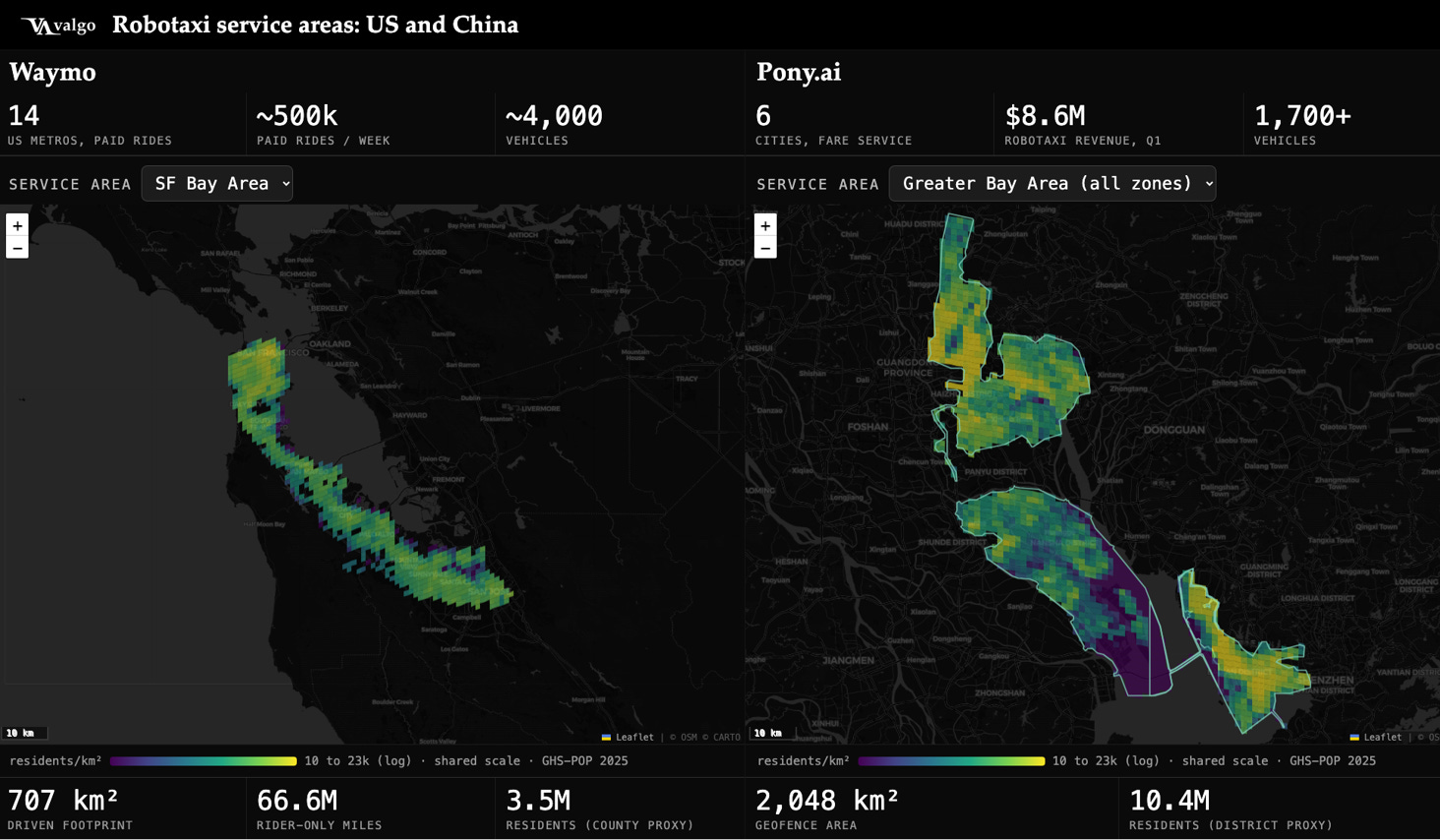
Qian showed a slide (see above) comparing Waymo’s robotaxi deployment in the San Francisco Bay Area to Pony.ai robotaxis serving “The great Bay Area China.” He was referring to the mega-metropolis in the Pearl River Delta, including Shenzhen, Guangzhou, and Foshan (Hong Kong).
Qian’s slide reveals that the number of robotaxis allowed to operate in this vast region is tiny compared to AVs deployed in any equivalent city in the United States.
In the San Francisco Bay Area, 707 square kilometers is known to be Waymo’s driven footprint. The area has 3.5 million residents. Waymo, armed with the total nation-wide fleet of 4,000 vehicles, was operating an estimated 1,600 vehicles in San Francisco during the blackout in December 2026.
In contrast, Poni.ai, serving 2,048 square kilometers of geofenced area in China’s great Bay Area (Pearl River Delta), with 10.4 million residents, runs about 1,700 robotaxis.
Qian concludes that the robotaxi in China is “not yet embedded in daily life ‘to the same extent’ they are in the SF Bay Area.”
Important to note on China’s regulatory approach is that when an incident happens, authorities quickly patch regulations and take decisive action.
The case in point is “a system failure” caused by Baidu Apollo Go in Wuhan late March.
An abrupt outage of more than 100 Baidu robotaxis occurred in the central megacity of Wuhan. Passengers were reportedly able to exit the vehicles safely, but some were stuck inside because they were afraid to get out. Although no injuries were reported, the incident certainly raised safety concerns among local authorities.
Shortly after the outage incident in Wuhan, China moved quickly, suspending the issue of new licenses for AVs. Under such a “halt order,” self-driving companies cannot add robotaxis to their fleets, launch new pilot projects or expand into additional cities, Bloomberg reported at that time. ()
The robotaxi “freeze” lasted about three months, but was lifted by late July, according to reports. China has begun issuing robotaxi permits again.
This resumption is being phased in, following completion of an industry-wide review. Details of what entails the regulators’ “full safety review,” however, remains unknown.
In addition to forceful actions to enforce regulations, China is also moving quickly to develop national AV standards, ahead of the United States and Europe.
China just this week approved a mandatory national standard on safety requirements for automated driving systems in intelligent connected vehicles, with implementation set for 1 July 2027. The standard, GB 44721—2026, was developed by the Ministry of Industry and Information Technology (MIIT) for Class M and Class N vehicles with level 3 or level 4 automated systems.
The standard requires manufacturers to build safety assurance capabilities spanning design, manufacturing and post-deployment use, covering safety policy, risk management, safety assurance and continuous improvement. It also sets minimum performance requirements for dynamic driving tasks, including triggers for minimum risk strategies when a vehicle cannot continue safely.
“Setting China’s requirements above the UN’s global technical regulation positions Beijing to shape the international benchmark rather than simply adopt it,” Automotive World reported.
For anyone not living in China, the truth about what’s up in China is always somewhat murky. Candid comments from Chinese locals might clash with the pronouncements of the authorities.
But on the ground, the hands-on experience of riding robotaxis in multiple cities, for a prolonged period, as did the two ATS panelists, serves to generate significant impressions.
For decades, players in the West have depended on playing the China card to steer regulation. We’ve all heard companies, lobbyists and politicians say that “If we’re not free to do X, Y, Z, we’ll fall behind China.”
Certainly, China’s auto industry has already made remarkable advancements. Such a progress occurs at so-called “China speed”—the eagerness of domestic system designers, marketers and even regulators to move fast. Another Chinese edge is a huge “domestic ecosystem” composed of Chinese companies not just manufacturing but advancing technologies critical to essential building blocks such as EV batteries, sensors, processors and software.
That dynamic worked for China’s EVs. It has not changed for AVs.
Further, accelerating the tailwind of China’s AV advancements is Chinese authorities’ active involvement, rather than laissez-faire oversight, in AV regulatory enforcements and mandatory autonomous driving safety standards.
China’s newly unified safety AV standard, effective of July 1, 2027, becomes a new hurdle to be cleared by U.S. and European carmakers who want to sell L3 and L4 autonomous vehicles in China.
AV Is No Longer about Car Crashes. It’s About Behaving.
·
Aug 3

While navigating my first Automated Transportation Symposium (ATS) last week in San Diego, I found myself pondering two potential headlines.Thanks for reading Junko's Tech Probe! Subscribe for free to receive new posts and support my work.
Comments
Nothing yet. Say the first thing.
Sign in to join the conversation.