
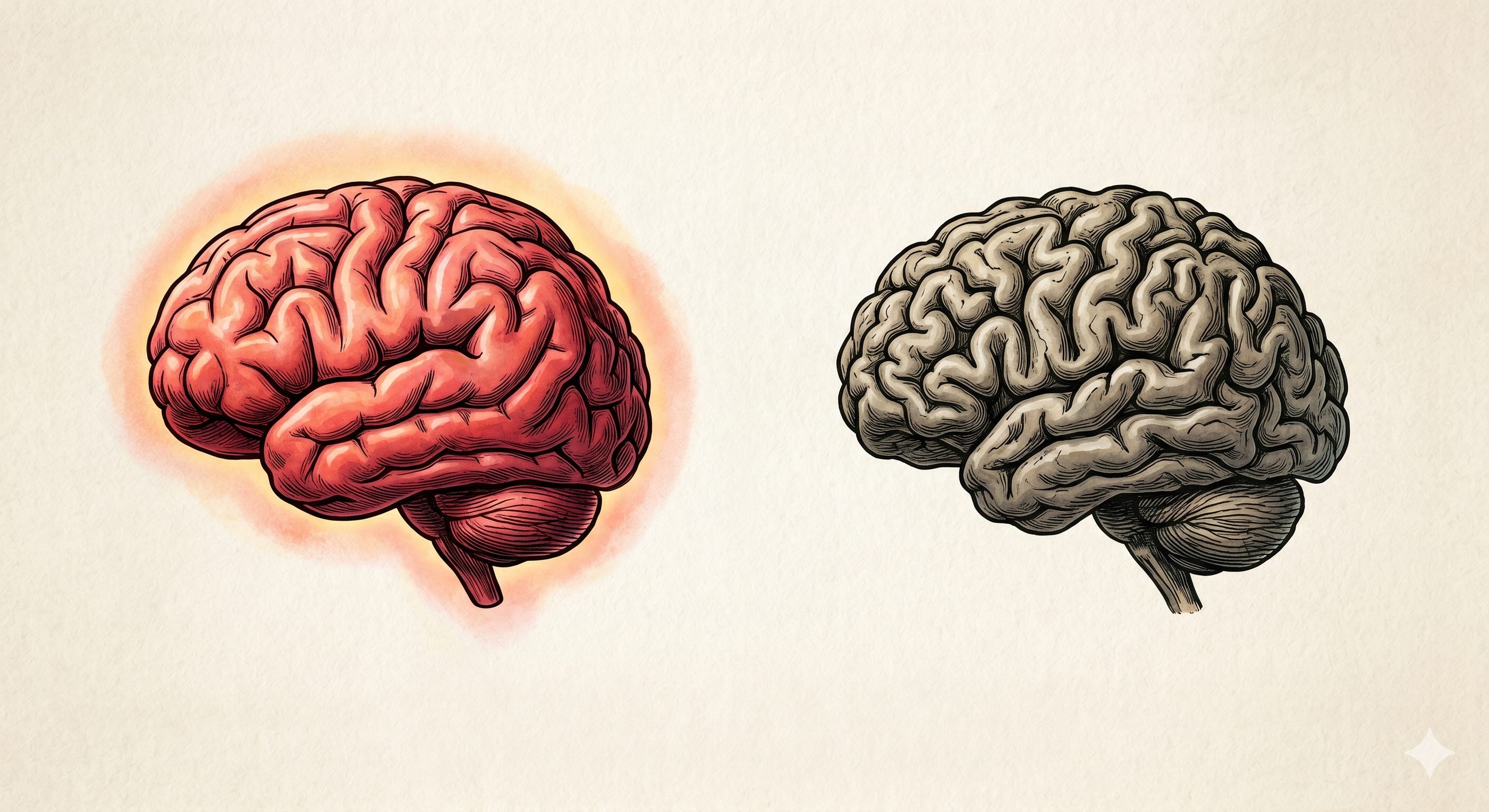
Physical health has quietly become one of the clearest markers of wealth we have, because a lean and rested body encodes the time, the food, and the safe streets that money buys, and the next marker is already forming one layer deeper, inside the brain. What worries me, watching this as a neuroscientist rather than as someone with a supplement or a brain-training app to sell, is that cognition is becoming the next line between the haves and the have-nots, and that the people closest to the resources have already started building a lead the rest of us cannot yet see.
Picture two children born this year, a few zip codes apart.
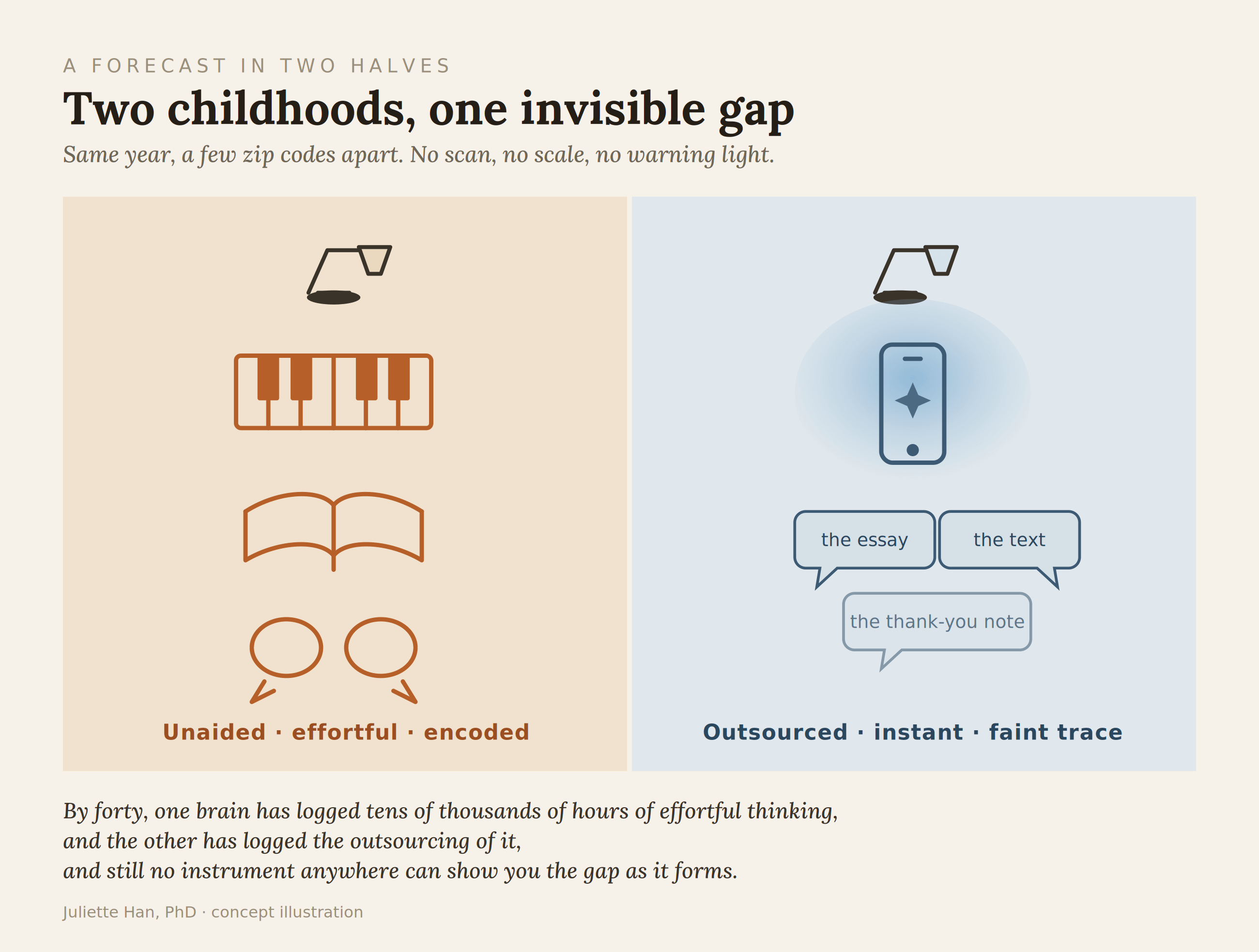
The first grows up in a house that treats deep focus, real community, and unaided struggle as a kind of inheritance, the way other families pass down a trust. She plays an instrument badly for a long time before she plays it well. She sits with a hard math problem until it cracks open, rather than pasting it into a chatbot. She argues about a book at the dinner table with adults who push back, and she learns to lose those arguments and come back the next night to try again. None of this shows up on a single test she takes at sixteen.
The second child grows up with a phone that answers everything and a model that will draft a very well-argued essay, the apology text, the college statement, and eventually the friendship itself on the nights when no one else is around. None of it requires an adult in the room, since the model explains, corrects, and signs off on its own help, so no one is left to push back or to ask that the work be tried alone first. This child reaches the answer faster, even creates more tunes through AI, and posts more complex ideas, and yet very little of it settles, because the brain tends to encode what it has to fight to produce, and work that is handed to you leaves a fainter trace than work you wrestle into being.
Neither set of parents is handed a number, a scan, or a warning light. By the time either child turns forty, one brain will have logged tens of thousands of hours of effortful, unaided thinking, and the other will have logged tens of thousands of hours of outsourcing it.
Which of these two children is more likely to grow up with better brain longevity? Which one can keep cultivating creative hobbies that take years to nurture, navigate difficult conversations to form deep bonds, and sustain the long problem-solving sessions that build robust connections across different cortical regions?
The answer seems clear, yet as adults, we are quietly drifting into the life of the second child. Roughly half of American adults now use AI chatbots, about a quarter of them every single day, and the true reach is wider than most people realize, since one analysis found that nearly everyone uses a product with AI features each week while only about a third recognizes they are doing it.
We reach for these tools to search for answers, draft our work, and increasingly to ask medical questions and look for emotional support, which means the model is sliding from a convenience into the place where our thinking, and sometimes our comfort, used to happen. And why wouldn’t we? AI therapists are cheaper than the copay; in-person friendships require time we do not have between two jobs, and our managers increasingly expect the kind of turnaround that only a machine can help us hit.
The deeper shift is that sixty percent of adults now read the AI-generated summary at the top of a search and take that synthesized answer at face value instead of reading the sources, weighing them, and reasoning to their own conclusion, so the friction that used to build judgment simply disappears. AI gives such fluid, eloquent answers that struggling to craft our own logic starts to feel pointless.
The cost of all this is not hypothetical. In a study from MIT’s Media Lab, the people who let the model do the writing showed the weakest brain connectivity of any group measured, and afterward could not quote a single line of what they had just produced, which is what an automated mental life looks like well before anyone calls it a problem.
Just as the Industrial Revolution changed our bodies, AI is coming for our cognition, and brain health is about to become the asset that separates two classes: those who can afford to maintain their minds and those who cannot. Read on for why this is the likely future, no matter what you believe about the benefits of AI, and for what it actually takes to keep from paying for convenience with your brain.
Long before anyone worried about brains, the physical body turned into the most visible ledger of wealth we have. A lean, strong, well-rested body now signals access more reliably than a watch or a car, because it quietly encodes the things money actually buys: time to exercise, a neighborhood safe enough to walk in, a kitchen stocked from somewhere other than the cheapest shelf, and the kind of unhurried sleep that a second job does not permit. The market has read this correctly, which is why whole foods, personal trainers, and boutique gym memberships are priced and sold as status rather than as the ordinary condition of being alive.
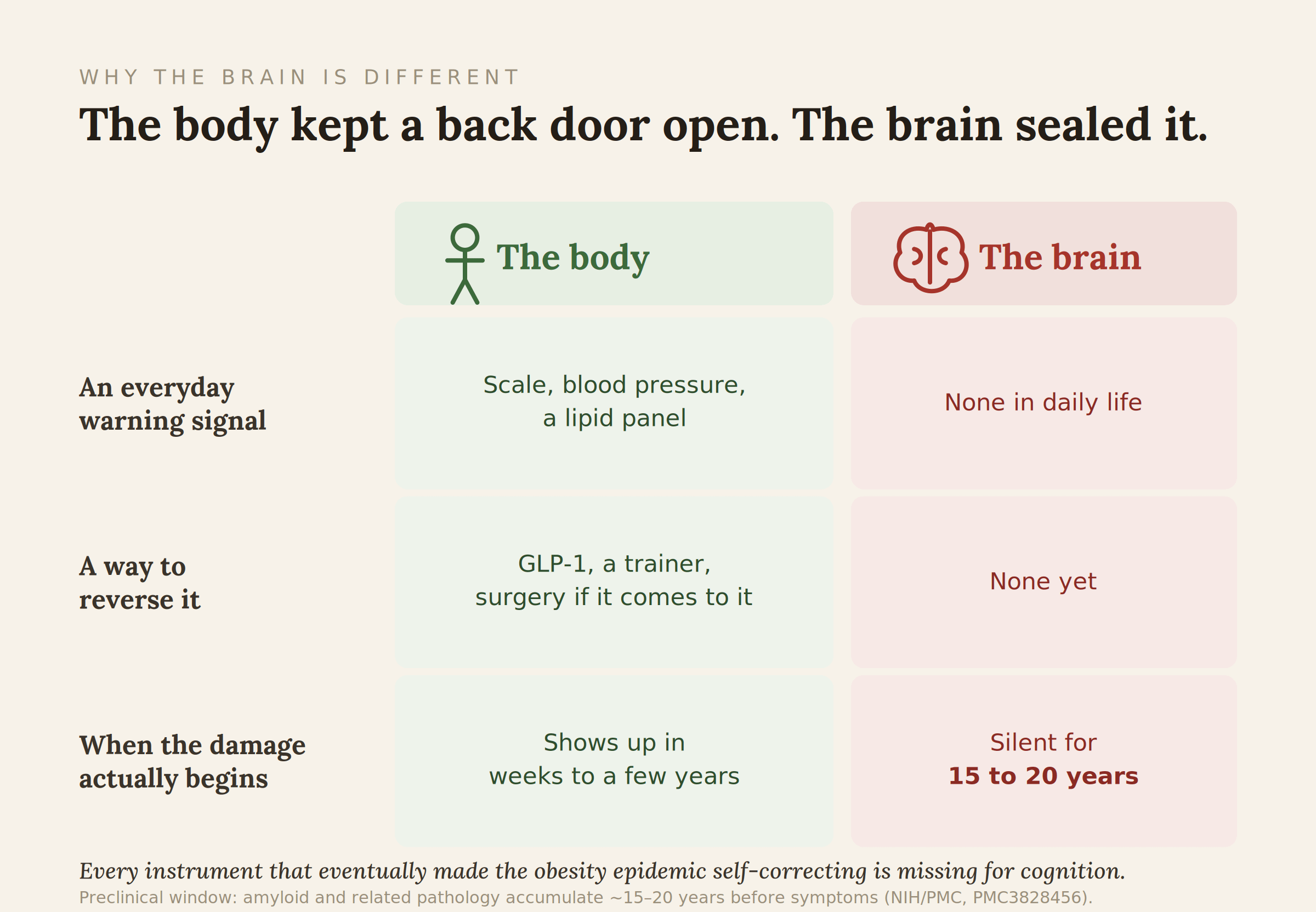
What made that inequality survivable, at least for the people on the wrong side of it, is that the body left a back door of quick fixes open, because it comes with instruments. A scale, a blood-pressure cuff, and a lipid panel each hand you a number and a direction, and when the number finally frightens someone into acting, the body now offers something close to a reset: a GLP-1 prescription, a trainer, or a surgeon if it comes to that, interventions that can undo years of damage in a matter of months. Often, we can literally see the harm of poor food and poor sleep written on our faces and feel it in our fatigue, so the harm announces itself, and it can often be reversed.
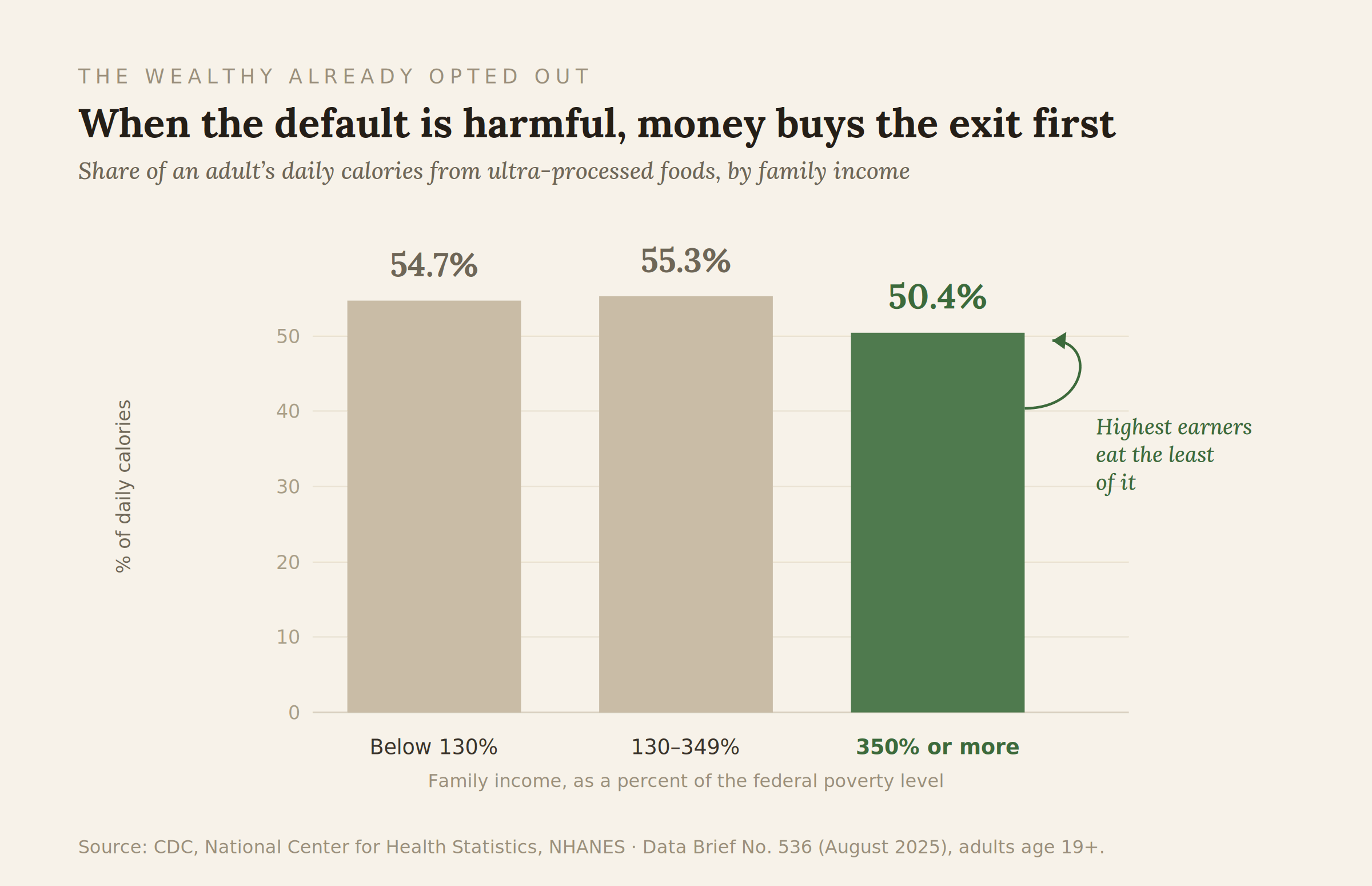
The scale of that harm is not in dispute. Obesity and excess weight now cost the US economy roughly $1.72 trillion a year, equivalent to about 9.3 percent of GDP, and ultra-processed products supply about 53 percent of the calories American adults eat. The most telling line in that CDC data is the one almost nobody quotes: the highest-income adults consume the least ultra-processed food of any group. The people with the most access have already quietly opted out of the cheap and harmful default, which is exactly the pattern worth holding on to as we turn to the brain.
Here is the part that should keep you up at night, because every escape hatch the body kept open, the brain has sealed. There is no liposuction for a mind that has spent fifteen years outsourcing its hardest thinking, and there is no injectable that restores the synaptic density of a brain raised on convenience.
We already treat a year of weight loss as a long commitment, one that requires constant feedback to stay motivated, yet reversing cognitive decline can take many years, if not decades, with no clear metric to track along the way. The pathology behind Alzheimer’s, to take the clearest example, begins accumulating in brain tissue roughly 15 to 20 years before the first symptom appears, which means that whatever biomarkers eventually reach the clinic will describe a single disease the way a bathroom scale describes a single number, useful in its narrow lane and silent about everything else, and arriving only after the process has been quietly writing itself into the tissue for two decades. The absence of any real-time instrument for cognition is the most underappreciated fact in this entire conversation, because it removes the one thing that eventually made the obesity epidemic self-correcting for those who could afford to respond. The body gets a wake-up call. The brain does not, and that single difference is what the rest of this argument turns on.
To see where this leads, it helps to watch the same sequence play out once before, in slower motion. Every major technological revolution tends to move through four stages: it first makes us safer, then makes us more comfortable, then lets that comfort curdle quietly into harm for the individual, and finally presents a societal bill once that individual harm has compounded over a generation.
The Industrial Revolution ran that arc over roughly a century. The first stage was simply not dying, as mechanization replaced the routine workplace deaths and crippling injuries that had defined manual labor, and as sanitation, transport, and refrigeration drove down the famines and infections that had capped human life for millennia, helping global life expectancy climb from around 30 years to more than 70. The second stage layered on convenience, as cars conquered distance and refrigeration and rail solved the oldest supply problem in history, turning famine from a recurring catastrophe into a rare event even as the population grew. Both stages improved human life with almost no asterisk.
The third stage is where it turned, because once food could be shipped, frozen, and engineered to be eaten well past fullness, the body that no longer had to labor for calories stopped having to labor at all, global obesity more than doubled, and the fourth stage arrived as the trillion-dollar bill described above. The final irony is the one that matters most for what comes next: physical effort, the very thing the assembly line had spent a century eliminating, returned as a luxury, sold back to the people who could afford it as a lifestyle brand.
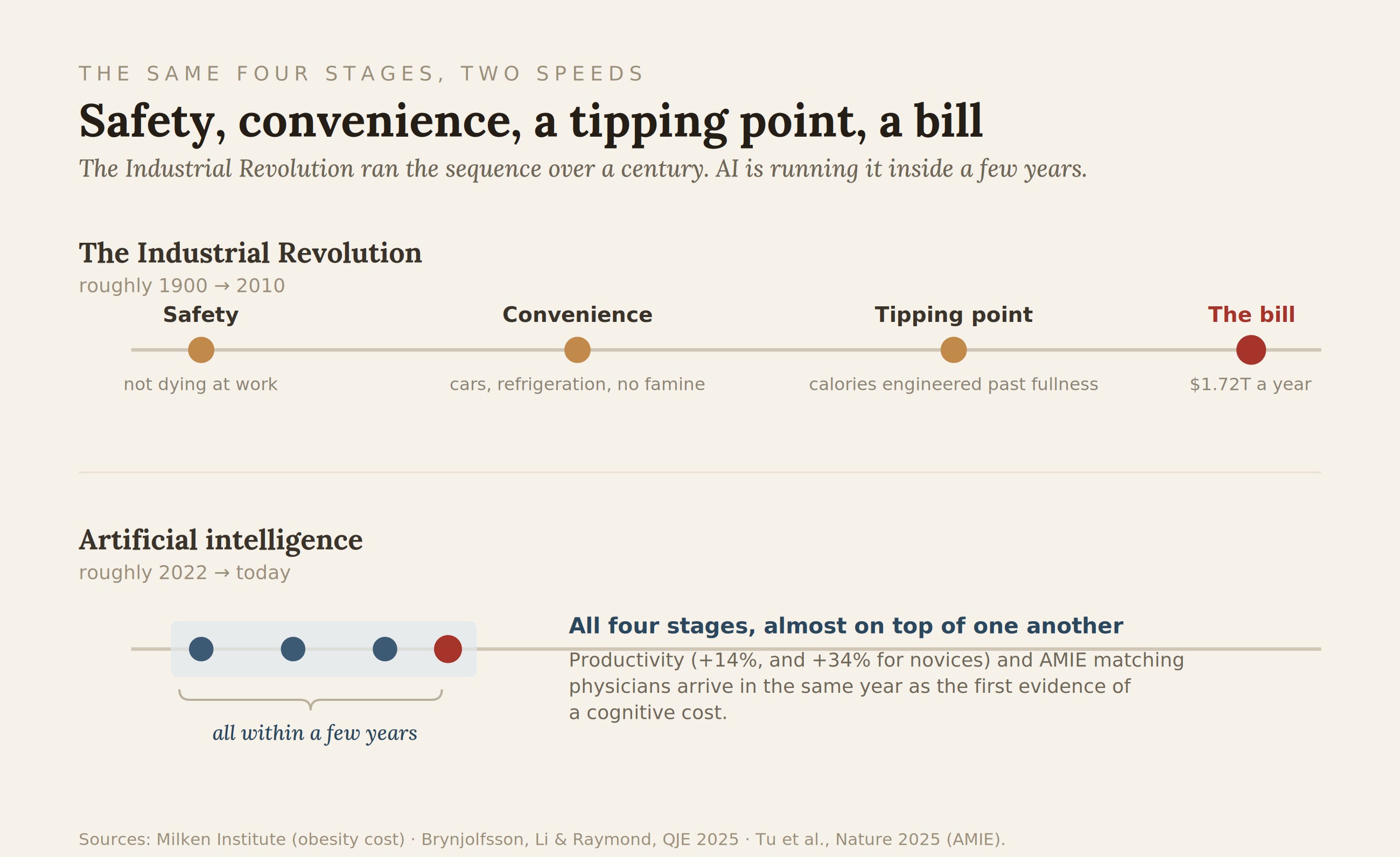
Now run AI through those four stages and notice what breaks. The safety and convenience gifts are real, and they are arriving together, which already departs from the slow pattern of food. A large workplace study found that a generative assistant raised worker productivity by about 14 percent on average, and by 34 percent for the least experienced staff, an unusual result for any tool, because it helped the bottom catch up faster than it helped the top pull ahead.
In medicine, a conversational diagnostic system has already matched or outperformed primary-care physicians in accuracy and communication, a capability that could eventually bring real expertise to places that have never had it. Drug discovery is another area I am genuinely excited about, since compressing ten years of research into three and finding new targets for rare diseases are exactly the promises I expect AI to keep.
The departure shows up in the third stage because the tipping point where convenience curdles into individual harm is not waiting two generations, as it did with food, but is arriving within the same calendar year as the benefit. To see why that harm is more than a hunch, it helps to look at what effort does to a brain in the first place.
Cognition behaves less like a fixed trait and more like muscle tissue, in the sense that the difficulty itself is the stimulus. When you sit with a hard problem, hold competing ideas in mind, or push through the discomfort of not yet knowing the answer, you recruit and strengthen networks across the prefrontal cortex and beyond, and that effortful engagement is what builds what neurologists call cognitive reserve, the buffer that lets some people withstand years of age-related damage while others decline.
A useful way to hold it is that physical exercise preserves the brain’s hardware while mentally demanding activity strengthens its software, and a lifetime of that demand is associated with a slower rate of hippocampal shrinkage and even lower amyloid buildup. The struggle is not the price of learning; it is the mechanism.
Which is exactly why the early data on AI should give us pause, because the consistent finding is that these tools quietly remove the struggle. Looked at closely, the same MIT study found connectivity in the chatbot group running up to fifty-five percent lower than in those who wrote unaided, and the disengagement lingered even after the tool was taken away, though the sample is small and the work is still a preprint, so it is a signal rather than a verdict. It is not the only signal.
Using functional near-infrared spectroscopy, researchers measured reduced activation in the dorsolateral prefrontal cortex when people handed a task to a digital assistant; a study of 666 people found that heavier AI use tracked with weaker critical-thinking scores, driven by cognitive offloading; and an experiment in PNAS Nexus found that leaning on an AI summary produced shallower understanding than doing the search and synthesis yourself. Across very different methods the picture is the same, that when the model does the thinking, the relevant regions of the brain simply light up less.
We do not yet have the decades-long study showing that AI use shrinks gray matter, because the technology is too young for that evidence to exist, but everything we do know points in that direction. When people stop engaging, whether through disuse or isolation, the brain measurably loses tissue: socially isolated adults show smaller hippocampal volume and a thinner cortex alongside poorer memory and executive function, loneliness is linked to reduced gray matter and a roughly 31 percent higher risk of dementia, and the cognitive-reserve research shows the mirror image, that sustained mental engagement protects the very regions disuse erodes. It is infinitely easier to lean on a chatbot for my own turmoil and save face, but the brain keeps a quiet ledger of what we stop doing for ourselves. Put the two bodies of evidence together, the real-time disengagement we can already measure under AI and the structural loss we know follows from disengagement in every other setting, and the conclusion is hard to avoid: a life steadily outsourced to AI is a life of less cognitive effort, and less effort, sustained over decades, is how brains grow smaller and dimmer rather than sharper.
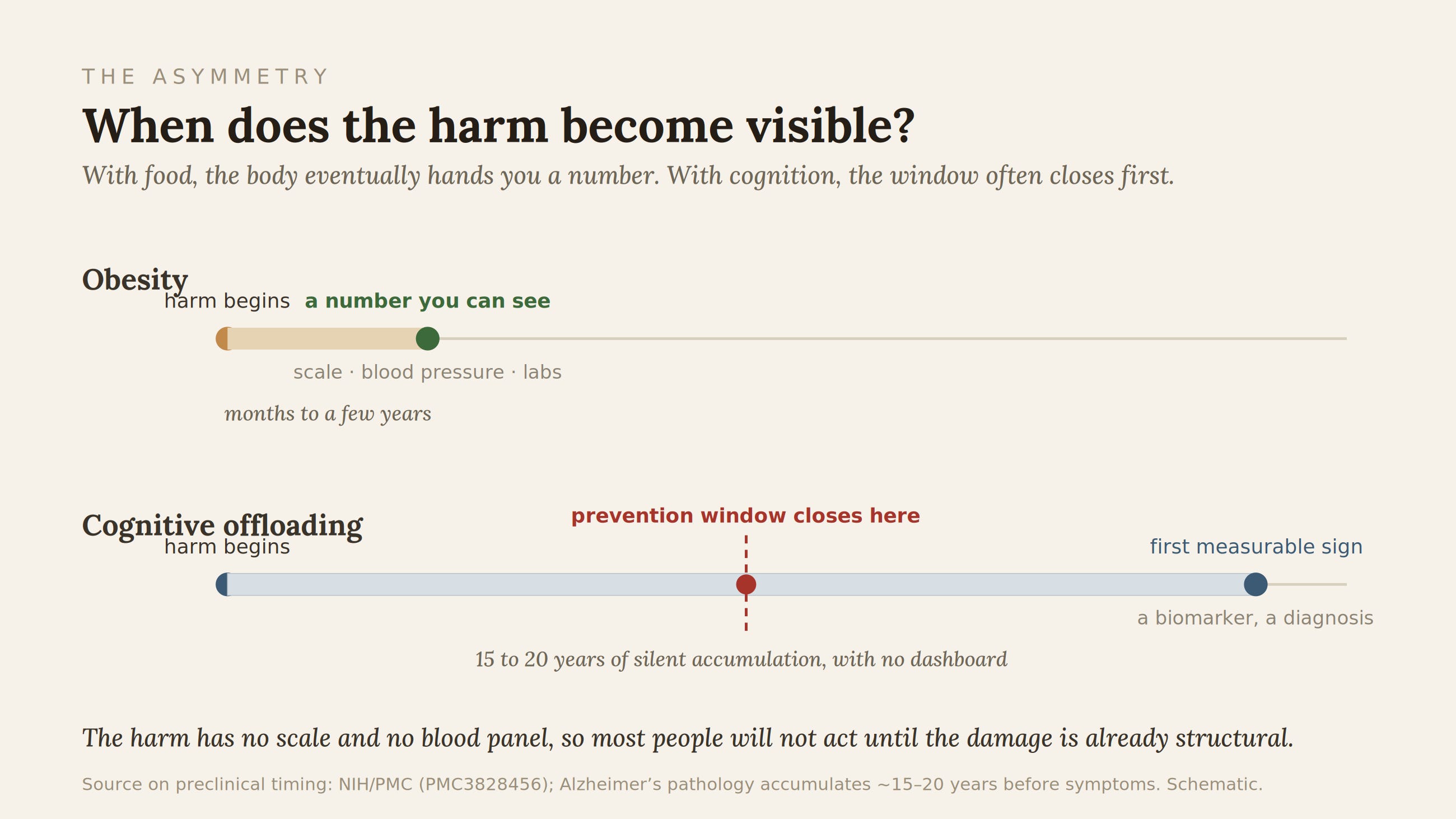
Here is what that combination produces. Because the body’s harm was both visible and reversible, the inequality it created stayed survivable even for the people on the wrong side of it, since a number on a scale eventually arrived with a reason and a direction to change course, while cognitive decline offers neither, so the gap between two kinds of minds will compound in silence and harden into something closer to a caste line than a health statistic. The new wealth class will not be the one with the GLP-1 prescription, the trainer, and the produce delivery, all of which can be bought at the moment of crisis. It will instead be the one that can afford the slower, far less marketable investment: hobbies that demand patience, friendships that require showing up in person, and intellectual engagement that offers no immediate payoff and no scale to step on afterward, the consistent habits that only time and access allow, and the freedom to slow down in a world that rewards speed.
Everyone else will default to whatever costs the least money and the least effort, which increasingly means a chatbot standing in for a mentor, a therapist, or a friend who might actually have sat with them, and that substitution will compound exactly the way the obesity gap compounded, except this time it will arrive without ever once announcing itself. The earliest sign of who opts out is already visible in the same place we first saw it with food, since the families closest to these tools are often the quickest to limit them for their own children.
I am not anti-AI any more than I am anti-technology, and none of this is an argument for putting the tools down. It is an argument for treating your own cognitive effort the way you would treat a body you intend to keep functioning for decades, with deliberate friction, with relationships that do not get quietly handed off to software, and with the discipline to do the hard mental rep yourself, even when something else could do it faster, and you would never feel the difference the next morning. It’s like weightlifting—surely a machine can lift those weights, but that’s not how you grow your muscles (yes, that’s an em-dash, no, I wrote this and typed in that em-dash).
The body eventually got its scale, its blood panel, and a drug that could undo years of damage in months. The brain is going to get none of that for a long while yet, and the people who understand this first will spend the next two decades building the only kind of wealth that was never for sale. What you can do now is the hard thing, the very thing the tools promise to spare you: pick up a creative hobby, solve a problem without AI in the loop, have the difficult conversation in person, and stay with one task long enough to feel it get easier.
Most importantly, definitely subscribe to my newsletter (Not the LinkedIn one, the real one!).
No posts
Comments
Nothing yet. Say the first thing.
Sign in to join the conversation.