
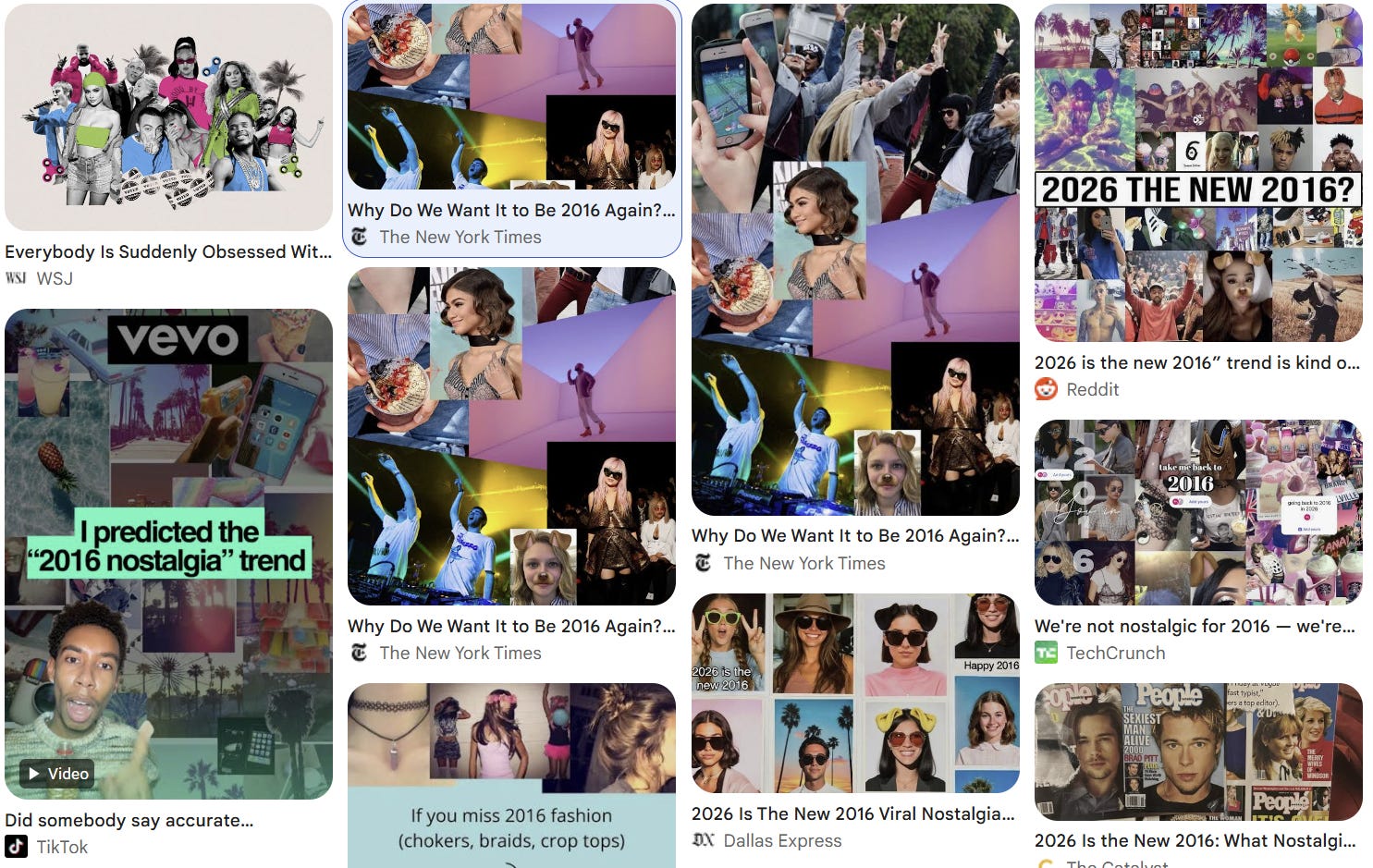
Has your Instagram and TikTok feed so far this year been a time machine?
Or a time whiplash. Showing me grainy edits à la the 2016 Instagram photo style of a very much current viral Pilates trend, followed by very 2026 AI mini short drama, then Shakira, who has looked the same fabulous for the last 20 years, completely warping my sense of time.
The current wave traces back to what people are calling the Great Meme Reset, an ironic TikTok joke that hardened into something real: flood the feed with old memes, drown out AI-generated content (why do I find AI-generated ads disturbing but clips of old QVC ads are weirdly comforting??), and will the internet back toward an earlier version of itself, as The Week recently chronicled.
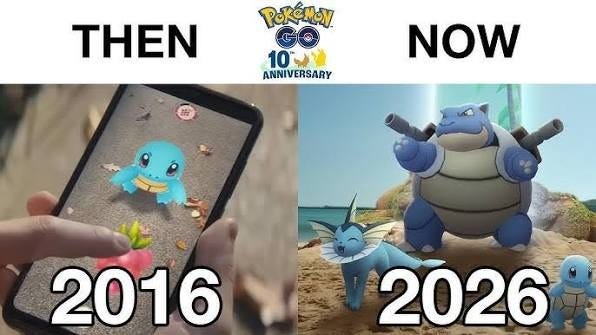
The nostalgia artifacts people keep mentioning are very specific: Vine, Pokémon Go (gah, was that already 10 years ago?), Snapchat’s dog-and-flower-crown filters, VSCO girls, Kylie Jenner’s lip kits, grainy photos of acai bowls, all resurrected as proof the internet once felt lived-in rather than fed to us.It’s tempting to write this off as nostalgia doing what nostalgia always does, except nostalgia has an actual mechanism in the brain, and it tends to switch on for a specific reason, and it’s not about actually missing the thing people say this misses (I don’t think we genuinely miss photodumping the whole night into Facebook albums).
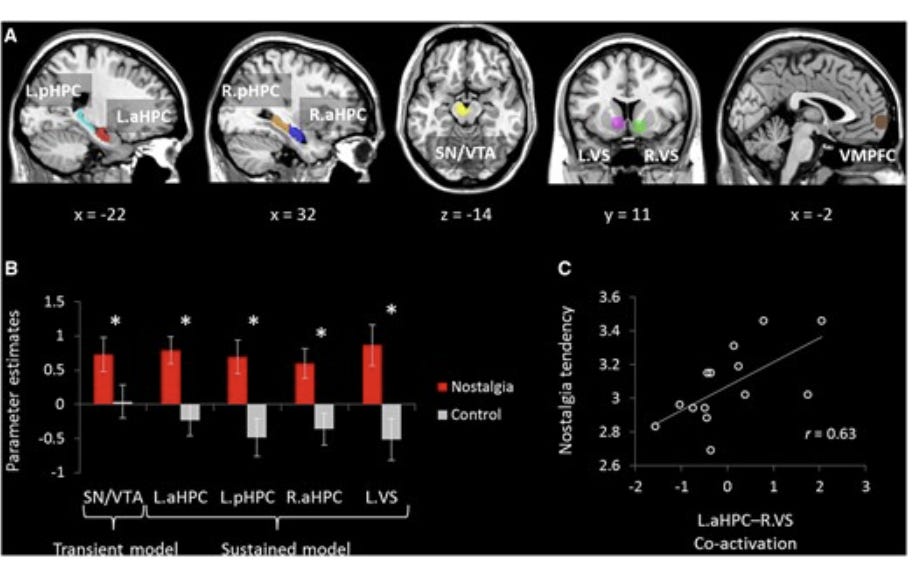
Reaching for nostalgic good isn’t just sentimentality. A 2022 review in Social Cognitive and Affective Neuroscience describes nostalgia as a countermeasure the brain launches under psychological threat, reliably summoned by loneliness and a sense that life lacks meaning, and working by surfacing memories that are unusually social and self-affirming. Your brain is fighting back from feeling disconnected.
That is why participating in nostalgia-motivated activities tends to leave people feeling more connected rather than simply happier. The real champion circuit behind it: the hippocampus, seat of autobiographical memory, firing together with the ventral striatum, part of the reward system, and in early imaging studies the two sync up more in people already prone to nostalgia.
(Side note: this is excluding fashion cycles, because fashion repeats on its own clock, nostalgia or not, and that particular cycle would keep spinning with or without any of this)
This is a lot of individual brains reaching for the same tool at the same time. Not surprising given the 2023 “trend” of mass loneliness epidemic that is still ongoing.
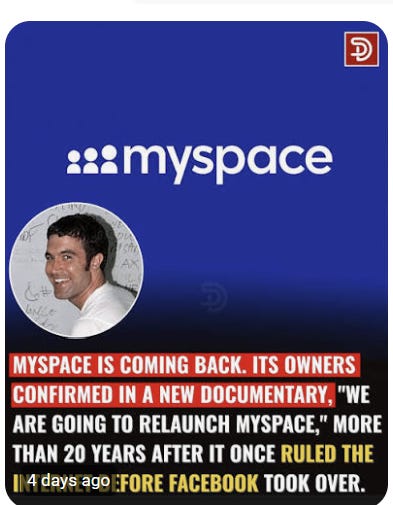
Except 2016 might not even be far enough back. Myspace’s owners confirmed this month that they are planning a full relaunch, more than two decades after the platform defined the early internet, betting a Top 8 and a custom soundtrack still mean something to people worn out by algorithmic feeds. If the internet can miss 2016, apparently it can miss 2003 too.
Which raises another question: what else could we or would go back to?
The more interesting version of the question is what people would actually want back from the 90s or early 2000s if they let themselves think about it honestly, and it is rarely a specific outfit or a specific app (and definitely not my sparse eyebrows from my 1997 high school era in Los Angeles). It is much more often a specific person or community. Or rather, what they made you feel.
That is the part the current wave is avoiding facing. Everyone is rebuilding the aesthetic: the filters, the apps. Almost nobody is doing the more obvious thing of reaching out to the specific people those artifacts are standing in for. The research above says nostalgia’s real function is restoring connection and continuity, not restoring a look. Recreating the object is not the same as recreating the relationship.
The same instinctual fight or trend is showing up at the box office. The Devil Wears Prada 2 reunited its original cast two decades after the 2006 original and opened to nearly three times that film’s debut, before the franchise crossed $1 billion combined. Spider-Man: Brand New Day then broke the all-time domestic opening weekend record outright, passing Avengers: Endgame.
Both are genuinely well-made films, and that matters. But audiences choosing familiar characters at that scale, right when trusting something new takes more effort than it used to, is probably not a coincidence.
People still want new connection. New communities, new inside jokes, new places that feel like theirs. But when that is hard to find, the brain reaches for a shortcut that is already sitting in memory, tuned to a version of connectedness that worked before.
The honest version of that shortcut is not really an app. It is a phone call to whoever the flower crown filter actually reminds you of (but don’t do it if it’s an ex!).
No posts
Comments
Nothing yet. Say the first thing.
Sign in to join the conversation.