
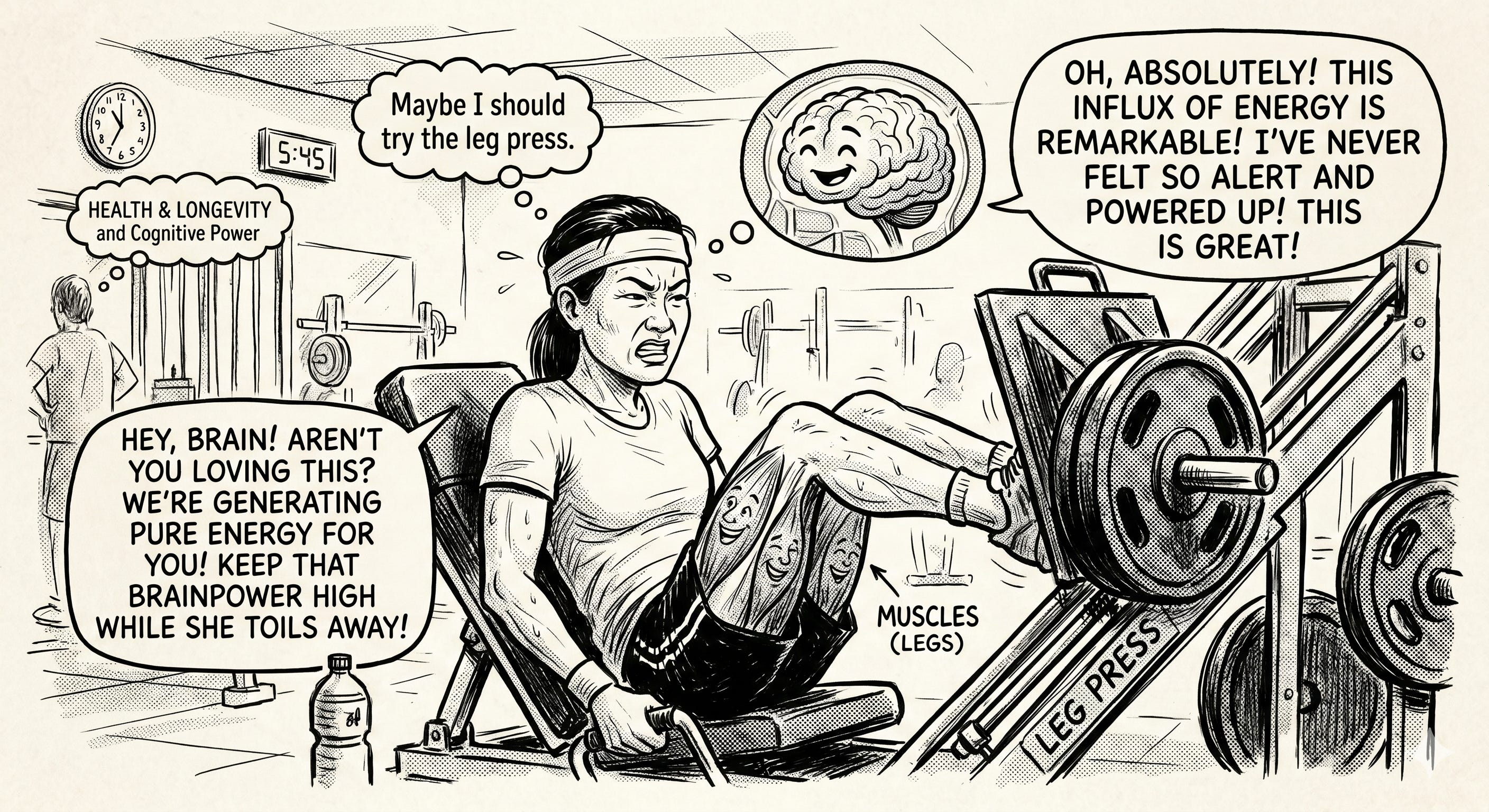
My mom used to tell me that people with bigger thighs live longer. I was a teenager complaining about my muscular legs, and I assumed she was trying to make me feel better about my inability to look daintily cute in short shorts (this was the 90s, and dainty was IN!). And it took science 30 years to catch up to my mother's instinct about thick thighs.
It turns out muscle is not a vanity metric nor just an athletic one. It is a survival organ, an endocrine system, and a brain-protective network that compounds its benefits over a lifetime. The fact that it's all over your feed right now is not a trend but the science catching up to what my mom’s been trying to tell me for years.
What started as gym-bro conventional wisdom has become one of the most robust signals in aging research. The conversation has also quietly shifted from aesthetics to biology, because it turns out muscle is not just something that makes you look good in a tank top, but a vibrant organ. It secretes things, talks to your brain, and predicts how long you live and how clearly you think while you’re doing it.
This issue covers five findings that make that case, starting with the one my mom figured out before any of them were published.
In this issue:
Every centimeter of thigh circumference reduces mortality risk, confirmed in 20,000 Americans followed for 16 years
Low muscle mass raises all-cause mortality risk by 57%, regardless of age or BMI
In 340,000 people, grip strength predicted Alzheimer’s risk with dose-response precision
Muscle releases signaling molecules that cross the blood-brain barrier and drive neuron growth
Twelve weeks of resistance training increased hippocampal volume in older adults at cognitive risk
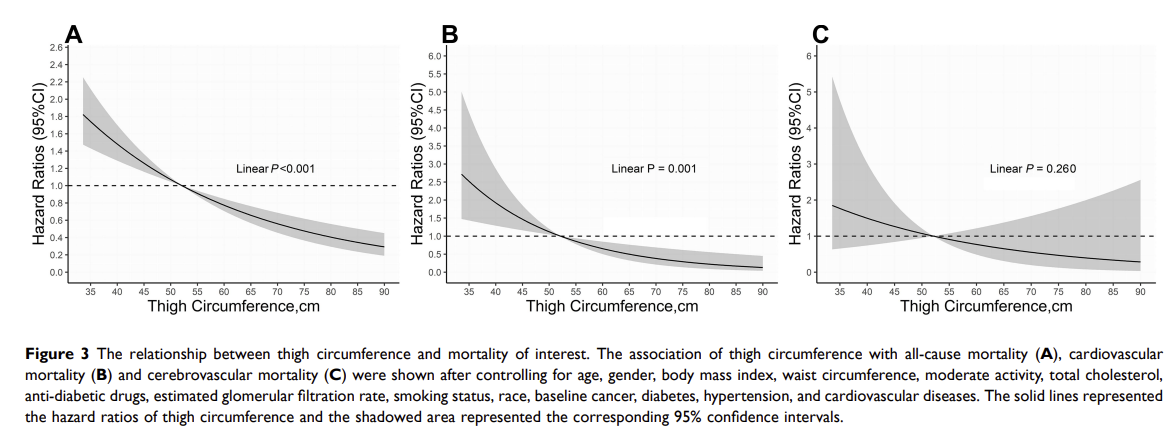
Here’s the study that would have won every argument my teenage self tried to have. A 2020 cohort study tracked 19,885 US adults for a median of 12 years and found that each additional centimeter of thigh circumference was independently associated with a 4% lower risk of all-cause mortality and a 6% lower risk of cardiovascular death, after adjusting for age, BMI, smoking, and activity.
The association held even in people with normal BMI, which rules out the easy explanation that bigger thighs just come with a healthier body overall. The study can’t fully separate muscle from fat within the thigh measurement, but imaging-based research consistently points in the same direction, suggesting muscle is doing most of the heavy lifting here, pun intended.
Action Items
Don’t skip leg day. Seriously, the data are in. If you need somewhere to start, three moves that build thigh muscle without requiring a gym membership: Bulgarian split squats (your legs will hate you, your longevity data will not), wall sits held for 45 to 60 seconds between meetings, and slow walking lunges anywhere you have a hallway.
If you want a number to track, measure thigh circumference with a tape measure at mid-thigh while standing, at the same time of day, once a month. It’s a better proxy for lower-body muscle than the scale, and it’s deeply satisfying when it goes up.
Scale weight tells you almost nothing useful. Here’s what does. A 2023 meta-analysis in PLOS ONE pooled 16 prospective studies, 81,358 adults, and 11,696 deaths, and found that adults with low skeletal muscle mass index faced a 57% higher risk of dying from any cause compared to those with normal muscle mass.
The risk didn’t just add up with higher BMI; it compounded: 34% excess mortality at normal weight, climbing to 158% in people with BMI above 30. That second number is the one worth sitting with, because it directly challenges the popular idea that being “big but strong” is a protected category. If the muscle isn’t there, the math doesn’t care about your weight.
Action Items
This is your permission slip to stop optimizing for the scale and start optimizing for what’s actually on it. A DEXA scan runs $50–$150 at most sports medicine clinics and gives you a real breakdown of muscle versus fat by body region, including your appendicular lean mass, which is what researchers use to calculate skeletal muscle index. If you’ve never had one, book it. It takes 10 minutes and tells you more than any BMI calculation ever will. It will also tell you other invisible and critical markers like visceral fat and bone density.

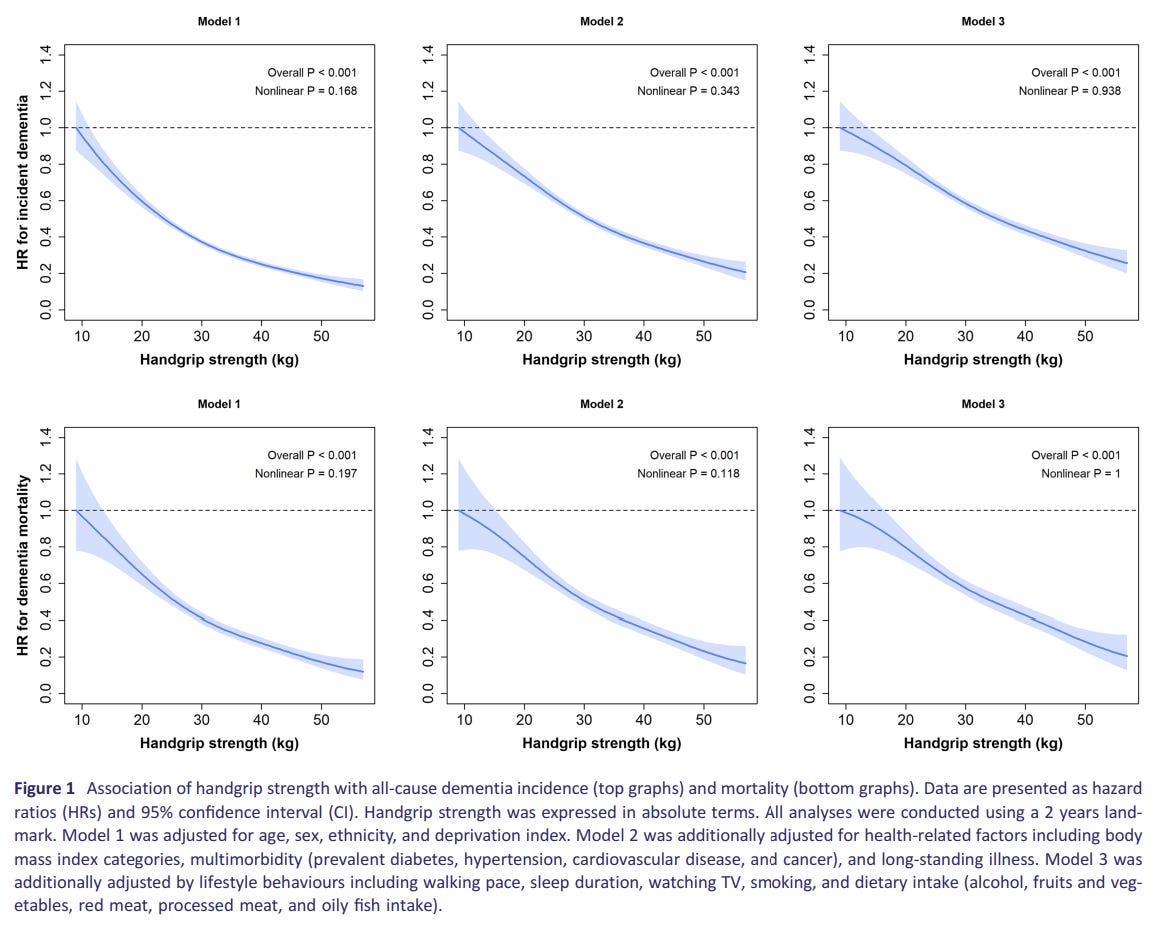
The largest study of its kind made a finding that should probably be on every wellness app’s home screen. Researchers analyzing 340,212 UK Biobank participants over 8.5 years found that every 5 kg increment in grip strength was associated with 14% lower all-cause dementia risk, 13% lower Alzheimer’s risk, and 21% lower vascular dementia risk, and the dose-response relationship held no matter how they sliced the measurement.
When slow walking pace was added to the picture, the combination of weak grip and slow pace more than doubled dementia risk compared to people who were strong and moved briskly. A 2022 replication using 466,830 participants confirmed the association for both incidence and dementia mortality. These are observational studies, so grip strength is likely doing some work as a general health proxy, but the signal is large enough across both cohorts that it’s hard to dismiss.
Action Items
Your hands, not eyes, are apparently a window to your brain, and that’s not a metaphor. A handgrip dynamometer might be able to tell you about your brain well before what your doctor can. Test yourself, look up sex-specific population norms for your age group, and note where you land. More practically: if you’re already lifting, prioritize compound movements that involve grip, deadlifts, rows, farmer’s carries, and pull-ups. If you’re not lifting yet, the carries alone are a genuinely low-barrier place to start. Walk around your neighborhood holding heavy things. The data will catch up with you.
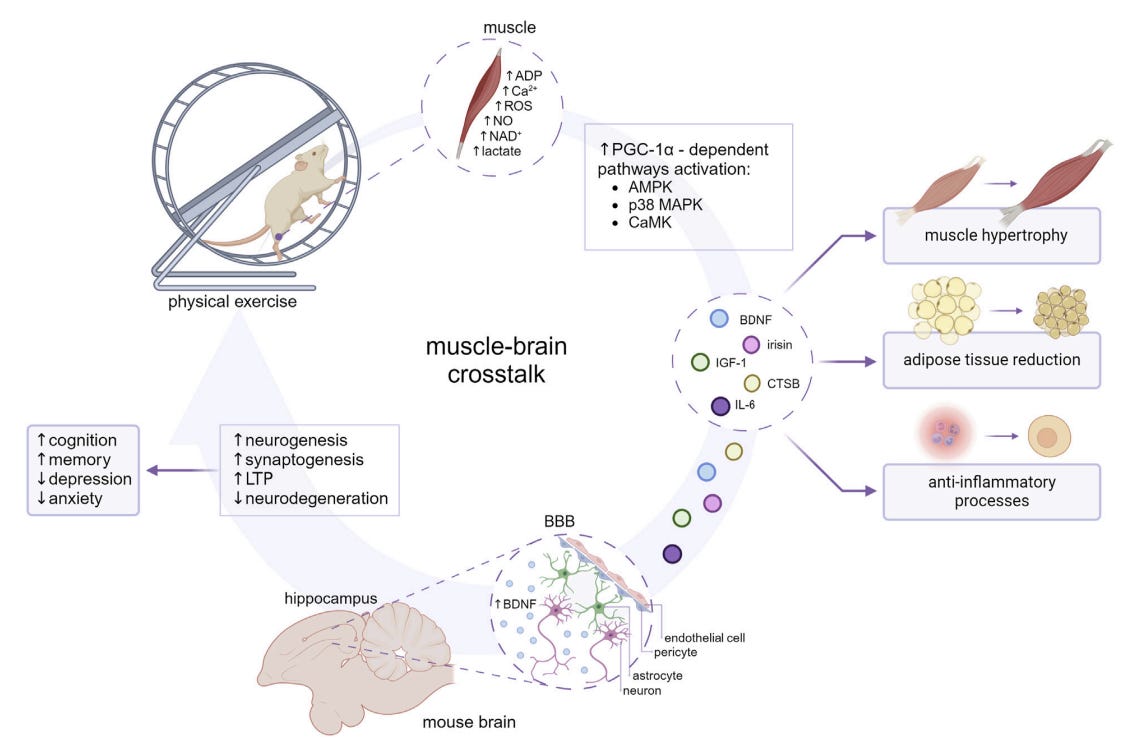
This is the one that changes how you think about what muscle actually is. Skeletal muscle is not a passive tissue that sits there looking good between workouts. It is an endocrine organ that, when contracted, releases signaling peptides called myokines, several of which cross the blood-brain barrier and get to work on your neurons.
A 2024 review in Frontiers in Physiology synthesized evidence that irisin, one of the best-studied myokines, triggers hippocampal BDNF production and promotes neurogenesis and synaptic plasticity, essentially the biological substrate of learning and memory. In sarcopenic animals, the pathway is disrupted, and cognitive decline follows. Most of the evidence of the mechanisms is still from animal models, and the brain receptor for irisin in humans hasn’t been pinned down yet, so the full causal chain is still being mapped. But the directional story is becoming hard to ignore.
Action Items
The implication here is that the type of exercise matters, not just the quantity. Cardio is great, but resistance training, which creates the kind of mechanical load that most strongly stimulates myokine secretion, is what appears to trigger this particular brain-signaling cascade. Two sessions per week of progressive resistance training is the minimum that the evidence points toward. If you’ve been exclusively a runner or a walker and are wondering why you’re plateauing on cognitive health benefits, this might be why. Add the weights. Your hippocampus is asking.
We now have randomized controlled trial evidence that lifting weights changes the structure of the brain, and it doesn’t take years. A 2024 RCT in GeroScience assigned 70 adults aged 60–85 to either 12 weeks of progressive lower-limb resistance training or no intervention, stratified by cognitive risk level. The people who trained showed measurably increased hippocampal subfield volumes, higher circulating IGF-1, and reduced markers of neuroinflammation. The effect was larger in the group that already showed early signs of cognitive risk, which is exactly the population where an accessible intervention matters most. The sample of 70 limits how far we can generalize, and 12 weeks is too short a window to know whether structural brain changes persist over years. But the direction of the finding and the population it most benefited are both worth paying attention to.
Action Items
Forward this to every person you know over 60 who has been thinking about starting strength training and keeps putting it off. The research now supports lower-limb resistance training as a specific, structural brain health intervention, not just a feel-good physical activity recommendation. The active ingredient appears to be progressive overload, meaning the resistance has to increase over time, not just stay comfortable. If you’re in this age range yourself: squats, leg press, step-ups with weight, lunges. Start light, add load every one to two weeks, and let your hippocampus catch up.
No posts
Comments
Nothing yet. Say the first thing.
Sign in to join the conversation.