
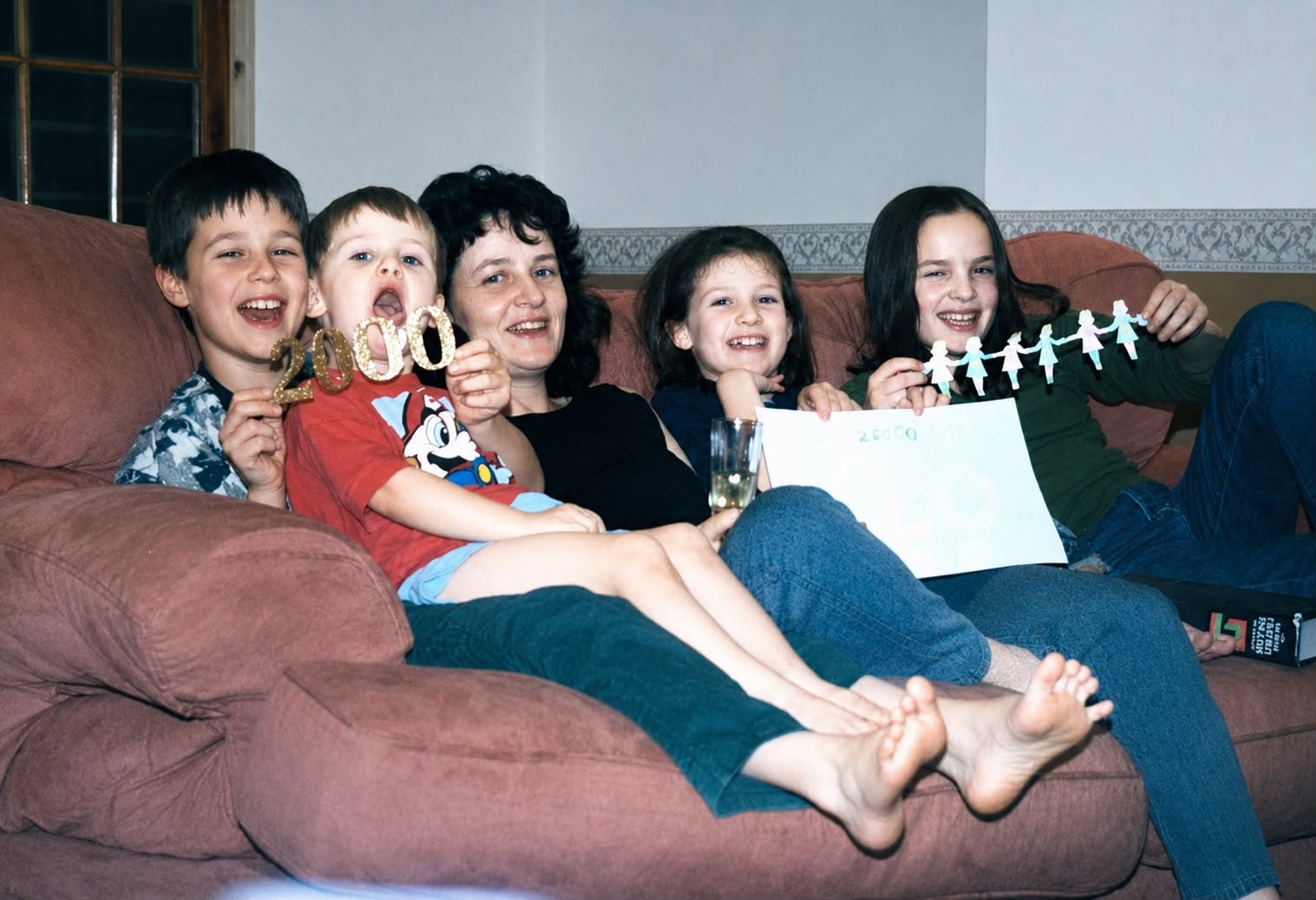
Linda, with her four children, celebrating the Millennium
Cat is the eldest of four children born to Linda and Glyn Razzell. “Mum had mental health problems, so the immediate assumption was that she had run away, and left the children. But we all knew he was violent”, she says. “He had been acquitted twice of attacking her… me, and then my brother and sister had witnessed it.”
In March 2002, just weeks before she disappeared, Razzell had been acquitted of the unlawful wounding of Linda. It was the second time he had been found not guilty of violence towards her.
Razzell was jailed for life in November 2003. He had claimed that Linda, from whom he was estranged, had disappeared, walking away and leaving their four children. A week earlier, the Family Court had frozen his bank account, because he was refusing to pay child maintenance.
The prosecution case was that his motivation was primarily financial; he wanted to access his money without having to go to court. On March 19th, 2002, Razzell borrowed a car from a friend, then drove across Swindon to abduct Linda from an alleyway on her route to work. He then murdered her and disposed of her body.
He was arrested eight days after her disappearance. There were significant inconsistencies in his story, and police accused him of disposing of evidence.
He applied twice for leave to appeal, in 2004 and 2005, but was refused both times. He then went to the Criminal Cases Review Commission, (CCRC), which also refused.
Never having shown remorse or admitted guilt, he was refused parole three years in a row. The first attempt was in 2021, when he became the first prisoner to be denied parole under Helen’s Law. This legal principle is named after Helen Court, a 22-year-old insurance clerk murdered in 1988 by Ian Simms. Like Linda, her body has never been found.
The Prisoners (Disclosure of Information about Victims) Act 2020 requires a parole board to weigh a convicted murderer’s refusal to the location of their remains.
In January this year, the parole board approved his release, claiming he was no longer a risk.
But four months after the Parole Board’s ruling, the High Court overturned the decision to release Razzell.
Judge Mrs Justice Cheema-Grubb said she was “not persuaded that the risk has diminished to such a level that offender management is capable of keeping the public safe if the defendant is released”.
It was the first time that the High Court had overturned a Parole Board ruling after a referral from the Secretary of State for Justice.
Following the decision, Cat said her father was “actively choosing to be controlling and abusive from within prison”.
Listen to my interview with Cat, in which she speaks about her mother’s disappearance when Cat was just 14, and how not knowing where her mother’s body is has affected her and her siblings. Razzell has never admitted his crimes, and shows no remorse.

Cat Razzell
The full judgement from the High Court
A BBC report from 17th August on what happens next for Razzell
Advocacy After Fatal Domestic Abuse (AFFDA) website and report on the case
Comments
Nothing yet. Say the first thing.
Sign in to join the conversation.