
A few months ago, a friend suggested we participate in the NYT challenge to memorize a poem line by line.
The poem in question was Auden’s The More Loving One.
As presented, I understood the poem to be about the nobility of loving more than you are loved. That vulnerability and attachment are preferable to indifference, even when affection goes unreturned.
I simply cannot find that interpretation in the text. I read no romance here.
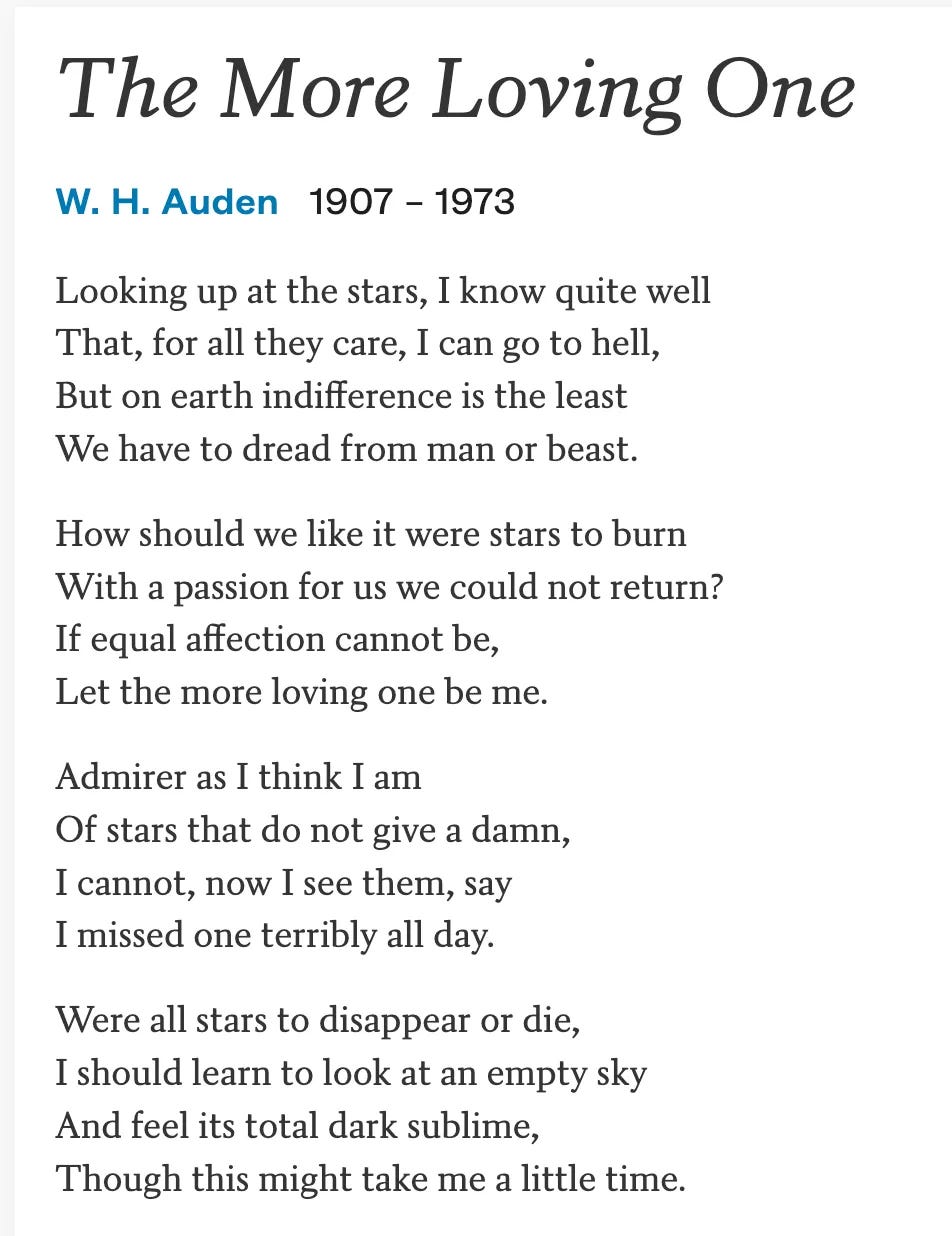
By my read, this poem essentially says:
The stars don’t care about me. And that’s okay, because indifference is the best we can hope for on Earth.
Would it even be desirable to be loved by something you couldn’t love back? I’d rather be the lover than the object of an unrequited passion.
Looking at these stars again, I’m realizing I didn’t even miss them during the day.
In time I’d probably find the absence of stars just as beautiful as their presence.
I’d like to challenge a premise of the poem. Auden claims “indifference is the least we have to fear,” and I do not agree. Our indifference to the stars has actually produced some pretty bad outcomes.
The second stanza re-emphasizes his point that indifference is the least-bad option among some very ugly alternatives—hatred, violence, cruelty, possessiveness, or even love.
The poem then demonstrates how indifferent Auden in fact is toward the stars. He didn’t think of them all day, and if they disappeared tomorrow he’d get over it.
A tidy little poetic package: Indifference is good, and I am indifferent.
Auden believed his choices to be (1) stars; or (2) an empty sky / dark sublime.
He did not know about option (3): The current stars, but shrouded and invisible due to light pollution and satellites.
Perhaps you are thinking, but I’m not indifferent to the stars! I'm a great admirer of stars!
Well, admirer as you think you are, let me call your attention to three things that I think will illustrate my point about the harms of our indifference:
The night sky visible to human eyes brightened an estimated 9.6% per year from 2011–2022. A place where a child could see 250 stars would, over an 18-year childhood, decline to about 100 visible stars.
According to 2016 data, the Milky Way was already invisible to nearly 80% of North Americans.
Starlink alone had 10,876 satellites in orbit as of July 30, 2026.
For perspective, DarkSky estimated in May that there were about 15,000 active satellites total orbiting Earth.
We have reached the point where darkness itself is being reconceived as a market inefficiency. Soon, if Reflect Orbital proves correct, you will be able to buy an end to night for $5000 per hour for their “Sunlight as a Service.”
They propose to illuminate 3-mile-wide sections of earth by reflecting sunlight off their 59-foot space mirrors. This will be helpful for search and rescue missions, they say, or nighttime concerts.1 Lighting isn't neutral. Darkness provides rest, concealment, ecological signals, privacy. Artificially extending daylight has historically been connected to work and productivity as much as convenience.
Reflect Orbital has proposed launching 1,000 satellites by 2028; 5,000 by 2030; and 50,000 mirror satellites by 2035.
Perhaps you will agree that, admirers as we think we are, at a societal level we remain stubbornly indifferent to the stars. And that indifference is not a boon but a massive threat.
I think of nighttime and starlight as part of my human inheritance: something no one created, no one earned, and no one needed permission to receive. For almost the entirety of human history, the night sky was simply there. Because no one owns it, there is remarkably little to stop individual actors from degrading everybody else's access to it.
It’s the great tragedy of the commons played out on an interstellar scale. A market gap just waiting to be privatized, exploited for capital gain, atomized and sold back for parts to the highest bidders. Like when corporations block views of the ocean by floating billboards.
No one owns a view, which makes it ripe for exploitation.
In 1957, when Auden penned his poem, you could look at the stars and imagine the relationship as one-way and consequence-free. They don’t care about us; we admire them or don’t; nobody gets hurt.
Auden could imagine a sky of endless blackness. He couldn’t have imagined a sky full of stars that remain exactly where they always were, while we systematically render them invisible—and then launch tens of thousands of artificial objects into the darkness.
We fill low Earth orbit with satellites. We wash the sky in artificial light. We build ever-brighter cities and then create “dark sky preserves” to protect scraps of something that used to belong to everyone. No one had monetized the stars—no one owned them, despite whatever certificate you printed off the internet—and soon they will be gone. Or not gone—there, but forever out of reach.
Apparently we are now technologically ambitious enough to ask whether nighttime itself is an inconvenience that can be engineered away. As if nighttime is not essential to the natural cycles of plants and animals. As if maximal productivity is the ultimate purpose of existence, and unintended consequences don’t exist.
Auden imagined an empty sky as the ultimate loss—though with self-assurance that it was a loss he could recover from. And perhaps he’s right. Maybe humans don’t need stars after all. Though they were instrumental to the evolution of human thought about mathematics, philosophy, religion, and our place in the universe.
But for most of us, maybe they don’t matter all that much. Maybe we’ll find meaning in the blinking satellites and giant space mirrors.
I was told this was a poem celebrating the person who loves more. But when I began to memorize it line by line, I kept encountering something else: A poem embracing indifference.
Here, in 2026, I’m not sure we can afford that comfort.
Admirers as we think we are, of stars we mostly cannot see.
I’ll have to work on cultivating my indifference.
But what does it mean to claim to love something that you have made invisible through accumulated acts of not caring very much?
I’m not a poet, but I do like a good parody/re-write, so here goes.
Looking up at the stars, I see at last
That they’re an object of the past.
On earth, indifference is the cause
Of so much squandered, loved and lost.
How should we like it, were stars to burn
With no eyes to see them in return?
Since equal access cannot be,
Let the more loving one be me.
Admirer as I think I am,
The stars know I don’t give a damn.
I leave on lights by night and day,
And watch the satellites launch away.
Were all stars to disappear or die,
How would we know it, you or I?
I look instead upon a screen
And endless day where night had been.
I can imagine far darker purposes. At prison camps, or work sites, for instance.
No posts
Comments
Nothing yet. Say the first thing.
Sign in to join the conversation.