
Spoilers of a 3000+ year old work of literature below.
Who does not understand thunder, or fire?
So says Athena, a goddess in a movie that is ultimately deeply human.
The events of The Odyssey take place not in some other land of myth. This is happening here, in our shared world. A long time ago, to be sure, but these are our cultural ancestors. Inhabiting a world where some men believe very literally in all manner of gods, and collect and study evidence of their actions. And where others remain skeptical, and suffer psychotic breaks and visual hallucinations.
Nolan’s film is in the end a human story. A story of religion and meaning and a man’s place in the world. What we owe to one another, and to the fallen, and to our children.
Scrolling through my Substack feed, perhaps these men are closer to us than their oars and helmets might suggest.
In Christopher Nolan’s The Odyssey, we’re told at the outset that this is “a world of apparent magic.”
Apparent is doing some heavy lifting in that sentence, and throughout the film I was riveted by that question. But are the Gods really real?
Odysseus seems to be the only man of his crew who does not believe in the literal wrath of Zeus or sabotage of Poseidon. And yet he prays often to Athena, literally seeing and speaking to her and clutching her totem, a talisman from his waiting wife.
But is Odysseus a non-believer? He does certainly believe in the law of Zeus, and he believes in Athena enough to pray to her, speak to her, and follow her instructions. So perhaps what he disbelieves is not the gods themselves, but in man’s ability to interpret their will. When his men say “this storm means Poseidon is angry because you did X,” Odysseus does not believe.
This is the difference between experiencing everything in nature and consciousness as mystical and charged with meaning, versus deciding that a bird hit my window because God is personally warning me of an imminent death. Odysseus might agree that it means something, but not in my ability to accurately decode the will of the gods.
But is the magic real?
The Cyclops is clearly real within the world of the movie, as is the monster Scylla. The Sirens and Circe’s magical abilities appear quite literal, too. The dead speak, and tell true tales, and provide a genuine physical threat.
So is this a world of magic, or a world of apparent magic?
According to Homer, Odysseus calls his true name out to Polyphemus, the blinded Cyclops, as they sail to freedom, and Polyphemus summons the wrath of his father, Poseidon.
In Nolan’s version, some men believe they hear the unnamed monster crying out in pain to Poseidon, and they then begin interpreting every adverse event that takes place at sea as the god’s wrath. But it is left ambiguous as to whether the weather is the routine course of storms and unfavorable winds, or if the gods are truly intervening.
Notably absent from Nolan’s telling is the bag of winds gifted to Odysseus by Aeolus. In Homer’s epic, Aeolus bags up all the winds save the gentle west wind, and Odysseus and his men are close enough to Ithaca to see the home fires burning when his men open the bag, thinking it some special plunder Odysseus is keeping from them, and the winds drive them away. I wonder if that event was excluded because it would have ruptured that ambiguity about the role of the gods, and man’s direct power over the forces of nature.
I thought Nolan’s version was psychologically rich. Rather than a victim of adverse fate, Odysseus could not go home because he was not ready to return, too traumatized by the violence he saw in the sacking of Troy. He ate Calypso’s lotus to hide from his psychic wounds. (This is not canon, by the way—in Homer’s version the land of the lotus eaters was a separate island, and Zeus orders Calypso to release Odysseus, she doesn’t do it out of the purity of her compassion.)
For Homer, the Gods are quite literal. Physically embodied and present. But the Gods do not appear in physical form in this movie. Even Athena, who seems the most real and present throughout, is revealed in the end to have been a priestess in Athena’s temple in Troy. Odysseus witnessed her decapitation at the same time the statue of Athena was beheaded, and all his pain and trauma got wound up tightly in the idea of Athena and became a psychic projection. He was seeing the face not of a goddess, but of a mortal woman murdered at the hands of his men. Whether this means Athena was always a psychic projection, or that guilt was the form through which Athena chose to speak, is left unresolved.
Odysseus is the closest to a non-believer in his crew, yet he is the only man to survive. He is favored by the Gods while disbelieving in their interventions. In the end he must submit himself entirely to Poseidon in order to return home.
Why do the Gods not speak in ways we can understand? Odysseus wants to know. Who does not understand pain, or a good harvest? Athena replies.
To me this suggests another layer of subtext to the film: Are there supernatural forces working in our world now? Gods we fail to understand as such, committed as we are to our rationality and the scientific method?
At the conclusion, as Odysseus and Penelope sail into the west, Odysseus tells Penelope that their Bronze age is ending. When he violated Zeus’s law with his scheme of the Trojan horse, he severed the fragile ties binding men to one another.
In this world, Zeus’s law is not only a religious commandment. It is the agreement that makes civilization possible: The stranger at your door may be dangerous, but you feed him before you ask his name.
Odysseus turned that trust into a weapon. Once he proved that hospitality could be exploited by the strong, why should anyone continue honoring it?
This reminded me inexorably of the current unraveling of our political institutions and system of international alliances. When you can bomb a country mid-negotiation three times, why would they return to the negotiating table? When a treaty signed by the president can be torn to shreds by the next administration, what is the value of a piece of paper, or a signature, or a promise?
When videos can be deepfaked, when politicians can lie in the face of clear evidence, what value has truth?
Words are wind, as George R. R. Martin writes.
Might makes right begins when shared norms become weaknesses available for exploitation.
In the Mediterranean after Troy, the lawlessness of Might Makes Right will reign, and the people from the sea will come with their lawless ways and seize what they wish, leaving death and devastation in their wake. The world will descend into darkness.
Odysseus initially imagines the people from the sea as lawless invaders who will arrive from elsewhere. Penelope understands before he does that they have already arrived. Odysseus and his men became them at Troy.
Perhaps civilizational collapse does not begin when faceless barbarians breach the walls, or when caravans of nameless migrants penetrate the borders. Perhaps it begins when the people inside the walls decide their own laws no longer constrain them.
A new culture will rise, Odysseus prophesies, one that knows of Troy only through song. Because song will be all that is left of those who can now write.
This turn at the end—not canon—brings Nolan’s film even more closely into our literal world. He locates the events of The Odyssey on the familiar historic timeline. Perhaps there was a time with literal cyclopses and scyllas, just as there were literal dinosaurs.
Ancient Greeks seem to have believed so. When Ancient Greeks in Sicily discovered the oversized skulls of Pleistocene dwarf elephants they believed1 they were giant human-ish cyclops skulls, and it’s not difficult to imagine why.
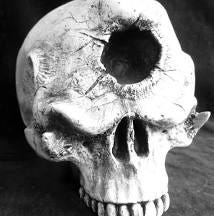
Sailors famously believed manatees and seals to be beautiful sea women, and the sirens are depicted perched on rocks surrounded by lounging seals, perhaps a nod to this history.
But I digress.
Watching the end of the film, with Matt Damon and Anne Hathaway chasing the setting sun, felt particularly profound here at the end of the Holocene.
We are all standing on the edge of a climate cliff in a world descending into war and nuclear proliferation. A world that moves every day inexorably toward its doom.
But how do you fight this?
I would ride out with my helmet on, but there is no battlefield. Odysseus’s battle is against the will of the gods and the forces of nature, but how do you fight to protect those forces from the relentless onslaught of man? I’d wish to fight for the ocean and alongside Poseidon in this battle. To surrender, as was Odysseus’s path to salvation, means death. And not just for myself.
So how do you saddle up and ride out to battle in this modern era?
Odysseus survives only when he stops treating the sea as something his will, intelligence and violence can conquer. Submission to Poseidon is an acknowledgment of human limits.
That is almost exactly the problem we face at the end of the Holocene: Our civilization is built around refusing to submit to material limits. We dam, burn, dredge, mine, fertilize, frack, refrigerate and engineer our way past every temporary boundary, and we interpret each successful deferral as proof that no boundary exists.
I wrote about managed retreat recently, and this feels connected. Submission looks like admitting that this land belongs to the sea now. We cannot hold back the tides indefinitely. Our survival requires accepting that fact and moving.
Perhaps the gods are real wherever human beings encounter powers they cannot control: weather, war, guilt, hunger, grief, love, time. The modern error may not be that we stopped believing in gods. It may be that we renamed them “systems” and then imagined that naming them meant we had mastered them.
Thanks for reading This is Not Ideal! This post is public so feel free to share it.
I’m not going to get into the weeds about every single point of divergence from the original Homeric epic. I haven’t read it since the ninth grade, for one thing, and who cares, for another.
The movie is very good. Go see it in theaters if you have any interest.
I did however feel that the dead people did not need to be violent attackers. I actually laughed when Odysseus and his men were getting chased to the ships yet again—I feel like I watched that same action sequence at least three or four times. I would have cut the island with the giants entirely, had it been up to me.
Matt Damon’s beard does a lot of storytelling work.
I was not clear what Odysseus understood in the end about Penelope posing the test for the suitors. Presumably we’re meant to believe that she recognized the beggar as Odysseus and deigned the trial for him? If I was meant to glean that from the acting then it was too subtle for me.
Odysseus asked Telemachus to test Penelope’s loyalty, and she seemed to pass, but when or how was that communicated to Odysseus?
Telemachus was cast as too old looking. Tom Holland is 30. It made the whole premise that he couldn’t possibly claim the throne of Ithaca a little bit thin, which weakened the stakes. They needed a less manly actor, perhaps a baby-faced 19 year old, or else to take artistic liberty and compress the timeline of Odysseus’s absence from 20 years to perhaps 15.
A compressed timeline also would have made the dog’s role more plausible ;)
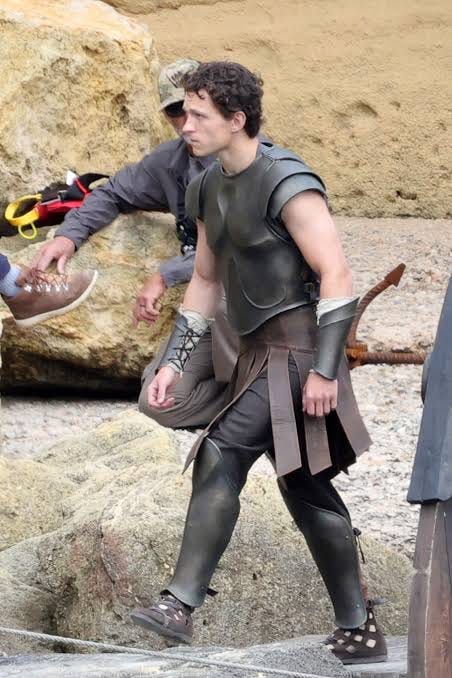
Throughout the film we are told the significance of Odysseus always wearing Penelope’s brooch, and yet I don’t think we ever actually see him wearing it. It’s always in his hand. This bugged me irrationally.
I didn’t completely understand Penelope’s motivations—I think this would have been solved by a younger Telemachus, but it kind of seemed in that one scene where she yells at him as if she were trying to selfishly cling to her position rather than relinquishing her own power in his favor.
It also seemed like Zeus’s law would have been fine with Telemachus killing some of the suitors once blades had been drawn and they were in a fight for their lives, no? I didn’t really get why it was so important that he not participate in the final fight with the suitors, other than to make Matt Damon look like a badass of course.
It didn’t really bother me that Nolan cut out all the sex—with Circe, with Calypso, etc—but in the book Odysseus fucks. I actually appreciated this omission as an artistic choice, though.
Okay, what did I miss?
apparently it’s disputed what they believed about these skulls, but I read this in a sign at the museum down the street from my house when they had an exhibit on mythical creatures and I am choosing to believe it.
No posts
Comments
Nothing yet. Say the first thing.
Sign in to join the conversation.