
There’s an old tweet from the Twitter of yesteryear, long since lost amid Elon ruining the search engine. I might get the specifics wrong, but in short;
“I’ve invented a new device that’ll transform the user into any creature, real or fictional, at the touch of a button!”
“Say no more, hand it over!”
“And best of all, it works with no pain or discomfort at all!”
“…
Well…”
I’m not a furry, but I do work in transformation fiction, and I think about this tweet so, so, so often. Transformation is ostensibly about finding your true self, but it’s also about the process of discovery and self awareness. You could think about it like a metaphor for growing up — it’s not just about getting older and wiser, it’s about the rampant hormones, the awkwardness around other people who can see you changing, and the painful feeling of your joints popping and itchy skin where hair is growing.
Without that discomfort and pain, it just doesn’t feel real. And just like BDSM, if it doesn’t feel real, if it doesn’t come with discomfort, it’s not hitting the buttons correctly. It’s integral to transformation fiction. Furries, gender, cybernetics, giantess… it’s all the same. It’s about the feeing of the you deep down, who craves to be dragged out of your shell, exposed to the world, and told you like it.
If you’ve ever seen forcefemme fiction, it’s this too. Yes, the ‘boy’ in question is being bullied into it, sat in front of a mirror, his hair brushed and makeup applied and every little angry shout silenced and teased as the girl around him force him into a dress and tell him his name is ‘Bethany’ now, but deep down… doesn’t he secretly like it? Or is he just surrendering? Either way, the story ends with him gleefully living as a woman, and soon the concept of what he ‘wants’ is gone. This is who she is, and she’s beaming in her wedding dress next to her man. What she was before no longer matters.
Welcome to the wonderfully icky world of dubious consent.
It is essential to good transformation fiction to create murkiness with the seven stages of grief. How much can a trans girl reader appreciate forcefemme if she doesn’t see her own process of accepting her gender — denial (“"I’m not trans”), bargaining (“maybe I’ll wear cute stockings in my room alone sometimes”), rationalization (“I mean tons of guys do this, right?”), et al?
So imagine my curiosity when I saw that there is a teaser for a sequel to the Hades Calculus — yes, that exact same Hades Calculus — in the form of a short dollification smut, as marketing for the release. I naturally was curious and looked into it, and, no prizes for guessing what I thought.
But I’m not here to dunk on the Ying crew (or just Benjanun) as a lazy, self absorbed writer. I did that enough with the review. Instead I’m going to use this as a jumping off point to demonstrate how kink needs to be mean — maybe a little, maybe a lot, but it cannot be cozy and life affirming the entire time.
I’m going to go over Maw of Spring, the Maria Ying short, and critique it in the places where it fails and succeeds. Then, for comparison, after that I’m going to show you some amateur bimbofication smut I found that has a nice amount of overlap with the meaning and fetishes operating in Maw of Spring, and use it as an example of how the writing team behind it (Benjanun S. most notably but also Devi Lacroix and apparently a third writer I couldn’t locate) could use improvement.
To any fans of the Gunmental Olympus world reading this and getting mad; no, this is not me going for a dunk or settling some grudge with Benjanun. This is my genre and it means a lot to me. Grow a thicker skin.
I will give you a second right now to read through the story. It is not long, and you’ll need context for when I start analyzing it.
Welcome back.
If you’re a filthy cheater who skipped ahead; Maw of Spring is a short story about a nameless reader-surrogate in Elysium who idolizes and worships Persephone, while feeling discomfort and disaffection in her life. She craves both to be turned into something better and also inexplicably to be hunted by Persephone like game. She’s sent an offer by Persephone herself, for some reason, to be hunted through the gardens, turned into a Persephone doll, then cannibalized. Her life after fades into a blur of increasing dolls being produced, eaten, or sent away, while she waits for her turn obediently.
I will say, the cannibalism at the end depicted is mercifully more graphic and gnarly.
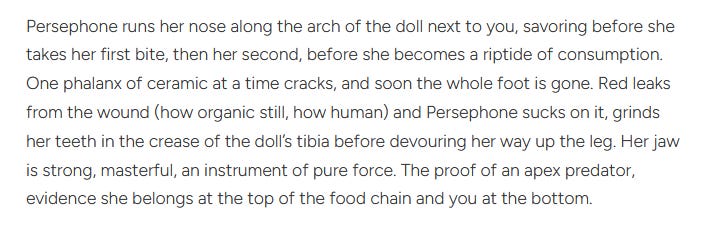
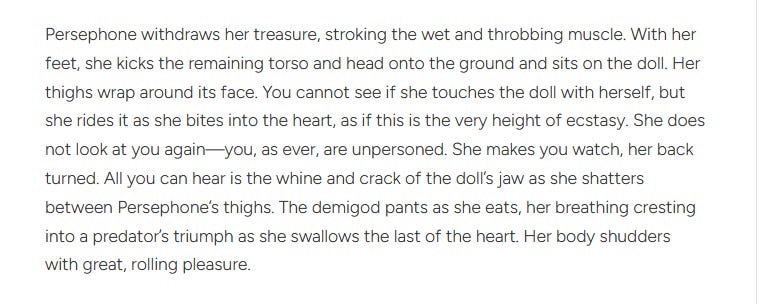
Hey, not bad! There’s some real viscera here, blood pooling on the floor and gore fed into her waiting mouth. There’s even that comment of “an apex predator,” reiterating the concept of hunter/hunted that is the core metaphor of devouring another living being. Seems like like the writers took the criticism I wrote in my review… to heart!
🥁
However, the transformation really doesn’t seem to get the kink at all. Like usual with the Maria Ying brand, there’s moments of true insight into the subjects they’re working with, and it’s all totally drowned out by the sloppiness. A constant feeling of just not really getting it.
Our protagonist;
Feels a sense of detachment to peers, family, and work✅
Secretly craves to be someone else ✅
Is fascinated with something disturbing she doesn’t fully understand✅
Reacts with denial and deflection when confronted about it✅
Great! Good start! But then we get this:
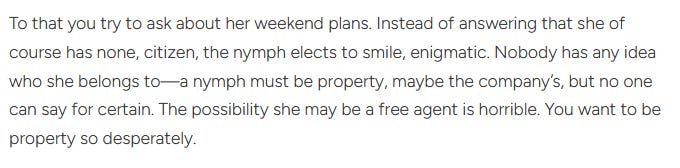
Five paragraphs in, and all of the tension is leaked out by the statement, “you want to be property so desperately.” We already know where the story is going, it’s a part of the premise, so why are we being this obvious and blunt? You can just imply this with the narrative, in fact that’s the entire point of the payoff!
But similar to THC, I get the feeling Ying’s crew (I’m just going to call them “Ying” from now on) are deeply uncomfortable with the concept of dubious consent and forcing the characters to do things they don’t want. Which is ironic, since THC is all about living as property, and contains multiple sex scenes between slave and master, but hey what do I know.
Well, maybe the hunter/prey cannibalism is better about the murky kink we’re playing about.
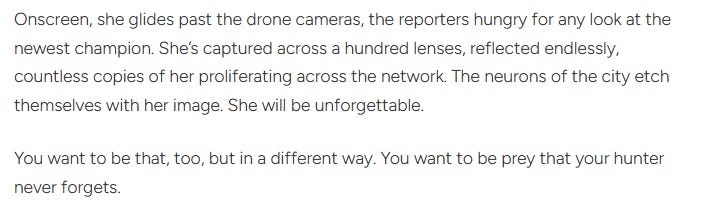
Recall when I said that THC was a loose assemblage of cliches from popular fiction jammed together — the combination of kinks here is similarly disjointed and strange. The hunt, an inherently violent act, is concluded with a taunting “Caught you,” and then her body is replaced, and then she’s not even eaten, other dolls are? Beyond bad and unsatisfying, this is just confusing.
Maybe it’s just my 10 years of experience speaking but why not pull from the classics in times like these. Take a quick glance over The Most Dangerous Game and think about how it works, and how to reproduce that same effect.
Ergo, I propose the following revision to Maw of Spring; Move the dollification scene up before the hunt. Persephone, bored by the luls in combat between colossi attacks, has taken to hunting citizens who volunteer to be her prey, but because of her augmentations she never loses and the hunt has become boring. Instead she needs to hunt the ultimate prey, the true apex predator — herself. The rest of the story continues the same, but moving the transformation earlier makes everyone’s personalities more obvious.
As of now, Persephone is just kind of wants to be a murdering sociopath for no reason, and the protagonist seeks a new life, but that’s all she seeks. She doesn’t mind dying from being eaten, or losing who she used to be in her new body, or even that terrifying sensation of what if I regret it now that she’s here? She just kind of exists to be the main character of this story, and yes I know it’s second person perspective — hence pointing at the reader with “you” — but these are the human, instinctual emotions people feel when their life is about to change forever. Cold feet when getting married, anxiety before a ski trip, feeling sudden dread when getting on the bus to go to the military, et al.
And also, what’s going on with Persephone in this? She’s already a flat, strange character in THC, but suddenly she’s here as some sort of wild animal Elysium just kind of throws its own citizens to keep her happy? Wasn’t she obsesed with not being like Demeter in the last book, and here she is just gutting and eating and fucking her clone army of dolls? I’d almost consider it clever narrative parallels between mother and daughter if it wasn’t happening so suddenly and violating everything I knew about her in the last book.
Side note; recall my THC review where I pointed out Persephone is (I believe) Benjanun’s personal author self insert mary sue who is always comforted and loved by the supporting cast, to the point that it’s kind of creepy.
Now think about how our nameless protagonist here worships, obsesses, and loves Persephone and fixates on her beauty, her violence, her poise, and thinks of her as a divine, perfect being and wants nothing but to please her, believing she herself is nothing but a bug who is blessed to grace its disgusting fingertips on Persephone’s divine feet, and it isn’t creepy, at all. Almost like the writer(s) are telling the reader she is correct to feel that way.
I’m just saying.
But okay okay okay, it’s transformation kink, that doesn’t matter. How is the process of changing, does that land?
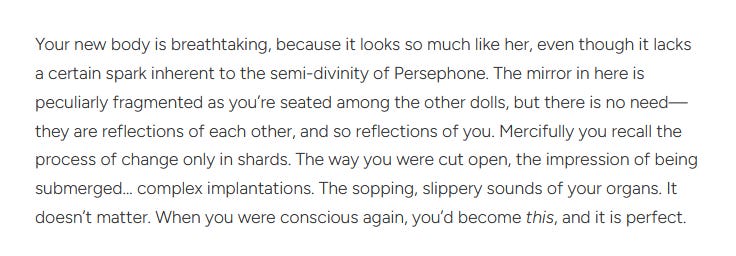
Once again — we shove something Ying is not interested in writing off screen. I reiterate the pattern once more, where we get little hints of understanding in things like “the way you were cut open, the impression of being submerged,” but we never see it, feel it, experience it. The kink of dollification is simply you were human, and now you are a doll.
There’s great little hints in the final scene about the blissful existence of simply waiting for your turn, never looked at or acknowledged, and when you’re summoned it is to perform someone else’s demands. Again, great! You are literally objectifying a person, terrific. The doll goes on the shelf to be pretty and not speak.
But then there’s no payoff. All of it keeps being about worshipping Persephone, but there’s not even anything to make our protagonist’s existence pleasingly pathetic. This is obviously sexual to the protagonist, right? So why do we not get some sort of embarrassing sudden orgasm when Persephone gets close enough to smell or brush against her? Maybe Persephone gives orders and she blurts out a “Yes mistress!” too loudly and feels embarrassment?
Again, circling back to the thing I said in the beginning — kink has to be a little mean. If we have a submissive subject and she’s not made deliberately uncomfortable, tortured a little with this thing she wanted, why bother? And yes it’s mean but it’s not violating consent — she already agreed to it, she’s here now, and she obviously enjoys it. So…why don’t we get a peek into her head in her new life? She should be euphoric, and yet that follow up is nowhere to be found. Setup, and no payoff.
But hey this is one piece of transformation erotica, thrown together quickly and for free on the internet as promotion. This is not a story dense enough to write any sort of review about. So instead let’s compare, contrast, and critique a similar story working in my genre — bimbo transformation fiction.
This is a story I collected more or less at random, by trawling through Literotica for something I’d never read before that fits my needs for this piece. I have my preferences on bimbofication fiction — limerick is a terrific writer in the genre — but this one is short, punchy, and follows similar themes as Maw of Spring; a disaffected, unhappy protagonist finding herself in a bad mental state, subjected to transformation into a new form. Her new form can’t do the tasks of the old job, so she finds a new one — and she’s happy to perform it.
Honeybird Bimbo is a three page bimbofication story about a failing inn, and the woman who inherited it from her father, Evelyn. The incompetence of her business is left vague — instead there’s just a slow collapse that makes her the sole employee trying to keep it running. She’s tired, stressed, and a little neurotic. The second a woman comes in looking for a place to stay, she’s overjoyed for customers.
The customer, Catherine, is uncomfortably observant of Evlyn’s woes, and Evelyn can’t help but dump her life story on her. Feeling some sympathy, Catherine magically changes the poor woman to be prettier, dumber, hornier, and more complacent. Evelyn resists and fights the changes, but acceptance takes hold as she becomes the Honeybird Inn’s star attraction — a ditzy, sexy little barmaid who loves to personally service the handsome men who attend it.
It’s light on graphical content — the most you get is a single blowjob — so I’d encourage you to read through it yourself. I’ll be collecting snippets, of course.
Similar to Maw, our heroine Evelyn is disaffected by her life, detached from people, and drained. This affects not just her personal life and mental state, but her physical appearance. She’s not doing well, and the harder she works keeping the inn alive, the more she and it decay. A fight against the inevitable, and she’s already losing.
Note also; Evie is about to lose her family business, in addition to being possibly made homeless if she does. In Maw of Spring, it’s explicitly stated that Elysium takes care of all needs for its citizens, which makes the mundane job merely disaffecting and not soul-crushing, thus robbing her of euphoria when she finds her new life. Another way the discomfort with punishing your characters makes them less relatable, less interesting. Be mean to them.
Catherine is your bog-standard witch character ‘fixing’ a problem for a person in transformation fiction. But there’s little details in the way they interact that add so much.
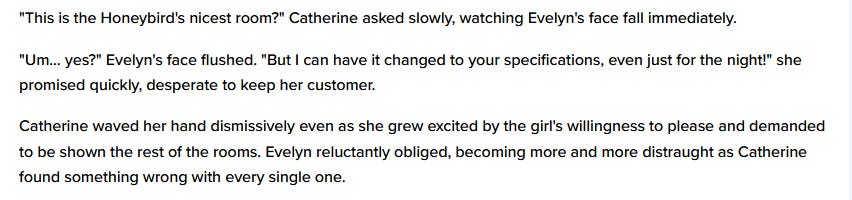
The dominant, imposing figure in the story toying with her prey. Again, I ask why Maw, which literally refers to the protagonist as someone who desires to be the perfect prey, has none of this sort of playfulness, not even Persephone standing in the distance simply watching, knowing there’s nowhere she can run.
Catherine then manipulates her with her faux disapproval, until Evelyn is out of options and shows her her personal room. Catherine insists on taking it, offers double her rates, and Evelyn bites back her desire to declare her personal space off limits because she needs the money. They share a meal together, and Catherine insists on some alcohol too, and in no time Evelyn is spilling her guts.
Lonely, broke, stressed, tipsy, and at her wit’s end, Evelyn walks right into Catherine’s trap.
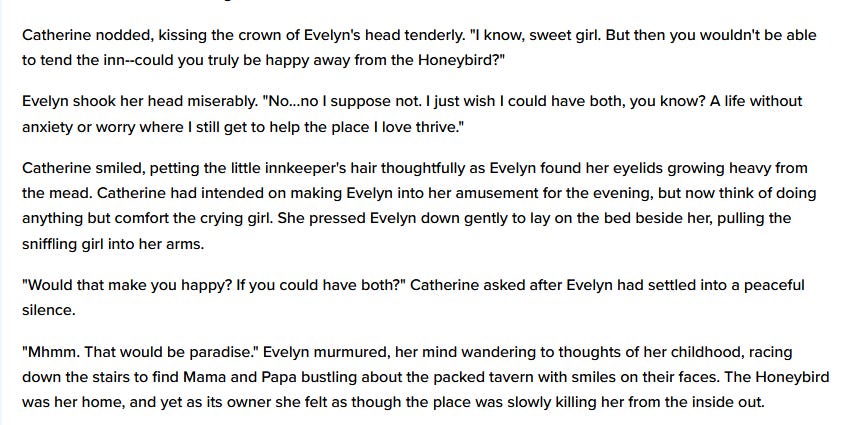
And like that, it’s done — Evelyn has unwittingly signed a contract. She will “help” the business, and stay here working for it. So humiliating to have your control over your family business taken from you, and yet at the same time, isn’t this really for the best?
Notice as how different this is from Maw. In Maw, we start out immediately aware the heroine wants things, thus robbing the story of any tension if she gets them. She worships Persephone, she wants to be property, she wants to be a doll. The rote job, detachment from the family, emotional withdrawal from peers, all of that feels less important compared to the simple, blunt, overly obvious declaration of, “I want that,” in a story about giving her that.
Therefore, when the letter arrives, all we get is little human moments like “of course not” or her secretly kissing the letter. The rest is just waiting for a transformation scene that got written around. Meanwhile here, Evelyn has relatable, human flaws and struggles and desires. If Catherine magicked her inn to be a booming success, Evelyn would have taken that deal in a heartbeat and we’d never get a bimbo transformation out of it. The murkiness makes the payoff all the hotter.
Evie wakes up the next morning, feeling strange all over, but oddly happier. And even a little… ditzy.
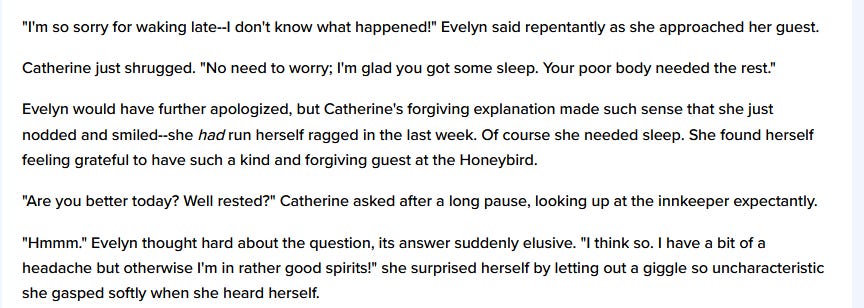
Her memory is in jumbles. Catherine helpfully reminds “Evie,” who she gaslights into thinking is what she likes to be called, that last night they talked about the inn, her stress, and Catherine simply can’t abide by watching women throw their youth away while miserable. And so Catherine took away her intelligence and stress.
Evie is outraged, but her brain runs slower and she’s more overwhelmed, and so she struggles to put to words the discomfort she’s feeling. And here’s where we get the absolutely essential scene in any transformation fiction — “What did you do to me?!”
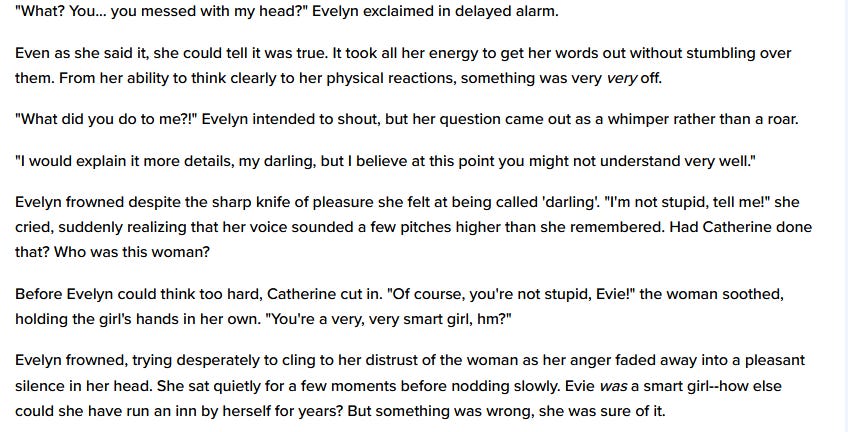
If you’re into transformation, especially ones with mental changes, this sort of scene is fantastic. We have an established character, unhappy to the core, being forced into something they want and they’re outraged by it. The denial stage. “Evie” wants so badly to be angry, outraged, but her brain isn’t cooperating.
Think of this like Goldblum’s fingernails falling off in The Fly, but in reverse. This is the moment the character realizes something is very, very wrong, and they’re slowly marching towards the inevitable, powerless to stop it.
Catherine clearly is doing this out of a sense of kindness, but there’s a condescending, predatory way she does it. She says she took away Evie’s intelligence, and Evie hotly declares she’s plenty smart, and Catherine gently comforts her, assuring her with no small amusement that of course you are sweetheart, just pertaining to… different things.
The bullying naturally turns more than a little sexual, paying off from earlier when Catherine undressed her and ogled her pretty body.
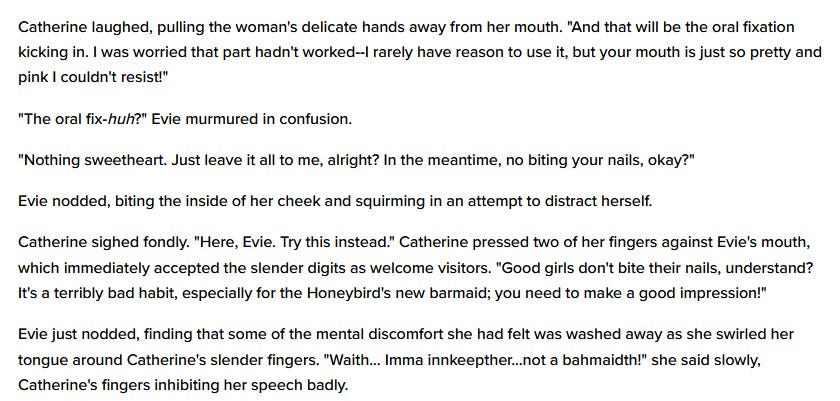
As Catherine explains her new role in the Honeybird, Evie starts to get compliant and numb to her previous confusion. It just feels better for her new simple mind to just… comply.
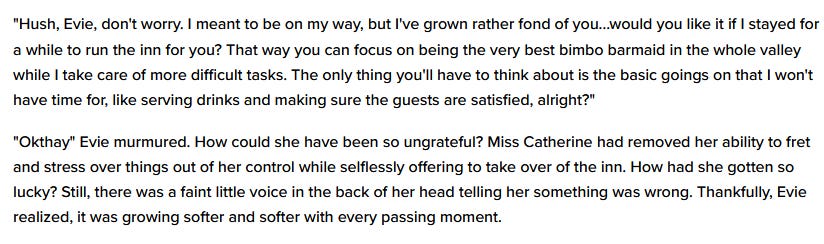
The transformation is taking hold. Her mind has been scrambled, reconfigured in a more pleasing way, and she’s already feeling tense and itchy all over as her body changes too. Complaints and worries fade as Evelyn fades, replaced only with Evie.
Again, none of this is in Maw of Spring. The nameless protagonist’s transformation happens and now she is like Persephone. The physicality, the loss of self, the mixed feelings — never appears. Wish fulfilment, absolutely zero struggle with the self.
Why is the struggle so important, you might be asking. Can’t we just give characters things they want and not make them suffer for it?
Let me ask you a hypothetical — which is more rewarding? A trophy you earned from years and years of grueling training, physical and mental focus building all for the moment where you compete in an Olympic race and achieve the gold, or a trophy you earned because you wanted it and someone handed it to you?
Obviously, the former. Achievement without struggle means nothing. You will look at that gold medal pendant for the rest of your life thinking about how hard you struggled and the moment you got what you craved. A trophy handed to you by some guy for nothing will collect dust and get thrown out because really, who cares.
This is how fiction works; setup and payoff. Zuko in The Last Airbender is a great character not because he rebels against his tyrant father, but because you watch two seasons of him struggling and flailing against his empty quest for honor, tripping and fucking up multiple times, to the point of returning home feeling utterly furious at himself for what he’s done.
The cry hug he has with Iroh means nothing without that long, painful, difficult struggle. Characters have to struggle with themselves, even in kink fiction, or the conclusion means nothing.
Where was I? Oh right, busty blondes sucking dick.
Catherine works to dress her like the slut she is, and we get this cute little callback to her new ‘oral fixation'.’
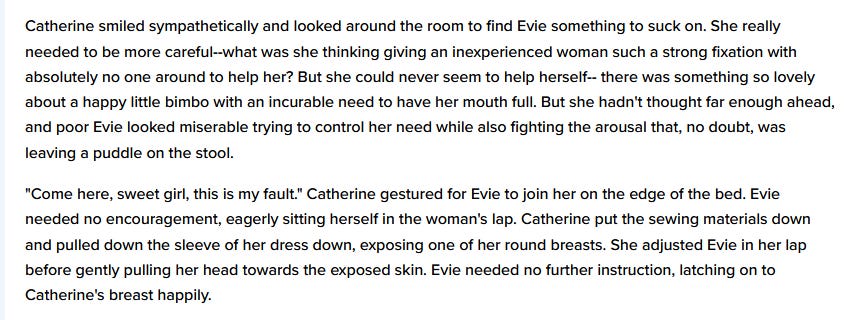
Notice how it’s even kind of inconvenient for Catherine, that her magic kind of overcorrected and is causing more problems for the witch. At this point Evie is so frothingly horny that she plans to fuck her just so she’ll stop suffering.
Is Catherine altruistic? Is she predatory? Is she just a mean lesbian who likes taking advantage of pretty little blondes, tricking them into asking for something so she can make them sexually compliant for her desires, rationalizing it as a form of kindness?
Who knows! The reader is not privileged for that information. That ambiguity reinforces the messiness of the characters and the nuances of their personalities. Which makes them more like real people, stuck in an extraordinary situation.
Ever obedient, the new Evie doesn’t question any of the orders she’s given anymore. Catherine says “greet the new customer,” and Evie says, “but I don’t have shoes.” Catherine says, “well, you don’t need those.” Evie immediately agrees and runs off. Would Evelyn have done such a thing? Absolutely not. Especially not while wearing something so slutty as a plunging neckline and no underwear at all.
The soldier is immediately taken in by her bright and sunny demeanor, obvious arousal, and slutty dress. He hesitates, but it’s abundantly clear that this woman is screaming for sex. So he tests the waters as they spend time together.
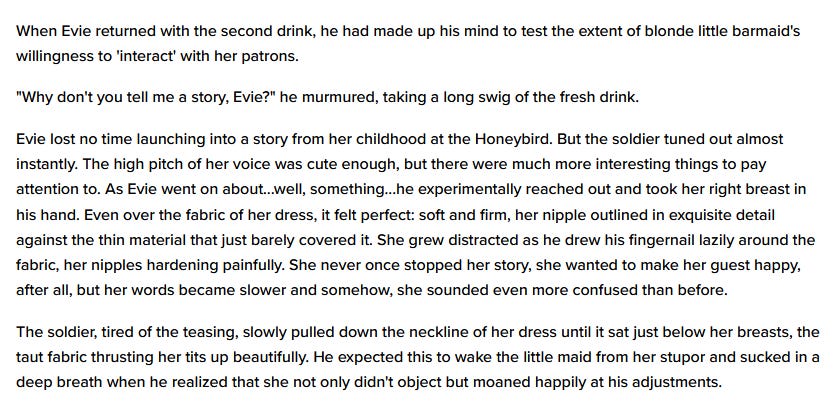
Note the subtle grounding effect here of the way the soldier interacts. Yes, Evie is a total ditzy bimbo now, dressed like a slut and the point of the story is for her to suck some dick and thank her customers, but he doesn’t know that. If anything, Catherine is the dominant here, not John. John just kind of is incidental to what’s happened, and he’s more than a little alarmed by what he’s seeing, even as his dick raises to attention. It makes him more relatable to be so complex.
He approaches it like a normal man, worrying about impropriety and violating a boundary. He sees body language, eye contact, and her tone of voice, and cautiously moves forward. He’s careful, but obviously very horny. If this was written like Maw of Spring, I assume we’d cut from Catherine telling her to greet the customer to her with his dick in her mouth already.
When Catherine interrupts them, he reacts like anyone with their pants down at their ankles and genitals out; panic, and shame.
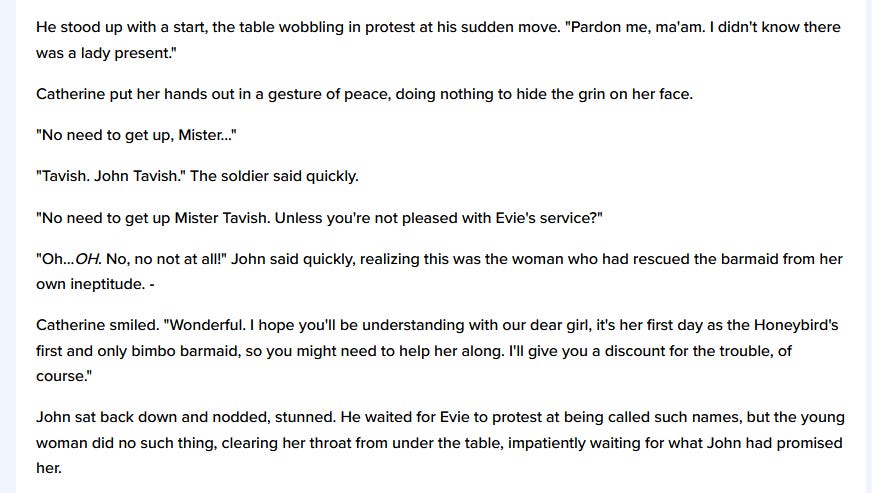
When she tells him, “go right ahead and fuck that mouth,” he’s not even eager at first. He’s largely confused and relieved, but certainly not discouraged. This is in fact very strange! But hey, she’s happy, Catherine is happy, and he’s getting a blowjob, so… when in Rome.
Eager consent? More than enough of it in his entire stay. Is it dubious consent, considering she never asked to be turned into a ditzy slut? Oh absolutely. But that’s part of the fun. John doesn’t know what Catherine did, and neither does Evie anymore. But everyone’s getting along great. So who’s it hurting? I reiterate — welcome to the fun of dubcon fiction.
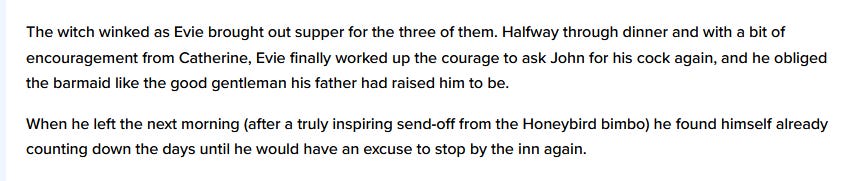
You might think to yourself, jeez, but turning her into a busty slut for men is a little misogynistic, isn’t it? And I ask you, I dunno, how misogynistic is it to forcibly change another human being into your exact likeness and then eat her? Again, this is kink, it has to be a little mean.
By the time the story wraps up a week later, with John Tavish’s friends all coming to the inn to see if he was lying about the bimbo barmaid, Evie is totally different. She’s spent a week getting fucked by Catherine, and growing wonderful curves from eating like crazy.
They stumble in on her doing jumping jacks wearing pratically nothing. She’s embarrassed, but not too much so. What else does a bimbo do?
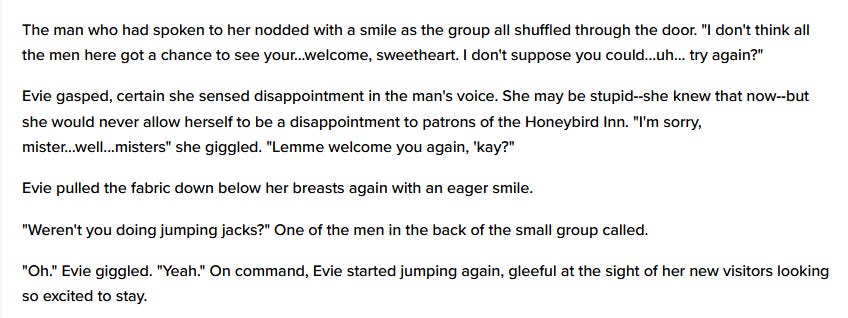
Now I will say, this story has some severe flaws. There’s some discomfort and awkwardness around describing bodies and faces, so the characters kind of blur into “Dark hair, beautiful” “small, blonde, nervous” “handsome man.” Eyes are also not mentioned, despite one of the core arousal points of flirting being eye contact. Just tons of little flaws of an amateur writer trying her best.
And sadly we must endure some baffling 4th wall breaks because the writer is terrified you might not pick up on subtle details like “Catherine lies about being out of thread so Evie’s legs are exposed,” which feels like it explains itself.
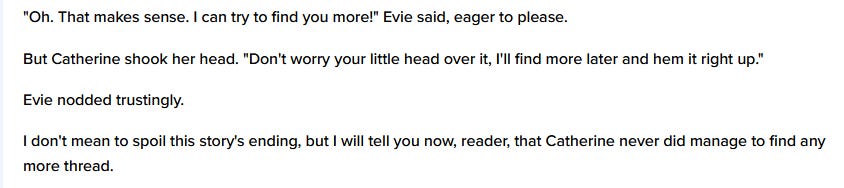
I think I might prefer a Marvel movie “uhh, in English, doc??” to this.
The prose kind of blunders around trying to make the act of fucking seem hot, which is probably why there’s so little actual sex in this book. The part where John cums in her mouth is very rough.
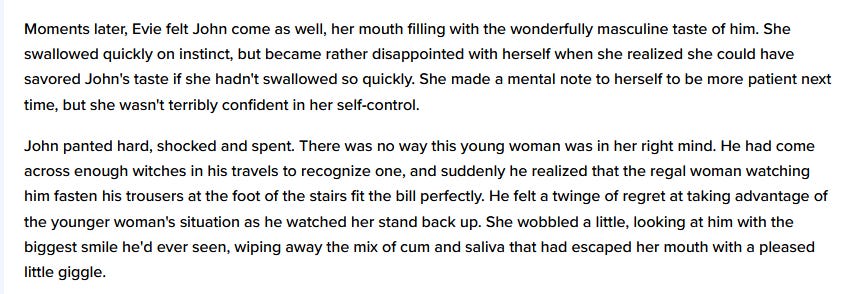
So many bashful, timid words like “masculine scent” or “member”, and it makes the piece seem bashful. We get “cock” but never “the head” or “the shaft” or what her tongue is doing in there? C’mon, this is good for fantasy novel fuck scenes, but this is smut, we’re here for some dirty words.
The concept of her sucking him off so aggressively and eagerly that she wants to savor the taste is nice, but nothing about actual taste here? Just, ‘masculine taste’, nothing about salt, or texture, or musky smell? The bio claims the writer is trying her first attempt at bimbo fiction, and I believe it. There’s a lot of telltale discomforts around blunt, physical, direct words in the act of fucking.
And yes, that second part, where he realizes what’s happening and just kind of goes along with it comes off as very strange, especially since the following paragraph adds that he just drops it immediately and compliments Catherine knowingly on her “talent.” There’s no reason to include him on the joke, and it doesn’t really add or subtract to anything, other than maybe delighting the reader that he knows and doesn’t care.
But all of this kind of falls away because of the plot construction and characterization. It kind of doesn’t matter because we like Evelyn a lot, and when she’s turned into Evie there’s a kind of sympathetic catharsis. You want her to be free of her misery, and now she is. Her new bimbo slut form is the payoff of all that struggle, both before the story and during. The reader wants to see her changed, because we know who she was before and it sucks to watch her suffer.
Or, as I’ve said elsewhere, if good people suffering is uncomfortable, then switch genres. Is your book too conflict-averse and everyone too nice for them to undergo strife? Then make the characters awful. Imagine if Honeybird started with Evelyn being a colossal bitch to Catherine, and Catherine took some petty revenge and the story rolled out exactly the same afterwards. Suddenly the catharsis of seeing Evie happy changes to the catharsis of seeing this obnoxious asshole getting a little comeuppance.
And if you’re not comfortable with a character getting justified punishment for her actions… are you sure like kink or writing?
No posts
Comments
Nothing yet. Say the first thing.
Sign in to join the conversation.