
I’ve tentatively started to freelance again, dipping my toe into occasional bakery jobs as I navigate getting back to work full time. As we get older, starting afresh is not really very fresh at all, there’s a whole suitcase of previous work-experience-luggage that we arrive at every new job with. There are good things too, of course, about having bags of experience. My hands still remember how to shape dough by default, my nose remembers the exact moment that the smell of bread changes from unbaked to baked, I can still feel when a timer is just about to go off or know how much something weighs just by picking it up. These are my baking superpowers and I’ve been reflecting on all the things that working in kitchens has given me over the past ten years.
The first thing I ever posted on this Substack page (which in itself was an old post originally posted on The Bread Companion) was an ode to being a baker. I wrote ‘A day in the life of a baker’ in 2017, three years into my hospitality career and re-reading it makes me incredibly nostalgic, soppy even — I was 28 and everything was so romantic, I was in love with my new career, rose tinted glasses very firmly on.
Ten years, one pandemic, two failed businesses and five freelance jobs (most of them awful) later, I’m not so rosey — in fact I feel pretty haggard, worn out by a decade on my feet, a decade of lifting things, a decade of burnt hands, early starts and late nights. If I directly compare my first account of life as a baker to my last bakery job the difference is poles apart. My first job was a dream, my last, an absolute bloody nightmare. I’d like to tell you all about it although I can’t name the bakery because I think they probably have a really good legal team and I’m not built for prison.
My shift would start at 6 am, but I was usually awake at around 4 because I lived in the poorly connected burbs and, also, I needed to walk the dog before I left. Previously, early mornings and late nights never bothered me. I would always joke that I was born to be a baker as I generally don’t sleep much and would describe myself as a professional napper, a useful skill for shift work. But those mornings killed me, most likely because, without realising it, I was very ill. I would drag myself over to the nearby bus stop on the side of the A406 as trucks, vans and others on their way to work hooned past, also fuming that they’d had to wake up this early. I’d arrive at the bakery an hour later and pull on my whites, awkwardly — there was no real changing room and the one staff toilet was windowless, full of fruit flies hanging over the pipes that leaked onto the battered concrete floor. There was no staff break room either, just a precarious mezzanine perched on top of the walk-in with only a ladder for access. One day, my line manager inevitably took a tumble off this ladder and seriously injured his back. The bakery was in a railway arch, there was very little proper ventilation, in the winter it was icy, in the summer it was a doughy sauna. No proper staff facilities was the first red flag I should have spotted.
Every morning, when the shop opened, a man would come by and purchase two croissants, one for himself and the other for his very old rescue dog. When we saw him approaching everybody would shout ‘CROISSANT DOG IS HERE!’ excitedly. It was charming, but I also found this slightly insulting as we, the staff, weren’t technically allowed to eat food from the bakery — staff food rules were cloudy, sometimes we would take a clandestine pastry, sometimes we were offered sandwiches and openly told to help ourselves, sometimes food was cooked for us, but the rules changed daily. Unclear messaging around staff food was the second red flag I should have spotted.
The first jobs of the shift were to weigh out ingredients and to get the focaccia, ciabatta and rye dough made. On my first day, I strolled into the walk-in in search of milk for croissant dough, only to find one of the pastry chefs screaming existentially at the eggs. She glared at me as I interrupted her — ‘oh, er… sorry…’ I muttered and about turned, returning to my station with no milk, much to the confusion of my colleagues. Witnessing someone having a mental breakdown in a fridge was the third red flag I should have spotted.
Queue red flags number four to one hundred and thirty seven — there were more very public mental health crises after that. They would most frequently occur in front of house, who, though were friendly were also extremely combative with each other — there were often tantrums, tears and dramatic exits.
The Pastry Girls were less shouty but deeply hostile, with a ‘you can’t sit with us’ vibe that I found thoroughly intimidating. Their boss was Pastry Daddy, a French guy who always wore leather when he wasn’t in whites, stank of aftershave and had his hair slicked back into a ponytail. Though he always had a grin on his face, he was perennially negative.
The bread section had far less drama, but we weren’t exactly an ideal team. I generally liked my colleagues except for the night bakers, a team of men who would arrive at 3 pm, usually stoned, for their evening shift — sometimes one of them would bring his pit bull to work and tie it to one of the posts in the warehouse entrance while he baked through the night.
With hindsight, none of these people were really, truly awful (apart from one who I will mention later). Everyone was just trying survive a toxic environment in a difficult city at a complicated point in time for the hospitality industry. Looking back on it they were all radically over worked, under-appreciated (most were very talented) and put under unnecessary pressure by poor leadership.
The bakery was a merger of two well established bakeries which had been bought by a large, flashy social enterprise. I loved the idea of being part of a new business, particularly one that on paper sounded so inspirational but realised quickly that I was just a cog in the machine and was treated accordingly by a whole team of people above me whose jobs seemed made up — there were a thousand line managers, account managers, social media managers, engagement managers, managers of all those managers who would often visit the bakery for ‘meetings’ and I never knew what any of them did or who they were in relation to me. It was like a parody of how to open a social enterprise, the ironic thing being that though this enterprise was attempting to do real good for people and climate, it treated its employees appallingly. It also massively exploited the previous owners of both bakeries. Part of the attraction of the job for me was that one of these owners was a baking hero of mine who had spent years building a really successful, top notch bakery. The social enterprise that bought their brand has not done it justice and it must be fucking heartbreaking to watch someone else mishandle the business you worked so, so hard to create.
Because the bakery was changing rapidly and I was a lowly, part time baker, nobody really noticed me and so I was never paid properly. The accountant who dealt with my invoices changed three times in the six months that I was there and nobody informed me of these changes. I was instructed (actually, I was ordered) that I would be paid weekly but this hardly happened and I was often left without pay for six weeks. Though the late pay and the revolving accountants were red flags, I’d also say that only giving the option for weekly payments is an orange flag to me, as it is basically impossible to budget when being paid on a weekly basis.
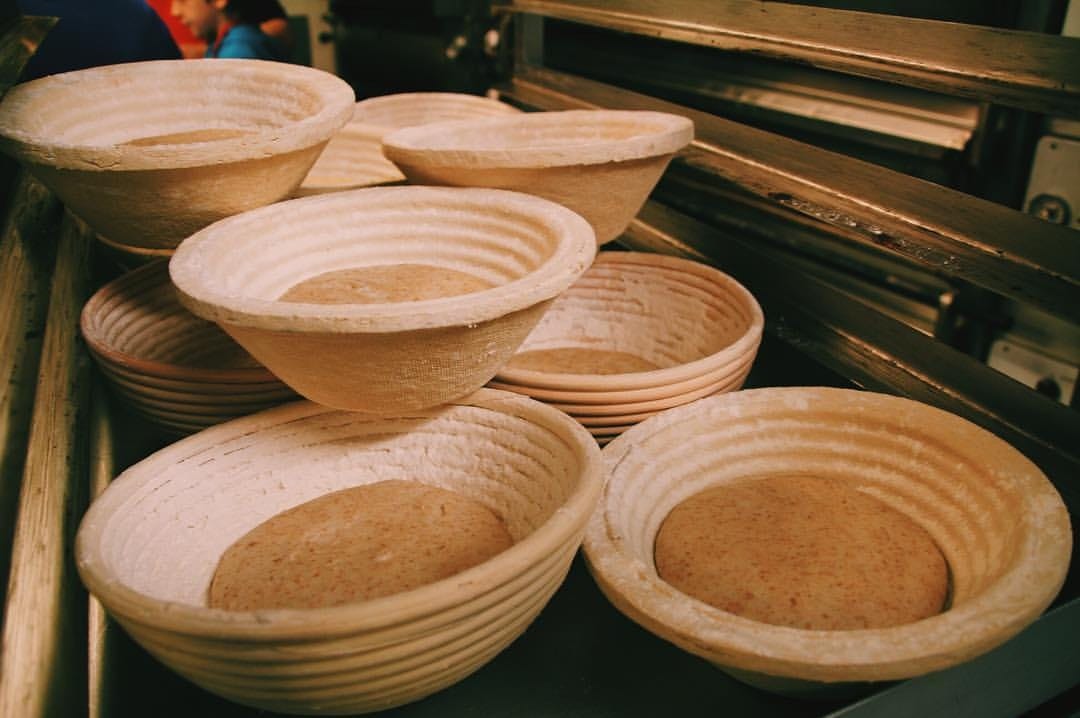
I liked to play a game at work. It was called ‘mouse poo or poppy seed’ and it was a pretty self explanatory game. Usually it was a poppy seed, but I’d say there were also times when no one really knew. The mice ran rampant around the railway arch, we often saw them dart under the workbenches in the early morning, or found entire families of them stuck to (inhumane) glue traps as we cleaned our stations in the afternoon. I once had to hold back tears after finding a little family of mice, tiny mice children included, stuck to the orange sticky paper, stunned and motionless. One day, it was my job to count out and prepare the bannetons, which are paper pulp or cane bread forms that give the bread its shape whilst it proofs. On a bake shift, unbaked dough is tipped out of the forms and they are re-stacked in very tall piles by the oven, ready for the next day. I counted out how many we needed and handed them to my colleagues whilst we shaped dough into rounds. As I got closer to the end of the stack, I noticed that a couple of bannetons were a little frayed around the edges. Suddenly, I found out why — there was a completely squashed mouse, flat as a piece of paper, in the banneton at the bottom of the pile. He would have climbed in to nibble on some dough or paper pulp while the night bakers were working and then would have had another pile of bannetons placed on top of him, then another, until he was slowly crushed by the weight of the ever growing stacks. The frayed edges of the paper pulp was where he had probably tried to chew his way out. I said nothing, just put the banneton under my manager’s nose. It was, he said, one of the worst things he had seen in a bakery.
As my time at the bakery progressed, my autoimmune condition flared up and up and away. My eyes swelled, like I’d been stung by a thousand bees and I couldn’t see out of them. My joints ached and the skin all over my body itched — I could barely walk after a shift. I ended up taking weeks off at a time and became uncharacteristically unreliable. Up until that point, I’d always been a grafter. Though I hadn’t been formally diagnosed with my autoimmune condition until I was 30, I had experienced flare ups from about 14 years old. This meant that, when I started working, I’d found it easier to work in a kind of boom-or-bust pattern, over-working two or three short contract, freelance jobs at any one time and eventually launching my own part time businesses so that I could take time out if I needed to temper any flares. Industries like design and hospitality were conducive to this way of working, but it was unsustainable and I often burnt myself out. It was this utterly horrendous bakery job that forced me to stop working in this way — eventually, I needed, not only to recover, but to take my Dr’s advice and start long term treatment so that I could live a more normal life.
Though I don’t attribute my chronic illness to magic, fate or anything other than what it is (an unfortunate combination of genetics), I do think that the bakery, in some ways saved me. My body said absofuckinglutely not, physically forcing me to hand in my notice.
On a hot August day, 3 pm arrived. It was the end of my final shift.
The Pastry Girls were silently rolling out dough and laminating pastries, looking furious.
The baristas and FOH team were crashing around, playing loud music and packing food away.
The nightbakers had arrived and were sweeping out the oven decks. I could hear one of them, a small Neopolitan man raising his voice at the Nigerian Kitchen Porter. The shouts became louder, I heard racial slurs and heated words, which became a shove, a shove became a stronger push and so on and so on.
I had said my goodbyes, changed out of my bakery clothes and swooped up a few unsold loaves of bread, packing them into my tote bag. I took one look at the fight, utterly depleted and walked away, my back to the bakery as the shouts of everyone else trying to break them up filled the air. Red flag number one thousand and fifty seven.
‘I am never coming back here,’ I told myself.
I didn’t work for another two years after that.
I have shared this story, not just because it is fun to bitch, but because I would like a reminder to respect myself, my skills and my value as I look for new work. If you work in hospitality and have found yourself in shitty, toxic kitchen after shitty, toxic kitchen, I hope you can do the same. As I now understand it, symptoms of chronic illness can include low confidence and a scarcity mindset due to an unreliable body, which means you’ll take whatever you can get, including the scraps of the job market. But I know now that it is never ok to ignore a bright, beaming red flag at work in the same way that it’s not ok to ignore them in relationships with partners or friends or family. Though there are plenty of bad hospo spots kicking about, there also must be brilliant ones and a job shouldn’t force anyone to beg for payment or recognition or care.
I am now looking for work that has all the magic of my first bakery job and believe that it’s worth refusing everything else that is anything less.
Thanks for reading! This post is public so feel free to share it.
No posts
Comments
Nothing yet. Say the first thing.
Sign in to join the conversation.