
I recently sat down with my old Vox colleague Ezra Klein for his great New York Times podcast to discuss #GLP1 drugs like Wegovy or Ozempic. Our conversation ranges from how the drugs work, to how they’re changing culture and healthcare.
Ezra has deep empathy and a rare ability to understand and argue issues from all sides. It’s what makes him one of the best journalists around, and a great conversationalist. Thanks to his questions, I think this is one of the most interesting discussions I’ve ever had about GLP-1s (or healthcare). I hope you’ll have a listen.
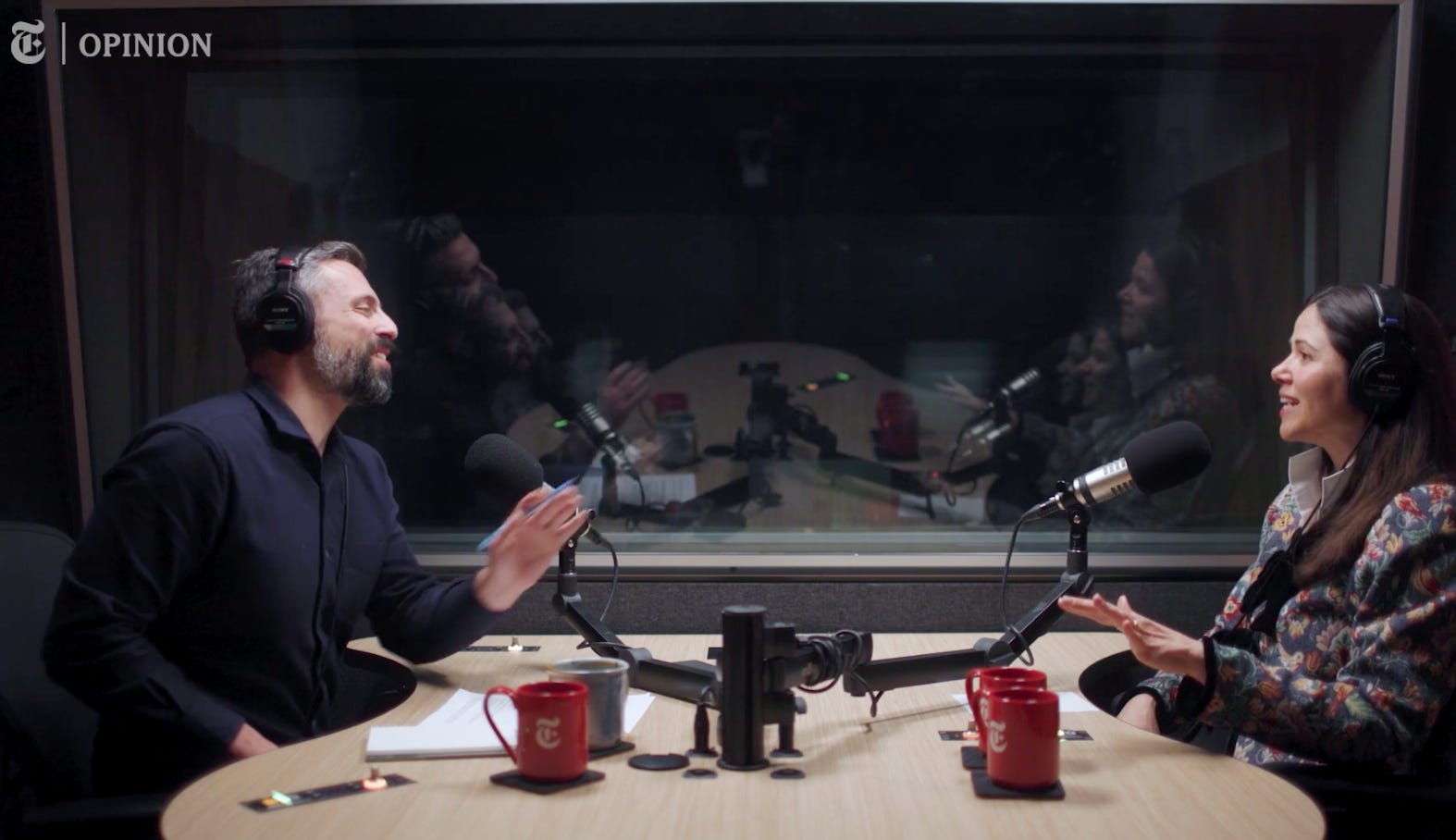
Toward the end of the podcast, we debated whether there’s any reason for hope that the U.S. food landscape will improve. Ezra was pessimistic:
I think you would need a level of paternalism for that. I guess what I would say about it is that there is not a single jurisdiction in this entire country where the politics of that have worked.
We cannot point at one thing, one place, one state, one city where we’ve been able to do that much. If it were there to do, I would be the first one to say we should do it. But I don’t think it’s there to do.
The public health community tried to get people to take vaccines in the aftermath, or in the math, during a deadly pandemic, and it led to like the largest public health backlash in my lifetime, such that R.F.K. Jr. is now the secretary of Health and Human Services.
People’s sensitivity to paternalism is very high. It’s a very potent political force.
His comment gets at a crucial reason we haven’t seen nutrition reform (or improvements in many areas of public health). As a reader recently put it to me, there’s a genuine “collision between scientific knowledge and a culture deeply committed to individual autonomy and skepticism of authority.” Instead of doing things like regulate supplements or mandate vaccines or clean up the food environment, we argue that people deserve the “freedom” to choose for themselves. We ignore evidence and put individual choice ahead of collective wellbeing.
And yet, I’m optimistic that things can change. There is currently a level of bi-partisan support for improving the food environment in the U.S. that I have never previously seen, even if action isn’t happening as quickly or comprehensively as I would like. Places as politically diverse as California and West Virginia are trying to do things like reduce ultraprocessed foods in school lunches, while the nutrition opinions of people as different as Robert F. Kennedy Jr. and the former F.D.A. commissioner David A. Kessler are virtually indistinguishable.
But more than that, history is littered with once-unthinkable public health measures that suddenly became thinkable. Over 100 years ago, it wasn’t uncommon to be poisoned by your lunch or to find ingredients like lead and calf brains in food in America. Thanks in part to research at the U.S.D.A. and Upton Sinclair’s book, The Jungle, Congress decided to act and impose laws that would prevent acute food poisonings in America. So that’s how we got the F.D.A.’s food inspection program, as well as the U.S.D.A.’s meat inspection program, as well as many other consumer and environmental protection laws. (For more, see Deborah Blum’s excellent The Poison Squad or Chapter 8 of my book with Kevin Hall, Food Intelligence.)
Before the passage of those laws, preventing acute food poisoning was a foreign concept, and one industry fought hard against. Now, we take it for granted that we will leave the dinner table without a stomachache.
Today, we need to work on preventing chronic food poisoning — that is, stopping people from developing food-caused diseases like obesity and type-2 diabetes in the first place. If we did it before, we can do it again!
What do you think? Are you optimistic or pessimistic?
Welcome. It’s nice to “meet” you. Here, I mostly ping any time I have a new story or podcast out, or with news and insights related to my reporting or book, Food Intelligence. For more on me, you can see this Substack intro, or my website. I’d love to hear from you, so send a note or comment any time.
No posts
Comments
Nothing yet. Say the first thing.
Sign in to join the conversation.