
I’ve been haunted by a dream that I thought was real—just this morning and many times before. In my pre-waking hours, I find myself behind the wheel of my car, facing down the cloverleaf entrance to a very busy highway. It’s something that has always frightened me, that I’ve learned to confront with calm, focus, and confidence that I don’t really have. In the dream, every time, I struggle to see ahead: the dashboard is too high, the rear windows too small, the side mirrors positioned wrongly.
Just this morning, the struggle was worse: I was literally blinkered, fighting with the visor which flopped to block my sight, unable to see in any direction, steering by instinct around the sharp curve. At one point, I do see, just inches before me, the back bumper of a truck, mostly white with red and blue stripes. Perhaps a postal delivery truck or service vehicle of some kind.
I’m desperate and focused and terrified, but like every time before, I do not fail to navigate the curve. I don’t die. I don’t crash. I don’t awakened in fright. But I am conscious of my panic as I navigate blindly forward.
This week, I’ve finally returned to my writing.
I’ve been struggling. Some would say blocked, though I tell my students I don’t believe in writer’s block.
I lie.
I am struggling because the work that I’m doing is extremely difficult and so different in tone, structure, content, approach. I’m experimenting. I’m risking. I’m absolutely uncertain. I lack confidence that what I’m creating even makes sense. But I keep trying. I keep doubting. I keep wondering if I should stop. Try something new. Something easier. Throw in the towel and maybe just knit or do something I can do without worrying whether it’s worthy, whether it matters, or will be published, or simply languish in the cloud. Whether anyone will care. Whether I dare even show it to someone who might.
If I knit a sweater, I get the pleasure of wearing it or giving it to someone I love.
If I write a novel, I spend hours, days, months, often years, putting words on a page that perhaps no one but my loved ones, under duress, will ever read—and may not like. In the case of this particular project, may not even understand.
In this 2019 interview on ON BEING, Joanna Macy, author, Buddhist teacher, climate activist, and translator of Rilke, talks about the unknown path, the uncertainty of seeing where we are going. She quotes a Rilke poem that spoke to me particularly strongly this morning, reminding me of why I do anything—write, wake up in the morning, live:
Widening Circles by Rainer Maria Rilke
I live my life in widening circles
that reach out across the world.
I may not complete this last one
but I give myself to it.I circle around God, around the primordial tower.
I’ve been circling for thousands of years
and I still don’t know: am I a falcon,
a storm, or a great song?
I am writing to figure myself out, to discover whatever it means to “circle God.” Letting go of the path to achievement and accolades and reaching for the amorphous walk toward greater understanding. Why else write? At this stage of my life, it is certainly not for money or fame. So does it matter if anyone reads it? Does it matter if anyone reads even these words? I am a blip of existence, trying to understand itself, using whatever means available. Using words, however inadequate and however inadequately. Discovering if I am a falcon, a storm, or a song.
I remember Madeleine L’Engle, the first writing teacher who ever really helped me grow, sitting at the head of a long oak table at an Episcopal convent on the Upper West Side, guiding a group of aspiring writers through their first attempts. She was always nurturing, not judging or diminishing even our most flimsy, uncertain literary thoughts. She wasn’t there to mold us into any particular vision of what a writer or writing should be, unlike some teachers I’d worked with before.
One professor I recall demeaned my early attempts at what today would be called eco-fiction; and another rejected my short story because it didn’t take place in an urban setting. These were just some of the limiting approaches toward writing that to me felt wrong. And though back then I was too daunted to speak up, I was still me… hurt, confused, and just a little appalled.
I knew what I wanted to write, even back then. And I knew that, with hard effort and time, I could make something worth reading. I also learned that, as a writing teacher myself, I never would put forward such limiting views. What is worthy should be judged in the effort and result, not by the inspiration.
What is worthy should be judged in the effort and result, not by the inspiration.
Madeleine never tried to redirect our self-expression. She only tried to help us discover ourselves. I follow that same method, working with writers as varied as humanity itself, each with their own voices, obsessions, and characters floating around in their heads.
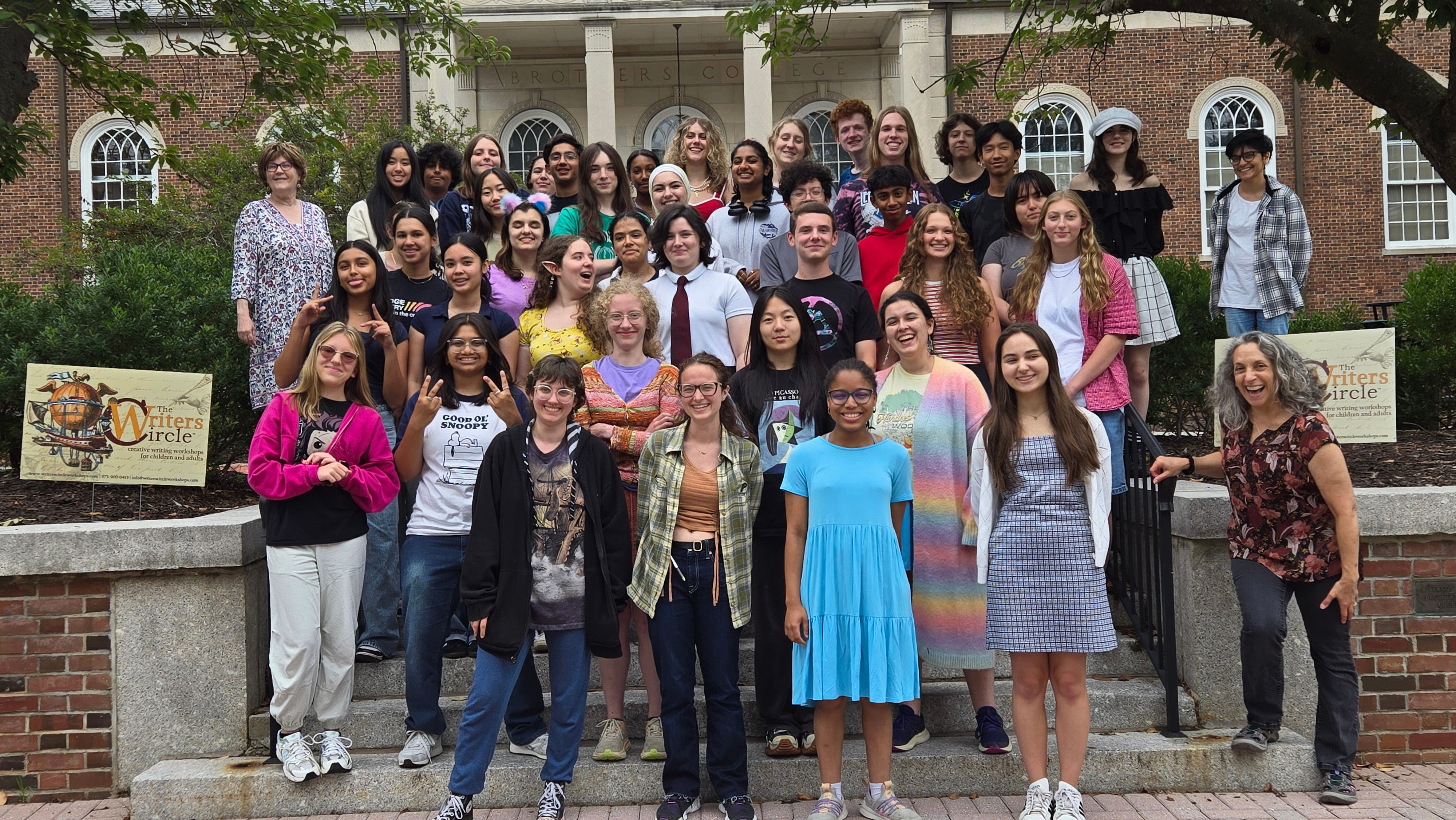
And look what it has brought me! A wonderful community of writers, young and old. Here’s a photo of just some of my students from this summer’s teen Intensives at The Writers Circle.
I’ve been blessed to have become part of the continuum of mentors, taking my first steps with Madeleine long ago, and carrying her lessons with me every day.
At the end of June, I was invited to teach a master class in narrative voice for The Historical Novel Society’s North American conference. I was honored, but also a tiny bit dismayed. The conference was in “glorious Las Vegas!” which is absolutely not my scene.
Whoever decided on Vegas for a gathering of historical novelists clearly had a great sense of humor. (In fact, I met her and she was lovely!) Sure, there is history there, but it’s rather hard to discover beneath all that fake gilding, flashing lights, and broiling concrete. Attendees and organizers alike shared full-throated critiques of Caesar’s Palace’s garish Romanesque statuary. (Historical novelists generally spend more time in actual museums in a year than normal humans do in a lifetime.)
While most of us avoided the casinos and absurd prices. (Starbuck’s coffee for $10 a cup! A glass of red wine? $30!), we spent priceless time sharing our unique historical obsessions from as recent as the 1970s and ‘80s (I’m sorry, but we’re all part of history now.) to 500 BCE Central Asia—yes, that was me!
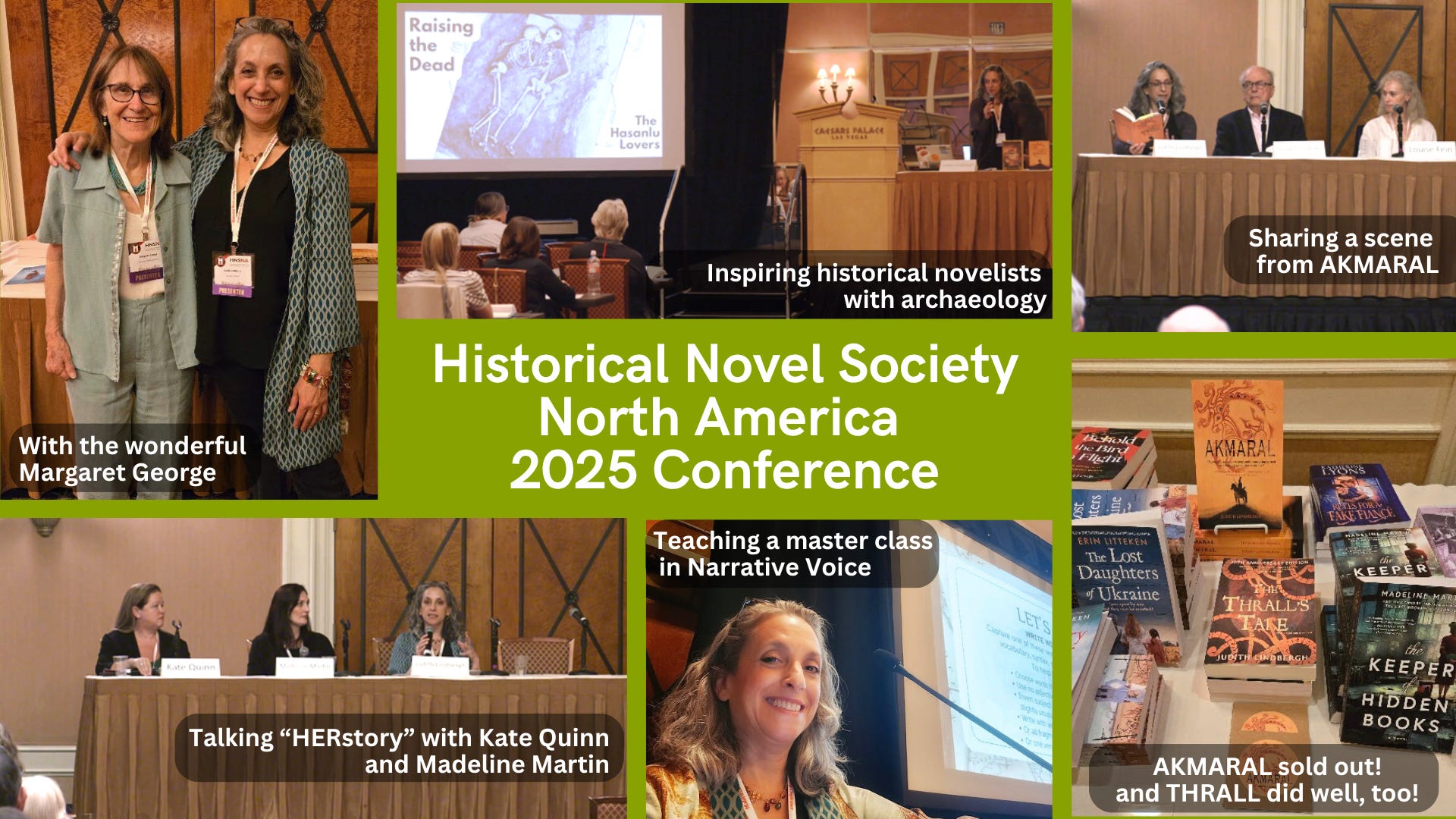
My master class went well, which was a relief; narrative voice is notoriously difficult to teach. Plus I joined a panel talking “HERstory” with bestsellers Kate Quinn and Madeline Martin. I read a battle scene from AKMARAL—which sold out at the conference bookstore! And I taught a second workshop on archaeological research, not as science, but as a source of inspiration for writing.
Best of all, I met some wonderful new writers and caught up with old friends, some I’d only met virtually, including the wonderful Margaret George whose brilliant historical novels were a formative influence on my writing.
Despite the incongruous setting, I was glad I accepted. It was a whirlwind weekend, so I was grateful for my quiet room and the very deep soaking tub where each night I’d gather my thoughts for the day to come.
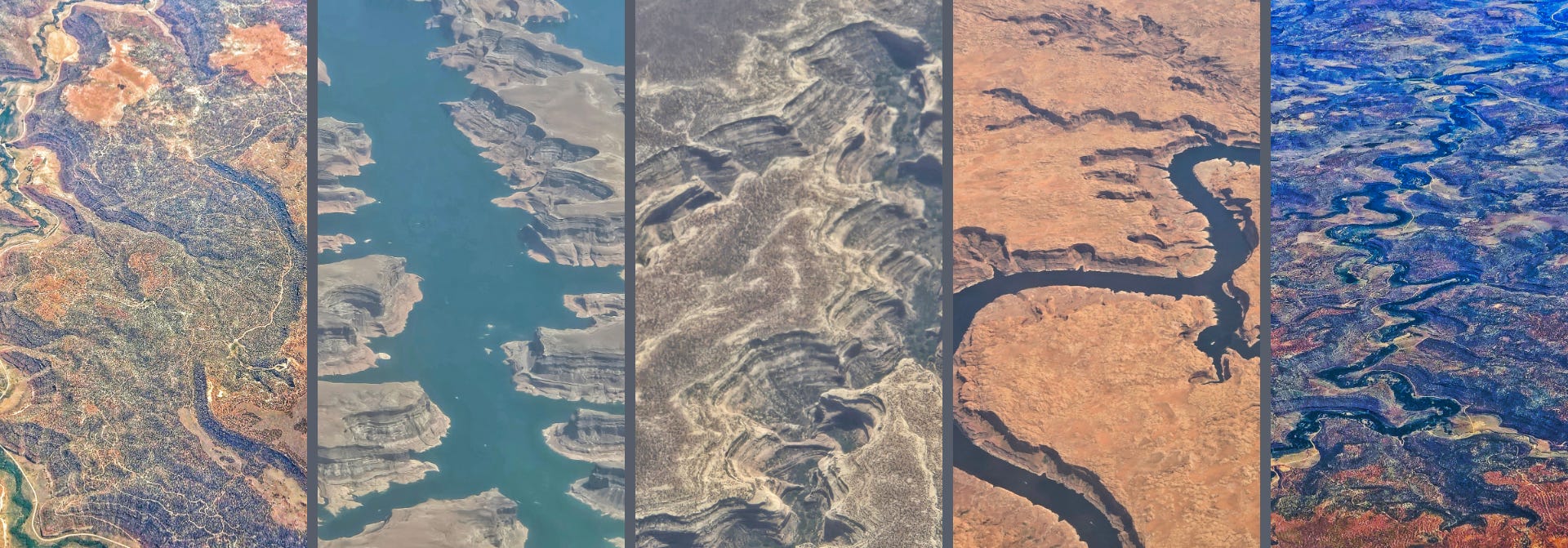
I once met a man who insisted that, in the desert, there is no rain.
It was the only other time I visited Las Vegas. My husband was going on a business trip and begged me to join him. I didn’t want to—feeling the same certainty that Vegas was not for me—and only agreed on the condition that, the minute I landed, I would go to the desert to ride horses. Which I did.
As we rode our rented horses across the sand, I chatted with this man who saw the Nevada desert only as it appeared. His assumption was understandable, given the landscape before us: spiny cactus, desiccated cholla twigs, bony buttes and distant mountains as shadowy and dry as the dust that kicked up on the wind. But I saw evidence that he was mistaken: contours in the sand that suggested wet gushes; sudden, rushing movements which had carved through the landscape and, just as at a beach, left deep undulations.
An arroyo, from Spanish, is a desert term meaning “a deep gully cut by an intermittent stream.” We’ve all heard news stories about flash flooding in the west this spring and summer. It is a natural phenomenon, though climate change has made it more extreme. Dry earth doesn’t soak up water the way moist ground does. When the rains come, they can be brutal and destructive. but they are also a gift, filling deep, underground aquifers and bringing the desert into bloom.
Perhaps, in this man’s experience, that desert has always been dry. The challenge is to comprehend and embrace the scale of time. What humans perceive as “forever” is as fleeting as a single breath for the planet on which we live. And yet, in just the past few centuries, our feeble human impact has transformed far more than the weather.
“Hold the map of your country in your mind. Imagine it now entirely blacked out except for the rivers and streams: these alone are present. Let them glow in vivid colors—blue and green, scarlet and violet. A new topography leaps to the eye. The land is suddenly intricately veined. Ridgelines show as dark, wandering absences; catchments gather fine filaments of water, braid them expertly into threads, ropes. Tilt—and zoom in. The pattern repeats, then repeats again with each scale-shift: a fractal branching of tributaries and channels, fronds and stems. It resembles the vascular system. It resembles a neural network.”
—Is a River Alive? by Robert Macfarlane
Indeed, is a river alive? Or an ocean? A mountain? What about rocks and boulders? (If you’ve seen the marvelous Everything Everywhere All at Once, perhaps you’ll answer affirmatively.) What about stars? And the Earth itself—herself? Is it coincidence or part of the shape of nature that the neurons of our brains form fractal constructs that look like waterways?
WRITING PROMPT: Take a moment to imagine the point of view of these “inanimate” life forms. What if even one entity were conscious and could “speak?” How would they express their feelings about our species, here and now? What they would say to us, if we could understand their language?
They have been here far longer than we have, and will outlast every single human on this earth. They have witnessed the demise of dinosaurs and the continental drift.
What would they tell us about our future?
Thank you, everyone, for your support. And to my paid subscribers, you are ANGELS!
AKMARAL: a nomad woman warrior of the ancient Central Asian steppes must make peace with making war
4.6 stars on Amazon | 4.24 stars on Goodreads - PLEASE ADD YOUR OWN REVIEW!

“A crackling novel”—Publishers Weekly
“A gripping saga”— #1 bestselling author Christina Baker Kline
Follow me on Instagram, Facebook, Threads, GoodReads, and Bluesky. Or visit judithlindbergh.com.
Comments
Nothing yet. Say the first thing.
Sign in to join the conversation.