
GraphicMEMOIRBlog | Creator Conversation #93
A few weeks ago, I was chatting with fellow Substack writer Peter Moore, who told me I absolutely needed to speak with Kelcey Ervick. I was already aware of her graphic memoir The Keeper and had been following her Substack, The Habit of Art, so his suggestion was a welcome nudge.
Ervick’s journey is particularly intriguing: a writer who gradually moved towards comics, experimenting with shorter visual essays and comics before developing The Keeper — a book that brings together graphic memoir, women’s history and sport, and has drawn praise from figures such as Alison Bechdel.
At the centre of our discussion was a question that continues to shape the medium: what exactly is a comic? As graphic literature evolves, creators are increasingly pushing beyond traditional definitions, exploring new relationships between words, images and design. Few people are better placed to discuss that evolution than Ervick, who co-edited Field Guide to Graphic Literature with Tom Hart in 2023. Hart’s Rosalie Lightning is a masterful example of the emotional and literary possibilities of graphic storytelling (See my review ).
I spoke to Ervick by Zoom from her home in South Bend, Indiana.
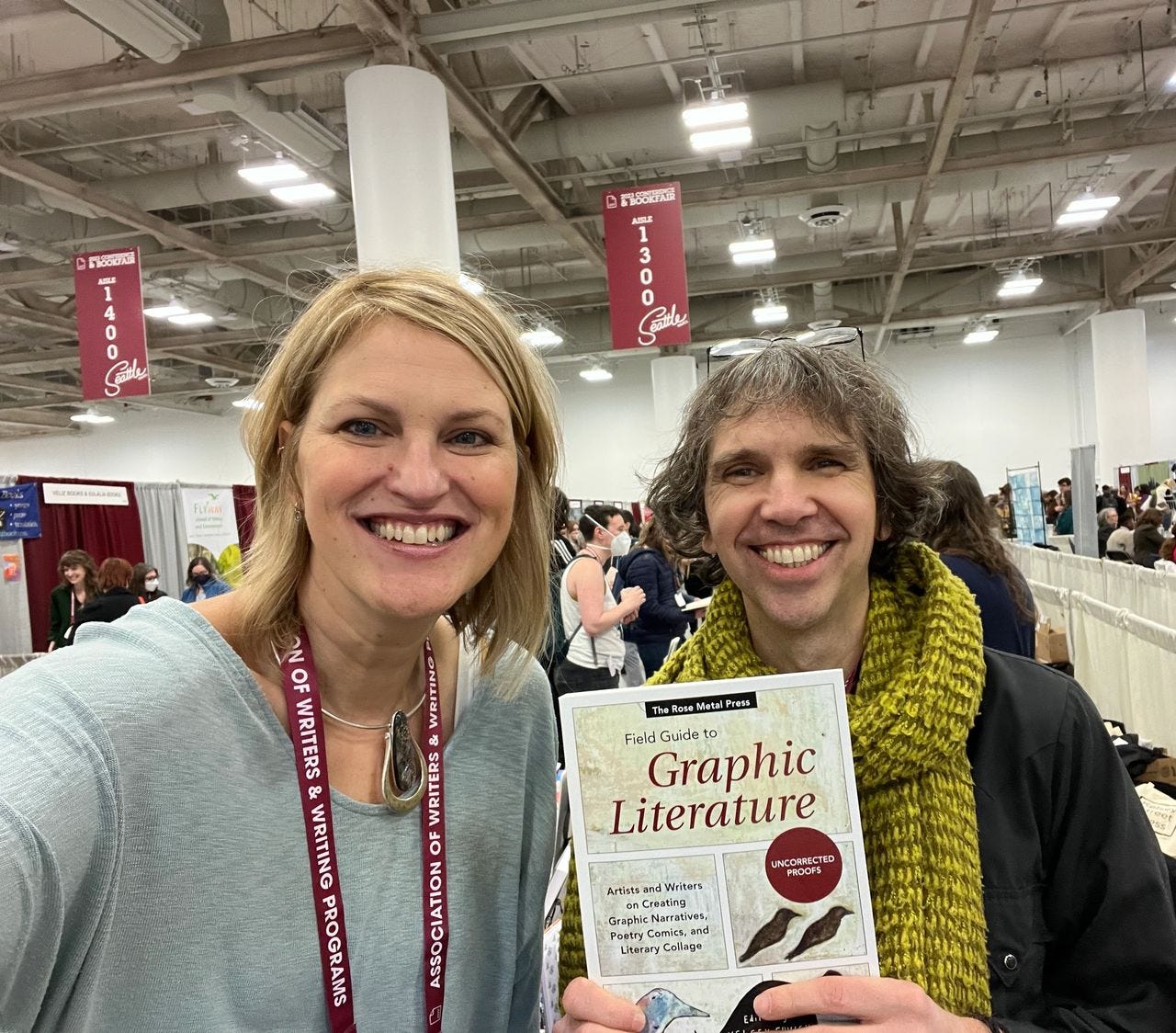
Coming from prose writing rather than traditional cartooning, Ervick became interested in the possibilities of visual storytelling and in the question of where this kind of work sits within comics. As she experimented with comics and hybrid forms, she found herself asking:
“I didn’t know if I was making comics. I was really reluctant to use that word.”
That question became one of the ideas behind Field Guide to Graphic Literature, which she co-edited with Tom Hart. The anthology explores the many ways words and images can interact, bringing together creators working across poetry comics, graphic poetry, collage, visual essays and other forms that challenge conventional boundaries.
Hart’s background in comics and Ervick’s literary perspective created an interesting balance. Together they produced a collection that maps the expanding possibilities of visual storytelling.
Ervick highlighted contributors including Alexander Rothman, Bianca Stone and Naoko Fujimoto, as well as creators such as MariNaomi, whose distinct approaches demonstrate the many directions the form can take.
I have noticed a growing number of graphic works moving beyond traditional panel grids, towards different relationships between words, images and design. My own feeling is that, once a creator moves away from established comics structures, the importance of design becomes even greater. Typography, layout, image placement and pacing all have to work together.
She emphasised that successful graphic storytelling is not simply about illustrating text. The aim is to create something where words and images contribute equally, with each adding something the other cannot.
Our discussion turned to creators who excel at this balance. I mentioned Nora Krug and Amy Kurzweil, both of whom produce highly literary graphic works where design is central. In an earlier interview, Kurzweil told me she considers herself as much a designer as an illustrator.
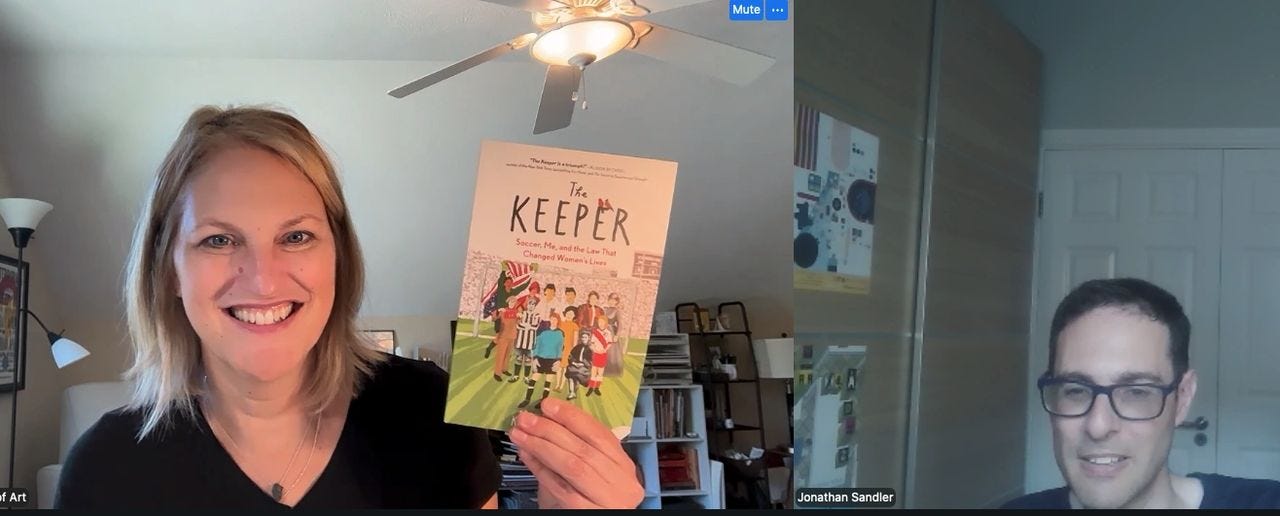
Ervick’s journey offers one possible pathway into graphic storytelling: allowing a larger work to emerge through shorter pieces.
Before The Keeper took shape, she experimented with visual essays and comics published in literary spaces, including Suffragette City, her series for The Rumpus exploring the American women’s suffrage movement.
“It was one of those projects that came together through a series of little moments,”
she explained.
As the project developed, Ervick began to look beyond a straightforward sports memoir. The challenge was finding the wider connections that could transform a personal story into something larger.
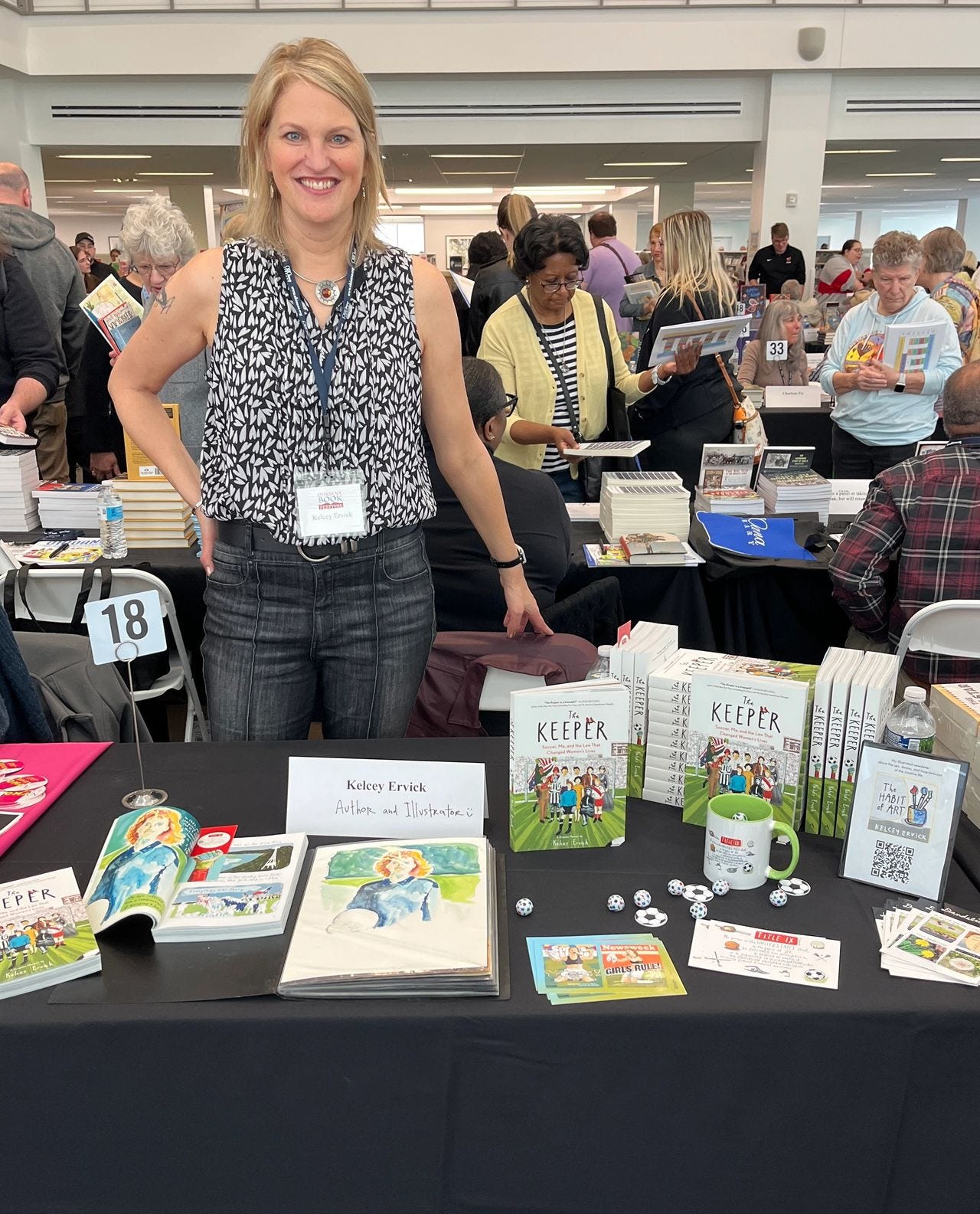
At the heart of The Keeper lies a simple question: what connection exists between being a goalkeeper and being a writer?
For much of her life, Ervick regarded those as separate identities. She was an athlete and an English major, but the two worlds rarely intersected. Looking back, however, she began to recognise unexpected similarities.
A goalkeeper spends much of a match observing, waiting and reading the game before suddenly becoming central to it — qualities that also connect with the writing process. Ervick also noted that iconic writers such as Albert Camus and Vladimir Nabokov spent time as goalkeepers.
One of the strengths of The Keeper is the way Ervick connects personal memoir with wider history. Her earlier work on women’s suffrage led naturally into research on women in sport, including the story of the Dick, Kerr Ladies, the pioneering English women’s football team.
The book also explores Title IX, the 1972 legislation that transformed opportunities for women in American education and athletics. For Ervick, Title IX is not simply historical background but part of her own story: the opportunities she experienced as an athlete were shaped by changes fought for by earlier generations of women.
Recognising both the growing interest in graphic memoir and the approaching fiftieth anniversary of Title IX, she approached agents with sample pages and a proposal. The project was eventually acquired by Avery Books, an imprint of Penguin Random House (no relation to the UK comics publisher Avery Hill).
The memoir has connected with comics readers, sports audiences, women’s history organisations and creative writing programmes. As a university professor, Ervick has found herself speaking at athletics departments, women’s studies programmes and comics events alike.
Although the book was not conceived specifically as a young adult work, she reflected that, because much of the memoir follows her younger self, it has naturally attracted younger readers.
The book’s ability to reach beyond a single audience was also recognised when The Keeper received the 2023 Ohioana Book Award.
Finally, I had to ask Ervick about the endorsement from Alison Bechdel, who described The Keeper as a “triumph”.
For Ervick, recognition from the creator of Fun Home carried enormous significance. Bechdel’s graphic memoir had been a major influence on her own creative development, demonstrating that comics could be as insightful, literary and emotionally complex as any prose work.
Her reaction captured the importance of the moment:
“Receiving the email and reading her blurb? I rank among one of the highest moments of my literary life. I opened that email, I read it, I read it again, I shut my computer, and I just sat at my desk and cried.”
What made the endorsement particularly special was not simply who it came from, but the way Bechdel had engaged with the book. For a creator whose own path into graphic storytelling had been shaped in part by Fun Home, the response felt especially meaningful.
Article written by Jonathan Sandler, author of The English GI: World War II Graphic Memoir, curator of the GraphicMEMOIRBlog, and Advisor to Mensch Publishing.
No posts
Comments
Nothing yet. Say the first thing.
Sign in to join the conversation.