
The total budget for the Ministry of Health (estimates of appropriations under Vote Health, page 3) is $31,052,217,000. The biggest chunks go to Health New Zealand (Te Whatu Ora) to Deliver Hospital and Specialist Services, $15.7 billion (up from $14.8 billion the year prior), and Deliver Primary, Community, Public and Population Health Services, $9.7 billion (up from 9.1 billion the year prior).
The 2025/26 Pharmac budget for pharmaceutical medicines is $1,760,435,000, up from $1,689,634,000 in 2024/5, the year prior.
Before the budget was announced, I attempted to understand if nutrition and diet would be prioritised. I was very aware that the Ministry of Health (including Health New Zealand Te Whatu Ora, and the Public Health Agency keep forgetting to put diet and nutrition in their work programme. So I made an Official Information Act request reference number SROIA-403).
Dear Shane Reti, (January 16, 2025)
Increasingly, conventional medical clinicians and general practitioners operate with one arm behind their back, on the surface, oblivious in the face of expanding scientific knowledge on the role of nutrition in preventing, treating and reversing common conditions.
It is evident that there is a prevailing hypocrisy – one that can only naturally erode public trust - at the heart of New Zealand's health system. It involves a crazy bifurcation towards the medical, where only medicine can be prescribed at the latest known dose, not vitamins and minerals (micronutrients). This is modern public health.
Markedly, drugs are not essential nutrients. Yet it seems there is no department in the Ministry of Health with an obligation to elevate the role of essential micronutrients to a level of importance in human health functioning to where dietary nutrients are equal to, or more important than chemically and biologically synthesised drugs.
Somehow the Ministry of Health appears to believe that increasing equity of availability to drug treatment is sufficient for the prevention and maintenance of health. Availability to nutrition is not prioritised for the prevention and maintenance of health. This approach is a pervasively corrupted approach. It perpetuates a path-dependent institutional myth, medical valorisation, that most appallingly, straightjackets our poorest and most nutrient-deprived groups into medical dependency and polypharmacy.
While higher income people have the capacity to address this shortfall and actively research and fund their own treatments to address the consequences of inadequate diets, poorer groups do not.
As a trained medical doctor, you should be well aware that many chronic physical and neurological conditions will present alongside chronic nutritional deficiencies. Deficiencies will of course, be exacerbated in low-income populations which include Māori and Pasifika.
Failure to address deficiencies, instead promotes intergenerational medical dependency, dietary poverty, chronic disease, and the fatigue and poor health that prevents people from actively participating in education, training, job seeking and full-time work.
Passive Health Ministers inevitably grow welfare dependency while limiting economic growth, because people remain effectively, disabled, as conditions accrue over time.
It is very obvious that Māori and Pasifika can lead healthy lives that do not include intergenerational drug dependency and medicalisation from infancy onwards.It is broadly obvious that people with neurological diseases and disorders commonly present with other common conditions. That across physical and mental illness, poor and insufficient diets underpin our common diseases and syndromes producing less resilient bodies and minds, to cope with the mundane, devastating and/or existential stressors of modern life.
It is well described in the literature that physiological processes require multiple micronutrients as cofactors. Health and homeostasis very simply, cannot be sustained without adequate levels of micronutrients.
But where is the funding and resourcing for this (pervasively neglected) work?
Vote Health includes funding for Pharmac to both manage and purchase pharmaceuticals. The Ministry of Health has the power to increase funding for testing services to assess nutritional deficiency by age and stage, and to expand nutrient access for treatment of chronic conditions (mental and physical).
Please forward all memos and advice sent from or to you relating to funding for the 2025/2026 budget:
(a) discussing nutrition programmes (including research). This can include reviewing the scientific evidence to update nutrition recommendations, staff and clinician education, and public health measures.
(b) Increased access to testing for nutritional deficiency where blood serum levels and deficiency is well described in the literature.
(c) Increasing access to vitamin D dietary supplementation and the range of conditions associated with vitamin D deficiency.
(d) Access to dietary nutrients for treatment of depression, anxiety and ADHD.
(e) Funding to support and promote nutrition education at primary and secondary level.Please do not delay a response to this. Members of Parliament deserve to understand how neglected nutrition-based health policy has been. It is only if MPs are made aware this situation, that they might support you in such endeavours.
A wide catchment of public health and practitioner physicians and experts would support you in such a policy shift, as they too are frustrated in having 'one arm tied behind their back'.
Yours faithfully,
J Bruning
Three days later Shane Reti ‘was stripped of his portolio’ as Health Minister.
January 27, 2025.
Thank you for your request for official information under the Official
Information Act 1982 (the Act) to the Minister of Health, Hon Simeon
Brown.The information you have requested is more closely connected with the
portfolio of the Associate Ministrer of Health, Hon Matt Doocey.
Therefore, this Office has decided to transfer your request to Hon Doocey
under section 14(b)(ii) of the Act. You can expect a response from Hon
Doocey in due course.
Response letter, February 9, 2025.
The response letter From Matt Doocey’s press secretary (since when do press secretaries communicate this stuff?) advised the following:
The Office identified two documents within scope of your request. However, these documents are withheld in full under section 9(2)(f)(iv) of the Act, to maintain the constitutional conventions for the time being which protect the confidentiality of advice tendered by Ministers of the Crown and officials.
But really - those ‘two documents’ that fell within the scope of my request that were then withheld because they were secret - did they really give a toss about nutrition? Were they really relevant to my request?
I do keep failing on this. A few months earlier, in Official Information Act request SROIA-221 (September 2024), I had asked Shane Reti as Minister of Health, to provide:
a) All memos, policy advice and information you have considered relating to ultraprocessed food as a driver of physical and mental illness since coming into office.
b) All plans by your office to investigate diets high in ultraprocessed food as a predominant driver of mental and physical illness.
c) How funding will be prioritised to ensure that research including (i) assessment of the current scientific literature on ultraprocessed food and health/multimorbidity can be undertaken; and (ii)the extent of calorific dependence on ultraprocessed in New Zealand by age and ethnic status, may be undertaken.
d) Please supply the list of all meetings and names of groups and individuals discussing diet and/or nutrition and/or ultraprocessed foods since coming into office.
e) The Ministry of Health does not recognise metabolic syndrome, instead considering: ‘The conditions referred to are considered either on their own or as part of a broader cardiovascular disease risk calculation.’ As a medical doctor and Minister of Health do you think this perspective reflects the current state of scientific knowledge? Do you have plans to address this quirky anomaly?
Of course, the Minister didn’t hold any information on a, b, c, or e - and thoughtfully referred me to the dietary guidelines. My request for (d) was sent to Matt Doocey - who responded to say:
Minister Doocey has met with Officials from the Ministry of Health and
Health New Zealand on a number of occasions as part of routine meetings to
discuss his Associate Minister of Health portfolio delegation for
nutrition.
Since then, the budget has been announced.
Perhaps they will have realised from my emails that there wasn’t enough money for nutrition!
A quick note about the different agencies…
The Public Health Agency (PHA):
‘sits at the heart of the Ministry of Health and leads the Ministry’s work on public health and population health’
The PHA was established by the Pae Ora (Healthy Futures) Act 2022. The PHA’s fancy Strategic Intent and High-level Operating Model design document talks about equity a lot, but it doesn’t think about nutrition at all - and really - it’s not in their work programme.
Then there is the (new, I believe) National Public Health Service which:
monitors environmental health
helps prevent the spread of infectious diseases
promotes healthy eating and physical activity
works with early childhood centres and kōhanga reo to promote safe environments and good health practices
provides health services for children
reviews licences and public health regulations
guides and enforces public health plans, strategies and legislation.
Well, the National Public Health Service will have a big budget then! Sounds good!
If we turn back to the Ministry of Health (estimates of appropriations under Vote Health, page 3) budget of $31 billion, we can see that there is no mention of nutrition or nutritional programmes. Vote Health describes funding for screening services, addiction services, mental health programmes and services.
There is a tiny budget of $6 million for the Public Health Agency which appears to be merging with a ‘National Public Health Service’ (page 32) although.
• a decrease of $6.474 million reflecting the reducing funding profile to support the establishment of the National Public Health Service and Public Health Agency
Yep. $6 million p.a. for the foreseeable future for the Public Health Agency and National Public Health Service (page 60). That’s it, folks.
Ed. July 31 - $87.5 million is tagged for: Public health and population health leadership: This category is limited to providing leadership on policy, strategy, regulatory, intelligence, surveillance and monitoring related to public and population health. There is no clarity on who the allocation.
Health New Zealand was also established under the Pae Ora (Healthy Futures) Act 2022. It’s role? To promote health and prevent ill-health, and achieve the best possible health outcomes for New Zealand.
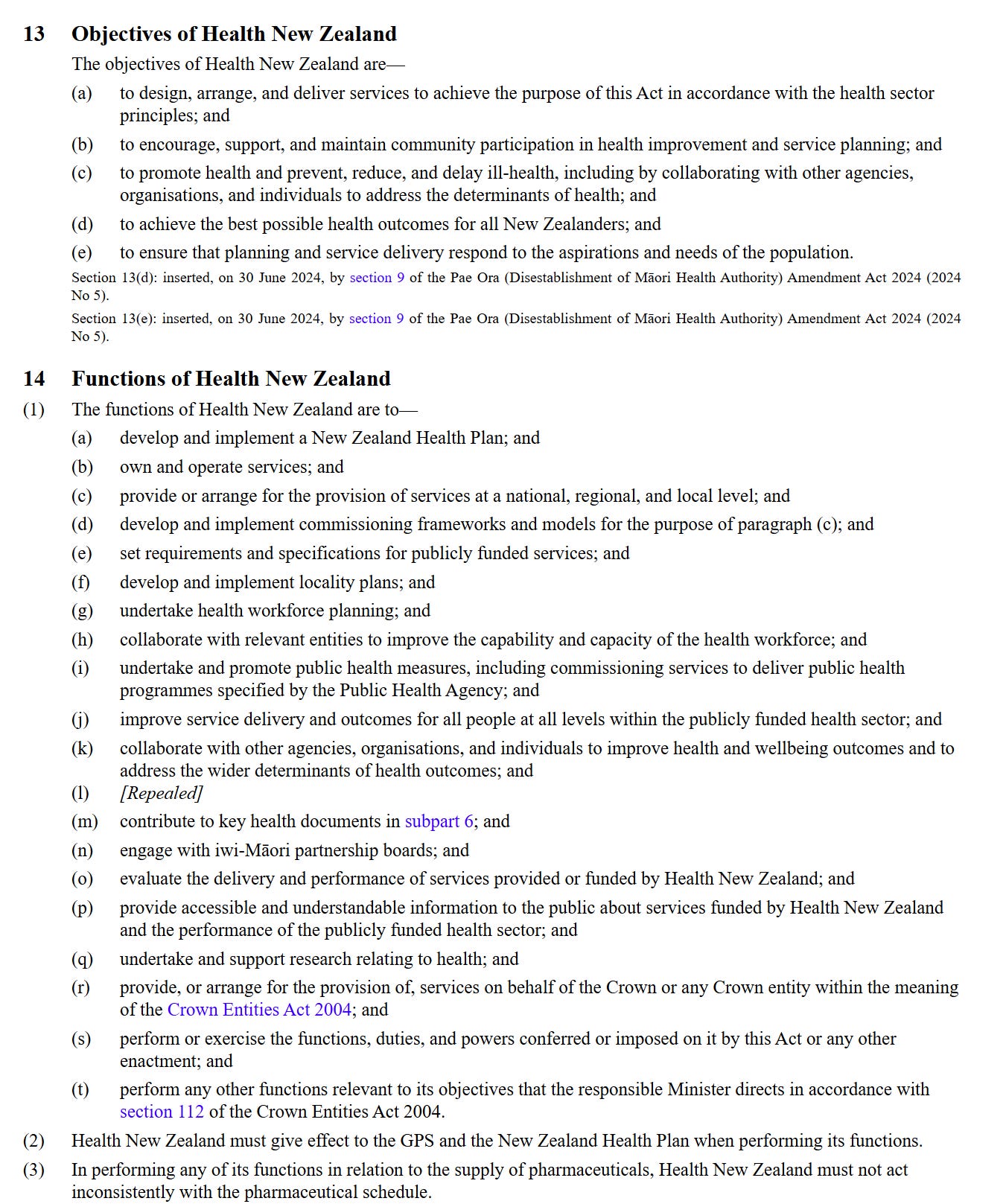
Unfortunately, the Health New Zealand’s Health Charter, forgot to mention diet or nutrition.
Health New Zealand are busy, I admit, as the 2025/2026 budget (page 2) includes:
$15,729 million (51% of the Vote) to enable Health New Zealand - Te Whatu Ora to deliver hospital and specialist services
$9,703 million (31% of the Vote) largely to enable Health New Zealand to deliver primary, community, public and population health services
$2,747 million (9% of the Vote) for capital investment, largely for infrastructure projects and to fund the resolution of claims from historical non-compliance with the Holidays Act 2003
$773 million (2% of the Vote) to enable Health New Zealand to deliver hauora Māori services
Because you see, people keep getting sicker and sicker. What are we to do?
The Pae Ora (Healthy Futures) Act 2022 doesn’t mention diet and nutrition either.
Although it is a bit strange, the Healthy Futures Act’s purpose?
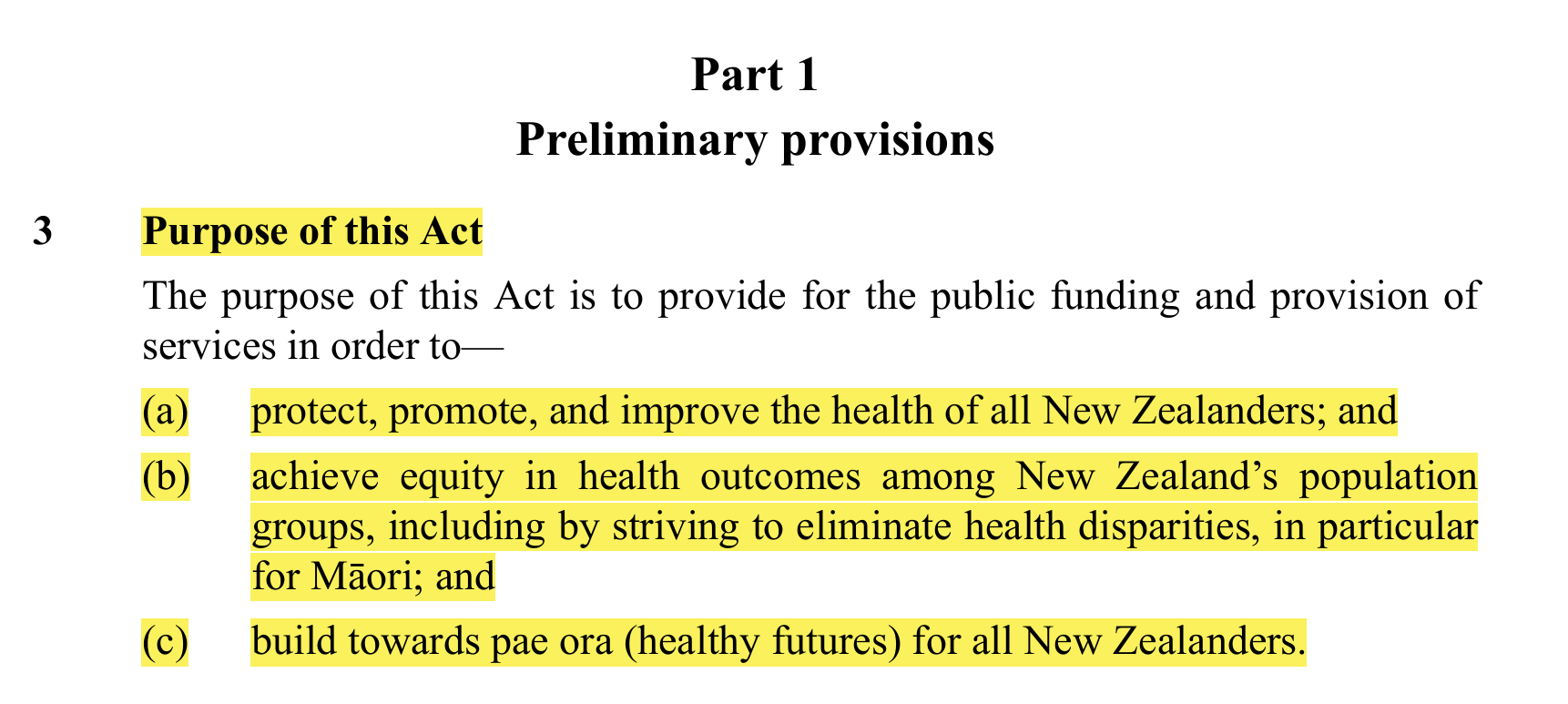
As every decade, chronic illness and mental illness rates increase, and younger and younger people are diagnosed early with multiple multimorbid conditions, I can only presume that I am incorrect, that protecting, promoting and improving health really means increasing hospital services and increasing pharmaceutical drug prescribing and probably, because ‘budget’ to get more people on private systems.
That that is really what ‘equity’ and ‘wellbeing’ really means.
I must be wrong about this quaint nutrition and diet obsession.
No posts
Comments
Nothing yet. Say the first thing.
Sign in to join the conversation.